
iPhone 17 Pro Review 2026: Camera, Battery & A19 Pro looks beyond launch-day specifications to the experience of using a flagship phone every day. Camera consistency, sustained performance, display quality, battery life, thermal behavior, software support, repairability and regional pricing all affect value.
Quick Verdict
- Best for: premium-phone buyers who will use the camera, performance and display advantages enough to justify flagship pricing.
- Focus on: camera consistency, sustained performance, battery life, display, software support, storage and local warranty.
- Watch for: storage options, network bands, charger inclusion and software features can vary by market.
Table of contents
What to Know in 2026
Apple’s current iPhone 17 Pro specifications confirm the A19 Pro chip, ProMotion up to 120Hz, IP68 resistance and 3,000-nit peak outdoor brightness. Regional storage and feature availability should still be checked locally. Official source.
Fact-checked: August 17, 2026 Price checked: Apple U.S. store Review type: Specification-led editorial analysis
The iPhone 17 Pro remains one of the strongest premium smartphones to buy in 2026 if camera versatility, sustained performance, long battery life and professional video tools matter more than price. Its A19 Pro chip, vapor-chamber cooling, three 48MP Fusion cameras and brighter ProMotion display are meaningful upgrades, but owners of a recent Pro model may not gain enough to justify another expensive purchase.
Quick verdict: Buy the iPhone 17 Pro if you want Apple’s smaller Pro flagship, serious photo and video features, fast USB 3 transfers and excellent long-term usefulness. Choose the Pro Max if screen size and the longest rated battery life matter more than weight. Skip both if you mainly need messaging, social media and casual photography—the regular iPhone 17 delivers better value for those tasks.
iPhone 17 Pro key specifications
Apple announced the iPhone 17 Pro and iPhone 17 Pro Max on September 9, 2025. Pre-orders opened September 12, and retail availability began September 19. The table below summarises the most important verified details from Apple’s current iPhone 17 Pro technical specifications.
On a phone, swipe the table sideways to compare every column.
| Feature | iPhone 17 Pro | iPhone 17 Pro Max |
|---|---|---|
| Display | 6.3-inch Super Retina XDR OLED, 2622 × 1206, up to 120Hz ProMotion | 6.9-inch Super Retina XDR OLED, 2868 × 1320, up to 120Hz ProMotion |
| Chip | A19 Pro: 6-core CPU, 6-core GPU with Neural Accelerators and 16-core Neural Engine | |
| Rear cameras | 48MP Fusion Main, 48MP Fusion Ultra Wide and 48MP Fusion Telephoto; 4× optical and 8× optical-quality telephoto options | |
| Front camera | 18MP Center Stage camera with autofocus, ultra-stabilized video and Dual Capture | |
| Storage | 256GB, 512GB or 1TB | 256GB, 512GB, 1TB or 2TB |
| Rated video playback | Up to 33 hours | Up to 39 hours |
| Size and weight | 150.0 × 71.9 × 8.75 mm; 206 g | 163.4 × 78.0 × 8.75 mm; 233 g |
| Starting U.S. price | $1,099 | $1,199 |
Important: Battery results, network support, Apple Intelligence features and prices vary by use, carrier, language, region and retailer. Apple does not publish RAM capacity or battery capacity in its standard technical specifications, so this review does not present unofficial figures as confirmed Apple specifications.
Design, build quality and durability
Aluminum unibody and vapor-chamber cooling
The iPhone 17 Pro replaces the previous titanium frame with an aerospace-grade 7000-series aluminum unibody. Aluminum conducts heat effectively, and Apple pairs the chassis with a laser-welded vapor chamber containing deionized water. Heat moves away from the A19 Pro chip and spreads through the body instead of remaining concentrated around the processor.
This design matters most during demanding work such as extended gaming, 4K video capture, photo processing and running larger on-device models. Apple says the new thermal system helps the phone deliver up to 40% better sustained performance than the previous generation. That is an Apple comparison under its own testing conditions, not a promise that every app will run 40% faster.
The broad rear camera plateau also creates more room for internal components and a larger battery. It gives the phone a distinctive appearance, although buyers who prefer a flat, minimal camera area may find the design visually heavy.
Colors, Ceramic Shield and water resistance
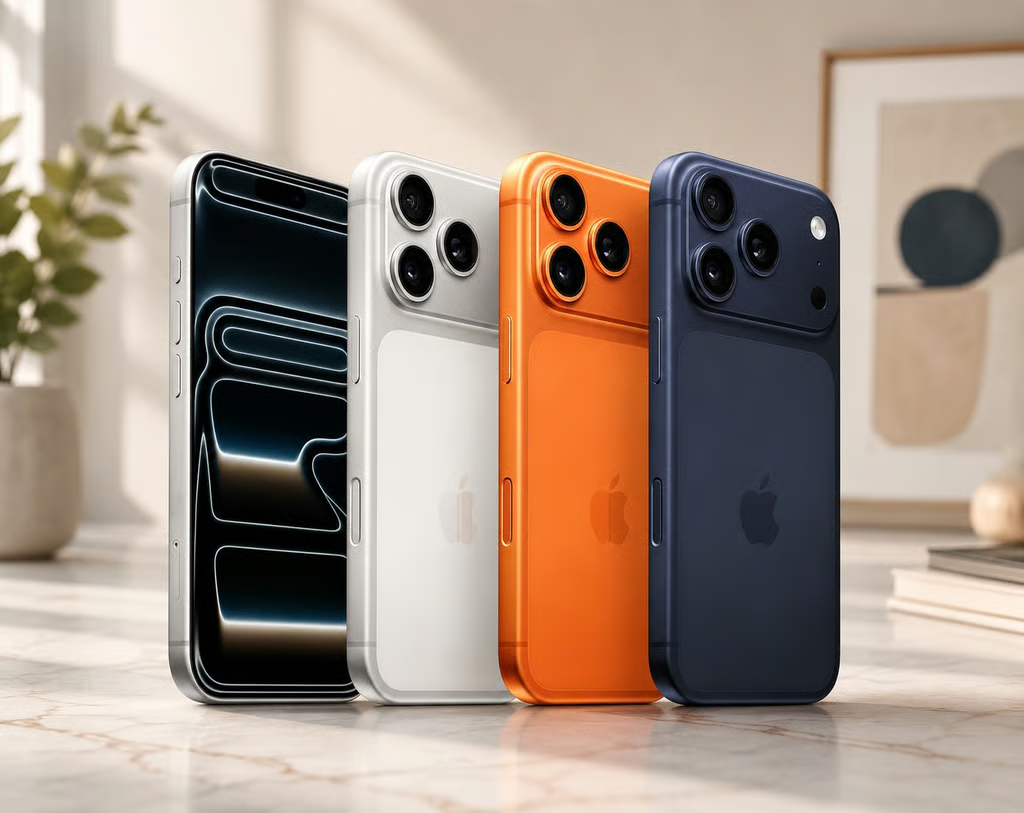
The official finishes are Deep Blue, Cosmic Orange and Silver. Ceramic Shield 2 protects the front, while Ceramic Shield is also used on the back. Apple claims three-times better scratch resistance for the front coating and four-times better resistance to back-glass cracks compared with earlier designs. These are controlled manufacturer comparisons; a protective case and screen protector still make sense for an expensive phone.
Both models carry an IP68 rating under IEC 60529—up to 6 metres for 30 minutes in controlled laboratory conditions. Water resistance is not permanent, can decline with wear, and liquid damage is generally not covered as ordinary warranty damage.
Ergonomics: Pro or Pro Max?
The 6.3-inch iPhone 17 Pro is the easier model to carry and use one-handed, but at 206 g it is not a lightweight compact phone. The 233 g Pro Max is better suited to people who prioritise a larger viewfinder, more room for editing, bigger text and Apple’s longest battery rating. If possible, handle both sizes before buying; dimensions and weight can matter more in daily use than a small specification difference.
Display and interface
Super Retina XDR with ProMotion
Both sizes use a Super Retina XDR OLED panel with ProMotion adaptive refresh rates up to 120Hz, an Always-On display, HDR, True Tone and wide P3 colour. The refresh rate adjusts to the content, supporting fluid scrolling and responsive games while reducing unnecessary refreshes when the screen is static.
Apple rates the display at 1,000 nits typical brightness, 1,600 nits peak HDR brightness and 3,000 nits peak outdoor brightness. A new anti-reflective coating further improves visibility in bright conditions. These changes are especially helpful for outdoor navigation, camera framing and reading in direct daylight.
Dynamic Island and Always-On display
Dynamic Island continues to surface timers, calls, music controls, navigation and Live Activities around the front-camera area. The Always-On display can show the time, widgets and notifications at a low refresh rate. Users who prefer maximum privacy or reduced overnight battery use can disable it in Settings → Display & Brightness → Always On Display.
A19 Pro performance and hardware
The A19 Pro combines a 6-core CPU with two performance and four efficiency cores, a 6-core GPU with Neural Accelerators, a 16-core Neural Engine and hardware-accelerated ray tracing. It is designed for demanding games, computational photography, video editing and Apple Intelligence workloads.
For everyday tasks—messaging, browsing, maps, social media, office apps and streaming—the phone has more performance than most buyers need. The extra headroom becomes more valuable when editing high-resolution media, recording long sessions, playing graphically intensive games or keeping the phone for several years.
The new N1 wireless networking chip enables Wi-Fi 7, Bluetooth 6 and Thread. Apple also says it improves the reliability of Personal Hotspot and AirDrop. Actual Wi-Fi speed still depends on a compatible router, internet service, congestion and regional spectrum rules.
iPhone 17 Pro camera review
Three 48MP Fusion cameras
The rear system includes a 48MP Fusion Main, 48MP Fusion Ultra Wide and 48MP Fusion Telephoto. The Main camera uses a 24 mm equivalent lens with an ƒ/1.78 aperture and second-generation sensor-shift optical image stabilisation. It also provides a 2× optical-quality crop for a tighter view without switching to the dedicated telephoto camera.
The Ultra Wide covers a 120-degree field of view and supports 48MP macro photography. It is useful for architecture, landscapes, interiors, group photos and close-up detail, although ultra-wide lenses can still stretch people or objects near the frame edges.
4× optical and 8× optical-quality telephoto
The 48MP Fusion Telephoto uses a tetraprism design at 100 mm equivalent for 4× optical zoom. It can also produce a 12MP, 200 mm equivalent 8× optical-quality view. That distinction matters: Apple’s technical specification describes the 8× result as optical-quality, not as a separate native 8× optical lens. Digital zoom extends to 40×, but quality naturally falls as magnification increases.
The 4× view is well suited to portraits, stage events and details that are too distant for the Main camera. The 8× option provides additional reach for travel, sport and wildlife in good light. For the best result, stabilise the phone, use strong lighting and avoid unnecessary digital zoom.
Photonic Engine, ProRAW and photographic styles
Apple’s image pipeline combines the Photonic Engine, Deep Fusion and Smart HDR 5 to balance detail, colour, texture and noise. The phone supports HEIF, JPEG and DNG, including Apple ProRAW for photographers who want more editing latitude. Latest-generation Photographic Styles can shape tone and colour at capture time, while portrait Focus and Depth Control allow adjustments after a compatible photo is taken.
18MP Center Stage front camera
The square 18MP Center Stage front-camera sensor can capture a wider field of view and support portrait or landscape framing while the phone remains upright. Center Stage can expand the view for groups, and Dual Capture records with the front and rear cameras at the same time. These features are particularly useful for interviews, reaction videos, travel clips and video calls.
Video recording and content creation
Video is one of the clearest reasons to choose the Pro model. The Fusion Main camera supports Dolby Vision recording up to 4K at 120 fps. ProRes recording can reach 4K at 120 fps with external recording, while advanced tools include ProRes RAW, Apple Log 2, ACES support and genlock.
Genlock precisely synchronises supported cameras and inputs, but it requires a compatible workflow and accessory such as Blackmagic Design’s Camera ProDock. It is a professional production feature, not something most everyday buyers will use. Casual creators may gain more immediate value from stabilisation, Dolby Vision, Audio Mix, wind-noise reduction, four studio-quality microphones and Dual Capture.
High-quality formats consume substantial storage. Anyone recording ProRes, long 4K clips or frequent 48MP photos should consider at least 512GB or budget for compatible external storage and a reliable backup plan.
Battery life and charging
Apple’s battery-life ratings
Apple rates the iPhone 17 Pro for up to 33 hours of local video playback or 30 hours of streamed video. The Pro Max is rated for up to 39 hours of local video or 35 hours streamed. These are controlled playback figures, not guaranteed screen-on time. Camera use, gaming, 5G, navigation, brightness, heat, background activity and battery age can change the result significantly.
The practical advantage is that buyers now get a larger battery design together with a more efficient chip and improved thermal management. The Pro Max remains the better option for travel, long workdays and heavy video capture, while the standard Pro balances endurance with easier handling.
Fast charging, MagSafe and Qi2
With a compatible 40W or higher USB-C power adapter, Apple says either model can reach up to 50% charge in about 20 minutes. With a 30W or higher adapter and MagSafe Charger, Apple rates a 50% charge at about 30 minutes. MagSafe and Qi2 wireless charging support up to 25W under compatible conditions.
A power adapter is sold separately. Charging time varies with temperature, battery state, cable, adapter and whether the phone is being used. For long-term battery health, keep Optimised Battery Charging enabled and avoid prolonged exposure to excessive heat.
5G, Wi-Fi 7, USB-C and eSIM
Connectivity includes 5G, Gigabit LTE, Wi-Fi 7 with 2×2 MIMO, Bluetooth 6, Thread, NFC and Apple’s second-generation Ultra Wideband chip. The USB-C port supports charging, DisplayPort and USB 3 data transfer up to 10 Gb/s with the required cable and compatible device.
eSIM and international use
According to Apple’s regional eSIM information, the company sells eSIM-only versions in Bahrain, Canada, Guam, Japan, Kuwait, Mexico, Oman, Qatar, Saudi Arabia, the United Arab Emirates, the United States and the U.S. Virgin Islands. Other markets may offer a physical SIM tray alongside eSIM support. Always check the exact regional model and carrier compatibility before importing a phone.
Apple says eSIM-only models use the space formerly occupied by the SIM tray for a larger battery, adding two hours to the relevant video-playback rating. eSIM can be convenient for travel and cannot be physically removed from a lost or stolen phone, but it still requires support from the user’s carrier and plan.
Action button and Camera Control
The Action button can launch Silent Mode, Focus, Camera, Visual Intelligence, Flashlight, Voice Memo, Translate, Magnifier, accessibility tools or a custom Shortcut. Camera Control provides quick access to exposure, depth, zoom, cameras, styles and tone. Whether Camera Control feels helpful depends on grip and shooting style; users who trigger it accidentally can adjust its settings or rely on the Action button instead.
iOS, Apple Intelligence and long-term use
The iPhone 17 Pro launched with iOS 26 and its Liquid Glass design. Apple’s current Apple Intelligence support guide lists features including Writing Tools, notification and message summaries, Genmoji, Image Playground, Clean Up in Photos, Live Translation, visual intelligence and optional ChatGPT integration in supported regions.
Privacy handling is more nuanced than saying every task stays on the phone. Many requests are processed on-device; more complex requests may use Apple’s Private Cloud Compute, and optional third-party integration can send a request to ChatGPT after the relevant permission flow. Feature and language availability varies by region, and Apple warns that generative outputs can be inaccurate. Apple’s July 2026 support documentation also says some more personal Siri features remain in development.
For a buyer planning to keep the phone for years, Apple’s chip performance, storage choices and established update record are encouraging. However, Apple does not promise a fixed number of future iOS versions on the product page, so no publisher should claim a guaranteed support end date without an official commitment.
Price, storage and availability in 2026
As checked on August 17, 2026, the Apple U.S. store lists the unlocked iPhone 17 Pro from $1,099 for 256GB and the Pro Max from $1,199 for 256GB. The standard Pro is also offered with 512GB or 1TB. The Pro Max adds a 2TB option for buyers with unusually large local media libraries.
Prices vary by country because of taxes, duties, currency conversion, carrier terms and promotions. A low advertised price may require activation, trade-in, bill credits or a long service agreement. Compare the total cost, warranty coverage, return policy and seller reputation—not only the headline price.
Which storage size should you buy?
- 256GB: Best for general users who stream media, use cloud storage and do not keep large ProRes libraries.
- 512GB: The balanced choice for frequent 4K recording, offline media, large games and multi-year ownership.
- 1TB: Suited to creators who regularly capture ProRAW, ProRes or large project files on the phone.
- 2TB Pro Max: A specialised and expensive option for high-volume professional media workflows.
iPhone 17 Pro comparisons and alternatives
iPhone 16 Pro versus iPhone 17 Pro
On a phone, swipe the table sideways to keep the comparison in one view.
| Area | iPhone 16 Pro | iPhone 17 Pro | Why it matters |
|---|---|---|---|
| Chassis and cooling | Titanium design | Aluminum unibody with vapor chamber | Better heat spreading for sustained demanding workloads |
| Chip | A18 Pro | A19 Pro | More sustained performance headroom |
| Outdoor brightness | Up to 2,000 nits | Up to 3,000 nits | Clearer viewing in bright daylight |
| Telephoto | 12MP 5× optical | 48MP 4× optical; 12MP 8× optical-quality | More flexible portrait and long-range framing |
| Front camera | 12MP TrueDepth | 18MP Center Stage | Wider framing, rotation and Dual Capture |
| Rated video playback | Up to 27 hours | Up to 33 hours | Longer manufacturer-rated endurance |
Owners of an iPhone 16 Pro should upgrade only if the longer battery rating, telephoto changes, improved thermals or new front camera directly solve a problem. Users coming from an iPhone 14 Pro or earlier are more likely to notice a broad improvement in battery life, USB-C workflows, camera flexibility and performance.
Other models to consider
- iPhone 17: Starts lower and covers mainstream tasks well, but lacks the full Pro camera and video system.
- iPhone Air: Prioritises a thinner, lighter design; choose it for portability rather than maximum camera flexibility or battery rating.
- Samsung Galaxy S25 Ultra: A useful Android alternative for buyers who want S Pen support and Samsung’s interface, especially if discounted.
- Google Pixel 10 Pro XL: Consider it if Google’s Android experience and computational-photo tools are a better fit.
For a deeper look at the previous Apple generation, see FrediTech’s iPhone 16 features and buying guide.
iPhone 17 Pro pros and cons
Advantages
- Three versatile 48MP Fusion rear cameras
- Useful 4× optical and 8× optical-quality telephoto options
- Strong sustained performance with vapor-chamber cooling
- Bright 120Hz OLED display with improved anti-reflection
- Longer Apple-rated battery life and faster charging
- Professional video tools, USB 3 and external recording support
- 256GB base storage instead of 128GB
Drawbacks
- High starting price before accessories or AppleCare
- Even the smaller Pro weighs 206 g
- Only three official colour choices
- Camera plateau design will not appeal to everyone
- Camera Control can be awkward for some grips
- Advanced video features require storage, accessories and expertise
- Some Apple Intelligence features vary by language and region
Who should buy it?
The iPhone 17 Pro is best for photographers, mobile filmmakers, creators, demanding gamers, professionals who move large files and Apple users keeping a phone for several years. It is also the better Pro choice for anyone who wants flagship features without the Pro Max’s larger body.
Who should skip it?
Skip the Pro if your main activities are calls, messaging, social media, web browsing and occasional snapshots. The standard iPhone 17 is more economical. Recent iPhone 16 Pro owners should keep their current device unless a specific battery, thermal or camera improvement is worth the upgrade cost.
Step-by-step guide to useful features
How to customise the Action button
- Open Settings and select Action Button.
- Swipe through functions such as Silent Mode, Focus, Camera, Translate, Magnifier or Shortcut.
- If you select Camera, choose the camera mode you want to open.
- Press and hold the Action button to test the assigned function.
How to use Center Stage and Dual Capture
- Open the Camera app and switch to the front camera.
- Use the framing control to change orientation or widen the scene for a group.
- For supported video modes, select Dual Capture to record the front and rear views together.
- Check resolution and storage before recording a long clip.
How to prepare for ProRes recording
- Open Settings → Camera → Formats and enable the required professional format.
- Connect a fast, compatible external storage device for formats or frame rates that require external recording.
- Confirm available storage, cable speed, frame rate and colour profile before the shoot.
- Record a short test and import it into the intended editing application before an important production.
Frequently asked questions about iPhone 17 Pro
When was the iPhone 17 Pro released?
Apple announced the iPhone 17 Pro and Pro Max on September 9, 2025. Pre-orders started September 12, and general availability began September 19, 2025.
Is the iPhone 17 Pro worth buying in 2026?
Yes, for buyers who value Apple’s strongest camera system, sustained performance, professional video tools and long battery life. It is less compelling for light users or current iPhone 16 Pro owners.
What is the difference between iPhone 17 Pro and Pro Max?
The Pro Max has a larger 6.9-inch display, weighs 233 g, offers up to 39 hours of rated video playback and adds a 2TB storage option. The standard Pro has a 6.3-inch display, weighs 206 g and is easier to handle.
How much does the iPhone 17 Pro cost?
Apple’s U.S. store listed the iPhone 17 Pro from $1,099 and the Pro Max from $1,199 when checked on August 17, 2026. Country, carrier and retailer pricing varies.
Does the iPhone 17 Pro have an 8× optical zoom lens?
Apple lists a native 4× optical telephoto camera and a 12MP 8× optical-quality telephoto option produced from the 48MP sensor. It should not be described as a separate native 8× optical lens.
What colours are available?
The official finishes are Deep Blue, Cosmic Orange and Silver.
Does the iPhone 17 Pro support physical SIM cards?
It depends on the region. Apple sells eSIM-only models in several markets, including the United States, Canada, Japan, Mexico, Saudi Arabia and the UAE. Check the exact regional model before purchasing or importing.
Can the iPhone 17 Pro record professional video?
Yes. It supports features including Dolby Vision up to 4K at 120 fps, ProRes RAW, Apple Log 2, ACES and genlock. Some formats require external storage or compatible accessories.
Which storage size is best?
256GB is adequate for many users, while 512GB is the safer balance for frequent 4K video, large games and multi-year ownership. Creators working with ProRAW or ProRes should consider 1TB or the Pro Max’s 2TB option.
Research methodology and sources
How this review was prepared: FrediTech checked Apple’s current technical specifications, September 2025 announcement, Apple Support documentation and U.S. store pricing on August 17, 2026. This is a specification-led editorial analysis, not a claim of laboratory testing. Manufacturer battery, durability and performance figures are identified as manufacturer claims, and regional differences are noted where relevant.
- Apple — iPhone 17 Pro technical specifications
- Apple Newsroom — iPhone 17 Pro announcement
- Apple Support — iPhone 17 Pro tech specs and regional notes
- Apple Support — Apple Intelligence requirements and feature availability
- Apple Store — current U.S. iPhone 17 Pro pricing

- UNIBODY DESIGN. FOR EXCEPTIONAL POWER.—Heat-forged aluminum unibody design for the most powerful iPhone ever made.
- DURABLE CERAMIC SHIELD. FRONT AND BACK.—Ceramic Shield protects the back of iPhone 17 Pro Max, making it 4x more resista…
- THE ULTIMATE PRO CAMERA SYSTEM—With all 48MP rear cameras and 8x optical-quality zoom—the widest zoom range ever in an i…

- UNIBODY DESIGN. FOR EXCEPTIONAL POWER.—Heat-forged aluminum unibody design for the most powerful iPhone ever made.
- DURABLE CERAMIC SHIELD. FRONT AND BACK.—Ceramic Shield protects the back of iPhone 17 Pro Max, making it 4x more resista…
- THE ULTIMATE PRO CAMERA SYSTEM—With all 48MP rear cameras and 8x optical-quality zoom—the widest zoom range ever in an i…

- BIG. BRIGHT. SMOOTH : Enjoy every scroll, swipe and stream on a stunning 6.7” wide display that’s as smooth for scrollin…
- LIGHTWEIGHT DESIGN, EVERYDAY EASE: With a lightweight build and slim profile, Galaxy S25 FE is made for life on the go. …
- SELFIES THAT STUN: Every selfie’s a standout with Galaxy S25 FE. Snap sharp shots and vivid videos thanks to the 12MP se…

- Please check with your carrier to verify compatibility.
- Tested for battery health and guaranteed to have a minimum battery capacity of 80%.
- This phone is unlocked and compatible with any carrier of choice on GSM and CDMA networks (e.g. AT&T, T-Mobile, Sprint, …
- Please check with your carrier to verify compatibility.
- When you receive the phone, insert a SIM card from a compatible carrier. Then, turn it on, connect to Wi-Fi, and follow …

- This device is locked to Boost Mobile only and not compatible with any other carrier.
- Please check with your carrier to verify compatibility.
- When you receive the phone, insert a SIM card from a compatible carrier. Then, turn it on, connect to Wi-Fi, and follow …

- This device is locked to Verizon only and not compatible with any other carrier.
- Please check with your carrier to verify compatibility.
- When you receive the phone, insert a SIM card from a compatible carrier. Then, turn it on, connect to Wi-Fi, and follow …
Bottom Line
A flagship phone earns its premium when its camera, performance and software support match the way you actually use a phone. Compare the exact storage and regional model, and judge upgrade value against the device you already own.