The PowRyte pressure washer warning is an urgent U.S. Consumer Product Safety Commission (CPSC) stop-use alert dated October 22, 2026. If you own a pressure washer described in the official CPSC warning, stop using it immediately. CPSC directs owners to unplug the unit first, then cut its power cord and dispose of it. Do not sell it or give it away. The concern is a missing electrical-protection device that could lead to serious shock or electrocution.
CRITICAL OWNER ACTION — STOP USE: Do not turn the washer on, connect it to power to check a feature, or use it with a different adapter. If plugged in, stop and disconnect the plug from the electrical outlet before handling the cord. CPSC’s sequence is unplug → cut the disconnected power cord → dispose. If the equipment or outlet is wet, damaged, sparking or unsafe to approach, do not touch it; get qualified electrical help before proceeding.
Quick answer: This is a CPSC safety warning, not an announced cooperative recall. Its published incident count is one report of a unit lacking a ground-fault circuit interrupter (GFCI), not a reported injury or death. Readers should consult the agency’s current notice for changes before taking further steps.
| Item | CPSC-reported information |
|---|---|
| Product | PowRyte pressure washers |
| Agency / warning | U.S. CPSC; safety warning 27-036 |
| Warning date | October 22, 2026 |
| Hazard | No integrated immersion-protection GFCI on or near the power plug; serious shock/electrocution risk |
| Appearance | Green with black; hose, quick-connect nozzles and foam cannon described |
| Sales channels | Amazon.com and eBay.com |
| Reported sale prices | $92–$320 USD (historical notice range, not current offers) |
| Official source | CPSC PowRyte warning 27-036 |
Table of contents
What CPSC Announced About PowRyte Pressure Washers
CPSC issued warning number 27-036 on October 22, 2026. It identifies PowRyte pressure washers that lack an integrated immersion-protection device—commonly called a GFCI—on or near the plug. According to the agency, that missing safeguard creates a potentially deadly shock and electrocution hazard when the washer is used. The notice tells owners to stop use and destroy the affected equipment through the specified unplugging, cord-cutting and disposal steps.
The agency states that Powell Works, Inc., of China, has not responded to requests for a recall. That is CPSC’s characterization of the company’s response; it is not evidence about the company’s motives. At the time of our October 23, 2026 research check, the agency’s publicly accessible PowRyte warning page continued to display the original October 22 notice and no subsequent remedy or status update was identified in the official listings reviewed.
Importantly, the notice does not list a model-number range, serial-number range, units sold, precise sale period or manufacturer-sponsored refund program. Its product description and photograph are therefore the appropriate public identification starting points, but consumers should not invent narrower exclusions or assume every PowRyte-branded accessory is involved. The warning describes pressure washers, not all pressure-washing products or every appliance sold on the named marketplaces.
The incident statement is narrow: CPSC records one report of a unit lacking a GFCI. This is a reported product condition, not a confirmed case of somebody being shocked, injured or killed. Serious injury and death are potential consequences of the identified hazard, not outcomes established by that reported incident.
How to Identify the Pressure Washers Described in the Warning
Start with the photograph on CPSC’s product-warning page. The agency depicts a green-and-black PowRyte pressure washer with a hose, four illustrated nozzle tips and a foam cannon. The notice more generally describes units sold in green with black and supplied with a hose, multiple quick-connect nozzles and a foam cannon. The exact accessories included with an individual order may differ; a missing accessory alone does not prove that the washer is outside the warning.
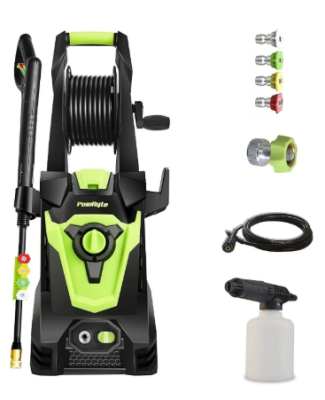
With the equipment unplugged and not in use, look at the branding visible on the housing, any label you can read safely and the packaging you retained. Compare those details with the official photo. If the washer was purchased online, open your order confirmation or purchase history and compare the listing title, photographs, seller information and invoice. Saved emails can help when the original listing has changed or is no longer active.
Do not rely on the historical price range as a model-identifier: the same kind of equipment can sell at different prices, with discounts or bundled accessories. Nor is color alone enough to identify a product definitively. CPSC has not published a serial-range test or an exclusion list in this warning. Do not energize the washer or inspect the inside of the plug to try to confirm whether a protective device is present.
If your product appears to match but the packaging or order record is unclear, keep it out of use while reviewing CPSC’s notice. You can ask the marketplace or original seller for identification information without operating the appliance. Treat an uncertain identification as a reason to seek authoritative clarification, not a reason to test-run a potentially hazardous washer.
What Is a GFCI, and Why Does It Matter Around Water?
A ground-fault circuit interrupter (GFCI) is a safety device intended to reduce the danger of electric shock. As explained in the CPSC’s GFCI fact sheet, it monitors electricity traveling out through a circuit and returning. When even a small difference suggests current is escaping along an unintended path, it interrupts the supply quickly. Its purpose is to reduce the chance that current passing through a person causes severe or fatal harm.
Imagine damaged electrical insulation exposing an energized part. If that electricity finds an unintended route through damp equipment, a wet surface or a person touching the wrong component, a ground fault can occur. Water does not have to be the only cause; physical damage or a defective electrical component can also create a fault. Pressure washing combines powered equipment with water and outdoor conditions, so protective design and careful handling matter especially much.
GFCI protection comes in several forms. A home may have a protected outlet, a circuit-breaker GFCI installed in an electrical panel, or a portable device for certain applications. Other products incorporate a protective device into their own power cord or near the plug. Those are distinct locations for protection, and their existence cannot be inferred just by seeing a familiar-looking receptacle. The CPSC reference describes these general forms and advises qualified help with electrical installation when needed.
There is one essential distinction for PowRyte owners: CPSC specifically identifies the absence of integrated immersion protection on or near the appliance’s plug as the product hazard. A GFCI-protected wall outlet, external adapter or household circuit does not cancel this stop-use warning. Do not substitute one type of protection and then resume operation. CPSC’s product-specific disposal instruction takes priority over general safety explanations.
GFCIs reduce risk, but no device promises absolute protection from all electrical hazards. A GFCI cannot excuse damaged cords, improper operation, unsuitable surroundings or ignored manufacturer instructions. When selecting unrelated equipment in the future, protection should be considered alongside the product’s own documentation, current warnings and safe-use directions—not as a universal assurance that powered equipment is risk-free.
What PowRyte Owners Should Do Now
The correct response is to remove the warned-about appliance from service right away. This practical checklist follows CPSC’s stated action; optional recordkeeping and marketplace inquiries must never delay the first step.
- Stop operating the washer immediately. Release any plan to clean with it. Do not try another outlet, an extension cord, a portable GFCI adapter or a brief test run. Tell household members who may borrow or use the tool that it must stay out of service.
- Unplug it before any cord-cutting. Disconnect the power plug from the outlet while the area is safe to approach. Never cut, nick or handle the cord with the unit connected to electricity. If you find it sitting in standing water or see electrical damage, keep away and seek qualified assistance instead of attempting an unsafe disconnect.
- Document the unplugged unit only if safe and convenient. Preserve an existing order receipt, order number, confirmation email and any photographs already available. A photograph of the safely disconnected product and visible labels may help identify a purchase or answer a marketplace inquiry. No new live testing is necessary.
- Cut the disconnected power cord as instructed by CPSC. This step is intended to make the appliance unusable; the order matters. If you cannot safely complete the direction—for example, because of damaged electrical components—seek appropriate local safety guidance before handling it further. Do not improvise electrical repairs.
- Arrange proper disposal. Check with your city or county solid-waste office or recycling authority about accepting an unusable electric pressure washer and its materials. The right collection route can differ by locality. Follow local handling requirements without sending the appliance into resale or a donation stream.
- Do not sell, give away, lend or reinstall it. CPSC explicitly says not to sell or give away the hazardous pressure washers. Set aside accessories if needed for identification, but do not package the washer as a usable secondhand item.
- Check for updates or assistance afterward. Consult the official warning, then ask Amazon, eBay or the original seller about any options that may apply to your purchase. Do not wait for a refund decision or a reply before you stop using the product.
The choice of a disposal facility is local: federal CPSC instructions tell owners to dispose of the unit, but they do not identify a universal nationwide drop-off point. Call or consult the waste department responsible for your address before placing it in a bin, at curbside, or at an electronics collection event. Tell the facility it is a disabled electric pressure washer subject to a federal stop-use warning. Seek their direction on acceptable materials and preparation.
Is This a PowRyte Recall or a CPSC Safety Warning?
This distinction matters. CPSC’s October 22 notice is titled as a warning to stop using PowRyte pressure washers. It is not presented as a jointly announced, manufacturer-run recall that provides a return process, repair or reimbursement. The agency explicitly says Powell Works, Inc., of China has not responded to requests for a recall. The wording comes from CPSC, and readers should not infer an agreement or speculate about the company’s reasons.
People searching for a “PowRyte pressure washer recall” may therefore reach articles about this event. The correct answer is that CPSC issued safety warning 27-036 and instructed consumers to stop use and dispose of the washers. A search phrase does not turn that warning into a cooperative recall. The official notice contains no listed recall registration form, replacement program or refund remedy for these products.
The practical priority is unchanged regardless of the label: do not continue using the equipment. For an example of a separately announced recall, see FrediTech’s VQQQ patio heater recall report; its remedy does not apply to PowRyte. Recheck the CPSC page if an actual change in warning status is later announced.
What Amazon and eBay Buyers Can Check
CPSC identifies Amazon.com and eBay.com as the online sales channels and reports a $92–$320 sales-price range. That amount describes transactions referenced by the warning; it is not a live marketplace price or a guarantee of what any particular owner paid. An order receipt remains the best source for your actual purchase details.
For an Amazon purchase, sign in to the account used for the order and look under Your Orders. Amazon’s customer-service guidance directs shoppers to order-based support for marketplace purchases. If your item came from a third-party seller, consult Amazon’s seller-contact instructions for available messaging options. Explain that CPSC has issued warning 27-036 and ask what assistance, if any, is available for that order.
On eBay, open Purchase history. eBay explains how to change the year to find older orders and use a purchase’s More actions menu to contact the seller. Keep the communication within official marketplace channels, and preserve responses and order identifiers privately.
Neither the CPSC notice nor these general marketplace help pages establishes a special PowRyte refund, repair, exchange, prepaid label or compensation program. Policies and eligibility depend on the transaction and current platform terms. Do not ship a warned-about electrical product back on your own initiative; ask the platform for instructions consistent with CPSC’s stop-use and disposal direction. Whatever answer you receive, never resume use while waiting.
How to Report a Product-Safety Incident
The CPSC notice links owners to SaferProducts.gov, the federal portal for reporting possible product defects and incidents. You can report an unsafe condition even when no injury occurred. A useful factual report states the product name and what happened, without assumptions about electrical testing you did not perform.
If known, include the seller or marketplace, approximate purchase date, order or listing details, visible branding, photographs taken when the appliance was safely unplugged, and the problem you observed. Explain whether there was any actual smoke, abnormal behavior, shock, property damage or injury; do not check boxes for events that did not happen. The agency’s already published count of one missing-GFCI report should not be confused with an injury tally.
Do not recreate a failure, plug the washer back in, touch suspect energized parts or open the device to collect evidence. Submit personally identifying details through the official reporting form where required, rather than posting order numbers, home addresses, medical details or contact information in public website comments. Reporting supplements, but does not replace, the immediate stop-use direction.
Safety Checks Before Choosing a Replacement
If you later need a replacement pressure washer, use this short screening process. First, search the CPSC recalls and product safety warnings for the exact brand and model under consideration, and check again near purchase. A product’s absence from a search result is not proof that every unit is safe.
- Read actual manufacturer documentation. Look for the specific model’s published manual, plug description, intended electrical supply and wet-location precautions. Avoid relying on stock photos or a seller’s vague “safe” statement.
- Check the stated protective design. Understand whether the equipment itself includes the protection appropriate to its intended use, including any integral or plug-end GFCI described in its instructions. Consult a qualified electrician if household outlet protection is uncertain.
- Inspect condition without operating an unknown item. Before buying secondhand, look for clearly identifiable branding, intact components, readable labeling and evidence of tampering. Walk away from equipment whose cord has been cut or whose safety history cannot be resolved.
- Keep the guide available. Follow the new product’s own operating, inspection and storage instructions. Protective devices are risk-reduction features, not permission to disregard hazards.
These are general consumer screening steps informed by the CPSC GFCI explanation and its safety-notice database. They do not certify a replacement as safe and should not be used to repair, modify or restart the warned-about PowRyte washer. This alert is intended to protect current owners, not promote a shopping recommendation.
Frequently Asked Questions
Is the PowRyte pressure washer warning an official recall?
CPSC has not announced a cooperative recall in CPSC warning 27-036. It is an official federal stop-use warning, dated October 22, 2026. CPSC says Powell Works, Inc., has not responded to recall requests. It provides disposal instructions, not a recall remedy.
How do I know whether my PowRyte washer is the one described?
Compare branding, appearance and accessories with the CPSC photograph and description. Cross-check existing packaging and Amazon or eBay purchase records. The notice does not supply an official model or serial range, so do not treat a specific number, accessory or purchase price as a verified exclusion.
Can I use the washer if I plug it into a GFCI outlet?
No. A protected receptacle does not override this product-specific stop-use warning. CPSC identified missing integrated protection on or near the plug and instructed owners to stop using and destroy the affected washer. Adding another outlet or adapter is not an authorized fix.
Could I replace the plug or ask someone to repair the cord?
Do not attempt that as a workaround. The public warning provides no approved replacement-plug kit or repair procedure. It instead calls for unplugging, cutting the disconnected power cord and disposing of the washer. Do not open, rewire, test or return the appliance to service.
Will Amazon, eBay or the maker refund my purchase?
The CPSC notice announces no refund or exchange program. Ask your marketplace or seller about order-specific options without assuming eligibility. Do not delay stopping use or ship the washer without appropriate instructions.
May I sell, donate or give the washer to someone who understands the risk?
No. CPSC explicitly warns owners not to sell or give away these hazardous pressure washers. Telling the next person about the risk does not change the agency’s instruction. Keep the equipment out of circulation and follow the safe unplug-and-disposal sequence.
Has CPSC reported anyone injured or killed by these washers?
CPSC’s notice lists one report of a unit without a GFCI. That entry is not a reported injury, electrocution or death. Those are potential hazards, not documented outcomes in this notice.
Where should I check for updates and file a report?
Check the CPSC warning page for official changes, using warning number 27-036 when discussing the case. The broader CPSC notice database is another route. Owners who experienced a defect or incident can submit a factual report at SaferProducts.gov without re-operating the equipment.
Final Safety Reminder
For a PowRyte pressure washer described in CPSC’s October 22, 2026 warning, act on the stop-use instruction immediately. Stop, unplug first, cut the disconnected power cord, and dispose of the product according to local handling guidance. Never sell or give it away. See the official CPSC warning 27-036 for current agency information.