
How Audible Saves Time for Busy Professionals in 2026 is most useful when Audible is evaluated by how you listen, not by an old promotional label. Current plan names, monthly selections or credits, catalog access, cancellation rules, title ownership and regional pricing determine the real value.
Quick Verdict
- Best for: listeners who can match a current Audible plan to their monthly listening habits.
- Focus on: Standard versus Premium benefits, selections or credits, catalog access, cancellation rules and local pricing.
- Watch for: older articles may still use Plus or Premium Plus terminology even though Audible's 2026 plan names and availability have changed.
Table of contents
What to Know in 2026
Audible Standard now offers a monthly audiobook selection, while Premium uses credits and additional member benefits. The best time-saving value depends on how often you listen and which plan structure matches your habits. Official source.

Introduction
In today’s work environment time feels like the scarcest commodity. Between long commutes, back‑to‑back meetings, endless email threads and family responsibilities, busy professionals often struggle to find hours for personal development. According to U.S. Census data, the typical one‑way commute in 2024 averaged 27.2 minutesyardikube.com. When you add the trip home, that’s nearly an hour per day and more than 250 hours per year spent travellingbiola.edu. Imagine turning those hours into an opportunity to learn new skills, gain fresh insights and stay inspired. Audiobook platforms like Audible do precisely that, allowing you to transform otherwise wasted time into meaningful growth.
This guide explores how Audible can help busy professionals save time while staying at the cutting edge of their industries. We’ll outline the benefits of audiobooks, present real‑world case studies, highlight potential drawbacks and show you how to build an efficient listening routine. You’ll learn how to integrate audiobooks into your day without sacrificing productivity or relaxation. By the end, you’ll have a clear strategy for using Audible to reclaim those spare minutes and stay ahead in your career.
Why time is so limited for professionals
The hidden cost of commuting and multitasking
Remote work peaked during the pandemic, but recent surveys show that employees are returning to the office. The average one‑way commute climbed back to 27.2 minutes in 2024, meaning the typical professional spends about one hour each day just getting to and from work. Over a year, that equates to more than six work weeks of unproductive time. When you factor in workouts, household chores, waiting rooms and grocery lines, the amount of “dead time” balloons further.
Even when we’re not commuting, many professionals feel tethered to their smartphones. It’s tempting to scroll social media or skim through emails whenever there’s a spare moment. But this type of multitasking can be unproductive—we often end up context switching instead of learning something newyourstory.com. To make matters worse, digital distractions increase stress and can erode focus.
The urgency of continuous learning
As industries evolve quickly, professionals need to continuously learn new technologies, management techniques and market insights. Yet fewer people can carve out dedicated reading time. Audiobooks bridge that gap by allowing you to learn while doing other activities. They turn downtime into an opportunity to build expertise.
Understanding Audible and how it works
Before diving into time‑saving strategies, it’s helpful to understand how Audible functions. As part of Amazon, Audible offers two core membership options. Audible Plus provides unlimited streaming from the Plus Catalogue—thousands of audiobooks and podcasts—for about $7.95 per monthepubor.com. Audible Premium Plus includes everything in Audible Plus and adds monthly credits that can be redeemed for premium titles you permanently own. The one‑credit plan costs $14.95 per month, while the two‑credit plan costs $22.95 per month. Annual plans offer discounted per‑credit pricing. For a more detailed breakdown of membership tiers, see our post on Audible Plus vs Premium Plus.
Audible allows you to download titles for offline listening, adjust playback speed, create bookmarks and take notes. The Audible mobile app syncs progress across devices, so you can pick up where you left off whether you’re driving, walking or cooking. Premium subscribers also enjoy a 30% discount on additional purchases and can return books they don’t enjoy. These features make it flexible enough to fit into a packed schedule.
Free trial and special offers
If you’re new to Audible, you can start with a 30‑day free trial, which includes one credit (two for Prime members) to keep any title you choose. After the trial, the membership automatically renews at the regular monthly rate. You can cancel at any time—any audiobooks purchased with credits remain in your library. See our Audible Free Trial Review for a step‑by‑step guide to maximising the trial period.
:root{ –card-radius: 16px; –shadow: 0 8px 24px rgba(0,0,0,.15); –ink: #eaf4ff; –ink-dim: #b3c3d9; –panel: #0c1b2a; –panel-grad: linear-gradient(180deg,#0f2238 0%, #0b1a2c 100%); –accent: #22d3c5; –accent-hover: #19beaf; –badge: #2bd4c2; }.ad-stack{ display: grid; row-gap: 14px; padding-block: 6px; }.ad-card{ display:grid; grid-template-columns: 42% 1fr; max-width: 760px; margin: 0 auto; border-radius: var(–card-radius); overflow: hidden; box-shadow: var(–shadow); background: #0a1626; }.ad-thumb{ position: relative; display:block; outline: none; isolation: isolate; }.ad-thumb{ position: relative; display:block; outline: none; isolation: isolate; }.ad-thumb.thumb:hover{ box-shadow:0 12px 34px rgba(8,13,30,.36); transform:translateY(-1px); }.ad-thumb img{ display:block; width:100%; height:100%; object-fit: cover; aspect-ratio: 16/15; }.ad-level{ position:absolute; top:10px; left:10px; background:rgba(34,211,238,.18); color:#99f6e4; border:1px solid rgba(34,211,238,.40); font-size:12px; letter-spacing:.03em; padding:4px 8px; border-radius: 999px; backdrop-filter:blur(6px); box-shadow: 0 2px 8px rgba(0,0,0,.25); }.ad-content{ padding: 18px 22px; color: var(–ink); background: var(–panel-grad); }.ad-title{ margin: 4px 0 6px; font: 800 20px/1.2 ui-sans-serif, system-ui, -apple-system, “Segoe UI”, Roboto, “Helvetica Neue”, Arial; color: var(–ink); }.ad-title{ margin: 4px 0 6px; font: 800 20px/1.2 ui-sans-serif, system-ui, -apple-system; color: #ffffff; }.ad-title a{ color:#ffffff; text-decoration:none; }.ad-title a:focus-visible{ outline: 2px solid var(–accent); outline-offset: 3px; }.ad-source{ margin: 0 0 10px; font: 500 14px/1.2 ui-sans-serif, system-ui, -apple-system; color: var(–ink-dim); }.ad-points{ margin: 0 0 16px; padding: 0; list-style: none; }.ad-points li{ position: relative; padding-left: 22px; margin: 8px 0; font: 500 14px/1.5 ui-sans-serif, system-ui, -apple-system; color: var(–ink); }.ad-points li::before{ content: “”; position: absolute; left: 0; top:.55em; width: 8px; height: 8px; border-radius: 50%; background: var(–accent); box-shadow: 0 0 0 4px rgba(34, 211, 197,.15); }.ad-cta{ display: inline-flex; align-items: center; gap:.45rem; padding:.7rem 1rem; border-radius: 10px; background: var(–accent); color: #052b28; font: 800 14px/1 ui-sans-serif, system-ui, -apple-system; text-decoration: none; box-shadow: 0 4px 14px rgba(34, 211, 197,.35); transition: transform.12s ease, background-color.12s ease, box-shadow.12s ease; }.ad-cta:hover{ background: var(–accent-hover); transform: translateY(-1px); }.ad-cta:focus-visible{ outline: 2px solid #fff; outline-offset: 3px; } @media (max-width: 520px){.ad-card{ grid-template-columns: 1fr; }.ad-thumb img{ aspect-ratio: 16/10; }.ad-content{ padding: 16px; } } Free Trial
 How Audible saves time: turning dead time into growth time
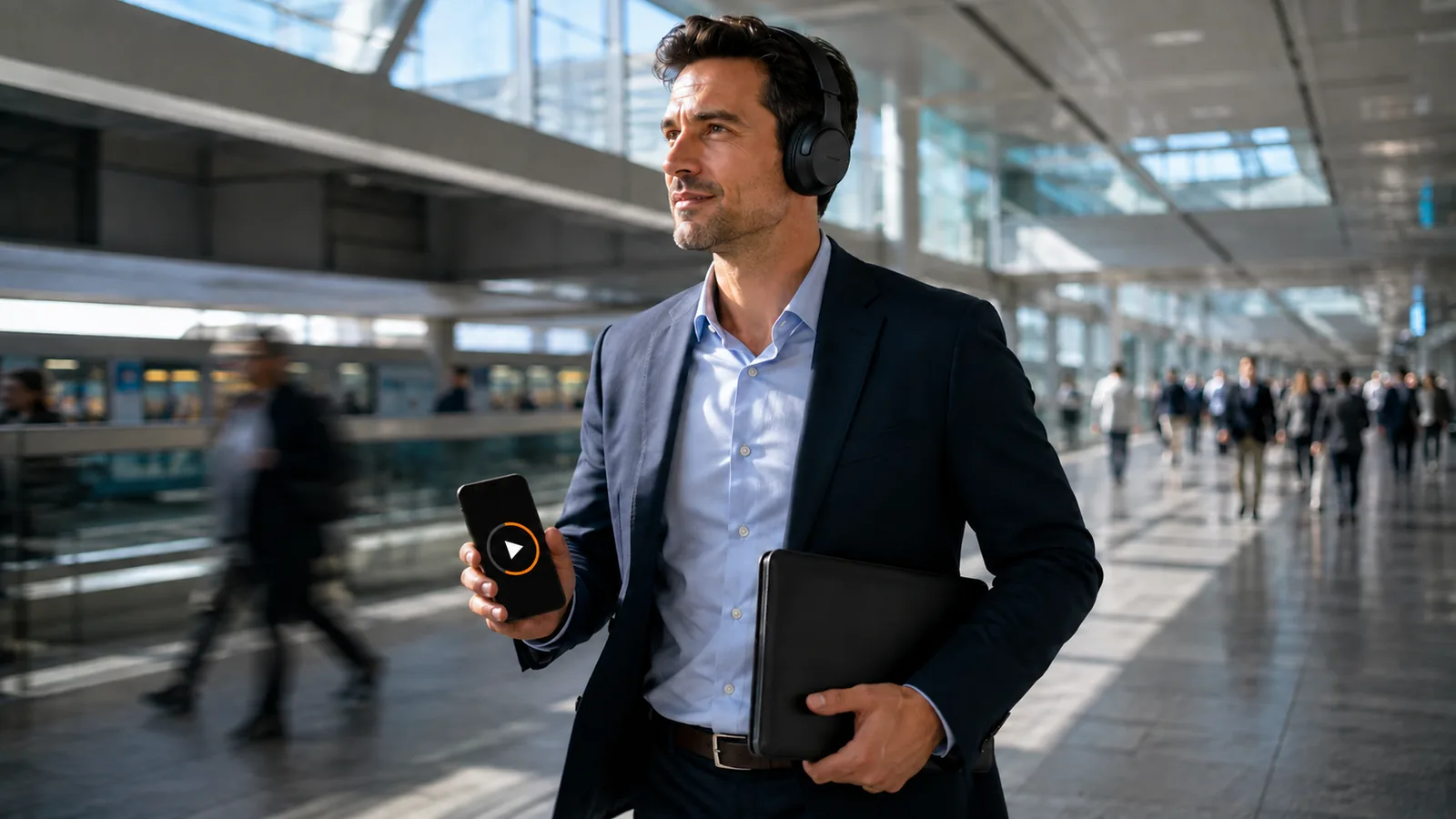
Learning while you commute
In 2024 the average American spent over 27 minutes each way commuting. Instead of allowing that time to drain away, Audible lets you fill it with knowledge. Listening to a book during a traffic jam allows you to finish a chapter on leadership. Similarly, an Online Learning Consortium case study described how Jeremiah Grabowski, a dean of online learning, used his two‑hour daily commute to listen to more than 80 leadership and management audiobooks over seven yearsonlinelearningconsortium.org. The experience not only made his commute enjoyable but also changed his approach to organizational management.
Step‑by‑step: Maximising your commute
- Pick the right book: Choose topics that align with your professional goals or personal interests. For leadership inspiration, titles like The Lean Startup or Good to Great (see our best Audible audiobooks for tech lovers) can spark new ideas.
- Download in advance: Before leaving home, download the book to avoid streaming interruptions in areas with poor reception.
- Use Car Mode or integrate with your vehicle: Audible’s Car Mode simplifies the interface with large buttons and minimal distractions. If you drive a newer car, integrate your phone via Apple CarPlay or Android Auto for safer controls.
- Adjust playback speed: Start with the standard speed and gradually increase to 1.25× or 1.5× as you become comfortable. Remember that comprehension may drop at very high speeds.
- Pause during complex sections: If the material becomes challenging, pause and resume later. Use bookmarks or notes to capture key ideas for later review.
Making workouts and chores productive
Audiobooks extend beyond commuting. You can replace music with an inspiring business book during workouts. This not only strengthens your body but also your mind. Listening while cooking, cleaning or folding clothes transforms mundane tasks into opportunities to sharpen your skills and dive into industry insights. Pairing tasks like cleaning or cooking with a good book turns chores into enjoyable momentsblog.libro.fm.
To integrate audiobooks into these activities:
- Choose energetic narrations for workouts: Look for motivational titles or biographies narrated by engaging speakers to maintain momentum.
- Set shorter sessions: If your chores last 20 minutes, pick shorter chapters or divide longer books into segments.
- Use waterproof headphones: For dishwashing or other wet tasks, invest in waterproof earbuds to listen safely.
- Reward yourself: Associate routine tasks with listening to a favourite book; this positive pairing can make chores more appealing.
Access knowledge anywhere
One of the biggest time‑saving benefits of Audible is mobility. With audiobooks, you can carry an entire library in your pocket. Waiting at the doctor’s office or boarding a flight becomes an opportunity for personal growth. Many platforms—including Audible—offer offline downloads, bookmarks, notes and playback speed controls. This flexibility eliminates the need to schedule dedicated reading time; you create it whenever a spare moment arises.
The cognitive and professional benefits of audiobooks
Sharper focus and continuous learning
Unlike passive entertainment, audiobooks actively engage your brain. Listening to a powerful story or thought‑provoking idea can turn repetitive tasks into an engaging experience. Audiobooks provide mental stimulation that makes boring tasks less tedious, boosts energy and encourages a growth mindset. Professionals who swap social media scrolling for 10 minutes of audiobook listening during breaks often feel more inspired and productive.
Communication and listening skills
Stress reduction and inspiration
Audiobooks also help busy professionals unwind while staying inspired. You can choose motivational titles to maintain high energy, mindfulness and self‑help books to manage stress, or fiction to relax creatively. This balance allows you to grow while also giving yourself permission to escape. The Listening to audiobooks can disrupt negative thinking patterns and boost your mood. Reducing screen time by listening rather than scrolling helps your eyes rest and may improve sleep quality.
Mental stimulation and multitasking research
Boosting literacy and lifelong learning
Audiobooks are not just for consuming fiction; they also build literacy skills. The National Literacy Trust notes that audiobooks help develop decoding, comprehension and critical thinking. They’re especially valuable for language learners and busy professionals looking to expand vocabulary. Beyond skill building, Forbes Books reports that busy professionals and younger generations prefer audio because they can listen while commuting, exercising or working. More than 57% of audiobook listeners are between 18 and 44 years old, and 53% of U.S. adults have listened to an audiobook, many of whom wouldn’t pick up a print bookbooks.forbes.com. Audiobooks therefore make personal development accessible to people who lack dedicated reading time.
Potential downsides and how to mitigate them
Reduced retention when multitasking
While audiobooks are great for multitasking, research shows that divided attention can reduce comprehension. A Collegenp article highlights that when listeners try to multitask, their comprehension and retention may suffercollegenp.com. Similarly, University of Delaware professor Stephanie N. Del Tufo notes that reading and listening engage overlapping but distinct cognitive processes. Listening requires more working memory because you can’t control the pace or easily re‑read a sectionudel.edu. Students who listened while multitasking scored lower on quizzes than those who read.
Mitigation strategies:
- Choose simple tasks: Pair audiobooks with activities that don’t require cognitive effort, such as walking, cleaning or driving on familiar routes. Avoid listening when you need to make decisions or solve complex problems.
- Practice active listening: Focus your attention on the narrative. Avoid switching to social media or email while listening. If your mind wanders, pause, rewind and revisit important sections.
- Take notes and summarise: Use Audible’s clip and note features to capture key ideas. Reviewing notes later helps reinforce learning.
- Adjust speed thoughtfully: Too high a playback speed can decrease comprehension. Experiment to find a pace that balances efficiency with understanding.
Narration quality and time commitment
Not all audiobooks are created equal. Engaging narrators can elevate a story, while flat performances may make listeners abandon a book. Long non‑fiction titles can also feel like a significant time commitment. To mitigate these issues, preview a sample before purchasing and read reviews focused on the narration. You can also break long books into multiple sessions or alternate between shorter titles and podcasts.
Potential cost concerns
Building an efficient Audible routine
Step‑by‑step guide to integrating audiobooks into your day
- Define your goals: Decide whether you want to build leadership skills, learn a new programming language, improve communication or simply relax. This helps you choose relevant books.
- Select the right membership: If you primarily stream content, Audible Plus might suffice. If you want to own titles or listen to new releases, Premium Plus provides credits at a reasonable cost. See our Audible Membership Cost for a deeper dive.
- Create a listening schedule: Identify daily pockets of time—commutes, workouts, chores, walking the dog—and assign them to specific books. Consistency builds a habit.
- Leverage offline mode: Download chapters or whole books ahead of time to avoid network interruptions and save data.
- Use technology to your advantage: Connect Audible to smart devices. Alexa integration allows voice commands; Kindle integration provides WhisperSync, so you can switch seamlessly between listening and reading.
- Track your progress: Audible’s statistics can show your total listening hours. Aim to steadily increase your time and celebrate milestones.
- Mix book lengths and topics: Alternate between short summaries (e.g., Tales app) and comprehensive works. This keeps your listening varied and prevents fatigue.
- Join communities: Share recommendations with colleagues or join book clubs. Discussing ideas reinforces learning and builds professional connections.
Real‑world examples and case studies
From commute to classroom: Jeremiah Grabowski’s story
Fiction for relaxation: balancing work and wellness
Entrepreneur case study: building a startup while staying informed
Imagine a Ghanaian fintech founder who spends time commuting across Accra. By subscribing to Audible and curating a playlist of entrepreneurial classics and tech trend analyses, he transforms each taxi ride into a mini‑masterclass. Books like Zero to One, Never Split the Difference and The Lean Startup (featured in our Best Audible Audiobooks for Tech Lovers and Entrepreneurs) provide actionable frameworks on innovation, negotiation and lean methodology. By the time he arrives at the office, he has new ideas to apply to product development. This hypothetical case mirrors many real professionals who leverage Audible to keep learning despite heavy workloads.
Tips and hacks to maximise time savings
- Use variable playback speeds: Many listeners gradually increase speed to 1.5× or even 2×. This can cut the length of an 8‑hour book down to 4–5 hours. Be careful not to sacrifice comprehension.
- Set reminders: Put calendar reminders at break times to listen for 10 minutes instead of browsing social media. Consistency builds the habit.
- Curate playlists by context: Create separate playlists for commuting, workouts, relaxation and professional development. This helps you quickly choose what fits your current activity.
- Mix audiobooks with podcasts: Audible includes exclusive podcasts and audio courses. Alternating formats keeps listening fresh.
- Combine audio with text: WhisperSync enables you to read on Kindle and listen on Audible, switching seamlessly. This dual approach can improve comprehension and recall.
- Take advantage of returns and Daily Deals: Premium Plus members can return books they don’t enjoy. Audible also runs daily deals with discounts of up to 80%, allowing you to build a library cheaply.
- Explore free alternatives: Use your public library’s apps (Libby or Hoopla) to supplement your Audible subscription. Spotify Premium also includes 15 hours of audiobook listening per month.
Frequently Asked Questions
Does listening to audiobooks count as reading?
Research shows that listening to audiobooks activates many of the same language processing regions as reading. Neuroscientific studies reveal that the brain simulates emotions and actions in narratives whether they’re read or heard. Audiobooks are therefore a legitimate form of reading and can be just as effective for comprehension when listeners pay attention.
How much time can I save per week by using Audible?
If your commute is one hour per day and you spend another hour on chores or exercise, that’s 10 hours per week. By listening during these periods, you can finish one or two average-length audiobooks. Over a year, you could reclaim 500+ hours for learning and personal growth.
Is it safe to listen to Audible while driving?
Yes, as long as you set up your device for hands-free use. Connect your phone via Bluetooth or CarPlay, use Audible’s Car Mode for large controls and avoid adjusting settings while the vehicle is moving. Keep the volume at a reasonable level so you can still hear traffic.
Which membership plan is best for busy professionals?
If you mostly stream content and don’t mind sticking to the Plus Catalogue, Audible Plus at $7.95 per month offers excellent value. For new releases and a wider selection, Premium Plus provides credits to own books and discounts on additional purchases. Annual plans reduce the cost per credit. See our full comparison for details.
How do I remember what I’ve listened to?
Use Audible’s bookmarks and notes to capture key takeaways. Revisit these notes during your next listening session or at the end of the week. Some professionals also maintain a digital journal summarising each book’s key points.
Can audiobooks replace all reading?
Audiobooks are a powerful complement to reading, but they don’t fully replace it. Listening allows you to multitask, while reading gives you control over pacing and easier navigation. Complex material may be easier to understand when you can reread sections. For maximum benefit, combine both formats—listen to audiobooks during busy times and read when you can focus.
Conclusion
Ready to make every moment count? Start with Audible’s free trial and turn your commute, chores and downtime into opportunities for continuous learning. For more tips, explore our guides on how to get two free audiobooks and best audiobook subscriptions in 2026.
Bottom Line
Audible can be useful for commuters, professionals and frequent listeners, but the right plan depends on how many titles you finish and whether you value permanent purchases or subscription access. Verify the current plan shown in your market before subscribing.