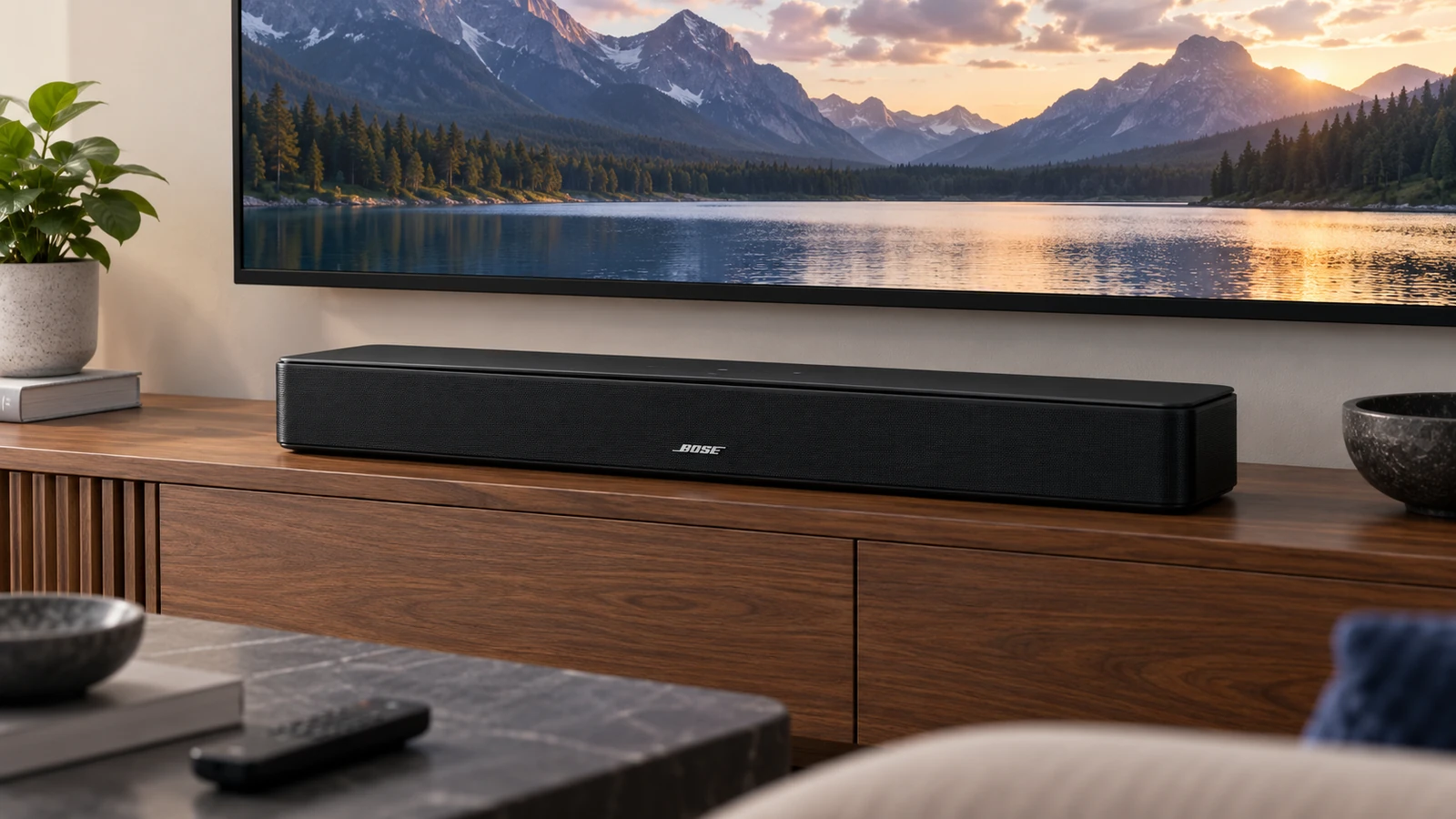
The Bose TV Speaker (2nd Gen) is now available from Bose US for $299, keeping the company’s compact, dialogue-first TV-audio formula but refreshing the enclosure, Bluetooth hardware and included connection cable. It still supports HDMI ARC and HDMI-CEC, optical audio, Bluetooth streaming, adjustable bass and Bose Dialogue Mode, while Bose now includes an HDMI cable in the box. What it does not add is just as important: there is no Dolby Atmos, no built-in voice assistant and no microphone. The original Bose TV Speaker is still sold by Bose for $279, so the immediate question is whether the newer model is worth paying $20 more. For many first-time buyers, the newer Bluetooth 5.1 hardware and HDMI-first setup make Gen 2 the easier choice. Existing owners have a harder decision because most core functions already existed on Gen 1.
Bose TV Speaker 2nd Gen: Quick verdict
The Bose TV Speaker 2nd Gen is a compact three-speaker soundbar aimed at people who want clearer TV speech without app setup, account logins or smart-speaker complexity. At $299, it supports HDMI ARC/CEC, includes the HDMI cable, keeps optical input for older TVs, moves to Bluetooth 5.1 and retains Bose Dialogue Mode and adjustable bass. Bose explicitly says there is no voice assistant, and the product is not a Dolby Atmos soundbar. The original remains $279, so Gen 2 costs only $20 more. That makes the new model sensible for first-time buyers, but feature-hungry shoppers should compare $200–$350 Atmos bars before deciding.
Bose TV Speaker 2nd Gen price and US availability
Bose currently lists the second-generation TV Speaker at $299 in black with Add to Cart availability. This is a new product, not a markdown from an earlier 2nd Gen MSRP. The original remains $279, creating a current $20 gap.
Because both models are sold side by side, this is not a $20 price increase on the same product. The useful question is whether Gen 2’s revisions justify the current premium.
Bose TV Speaker 2nd Gen specifications
| Specification | Bose TV Speaker 2nd Gen |
|---|---|
| US price | $299 |
| Color | Black |
| Width | 23.465 in |
| Height | 2.244 in |
| Depth | 4.154 in |
| Weight | 4.409 lb |
| Speaker count | 3 |
| Tweeter | 1 center-focused tweeter |
| HDMI | Yes |
| HDMI ARC | Yes |
| HDMI-CEC | Yes |
| Optical | Yes |
| Bluetooth | Yes |
| Bluetooth version | 5.1 on Bose’s dedicated Gen 2 specification page |
| Dolby Digital | Yes |
| Dolby Atmos | Not supported |
| Voice assistant | Not supported |
| Microphone | No |
| Wi-Fi | Not listed by Bose |
| App control | Not listed by Bose |
| Remote | IR remote included |
| Bass adjustment | Yes |
| Bass-module support | Wired Bose Bass Module 500, Bass Module 700 or Lifestyle Ultra Subwoofer; one at a time |
| Included HDMI cable | Yes |
| Included optical cable | No |
| Wall-mount support | Yes; Bose Soundbar Wall Bracket sold separately |
| Best for | Compact TV setups, simple operation and dialogue-first viewing |
| Main limitation | No Dolby Atmos, Wi-Fi smart platform or included subwoofer |
What actually changed from the original Bose TV Speaker?
| Feature | Bose TV Speaker 2nd Gen | Original Bose TV Speaker | Meaningful change? |
|---|---|---|---|
| Current Bose US price | $299 | $279 | Yes — $20 difference today |
| Design | Refreshed enclosure with softer rounded edges | More squared-off original enclosure | Changed, but not a total redesign |
| Dimensions | 23.465 W × 4.154 D × 2.244 H in on current product page | 23.38 W × 4.02 D × 2.21 H in | Almost the same footprint |
| Weight | 4.409 lb | 4.34 lb | Negligible difference |
| Speaker arrangement | 3 speakers: 2 woofers/full-range drivers + 1 tweeter | 3 speakers | Broad concept carried over |
| Dialogue Mode | Yes | Yes | Same core feature |
| HDMI ARC | Yes | Yes | Same |
| HDMI-CEC | Yes | Yes | Same |
| Included TV cable | HDMI cable | Optical cable | Practical change |
| Optical input | Yes; cable not included | Yes; cable included | Connection remains, box emphasis flips |
| Bluetooth | 5.1 | 4.2 | Hardware revision |
| Bass adjustment | Yes | Yes | Same |
| Voice assistant | No | No built-in voice control | Same simplicity-first approach |
| Dolby Atmos | No | No | Same limitation |
| App / Wi-Fi | Bose does not list app or Wi-Fi control | No dedicated app; Bluetooth-focused | No smart-platform upgrade |
| Subwoofer expansion | Wired Bose Bass Module 500/700 or Lifestyle Ultra Subwoofer; one at a time | Wired Bass Module 500/700; Acoustimass 300 also documented | Same basic wired-expansion concept |
| Remote | IR remote included | Remote included | Same |
The design is newer, but the footprint is almost unchanged
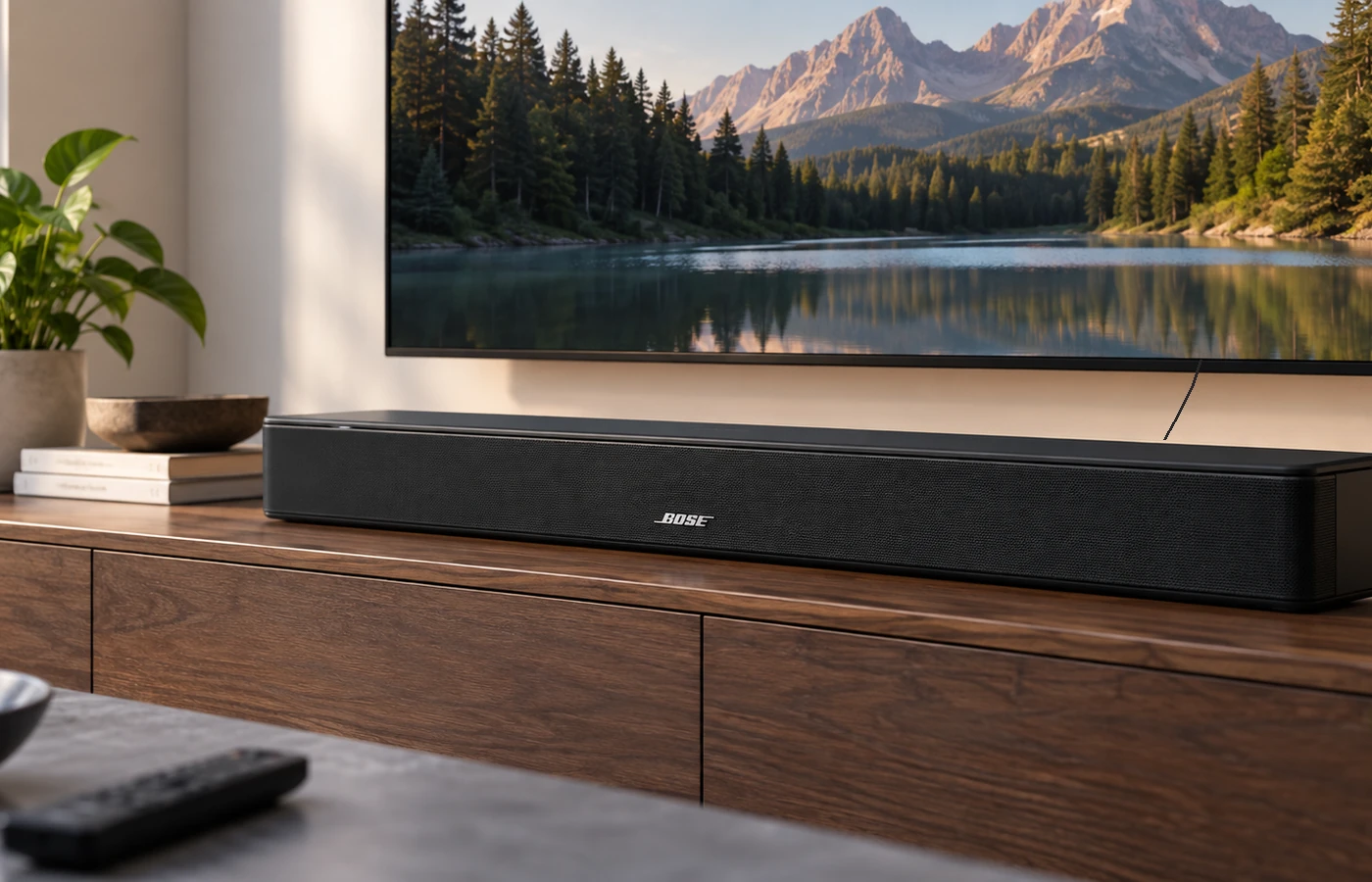
Bose describes Gen 2 as having a refreshed exterior with softer, rounded edges. Visually, that makes the soundbar look a little less boxy, but this is not a dramatic redesign. Bose’s current Gen 2 product page gives dimensions of approximately 23.47 inches wide, 4.15 inches deep and 2.24 inches high, with a weight of about 4.41 lb. The original is roughly 23.38 × 4.02 × 2.21 inches and 4.34 lb.
Both occupy the same compact class. Bose recommends placing the bar centered beneath the TV on a stable surface near the front edge, and says not to mount it above the television. A Bose Soundbar Wall Bracket is sold separately.
Did Bose improve the sound?
Bose says Gen 2 improves acoustic performance and clarity, with angled left/right speakers intended to widen the soundstage and deeper bass than typical TV speakers. These are manufacturer claims, not FrediTech measurements.
Controlled Gen 1-versus-Gen 2 testing is not yet mature enough to claim measurably clearer dialogue, deeper bass, wider imaging or lower distortion. For now, Bose is promising a tuning refinement rather than demonstrating a completely new acoustic architecture.
Dialogue Mode remains the main reason to consider it
The three-speaker system uses angled left and right speakers plus a center-focused tweeter dedicated to speech. Dialogue Mode analyzes the program audio and emphasizes voices relative to background content. That can be useful for dramas, documentaries, news, sports commentary and scenes where quiet dialogue is mixed under music or effects.
Dialogue Mode itself is not new. The original Bose TV Speaker already has it, so buyers should not treat the button as a Gen 2 invention. The unanswered question is whether Bose materially changed the tuning or DSP behavior. Bose’s product copy promises improved clarity overall, but independent comparison testing is still needed.
Does Bose TV Speaker 2 have HDMI ARC?
Yes. Bose officially lists HDMI ARC and HDMI-CEC support. The simplest setup is to connect the included HDMI cable from the soundbar to the TV’s HDMI port labelled ARC or eARC, connect power, select external speakers if the TV requires it, and test power and volume control with the television remote.
Bose support tells users to connect to a TV port labelled eARC or ARC, but the soundbar itself is specified as HDMI ARC. That is not the same as Bose explicitly claiming full eARC capability on the soundbar. The accurate wording is that it can connect to a compatible ARC/eARC-labelled TV return port through its HDMI ARC connection.
HDMI-CEC makes TV-remote control simple
With HDMI-CEC, a compatible television can power the speaker on and off and control volume using the TV remote. Manufacturers give CEC different names, so the setting may not literally say “CEC” in your television menu. Bose’s setup guidance keeps this intentionally generic because brands handle the feature differently.
That included cable matters: Gen 1 supplied optical and sold HDMI separately, while Gen 2 makes the more automated ARC/CEC route the default out of the box.
What if your TV only has optical audio?
Gen 2 still accepts TOSLINK optical audio, which keeps it useful with older televisions that lack ARC. The difference is that the optical cable is no longer included. You need to buy one separately.
Optical can deliver perfectly usable TV audio here, but it usually gives you less automatic power/volume behavior than HDMI-CEC. Bose says TV remotes do not automatically control the speaker over optical, although compatible TV, cable or universal remotes can often be programmed to control volume. For an optical-only TV, the original model’s included optical cable is a small but real convenience.
Bluetooth 5.1 vs Bluetooth 4.2 on the original
The second generation’s support-spec page lists Bluetooth 5.1 with a rated range of about 30 feet / 9 metres, versus Bluetooth 4.2 on the original. It is a genuine hardware revision, not proof of an audible improvement.
Bluetooth is mainly for music and podcasts from phones, tablets and computers. Bose recommends HDMI or optical for TV audio, where lip-sync, control and connection reliability matter more. Bluetooth 5.1 is therefore a modest rather than transformative upgrade.
Does Bose TV Speaker 2nd Gen support Dolby Atmos?
No. Bose’s technical specification lists Dolby Digital, not Dolby Atmos. That distinction is important at $299 because several current competitors around the same price advertise Atmos, height processing or multichannel packages.
Atmos branding does not automatically mean a rival sounds better. A dialogue-focused bar can still suit news, sitcoms and dramas, while movie-first buyers may value the extra immersive-format support available near this price.
Does it have Alexa, Google Assistant or another voice assistant?
No. Bose explicitly says the TV Speaker 2nd Gen does not support voice assistants, and the product specification lists no microphone. Bose also lists Bluetooth as the wireless connection and does not advertise Wi-Fi, AirPlay, Chromecast, Spotify Connect or a smart-control app for this model.
For some buyers that is a limitation; for others it is the point. FrediTech’s Bose QuietComfort Ultra guide shows how feature-rich Bose products can become; the TV Speaker takes the opposite path with TV sound, Bluetooth and direct remote control.
Can you add a subwoofer?
Yes, but expansion is wired. Bose lists the Bass Module 500, Bass Module 700 and Lifestyle Ultra Subwoofer, one at a time, using a Bose Bass Module Connection Cable or compatible stereo cable. Bose also notes the older Acoustimass 300 in support material.
Do not confuse this with the wireless ecosystem used by Bose’s smart soundbars. The TV Speaker is not positioned as a full wireless-surround hub, and Bose does not list satellite surround-speaker expansion for the model. If deep movie bass is a priority, compare the total system cost before buying the bar plus a separate Bose bass module.
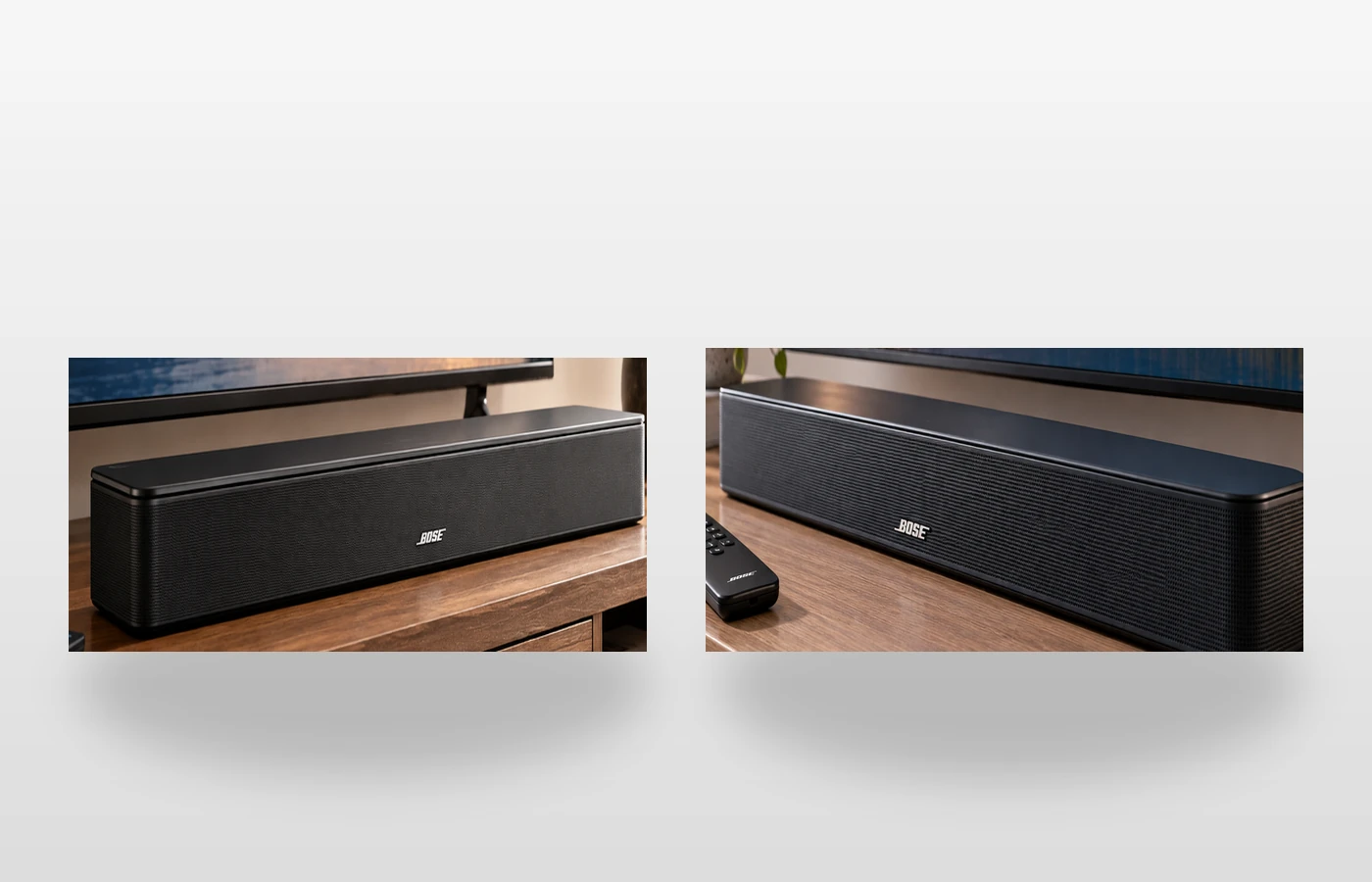
Bose TV Speaker 2nd Gen vs original: Is Gen 2 worth $20 more?
For a new buyer, probably yes at today’s Bose prices. The gap is small, Gen 2 includes the cable most modern TVs use, moves Bluetooth from 4.2 to 5.1 and starts a newer product lifecycle. Bose also claims improved clarity.
The original still makes sense if it becomes materially cheaper, if an optical-only TV makes its included cable useful, or if testing finds the acoustic differences minor. At only $20 less today, its value case is limited.
Should existing Bose TV Speaker owners upgrade?
Probably not for features alone. Gen 1 already gives you Dialogue Mode, Bluetooth, HDMI ARC, HDMI-CEC, optical input, adjustable bass and wired bass-module support. Gen 2 does not suddenly add Atmos, Wi-Fi, an app or voice control.
An existing owner should wait for meaningful comparative evidence. An upgrade makes more sense if independent tests prove a clearly better speech balance or overall tuning, if Bluetooth 5.1 matters for a particular use case, or if the old speaker simply needs replacing. A “2nd Gen” badge by itself is not a good reason to discard working hardware.
How does $299 compare with budget Dolby Atmos soundbars?
This is where Bose’s value proposition becomes more specialized. Live U.S. pricing shows that $299 sits among soundbars with Atmos, eARC, apps, Wi-Fi and even wireless subwoofers.
| Model | Live price | Configuration | Dolby Atmos | HDMI ARC/eARC | Subwoofer | Wi-Fi / app | Dialogue feature | Why choose it over Bose? |
|---|---|---|---|---|---|---|---|---|
| Samsung HW-S60D | $299.99 at Best Buy | 5.0 all-in-one | Yes | eARC | No included sub | Wi-Fi + SmartThings, AirPlay, Chromecast, Spotify Connect | Voice Enhance / Adaptive Sound | Much richer smart/Atmos feature set at essentially the same price |
| LG S70TY | About $299–$299.99 in current U.S. listings | 3.1.1 + wireless subwoofer | Yes | eARC | Included | Remote app supported | Clear Voice Pro / AI Sound Pro | Atmos, dedicated subwoofer and eARC for roughly Bose money |
| TCL Q6CH | $329 at Walmart | 5.1 + wireless subwoofer | Yes | HDMI plus optical; verify exact eARC behavior on current SKU/manual | Included | TCL mobile app with room calibration | Processing-focused rather than Bose-style dedicated Dialogue Mode | More channels and a subwoofer for $30 more |
| Sonos Ray | $219 at Best Buy | Compact standalone bar | No | No HDMI; optical only | Optional Sonos sub | Wi-Fi + Sonos app + AirPlay 2 | Speech Enhancement | Cheaper, smart streaming and app EQ |
The Samsung comparison is particularly revealing: at $299.99, the HW-S60D adds Dolby Atmos, eARC, Wi-Fi, SmartThings, AirPlay, Chromecast and Spotify Connect while remaining an all-in-one bar. LG’s S70TY goes in a different direction, pairing Atmos and eARC with a wireless subwoofer. TCL adds a 5.1 package and wireless sub at $329. Sonos Ray is cheaper and smart-connected but loses HDMI entirely.
Those products are not automatically better. A feature sheet cannot tell you which has the clearest speech, most natural tonality or least annoying setup. Bose is competing on compact size, simplicity, direct remote control and a clear speech-first identity rather than maximum feature count.
For broader audio-buying context, FrediTech’s best headphones and earbuds under $300 discusses why features per dollar and listening priorities can point to different winners. The Sony WH-1000XM5 vs Bose QuietComfort Ultra comparison makes the same broader point: simpler or more expensive hardware can still make sense when it better matches the user’s actual priorities.
Who should buy Bose TV Speaker 2nd Gen?
It makes the most sense for buyers whose first priority is understanding television speech and who want a compact bar they can connect once and operate mostly with the TV remote. Bedrooms, apartments, offices, secondary TVs and smaller living rooms are natural fits. The physical remote is also useful for people who do not want a phone app involved in basic audio control.
It is also a sensible fit for people who actively dislike smart-speaker complexity. No microphone, no built-in voice assistant and no advertised Wi-Fi ecosystem can be a deliberate benefit when the goal is simply better TV audio. For casual phone music, Bluetooth is enough.
Who should buy something else?
Movie-first buyers should compare Atmos alternatives. Smart-home users should look for Wi-Fi, app EQ, AirPlay, Chromecast or Spotify Connect. Buyers who want strong low bass without a second purchase should compare bars that include a wireless subwoofer. Gamers or home-theater enthusiasts should also pay attention to eARC, surround options and latency rather than assuming a compact dialogue bar is built for those priorities.
If Bose’s broader sound signature is what attracts you, FrediTech’s Sound by Bose tuning explainer shows why the Bose name or tuning involvement should still be separated from measured performance, and the Sony WH-1000XM6 review provides another example of why mature independent testing matters before making performance claims.
FrediTech verdict
The Bose TV Speaker 2nd Gen is not trying to win the $299 feature war. Its case is simpler: compact size, HDMI setup, TV-remote control, dialogue emphasis and Bluetooth music.
At only $20 more than the original Bose TV Speaker, Gen 2 is the logical Bose choice for most new buyers while both prices remain close. Existing Gen 1 owners should wait for independent comparative testing rather than upgrading because of the generation number. And anyone who cares about Dolby Atmos, Wi-Fi, app control, eARC or an included wireless subwoofer should compare today’s alternatives before spending $299. The right reason to buy Bose here is simplicity and speech clarity—not maximum home-theater capability per dollar.
Frequently Asked Questions
How much is Bose TV Speaker 2nd Gen?
Bose US currently lists it at $299.
Is Bose TV Speaker 2nd Gen available now?
Yes. Bose.com currently shows Add to Cart availability in the United States.
What changed from the original Bose TV Speaker?
The main documented changes are softer rounded styling, Bluetooth 5.1 instead of 4.2, an HDMI cable included instead of optical, and Bose-claimed acoustic/clarity improvements.
Does Bose TV Speaker 2 have HDMI ARC?
Yes. Bose officially lists HDMI ARC and HDMI-CEC.
Does Bose TV Speaker 2 have optical input?
Yes. Optical is supported, but Gen 2 does not include the optical cable.
Is an HDMI cable included?
Yes. Bose includes HDMI in the Gen 2 box.
Does Bose TV Speaker 2 support Dolby Atmos?
No. Bose lists Dolby Digital, not Dolby Atmos.
Does Bose TV Speaker 2 have a voice assistant?
No. Bose explicitly says voice assistants are not supported, and the specifications list no microphone.
Does Bose TV Speaker 2 have Bluetooth?
Yes. The current Gen 2 specification lists Bluetooth 5.1 with a rated range of about 30 feet / 9 metres.
Can Bose TV Speaker 2 connect to a subwoofer?
Yes. Bose documents wired support for Bass Module 500, Bass Module 700 and Lifestyle Ultra Subwoofer, one at a time.
Does it work with Bose Bass Module 500?
Yes, using a wired Bose Bass Module Connection Cable or compatible stereo cable.
Does it have Dialogue Mode?
Yes. Dialogue Mode emphasizes speech relative to background audio, but the original TV Speaker already had this feature.
Is Bose TV Speaker 2nd Gen worth $299?
It is strongest for buyers who value compact size, simple HDMI setup and speech clarity. Feature-focused buyers should compare Atmos and subwoofer-equipped alternatives at similar prices.
Should I upgrade from the original Bose TV Speaker?
Probably not for features alone. Wait for independent evidence that the claimed acoustic improvements are meaningful for your use.
Sources and Further Reading
- Bose — TV Speaker 2nd Gen product page
- Bose Support — TV Speaker 2nd Gen specifications
- Bose Support — TV Speaker 2nd Gen setup
- Bose Support — Bass Module connection
- Bose — original TV Speaker product page
- Best Buy — Samsung HW-S60D current price
- LG — S70TY official product page
Fact-check date: September 15, 2026. Prices, stock and retailer promotions can change quickly.