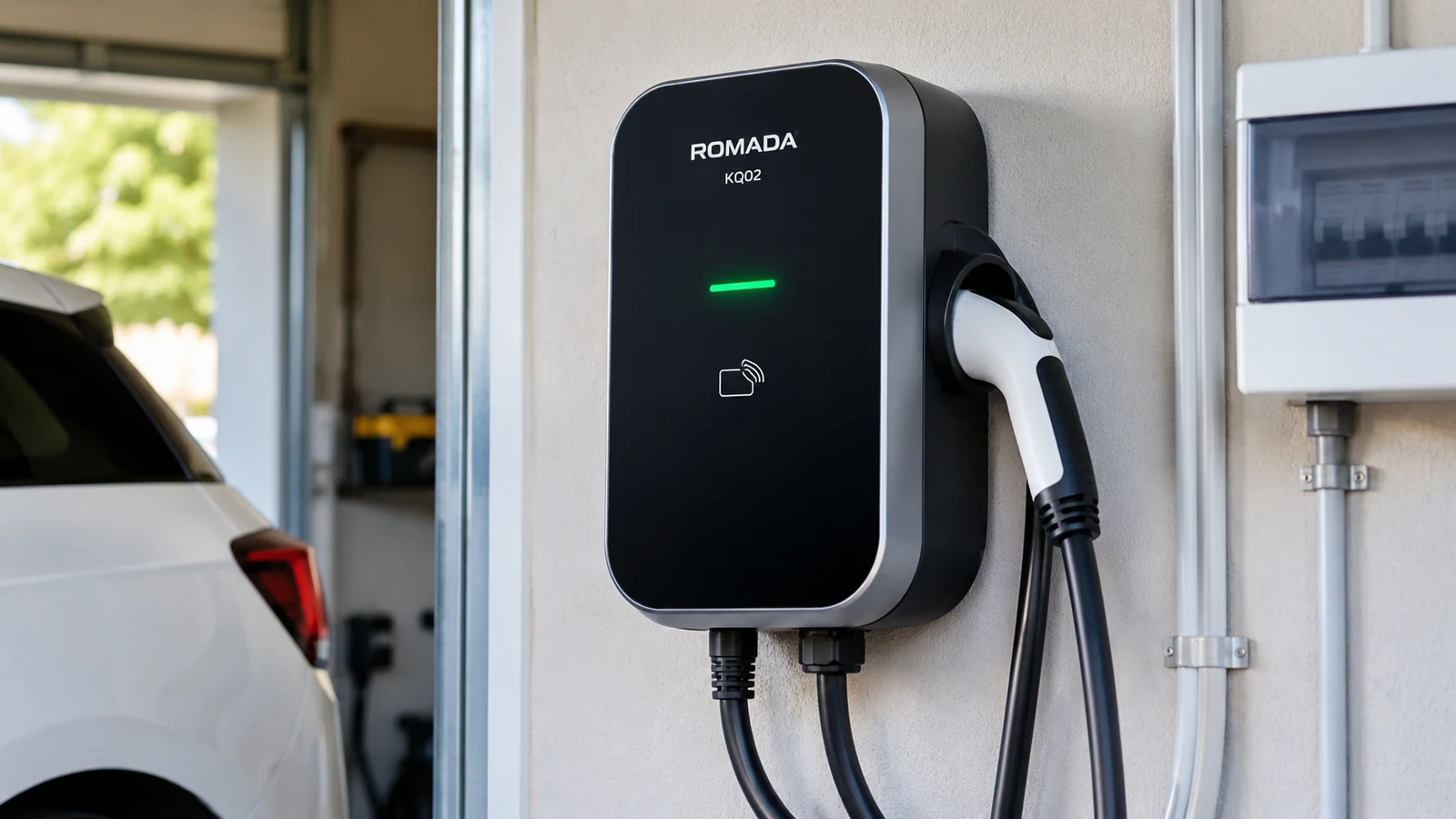

SERIOUS ELECTRIC-SHOCK RISK. The UK Office for Product Safety and Standards has published a Product Safety Report for the ROMADA KQ02 wall-mounted EV charging system. OPSS says the output cable’s protective-earth conductor is the same length as the live and neutral conductors, so under cable strain or a vehicle drive-off event the earth could disconnect before the live conductors.
Official action: import rejected at the UK border. Recall status: the notice does not announce a consumer recall or customer-return programme.
ROMADA KQ02 safety report: Quick answer
OPSS published Product Safety Report 2609-0021 on September 15, 2026 for the ROMADA KQ02, an EV charging cable with wall-mounting power supply. The official risk level is Serious. OPSS says the output-cable protective-earth conductor is the same length as the live and neutral conductors. Under cable strain or a vehicle drive-off event, the earth could therefore disconnect before the live conductors, potentially leaving accessible metal parts without effective earthing while the equipment remains connected to the electricity supply. The charger also failed an earth-bond test. The import was rejected at the border. This is a Product Safety Report, not a consumer recall, and it is separate from report 2609-0023 covering ROMADA model K02-1.8 13A 5.
ROMADA KQ02 UK safety report at a glance
| Product | ROMADA New Energy Charging Pile (EV Charger) |
|---|---|
| Brand | ROMADA |
| Model | KQ02 |
| SKU | 048607 |
| Product type | EV charging cable with wall-mounting power supply |
| Country of origin | China |
| Risk level | Serious |
| Hazard | Electric shock |
| Official measure | Import rejected at border |
| Recall status | No consumer recall announced in this notice |
| PSD number | 2609-0021 |
| Published | September 15, 2026 |
Which ROMADA EV charger is affected?
The current notice covers the ROMADA New Energy Charging Pile (EV Charger), model KQ02. OPSS describes it as an EV charging cable with a wall-mounting power supply and lists China as the country of origin.
| Identifier | Official value |
|---|---|
| Model | KQ02 |
| SKU | 048607 |
| Additional identifier | KQ02-1.8 |
| Carton / product identifier | B04000000001409022734 |
| Carton / product identifier | WI49803276 |
| Carton / product identifier | M0100000000010472173 |
| Number | No. 158 |
Important: this is not the portable ROMADA charger reported earlier. The current KQ02 report covers a wall-mounted charging unit. A separate OPSS report covers model K02-1.8 13A 5, a portable charger with an attached wall plug and carry case. The spelling difference—KQ02 versus K02—is small but the products, identifiers and safety findings are different.
Why UK authorities rejected the KQ02 charger
OPSS says the KQ02 presents a serious risk of electric shock because its protective-earthing arrangement may not remain intact for as long as the live conductors if the charging cable is placed under severe strain. The product also failed an earth-bond test, which is separate supporting evidence that the protective-earthing path may have inadequate continuity.
The official corrective action is straightforward: the import was rejected at the border. The report does not say every KQ02 ever made was seized or that a nationwide consumer return programme has been started.
The protective-earth conductor could disconnect too early
OPSS found that the output-cable earthing conductor is the same length as the live and neutral conductors. In a safety-conscious cable design, the protective-earth connection should not be the first protective connection lost when the cable is pulled apart. If the earth connection opens while live conductors remain connected, fault protection can be compromised.
Protective earthing in plain English: earthing provides a low-resistance path for fault current so protective devices can operate and exposed conductive parts do not remain dangerously energised. It is a safety path, not an operating conductor that consumers should modify or test themselves.
Electrical Safety First similarly explains that earthing provides a protective-conductor path for fault current and helps protective devices disconnect a faulty circuit. That context helps explain why continuity of the earth path matters in EV charging equipment.
Why cable strain or driving away while connected matters
A drive-off event occurs when a vehicle starts moving while it is still physically connected to charging equipment. That movement can place substantial pulling force on the connector, cable and wall-mounted charger. OPSS also refers more broadly to cable strain, so drive-off should not be treated as the only scenario in which the cable could be stressed.
The safety concern is about the sequence of disconnection under strain. If the protective earth disconnects before the live conductors, the equipment can lose the safety path that is intended to protect accessible conductive parts under fault conditions.
How accessible metal parts could become live
The KQ02 report does not say the charger casing is always live. It says the identified defect could allow accessible metal parts to become live under the failure conditions described by OPSS. If the protective earth has been lost while live electrical connections remain, a fault could leave exposed conductive parts dangerously energised.
A person touching a live part under those conditions could receive an electric shock. That is why the official risk level is Serious.
Official finding: the protective-earth conductor may disconnect before the live conductors under cable strain, and the product failed the earth-bond test.
Not established by the notice: that every KQ02 has shocked someone, that any injury occurred, or that all ROMADA chargers share the same defect.
The charger also failed its earth-bond test
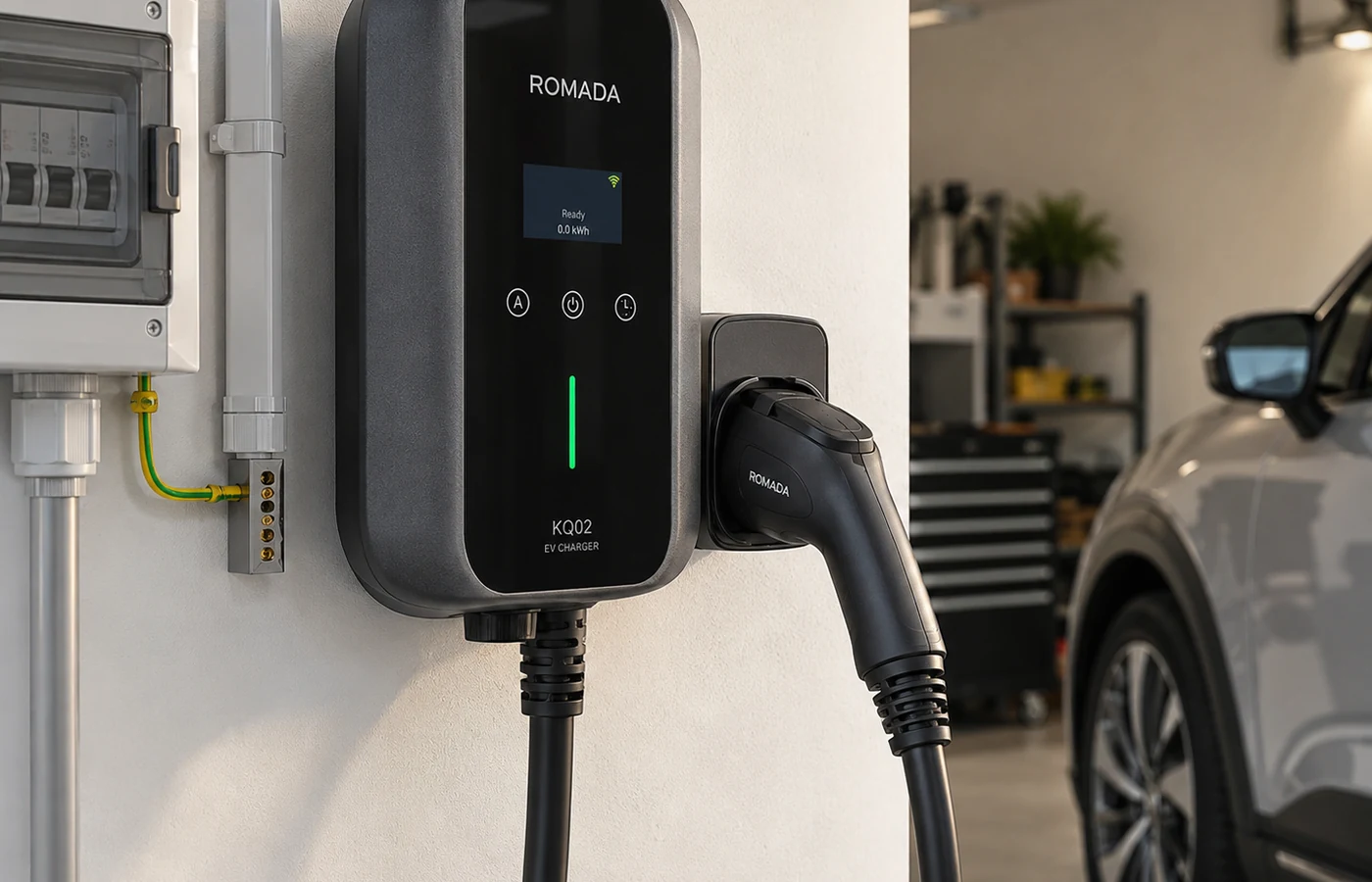
OPSS says the KQ02 failed the earth bond test. In practical terms, an earth-bond or protective-conductor continuity test checks whether the protective-earth path has sufficiently reliable electrical continuity for its safety role. The failure reinforces the concern that the charger’s protective-earthing path may not be adequate.
This article intentionally does not provide resistance values, probe locations, pull-test procedures or instructions for opening the charger. This is mains EV charging equipment. Testing protective-conductor continuity should be carried out by appropriately qualified professionals with suitable equipment.
What an earth-bond failure means in practical terms
Earthing is intended to give fault current a controlled low-resistance route so protective devices can disconnect a faulty circuit instead of allowing a person to become part of the current path. If that protective route is interrupted or has inadequate continuity, the protective system may not perform as intended.
UK government EV-chargepoint guidance also requires qualifying installations to follow standards including BS EN 61851, BS 7671 and the IET Code of Practice for Electric Vehicle Charging Equipment Installations. FrediTech is citing that only as broader installation-safety context; the KQ02 report itself specifically states that the product does not meet the Radio Equipment Regulations 2017. That unusual wording should not be silently replaced with regulations cited in a different ROMADA case.
This is a border rejection—not a consumer recall
This is a border safety action, not a consumer recall. OPSS classifies 2609-0021 as a Product Safety Report and says the import was rejected at the border. The notice does not announce a recall from end users, refund programme, modification programme or customer-return process.
That distinction matters for readers and search engines. The accurate wording is that UK authorities rejected the identified KQ02 import after finding a serious electric-shock risk.
Did KQ02 chargers reach UK customers?
The notice does not establish that units from the rejected import reached UK end users. Because the shipment was rejected at the border, FrediTech will not infer installation counts, owner counts or customer exposure that the official report does not provide.
Likewise, the absence of a consumer recall in this report does not prove that every KQ02 outside the rejected shipment is safe. It only means the current OPSS action described on this page is border rejection rather than an end-user recall.
What should you do if you already own a matching KQ02?
If you believe you already have the exact ROMADA KQ02 identified in report 2609-0021, do not dismantle it or electrically test the earthing yourself. Compare the model and identifiers, then contact the seller, installer, manufacturer or your local Trading Standards service for current guidance.
FrediTech precautionary guidance: because OPSS classifies the electric-shock risk as Serious, seek qualified electrical advice before continued use of a matching unit. This is FrediTech’s safety-oriented recommendation; it is not an OPSS consumer-recall instruction.
- Do not open the wallbox or charging cable to inspect the earth conductor.
- Do not measure continuity or resistance unless you are a qualified professional using appropriate equipment.
- Do not modify the earth connection, plug, cable or protective devices.
- Do not deliberately pull the cable or simulate a vehicle drive-off.
- Keep the product identifiers and purchase/installation records available when asking for guidance.
This is different from the earlier portable ROMADA EV charger
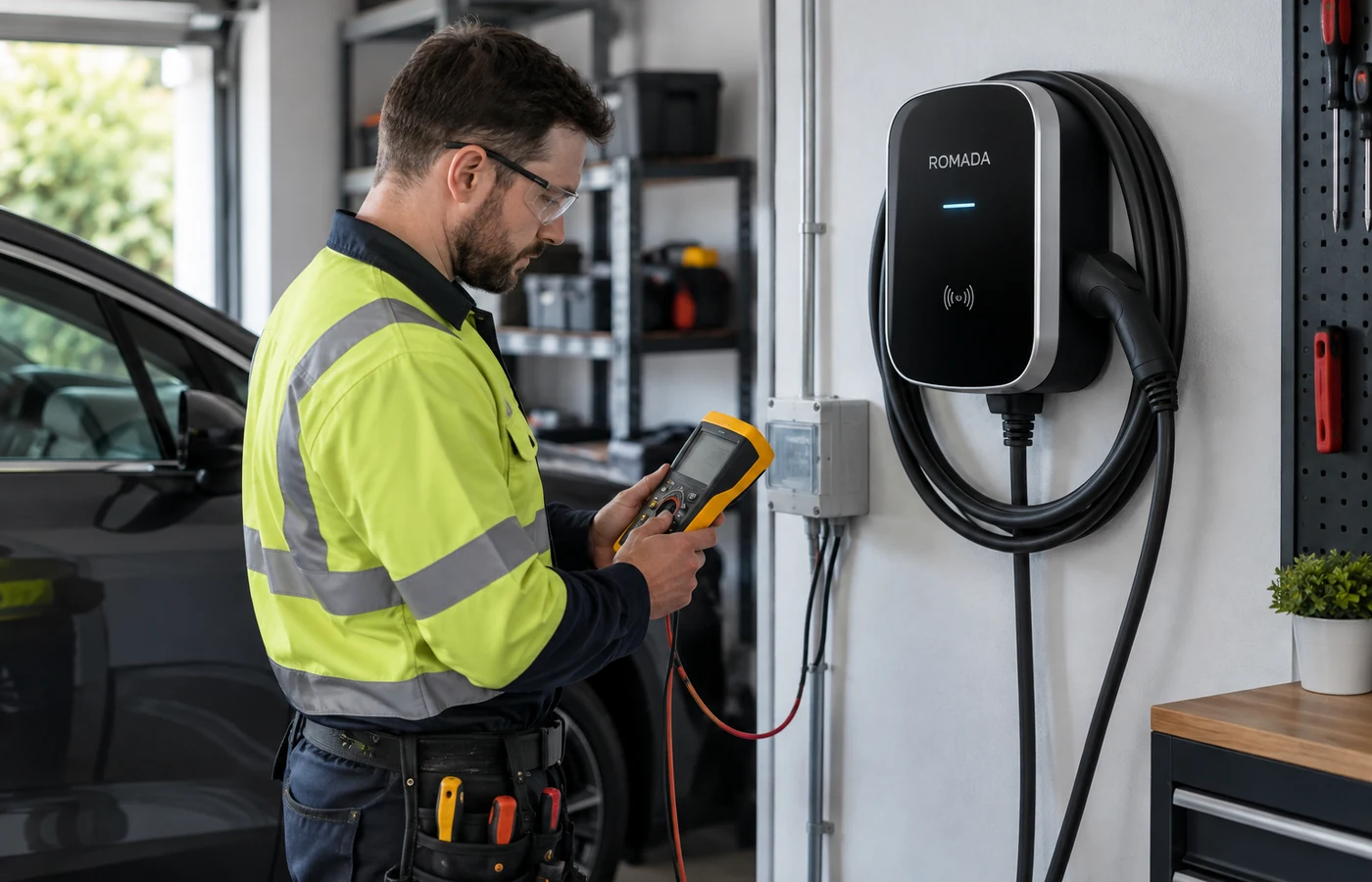
ROMADA now appears in two separate September 2026 OPSS safety reports, but the products must not be merged. The current KQ02 is a wall-mounted charging system. The earlier K02-1.8 13A 5 is a portable-style charger with an attached wall plug and carry case.
The earlier report, 2609-0023, says the portable charger had poor-quality internal connections and internal wires of the same length, which could lead to loss of protective earthing and the product becoming live. It also says the supplied plug lacked required accreditation markings. Those exact findings should not be copied into the KQ02 article.
KQ02 vs K02-1.8 13A 5: Two separate safety cases
| Feature | ROMADA KQ02 | ROMADA K02-1.8 13A 5 |
|---|---|---|
| Report number | 2609-0021 | 2609-0023 |
| Publication date | September 15, 2026 | September 11, 2026 |
| Recall/alert date | September 15, 2026 | September 10, 2026 |
| Product style | Wall-mounting power supply with EV charging cable | Portable-style charger with attached wall plug and carry case |
| Main hazard | Serious electric-shock risk from protective-earthing integrity under cable strain | Serious electric-shock risk from poor internal connections and internal wires of the same length |
| Earthing issue | Output cable earth conductor same length as live/neutral; may disconnect first; failed earth-bond test | Internal wiring/connections could lead to loss of protective earthing |
| Plug issue | No separate plug-marking issue stated in the KQ02 notice | Supplied plug missing required accreditation markings |
| Official action | Import rejected at border | Import rejected at border |
| Regulations cited | Radio Equipment Regulations 2017 | Electrical Equipment (Safety) Regulations 2016; Plugs & Sockets etc. (Safety) Regulations 1994 |
The two products also use different carton identifiers. The portable K02 report lists B04000000001409021663, WI49803276, M0100000000010472175 and No. 51. These must not be substituted for the KQ02 identifiers above.
Which UK regulation does the KQ02 report cite?
The current KQ02 notice states that the product does not meet the requirements of the Radio Equipment Regulations 2017. That may seem unusual in an article focused on electric-shock risk, but it is the regulation currently cited by OPSS and should be reproduced accurately unless the government page is later corrected.
By contrast, report 2609-0023 for the portable K02 charger cites the Electrical Equipment (Safety) Regulations 2016 and the Plugs & Sockets etc. (Safety) Regulations 1994. FrediTech should never copy those regulatory references across to the KQ02 merely because both products are EV chargers.
What EV-charger buyers should check before buying online
- Check the exact manufacturer and model rather than relying on a generic listing title.
- Review current UK product-safety notices before buying unfamiliar charging hardware.
- Confirm that the product is intended for the UK market and carries the required conformity documentation and markings.
- Check installation requirements and use a qualified installer where the installation requires professional electrical work.
- Confirm warranty and manufacturer or distributor support.
- Avoid unapproved adapters, cable alterations or improvised wiring modifications.
- Do not assume that availability on an online marketplace proves regulatory compliance.
This checklist is deliberately non-commercial. FrediTech is not linking to replacement wallboxes or alternative sellers from a serious electric-shock safety article.
What FrediTech will monitor next
This same URL should be updated if OPSS changes the KQ02 report, publishes a consumer recall or modification programme, adds identifiers, documents retail supply, reports an incident, or issues another notice covering a related ROMADA charging product. It should also be updated if the regulation cited on the official page changes.
Frequently Asked Questions
What is the ROMADA KQ02 safety warning?
OPSS published Product Safety Report 2609-0021 for the ROMADA KQ02 wall-mounted EV charging system, classifying it as presenting a Serious risk of electric shock.
Is the ROMADA KQ02 recalled?
No. The current UK notice is a Product Safety Report and says the import was rejected at the border. It does not announce a consumer recall from end users.
Why was the ROMADA KQ02 rejected?
OPSS says the output-cable earth conductor is the same length as the live and neutral conductors, so under cable strain the earth could disconnect first. The product also failed an earth-bond test.
What is the risk level?
Serious, according to OPSS.
Can the charger cause an electric shock?
OPSS says the defect could leave accessible metal parts no longer effectively earthed while the equipment remains connected to the electricity supply. If a person touches a live part under those conditions, they could receive an electric shock.
What is protective earthing?
Protective earthing provides a low-resistance path for fault current and helps protective devices disconnect a faulty circuit so exposed conductive parts do not remain dangerously energised.
Why does earth-conductor length matter?
Under severe strain, a protective conductor should not be the first safety connection lost. OPSS found that the KQ02 earth conductor is the same length as live and neutral, creating a risk that it could disconnect first.
What is an earth-bond test?
It assesses the continuity and reliability of the protective-earth path. OPSS says the KQ02 failed this test.
What happens if an EV drives away while still connected?
A drive-off can place substantial pulling force on the charger, connector and cable. OPSS identifies vehicle drive-off as one scenario in which the KQ02 protective earth could disconnect before the live conductors.
Did KQ02 chargers reach UK customers?
The current notice does not establish that units from the rejected import reached UK end users.
What should I do if I already own a KQ02?
Do not dismantle or electrically test it yourself. Check the identifiers and contact the seller, installer, manufacturer or local Trading Standards for current guidance. Given the Serious risk finding, FrediTech recommends seeking qualified electrical advice before continued use.
Is this the same ROMADA charger reported earlier?
No. KQ02 is the wall-mounted system in report 2609-0021. K02-1.8 13A 5 is a separate portable-style charger in report 2609-0023.
What is the difference between KQ02 and K02-1.8 13A 5?
They have different designs, identifiers and official findings. KQ02 focuses on output-cable earthing under strain and an earth-bond failure. The portable K02 report focuses on poor internal connections, same-length internal wires and missing plug accreditation markings.
What product identifiers should I check?
For KQ02, OPSS lists SKU 048607, KQ02-1.8, B04000000001409022734, WI49803276, M0100000000010472173 and No. 158.
Which regulation did the KQ02 fail to meet?
The current OPSS KQ02 page cites the Radio Equipment Regulations 2017.
Official Sources
OPSS — ROMADA KQ02: Product Safety Report 2609-0021.
OPSS — separate portable ROMADA K02: Product Safety Report 2609-0023.
Electrical Safety First: Earthing and bonding safety guidance.
UK EV chargepoint installation context: Government EV chargepoint and infrastructure specifications.
No affiliate parameters or marketplace-stock links are included.