
RYOBI vs Sun Joe Pressure Washers: Which Is Better? turns PSI, GPM, power source, hose reach, nozzles, maintenance and surface safety into practical buying guidance rather than a specification race.
Quick Verdict
- Best for: homeowners matching cleaning power to surfaces and frequency of use.
- Focus on: PSI and GPM together, motor/engine quality, hose reach, nozzles, maintenance and warranty.
- Watch for: too much pressure can damage paint, wood, seals and other delicate surfaces.
Choosing the right pressure washer often comes down to power, build quality, and features. RYOBI and Sun Joe are two popular brands that cater to homeowners and pros alike. RYOBI (by Techtronic Industries) offers both electric and gasoline models, while Sun Joe (by the Snow Joe, Inc. family) specializes in high-value electric washers.
In this post, we compare RYOBI and Sun Joe pressure washers — including flagship models like the brushless RYOBI RY142300 (2300 PSI) and the Sun Joe SPX3000 (2030 PSI) — side by side. We’ll look at PSI, flow rate (GPM), durability (motors and pumps), usability (mobility, weight, noise), included accessories (nozzles, detergents, hoses), warranties, and price. We also discuss which scenarios each brand excels in (home light-duty vs. heavy-duty or professional use). Throughout, we cite reputable sources and include links for deeper guides (e.g. FrediTech’s pressure washer fundamentalsfreditech.comfreditech.com). Finally, we answer common FAQs on this topic.

Table of contents
Electric Pressure Washers: RYOBI vs. Sun Joe
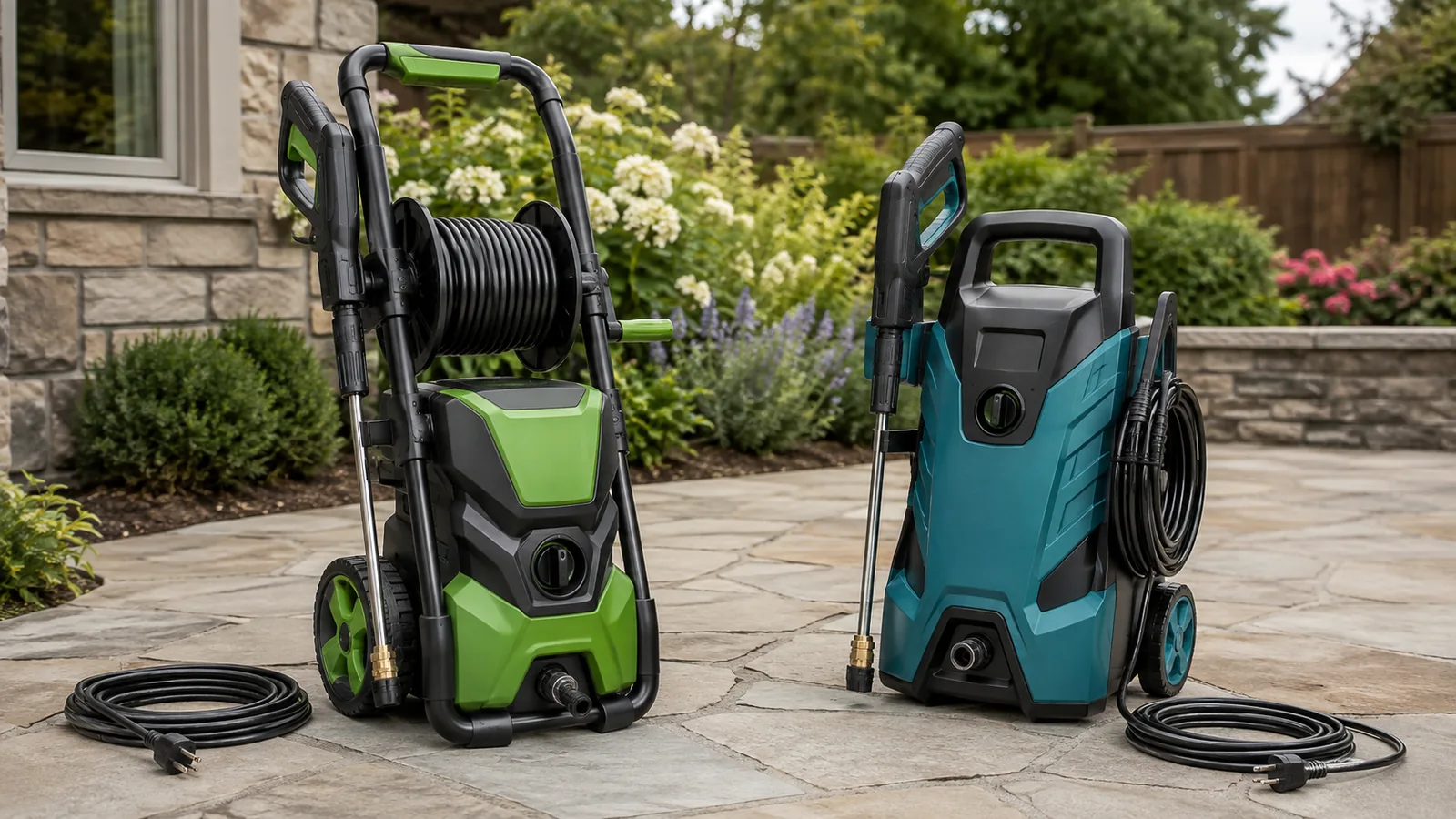
Performance: RYOBI’s top electric model (RY142300VNM) uses a brushless induction motor, delivering up to 2300 PSI at 1.2 GPM. In contrast, Sun Joe’s SPX3000 (a widely sold model with “thousands of 5-star reviews”) produces 2030 PSI at 1.76 GPM. In practice, RYOBI’s higher PSI helps strip stubborn grime (ideal for concrete and masonry), while Sun Joe’s higher GPM rinses surfaces faster (advantageous for larger areas or using detergents). FrediTech’s guide notes that Cleaning Units (PSI×GPM) both matter: e.g. a 2000 PSI × 2.5 GPM washer can clean more quickly than a 3000 PSI × 1.5 GPM unit, because the larger water volume removes dirt more efficientlyfreditech.com.
Warranty & Price: Sun Joe’s SPX3000 comes with a 2-year limited warranty. RYOBI typically offers a 3-year limited warranty on outdoor tools (standard for RYOBI) – though official RYOBI sources are sparse, it’s widely noted that RYOBI covers this kind of equipment for 3 years. In practice, RYOBI’s longer warranty reflects their positioning as a mid-range/pro-sumer brand. As for price, the SPX3000 retails around $169homedepot.com. The RY142300 is often in the $200–$250 range (depending on retailer and promotions).
Comparison: RYOBI RY142300 vs Sun Joe SPX3000
Feature | RYOBI RY142300 (Electric) | Sun Joe SPX3000 (Electric) |
Power | 2300 PSI @ 1.2 GPM (13A brushless motor) | 2030 PSI @ 1.76 GPM (14.5A / 1800W motor) |
Motor Type | Induction brushless (more efficient/durable) | Universal/induction (standard) |
Durability | Sturdy hand-truck frame for stability; longer life due to brushless motor | Total Stop System (TSS) pump saver; solid design (but less premium than Ryobi) |
Portability | Wheels + telescoping handle; 25′ hose, 35′ cord | Wheels + handle; 20′ hose, 35′ cord (plus 5 removable tips) |
Accessories | Includes 3 nozzles + Turbo nozzle (50% faster cleaning); 1-gal onboard soap | Includes 5 quick-connect spray tips (0°–40°+soap); dual 0.9L detergent tanks; (often foam cannon sold separately) |
Warranty | RYOBI 3-year limited (typical) | Sun Joe 2-year limited |
Price (approx.) | ~$200–$250 | $169 |
Gas Pressure Washers: RYOBI’s Edge
Sun Joe does not offer gas pressure washers – their brand focuses on electric models. By contrast, RYOBI has a full lineup of gas washers for tougher jobs. A notable example is the RYOBI RY80589, which uses a 212cc (7 HP) engine to deliver 3300 PSI at 2.4 GPMhomedepot.com. This model can tackle heavy-duty cleaning (concrete, heavy machinery, deck stripping) that electric units might struggle with. It features a large fuel tank (.95 gal) for extended runtime and an extended-reach hose nozzle for second-story windows. RYOBI’s gas washers are generally gas-engine reliable (often Honda-powered) with axial pumps, and come with a 3-year warranty.
Since Sun Joe doesn’t compete in this category, if you need a gas washer, RYOBI (or sister brand Westinghouse) is the way to go. RYOBI’s gas models are louder, heavier, and require maintenance (fuel, oil changes), but they give portable high PSI without outlets. For example, RY80589 is rated 2300–3300 PSI, far above any electric model. FrediTech’s overview explains that gas units typically start around 2500 PSI and are best for medium/heavy tasksfreditech.com. Thus for professional or large-scale use, RYOBI’s gas washers are superior; Sun Joe’s strengths remain in the electric, DIY space.
Home Use vs. Professional Use
Accessories, Maintenance & Ergonomics
Both brands offer a range of attachments. Internally, RYOBI has a pump protector kit and foam blaster available. Sun Joe has specialized foam cannons and extension wands. In operation, RYOBI’s brushless motor generates less heat and requires no carbon brush replacement, meaning less maintenance. Sun Joe’s induction motor is robust but includes carbon brushes, which could wear out in years of hard use.
Summary & Recommendation
Frequently Asked Questions
Which pressure washer is more powerful, RYOBI or Sun Joe?
Can I use a Sun Joe pressure washer professionally?
Does Sun Joe make gas pressure washers?
How many nozzles do these washers come with?
What about detergents and foam?
Which offers a better warranty?
Are Sun Joe pressure washers any good?
How do RYOBI and Sun Joe compare in value?
Can I connect accessories between brands?
How do I choose between PSI and GPM?
Is there a big difference in noise?
In summary, Sun Joe excels for light to medium home tasks at great value, while RYOBI shines for heavier jobs and professional use (especially if you need higher PSI or the freedom of gas power). Choose based on your cleaning needs: either way, you’re getting a top-selling model backed by clear specs and reputable brands.
Bottom Line
Choose a pressure washer by the surfaces you clean and how often you use it. Balanced cleaning units, safe technique, durable accessories and straightforward maintenance usually matter more than chasing the highest PSI number.