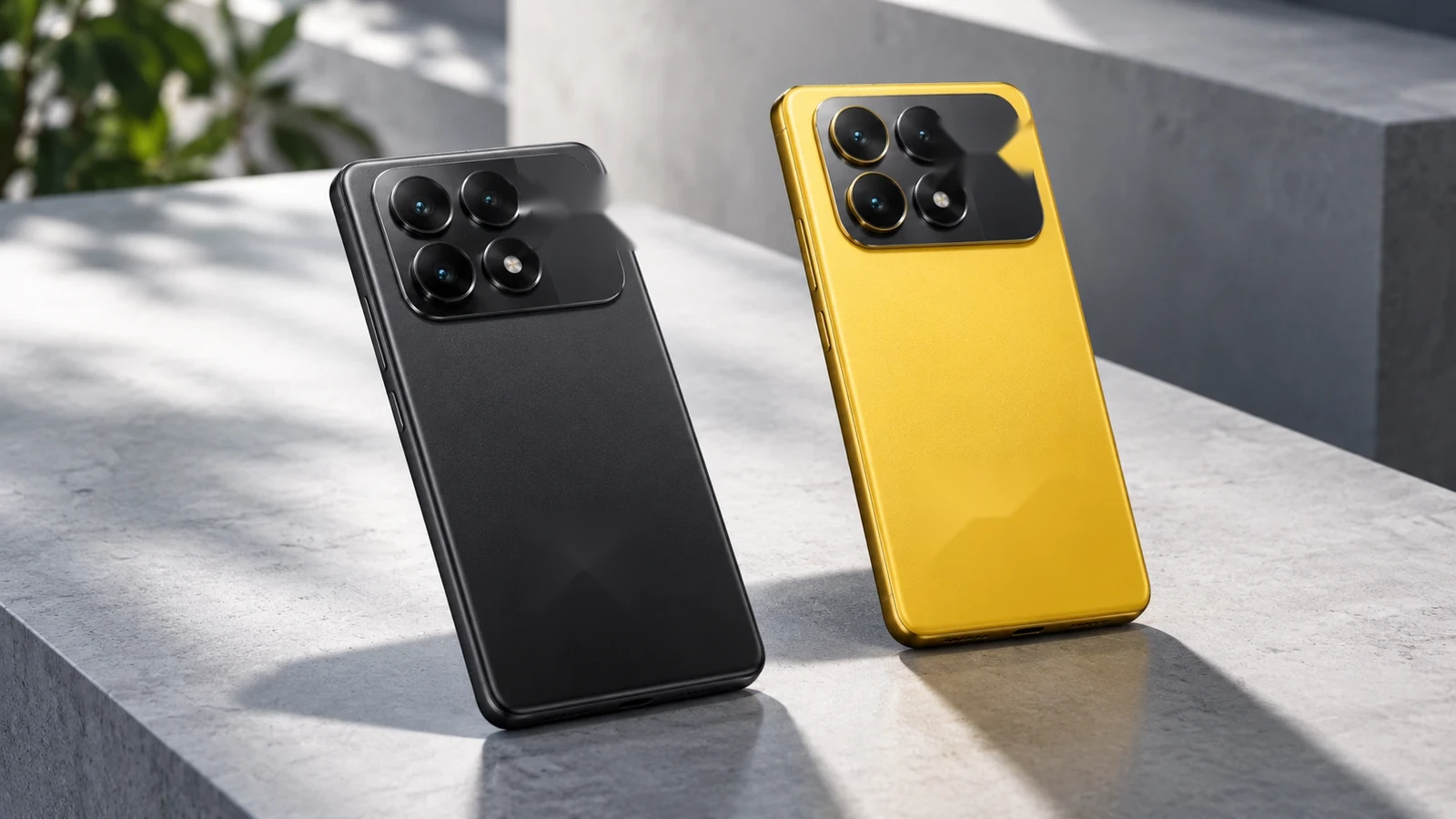

₹29,999 versus ₹35,999 is the real POCO X8 decision in India.
The regular POCO X8 already pushes battery capacity far beyond a typical mid-range phone with a 9,000mAh silicon-carbon cell and 67W charging. The X8 Power asks ₹6,000 more and increases that to 10,000mAh and 100W, while also moving to the newer Snapdragon 6 Gen 5, LPDDR5X memory and much faster storage on the 256GB configuration.
The Power is more than a battery upgrade, but the standard X8 still saves 20% at base price and already has an unusually large 9,000mAh cell.
Regional specs also differ. POCO’s global X8 page lists 8,340mAh and no adapter, while India gets 9,000mAh and launch material says a charger is supplied.
Table of contents
POCO X8 vs X8 Power at a Glance
| Feature | POCO X8 India | POCO X8 Power India |
|---|---|---|
| Starting price | ₹29,999 | ₹35,999 |
| Conditional effective price | ₹26,999* | ₹32,999* |
| Battery | 9,000mAh silicon-carbon | 10,000mAh silicon-carbon |
| Charging | 67W | 100W |
| Reverse charging | 22.5W | Up to 27W launch claim |
| Chipset | Snapdragon 6s Gen 4 | Snapdragon 6 Gen 5 |
| RAM | 6GB/8GB LPDDR4X | 8GB LPDDR5X |
| Storage | 128GB UFS 2.2 / 256GB UFS 3.1 | 128GB UFS 2.2 / 256GB UFS 4.1 |
| Display | 6.83″ 1.5K 120Hz AMOLED | 6.83″ 1.5K 120Hz AMOLED |
| Main camera | 50MP OIS | 50MP OIS |
| Second rear camera | 2MP depth | 8MP ultrawide |
| Selfie | 16MP | 32MP |
| Weight | about 223g | about 229g |
| Thickness | 8.60mm | 8.65mm |
| Software | Android 16 / HyperOS 3 | Android 16 / HyperOS 3 |
| Updates | 4 Android upgrades + 6 years security | 4 Android upgrades + 6 years security |
| Sale | Sept. 11, noon IST | Sept. 11, noon IST |
*Requires the qualifying launch promotion; not the normal list price.
India Prices, RAM and Storage Variants
The standard X8 has three India configurations:
| POCO X8 | Launch price |
|---|---|
| 6GB + 128GB | ₹29,999 |
| 8GB + 128GB | ₹32,999 |
| 8GB + 256GB | ₹35,999 |
The X8 Power is simpler:
| POCO X8 Power | Launch price |
|---|---|
| 8GB + 128GB | ₹35,999 |
| 8GB + 256GB | ₹38,999 |
A useful crossover appears at ₹35,999: it buys either X8 8/256 or X8 Power 8/128. That is effectively a choice between more storage and the Power’s larger battery, faster charging, newer chipset and better cameras.
Both go on sale through Flipkart on September 11 at 12:00 noon IST; broader offline availability was not clearly confirmed.
[CHECK POCO X8 PRICE ON FLIPKART]
[CHECK POCO X8 POWER PRICE ON FLIPKART]
Are ₹26,999 and ₹32,999 Real Prices?
Yes, but they are conditional effective prices, not the unconditional MRPs.
POCO’s India launch offer combines:
- a ₹2,000 coupon; and
- an additional ₹1,000 bank offer or exchange bonus.
That brings the X8 base model from ₹29,999 to ₹26,999 if the buyer qualifies, a ₹3,000 reduction of about 10%. The Power moves from ₹35,999 to ₹32,999, a reduction of about 8.3%.
Live Flipkart discounts can still vary by account, bank, exchange condition and pincode.
Is X8 Power Worth ₹6,000 More?
The gap stays ₹6,000 whether you compare the list prices or the stated conditional offer prices.
Relative to ₹29,999, ₹6,000 is almost exactly a 20% premium.
For that extra money, the X8 Power adds:
- 1,000mAh more battery capacity;
- 100W instead of 67W charging;
- Snapdragon 6 Gen 5 instead of Snapdragon 6s Gen 4;
- LPDDR5X instead of LPDDR4X;
- UFS 4.1 on the 256GB Power model instead of UFS 3.1;
- an 8MP ultrawide instead of a 2MP depth sensor;
- a 32MP selfie camera instead of 16MP;
- 4K video support in launch specifications.
The question is whether those upgrades matter when the normal X8 is already extremely battery-focused.
Battery: 9,000mAh vs 10,000mAh
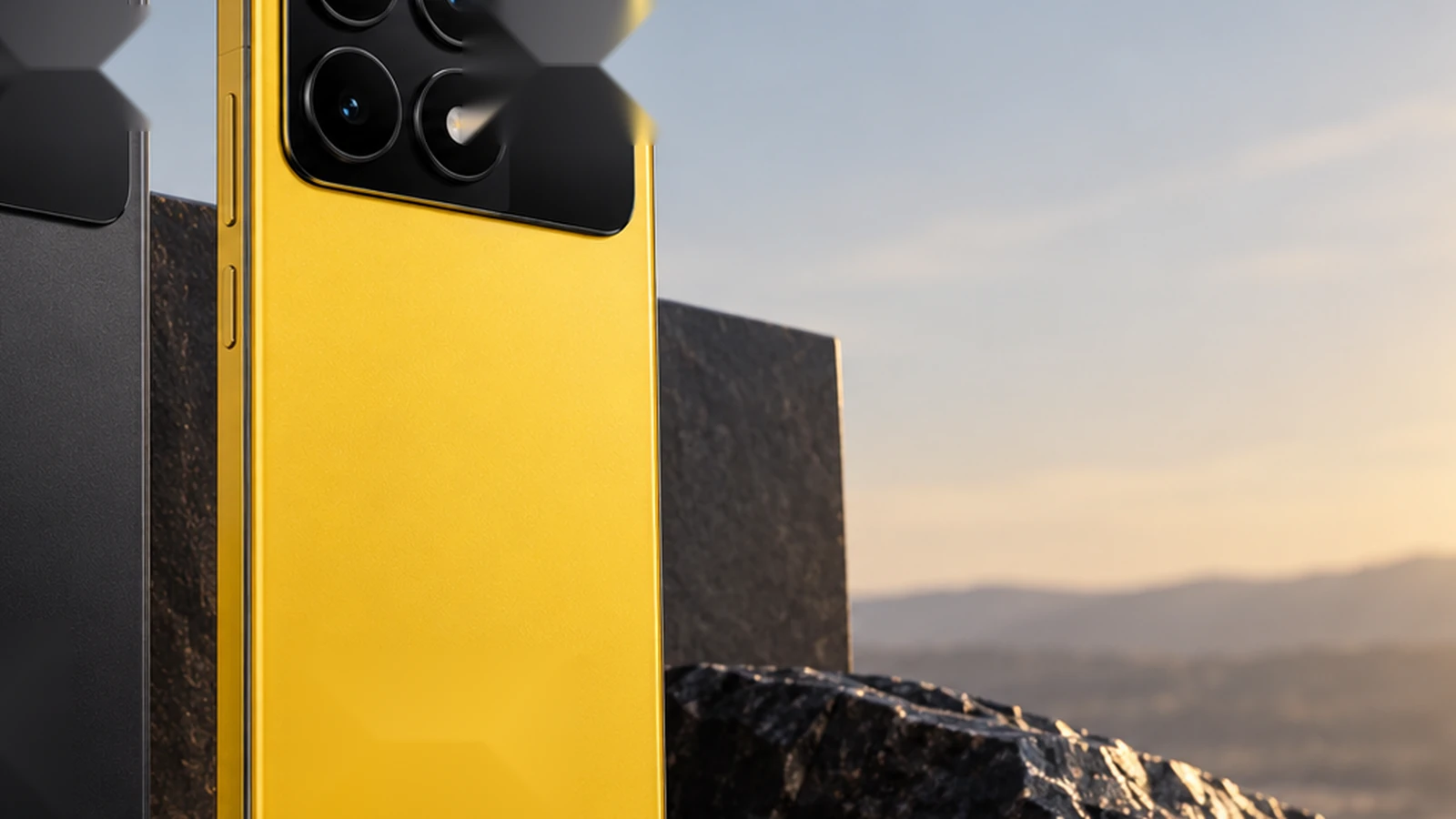
The X8 Power has 1,000mAh more nominal capacity, which is about 11.1% more than 9,000mAh.
That does not mean it will last 11.1% longer in every test. Endurance depends on display brightness, refresh behavior, modem efficiency, chipset load, camera use, background apps, signal strength and software tuning.
Both India models use silicon-carbon batteries. POCO also markets a six-year battery-health proposition; treat that as a controlled-test longevity claim, not a guarantee for every owner. The global X8 page claims at least 80% after 1,600 cycles, but FrediTech does not automatically apply every global lifecycle figure to the different-capacity Indian pack.
India vs Global POCO X8 Battery: 9,000mAh vs 8,340mAh
This is the biggest regional specification trap.
| Specification | X8 India | X8 Global |
|---|---|---|
| Battery | 9,000mAh | 8,340mAh |
| Difference | +660mAh | — |
| Charging | 67W | 67W |
| Reverse charging | 22.5W | 22.5W |
| Adapter | India launch material says included | Official global page says not included |
| RAM/storage | 6/128, 8/128, 8/256 | 6/128, 8/256, 12/256 |
India’s battery is 660mAh larger, about 7.9%. POCO has not publicly explained why, so do not invent a certification or supplier explanation. Check the country-specific listing before importing.
Does POCO X8 Include a Charger in India?
India launch coverage says the charger is supplied with the X8, and Flipkart’s Power listing identifies an adapter among the box contents.
The global X8 specification page, however, explicitly states no power adapter included.
Charger advice must therefore be regional. A generic “100W” USB-C adapter also does not automatically deliver POCO’s full proprietary rate.
67W vs 100W: Which Actually Charges Faster?
100W is a higher ceiling, not a direct charge-time percentage. The Power’s battery is also larger, and charging tapers as it fills. FrediTech did not find matched official 0–100% times, so independent testing is needed. POCO’s launch teaser also advertises bypass, PPS and smart charging; retail behavior should still be verified.
Snapdragon 6s Gen 4 vs Snapdragon 6 Gen 5
The standard X8’s Snapdragon 6s Gen 4 is a 4nm platform with four performance CPU cores running up to 2.4GHz and four efficiency cores up to 1.8GHz. Qualcomm lists a 5G modem, Adreno graphics and Quick Charge 4+ support at the platform level.
The X8 Power moves to the newer Snapdragon 6 Gen 5, also with a CPU ceiling of up to 2.6GHz. Qualcomm adds newer gaming and connectivity capabilities at the chipset level, including Adaptive Performance features, Game Super Resolution, Release 17 5G and support for Wi-Fi 7/Bluetooth 6.
Chip capabilities should not be confused with the phone’s implementation: India launch summaries list Wi-Fi 5, for example. Qualcomm’s percentage claims also are not a direct X8 Power-versus-X8 benchmark, so FrediTech does not invent a performance gap.
For a deeper explanation of why chipset, storage and thermal behavior matter more than one benchmark number, see FrediTech’s smartphone performance metrics guide.
LPDDR5X and UFS 4.1: The Power Advantage Has a Catch
The X8 Power uses LPDDR5X RAM, while the X8 uses LPDDR4X. Faster memory can improve bandwidth and efficiency in heavier workloads.
Storage is more nuanced:
- X8 128GB: UFS 2.2
- X8 256GB: UFS 3.1
- X8 Power 128GB: UFS 2.2
- X8 Power 256GB: UFS 4.1
So the ₹35,999 base Power does not give you UFS 4.1 according to the India launch specification. You need the ₹38,999 256GB model for the fastest storage.
That is one of the most important buying details in the entire comparison.
Displays: Mostly a Tie
Both phones use large 6.83-inch 1.5K AMOLED panels with up to 120Hz refresh, high-frequency PWM dimming, Gorilla Glass Victus 2 and launch material quoting up to 3,500 nits peak brightness.
POCO also promotes Dolby Vision/Dolby Atmos in India. On paper, the display is not a reason by itself to pay more; calibration and sustained brightness still need testing.
Cameras: Power Does Get a Better Setup
Unlike some “Power” phones, the more expensive model is not simply the same camera system plus a larger battery.
The X8 has:
- 50MP main camera with OIS;
- 2MP depth camera;
- 16MP selfie camera;
- launch specifications centered on 1080p video.
The Power has:
- 50MP OIS main camera;
- 8MP ultrawide;
- 32MP selfie camera;
- 4K video support reported for front and rear.
That makes the Power more versatile on paper, though processing, stabilization and low light still need testing.
Size, Weight and Durability
Despite the extra 1,000mAh, the Power is only slightly larger on paper:
| Model | Battery | Thickness | Weight |
|---|---|---|---|
| X8 | 9,000mAh | 8.60mm | ~223g |
| X8 Power | 10,000mAh | 8.65mm | ~229g |
The 6g and 0.05mm differences are small, though neither phone is compact: both pair a 6.83-inch screen with weight above 220g.
Both India models are marketed with IP66, IP68, IP69 and IP69K ratings. These are laboratory ingress ratings, not permission to intentionally use the phone underwater or assume liquid damage is covered by warranty.
Software, Updates and Connectivity
Both launch with Android 16-based HyperOS 3. POCO promises four Android OS upgrades and six years of security updates, a meaningful commitment for this price class.
Both use dual nano-SIM and 5G. Exact Indian 5G band lists should be checked on the final regional listing; do not substitute the global band’s matrix automatically.
Launch specifications list stereo speakers with Dolby Atmos and in-display fingerprint readers. Neither phone is positioned around a 3.5mm headphone jack; USB-C audio is the safer assumption from the published X8 specification.
NFC support for the exact Indian models was not consistently documented across the launch sources checked, so FrediTech does not present it as confirmed.
Competitor Context: Battery Is Not the Only Value Metric
At ₹35,999–₹38,999, the X8 Power enters territory where some competitors prioritize performance more aggressively.
| Phone | Current India price reference | Chip | Battery | Charging | Storage focus |
|---|---|---|---|---|---|
| POCO X8 | ₹29,999 | Snapdragon 6s Gen 4 | 9,000mAh | 67W | Up to UFS 3.1 |
| POCO X8 Power | ₹35,999 | Snapdragon 6 Gen 5 | 10,000mAh | 100W | UFS 4.1 only on 256GB |
| OnePlus Nord CE6 | ~₹35,699 for 8/256 before some bank promos | Snapdragon 7s Gen 4 | 8,000mAh | 80W | UFS 3.1 |
| POCO X8 Pro | ₹39,999 for 8/256 on Flipkart when checked | Dimensity 8500-Ultra | 6,500mAh | 100W | UFS 4.1 |
The OnePlus Nord CE6 pairs Snapdragon 7s Gen 4, 8,000mAh and 80W around similar money. Meanwhile, the X8 Pro 8/256 at ₹39,999 sits only ₹1,000 above X8 Power 8/256, so gamers should compare sustained performance rather than battery size alone.
FrediTech’s POCO F9 Ultra vs F9 Pro comparison is another useful example of how POCO’s bigger-battery models can trade differently against performance-focused siblings.
Which POCO X8 Should You Buy?
Buy the POCO X8 if:
- ₹29,999 is already near your budget ceiling;
- you want exceptional battery capacity without paying for the maximum;
- 67W charging is fast enough;
- you do not need an ultrawide camera;
- LPDDR4X/UFS 3.1 at 256GB is acceptable;
- saving ₹6,000 matters more than the performance uplift.
Buy the POCO X8 Power if:
- you use navigation, hotspot, video or gaming heavily;
- you value the largest possible battery reserve;
- 100W charging matters;
- you want the ultrawide and 32MP selfie camera;
- you want LPDDR5X;
- you are willing to buy the 256GB version to get UFS 4.1.
Skip both if:
You want a compact phone, telephoto-focused camera system or maximum gaming performance per rupee.
FrediTech Early Take
Best value: POCO X8. A 9,000mAh battery at ₹29,999 is already the central value story.
Best for maximum endurance: POCO X8 Power.
Best charging: X8 Power at 100W.
Best storage performance: X8 Power 256GB, because the 128GB model uses UFS 2.2 rather than UFS 4.1.
Best camera hardware: X8 Power, thanks to the ultrawide, stronger selfie specification and 4K support.
Most important warning: Indian and global X8 specifications are not identical.
What Independent Testing Still Needs to Verify
- real battery life for both models;
- 0–50% and 0–100% charging times;
- charging and gaming temperatures;
- Snapdragon sustained performance;
- UFS 4.1 real transfer speeds;
- display brightness and PWM behavior;
- camera processing and stabilization;
- 5G endurance and standby drain;
- HyperOS background behavior;
- long-term battery degradation.
Frequently Asked Questions
What is the POCO X8 price in India?
It starts at ₹29,999 for 6GB/128GB.
What is the POCO X8 Power price in India?
₹35,999 for 8/128 and ₹38,999 for 8/256.
Are ₹26,999 and ₹32,999 normal prices?
No. They are conditional effective launch prices using the stated coupon plus an eligible bank offer or exchange bonus.
When do the phones go on sale?
September 11, 2026 at 12:00 noon IST through Flipkart.
Does X8 Power really have 10,000mAh?
Yes, POCO India confirmed a 10,000mAh silicon-carbon battery.
Why does the global X8 show only 8,340mAh?
The global model has a different regional battery specification. POCO has not publicly explained the reason for the difference.
Does the Indian X8 include a charger?
India launch coverage says a charger is included; the global page explicitly says no adapter is included.
Which phone has UFS 4.1?
Only the 256GB X8 Power configuration is listed with UFS 4.1. The 128GB Power uses UFS 2.2.
Which chipset is faster?
X8 Power has the newer Snapdragon 6 Gen 5, but the real gap needs matched testing.
Is X8 Power worth ₹6,000 more?
Yes for heavy users who value 100W charging, the extra battery, better cameras and faster 256GB storage. For most value-focused buyers, the standard X8 is likely the better deal.
Which has better battery life?
The Power has more capacity, but the exact endurance gap cannot be calculated from mAh alone. Independent matched-use testing is still needed.