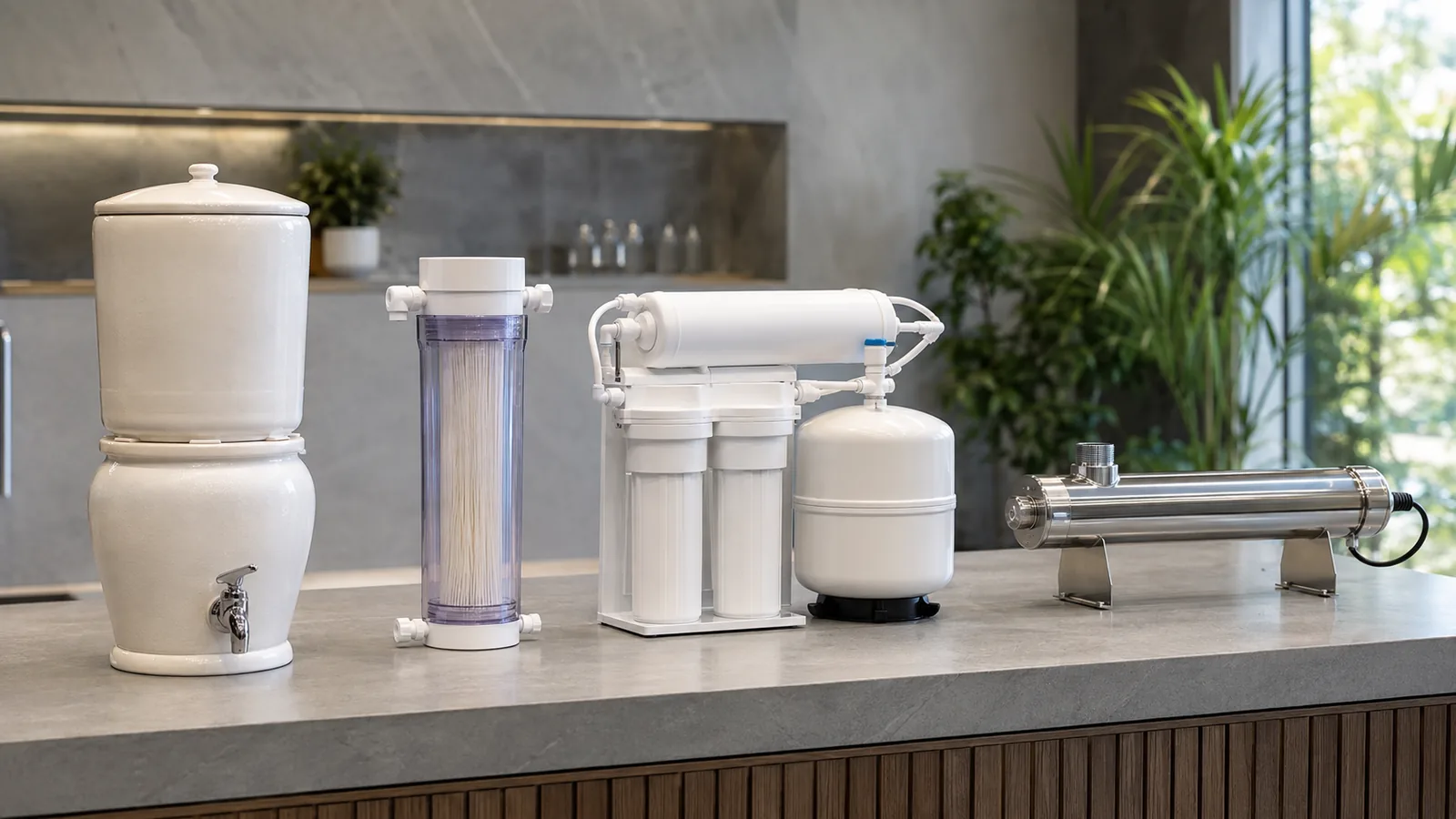

The right filtration technology depends on the water problem you are trying to solve. Activated carbon, reverse osmosis, ultraviolet treatment, softening and sediment filtration address different concerns, so a useful comparison starts with water quality and specific certified reduction claims—not a generic promise that one system removes everything.
Primary reference: authoritative guidance/source.
Quick Verdict
- Best approach: identify the water-quality problem first, then match the treatment technology to it.
- What matters most: the applicable NSF/ANSI standard, specific contaminant claims, flow rate, maintenance and replacement cost.
- Key caution: certification to one standard does not mean a system is certified to reduce every possible contaminant.
Table of contents
Introduction: The Global Drive for Water Security and Purity
Across the globe, the purity of our drinking water is facing unprecedented challenges. Aging infrastructure in established cities, the rise of “emerging contaminants” like PFAS and microplastics, and widespread industrial and agricultural pollution threaten water sources on every continent. This has fueled a global reliance on bottled water, creating a secondary crisis of plastic waste and environmental strain.
As we look to 2025 and beyond, the demand for effective, sustainable, and accessible water purification has spurred remarkable innovation. A new generation of filtration technologies is moving beyond the status quo, offering intelligent, powerful, and environmentally conscious solutions. These advancements hold the key to enhancing water security for households, communities, and industries worldwide.
This comprehensive guide explores the top water filtration technologies set to redefine the landscape by 2025. We will delve into the science behind each innovation, explore their real-world applications across diverse global contexts, and reveal how they are paving the way for a safer, more sustainable water future.

1. Reverse Osmosis (RO) Gets Smarter: The Rise of IoT-Enabled Purification
What It Is: For decades, Reverse Osmosis has been the benchmark for high-intensity water purification. It utilizes high pressure to force water through an ultra-fine, semi-permeable membrane, which can remove up to 99% of all contaminants. This includes salts, viruses, chemicals like chlorine, and heavy metals such as lead.
The 2025 Leap: The evolution of RO lies in its integration with smart technology. By incorporating the Internet of Things (IoT), modern smart RO systems now feature advanced sensors that continuously track water quality (like Total Dissolved Solids or TDS levels) and system performance in real time, relaying this data to a user’s smartphone.
Real-World Applications & Future Scope: In the residential space, smart RO systems are becoming a staple in high-tech smart homes, offering users push notifications for filter changes and detailed water quality reports. Commercially, they are invaluable for restaurants, cafes, and laboratories that require water of a consistently high purity. On a community level, they can power decentralized water vending kiosks in water-stressed urban areas, providing a reliable and affordable alternative to bottled water.
Key Advantages:
- Real-Time Quality Assurance: Provides users with instant data on their water’s purity.
- Predictive Maintenance: Uses AI to forecast filter lifespan based on actual usage, optimizing performance and reducing waste.
- Remote Management: Allows for monitoring and control of the system from anywhere via a mobile app.
Current Hurdles: These systems carry a higher initial cost and require a stable electricity supply to operate the pumps and electronics, making them best suited for areas with reliable power grids.
2. UV-C LED Systems: Chemical-Free, Point-of-Use Disinfection
What It Is: Ultraviolet (UV) light at the C-spectrum wavelength (UV-C, typically 254 nm) serves as a powerful germicide. It works by penetrating the cell walls of microorganisms—including bacteria, viruses, and protozoa—and scrambling their DNA, rendering them harmless and unable to replicate.
The 2025 Leap: The industry is rapidly shifting from traditional mercury-vapor UV lamps to UV-C LED technology. These solid-state light sources are more durable, mercury-free, energy-efficient, and offer instant on-off capabilities. For detailed information on UV disinfection principles, the International Ultraviolet Association (IUVA) is a leading authority.
Real-World Applications & Future Scope: The compact nature of UV-C LEDs has opened up a world of applications. They are being integrated directly into “smart” water bottles for hikers and travelers, into home faucets for on-demand disinfection, and into portable units for disaster relief and remote medical clinics. For households on municipal water who are confident in its mineral content but wary of potential microbiological contaminants, a UV-C LED system is the perfect final-barrier solution.
Key Advantages:
- Eco-Friendly: Contains no hazardous mercury and consumes less power.
- Instant and Effective: Disinfects water on-demand without altering its taste, pH, or chemical composition.
- Versatile and Compact: The small size of LEDs allows for integration into a wide array of devices.
Current Hurdles: UV is a disinfection technology, not a filtration one. It does not remove sediment, chemicals, or heavy metals, so it must be paired with pre-filters when used with turbid or chemically contaminated water sources.
3. Graphene Filters: The “Miracle Material” Revolution
What It Is: Graphene, a single layer of carbon atoms arranged in a 2D honeycomb lattice, is lauded for its extraordinary properties. It is incredibly lightweight, yet stronger than diamond, and when formed into a membrane, it creates a near-perfect molecular sieve.
The 2025 Leap: Long confined to research labs, graphene-based filtration is now on the cusp of commercialization. New manufacturing techniques are making it possible to create graphene oxide membranes that allow water molecules to pass through rapidly while physically blocking nearly all other contaminants. Scientific journals like Nature regularly publish cutting-edge research on these advancements.
Real-World Applications & Future Scope: The potential applications are vast. Graphene membranes could enable highly efficient, low-energy desalination plants for drought-stricken coastal cities. In industry, they could be used to treat and recycle challenging wastewater streams. For consumers, this technology could lead to portable purifiers that can turn nearly any water source into potable water instantly, a game-changer for military, disaster response, and outdoor adventure use.
Key Advantages:
- Ultimate Filtration: Can block even the smallest contaminants at a molecular level.
- Exceptional Efficiency: Requires far less energy than traditional RO due to its high permeability to water.
- Robust and Durable: Highly resistant to clogging and chemical degradation.
Current Hurdles: The primary obstacle remains the high cost and complexity of producing large, defect-free graphene sheets, though rapid progress is being made.
4. Enhanced Ceramic Filters: Simple, Robust, and Reliable
What It Is: Ceramic filtration is a centuries-old technology that uses the microscopic pores in fired clay to physically trap sediment, protozoa, and bacteria from water.
The 2025 Leap: Contemporary ceramic filters are far more advanced than their predecessors. They are often infused with other materials to boost their performance. Colloidal silver is commonly incorporated to provide self-sterilizing properties, while activated carbon can be mixed into the ceramic matrix to adsorb chemicals and improve water taste and odor.
Real-World Applications & Future Scope: This technology’s strength lies in its simplicity and reliability. In developed countries, enhanced ceramic filters are a popular component of emergency preparedness kits for events like hurricanes or earthquakes. For developing regions and off-grid communities, they represent a life-saving, low-cost solution for daily water treatment, effectively reducing the incidence of waterborne diseases.
Key Advantages:
- Affordable and Accessible: Relatively inexpensive to produce and maintain.
- No Electricity Required: Operates entirely on gravity, making it universally applicable.
- Proven Pathogen Removal: Highly effective against common bacterial and protozoan threats.
Current Hurdles: The filtration rate is slow, and standard ceramic filters are not effective against viruses or dissolved chemical contaminants unless specifically enhanced.
5. Membrane Distillation (MD): Harnessing Thermal Energy for Purity
What It Is: MD is an innovative, thermally-driven separation process. It works by creating a temperature difference across a hydrophobic (water-repelling) membrane. Water vapor from a heated, contaminated feed solution passes through the membrane’s pores and condenses into ultra-pure water on the cooler side, leaving salts and non-volatile contaminants behind.
The 2025 Leap: The key innovation is the ability to power MD with low-grade or waste heat (below 100°C), including heat from industrial processes or, most promisingly, from solar thermal collectors. This makes it far more energy-efficient than traditional distillation.
Real-World Applications & Future Scope: MD is uniquely suited for treating highly challenging water sources, such as industrial brine, textile industry effluent, or water with extremely high salinity that would damage an RO system. For coastal regions facing severe water scarcity, solar-powered MD plants offer a sustainable path to desalination.
Key Advantages:
- Treats High-Salinity Water: Can purify water with contaminant loads far beyond the range of RO.
- Energy-Efficient: Can run on waste heat or solar thermal energy.
- Produces Ultra-Pure Water: The output is essentially distilled water.
Current Hurdles: Membrane fouling (clogging) and wetting can be issues, and the technology is currently better suited for industrial or community-scale applications rather than individual home use.
6. Bio-Inspired Filtration: Nature’s Engineering, Perfected
What It Is: This exciting field, also known as biomimicry, seeks to emulate the highly efficient filtration mechanisms found in nature. A key focus is on aquaporins—specialized proteins in cell membranes that transport water molecules with perfect selectivity and incredible speed.
The 2025 Leap: After years of research, the first commercial-scale aquaporin-based membranes are emerging. These biomimetic filters embed aquaporin proteins into a synthetic membrane, creating a barrier that combines the high rejection rate of RO with a much faster flow rate and lower energy requirement.
Real-World Applications & Future Scope: This technology could disrupt both industrial and consumer markets. It promises to make large-scale desalination more energy-efficient and could be used to produce ultra-pure water for the semiconductor and pharmaceutical industries. For consumers, it could lead to household systems that purify water faster and with less waste than current RO systems.
Key Advantages:
- Exceptional Selectivity and Speed: Leverages biology’s billions of years of R&D for near-perfect filtration.
- Superior Energy Efficiency: Requires less pressure (and thus less energy) than conventional RO.
Current Hurdles: Manufacturing stable, long-lasting aquaporin membranes at an industrial scale and competitive cost remains the primary challenge.
7. Solar-Powered Desalination Systems: Direct Sunlight to Drinking Water
What It Is: This broad category includes any desalination technology powered directly and sustainably by the sun. This ranges from simple solar stills to complex, containerized systems that use photovoltaic (PV) solar panels to power Reverse Osmosis (SolarRO).
The 2025 Leap: The focus is on creating modular, decentralized systems. Instead of building massive, centralized plants, companies are developing containerized “water factories” that can be shipped and deployed quickly to a specific location. Advances in solar panel efficiency and battery storage are making these systems more reliable and cost-effective than ever.
Real-World Applications & Future Scope: Solar-powered desalination is a lifeline for remote island nations, arid coastal regions (like parts of Australia, the Middle East, and South America), and off-grid establishments like sustainable tourist resorts. These systems provide true water independence, free from the constraints of the electrical grid and the price volatility of fossil fuels.
Key Advantages:
- Fully Sustainable: A renewable process with a minimal carbon footprint during operation.
- Decentralized and Resilient: Provides water security in remote or disaster-stricken areas.
Current Hurdles: The technology involves a high upfront capital investment and, for 24/7 operation, requires significant battery storage, which adds to the cost and complexity.
Frequently Asked Questions (FAQs)
What is the most effective technology for removing PFAS and microplastics?
Reverse Osmosis (RO) is currently the most effective and widely available technology for removing both PFAS and microplastics. Emerging Graphene filters also show immense promise for this application due to their ability to block contaminants at the molecular level.
What is the difference between a water “filter” and a “purifier”?
In technical terms (as defined by agencies like the EPA), a filter reduces contaminants, while a purifier must remove a specific high percentage of all classes of microorganisms (bacteria, viruses, and protozoa). Technologies like UV and properly functioning Berkey systems are considered purifiers, while most carbon-based pitchers are filters.
How can I find out what contaminants are in my local tap water?
Most municipal water providers in developed countries are required to provide an annual water quality report (sometimes called a Consumer Confidence Report). You can typically find this on your local utility’s website. For more detailed, independent analysis, you can use a home water test kit or consult databases from non-profit organizations.
Will these advanced technologies make bottled water obsolete?
While bottled water offers convenience, these technologies make it increasingly unnecessary from a quality standpoint. Point-of-use systems like Smart RO or UV-C-enabled faucets can provide water of equal or superior purity at a fraction of the long-term cost and without the environmental impact of single-use plastics.
Which filtration technology is the most sustainable or eco-friendly?
This depends on the definition. Gravity-fed systems (like Ceramic or Berkey) are highly sustainable due to their lack of electricity needs. Solar-powered systems are sustainable from a carbon footprint perspective. Technologies like UV-C LED are eco-friendly because they are mercury-free and energy-efficient. Overall, any system that reduces reliance on single-use plastic bottles is a major step toward sustainability.
Conclusion: A Global Toolkit for a Water-Secure Future
The advancement of water filtration technology is a powerful response to one of the most pressing global challenges of our time. From intelligent home systems that provide ultimate peace of mind to robust, off-grid solutions that bring safety to the world’s most vulnerable, innovation is creating a diverse and powerful toolkit. As we move towards 2025, these technologies will play an instrumental role in shifting the global paradigm from water scarcity and contamination to one of security, purity, and sustainability.
Related Articles:
- Best Reverse Osmosis Systems for 2025
- How to Maintain Your Water Purification System
- How Reverse Osmosis Works: A Comprehensive Guide
- Top Countertop Water Filtration Systems in 2025
Affiliate Disclosure: This article may contain affiliate links. If you purchase through these links, we may earn a commission at no extra cost to you.
Bottom Line
Water treatment works best when the decision starts with the source water. Identify the problem, verify the relevant certification and contaminant claims, and include maintenance and replacement costs in the purchase decision.