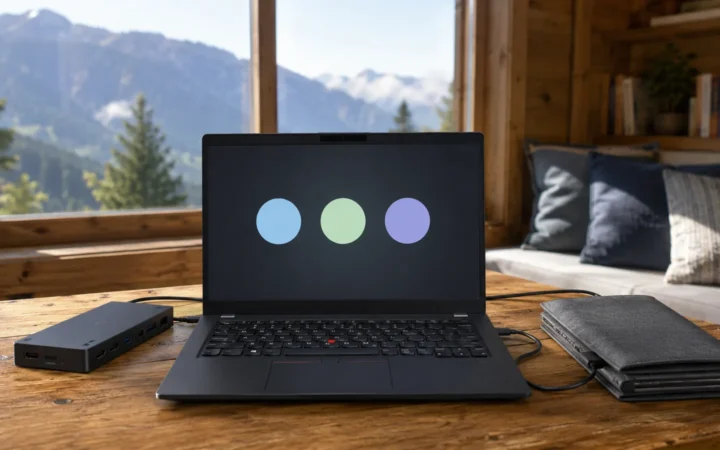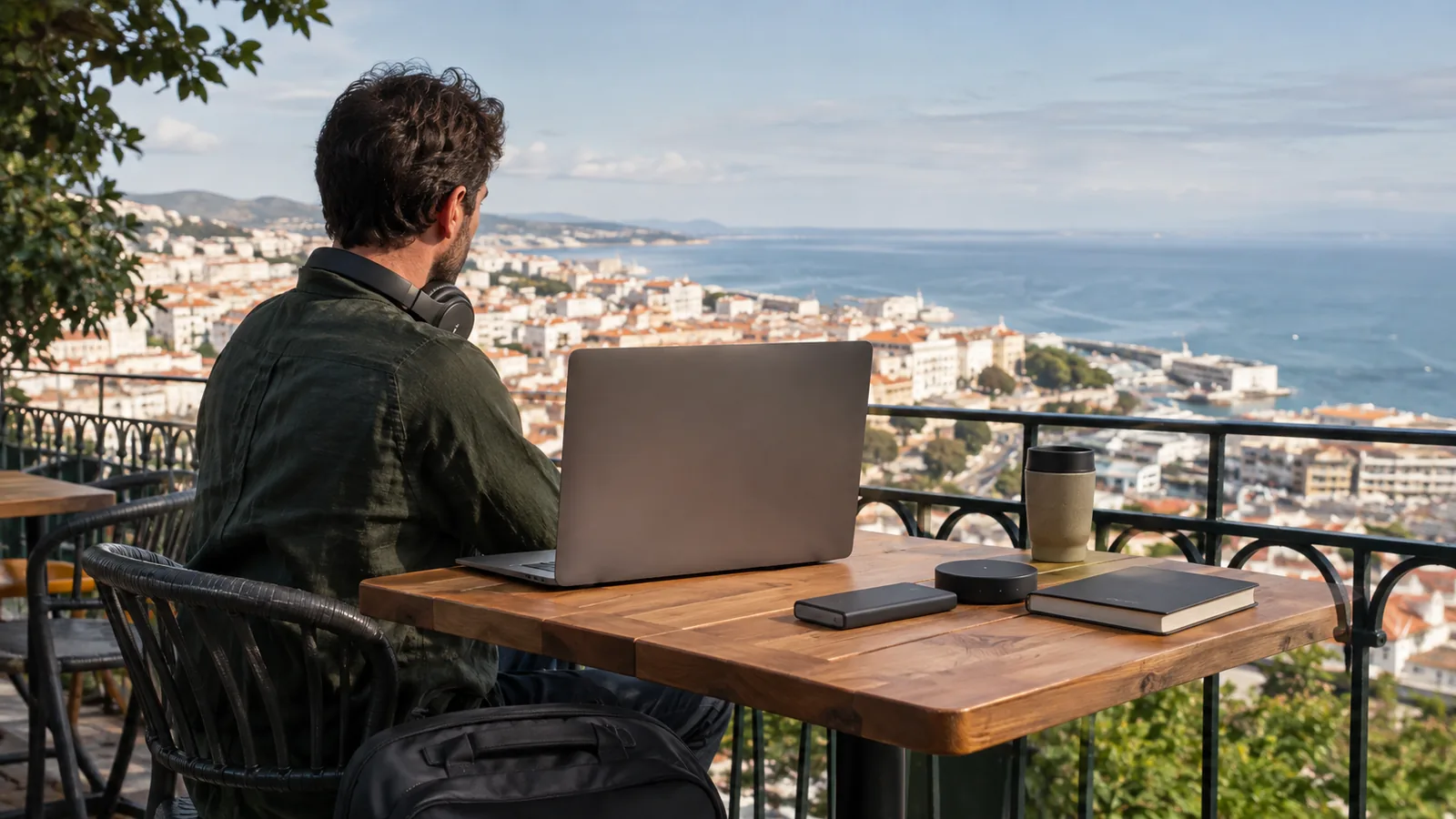

Digital-nomad productivity depends on reducing friction across travel, connectivity, files, meetings and focused work. The best systems are portable, secure and easy to recover when a device, network or schedule fails.
Quick Verdict
- Best for: readers who want simpler systems that reduce friction.
- Focus on: priorities, integration, focus, portability and repeatable workflows.
- Watch for: adding more apps and automation can create more overhead than it removes.
Table of contents
The Digital Nomad’s Dilemma: Drowning in Freedom, Starving for Focus
The life of a digital nomad is the modern-day dream. Swapping a cramped cubicle for a beachfront cafe in Bali, a bustling co-working space in Lisbon, or a quiet mountain cabin in the Alps is an unparalleled expression of freedom. You’ve escaped the 9-to-5 grind, the soul-crushing commute, and the beige office walls. But with this incredible liberty comes a hidden challenge that can quietly sabotage the entire lifestyle: the productivity paradox.
When your office can be anywhere, it can sometimes feel like your focus is nowhere. The constant allure of new sights, the logistical challenges of travel, and the lack of a traditional work structure can conspire to derail your output. It’s a significant struggle; a 2024 survey by Buffer on the State of Remote Work revealed that “staying motivated” and “unplugging after work” are two of the top challenges for remote workers.
The dream isn’t just to travel—it’s to build a sustainable career that funds that travel. This requires discipline, strategy, and a set of tools designed for a workforce in motion. It’s about creating structure in a life defined by its lack of it.
This guide is your blueprint for mastering that balance. We will dive deep into actionable, field-tested productivity hacks for digital nomads, moving beyond generic advice to provide a comprehensive framework for staying focused, efficient, and successful, no matter where your laptop is. From structuring your day across time zones to building a portable “deep work” sanctuary, you’ll learn how to make freedom your greatest asset, not your biggest distraction.

The Foundation: Building a Routine Without Walls
The single most important factor for sustained productivity on the road is creating a consistent routine. In the absence of a boss telling you when to start or an office to clock into, you must become the architect of your own structure. This isn’t about rigidity; it’s about creating a mental framework that signals to your brain when it’s time to work and when it’s time to explore.
1. The “Anchor” Habit: Your Non-Negotiable Start
Every productive day starts with a single, consistent action. This “anchor habit” is a non-negotiable ritual that you perform every morning, regardless of your location or time zone. It stabilizes your day before the chaos of travel and work can intervene.
Step-by-Step Implementation:
- Choose Your Anchor: Select a simple, enjoyable activity. It could be a 15-minute meditation session using an app like Calm or Headspace, a quick bodyweight workout, journaling for ten minutes, or simply brewing and enjoying a cup of coffee without checking your phone.
- Make it Location-Independent: The activity should require minimal equipment and be doable anywhere—a hotel room, an Airbnb, or a hostel.
- Execute Immediately Upon Waking: Don’t let your email or social media be the first thing you see. Your anchor habit comes first, creating a proactive, rather than reactive, start to your day.
- Real-World Example: Sarah, a freelance graphic designer traveling through Southeast Asia, starts every day with a 20-minute yoga session she follows on YouTube. She says, “It doesn’t matter if I’m in a high-rise in Bangkok or a bungalow in Koh Lanta. That 20 minutes centers me and tells my brain, ‘The day has officially begun.'”
2. Time Blocking and Themed Days
Time blocking is a powerful technique where you schedule your day in advance, dedicating specific blocks of time to specific tasks. For digital nomads, this can be supercharged by theming your days.
How it Works:
- Micro-Level (Time Blocking): Instead of a vague to-do list, your calendar might look like this: 9 AM – 11 AM: Deep work on Project X. 11 AM – 11:30 AM: Client communication. 11:30 AM – 1 PM: Writing blog posts. This fights procrastination by defining not just what you have to do, but when.
- Macro-Level (Themed Days): Assign a theme to each workday. For example: Monday is for “Client Work,” Tuesday is for “Marketing and Content Creation,” Wednesday is for “Admin and Finance,” and so on. This helps you batch similar tasks, reducing the mental friction of context switching.
- Expert Source: Cal Newport, author of “Deep Work,” is a major proponent of time blocking, arguing that it allows for more focused, high-value output by treating your time as a finite, precious resource.
3. The Shutdown Ritual: Reclaiming Your “Off” Switch
One of the biggest struggles for digital nomads is separating work from life when your laptop is always with you. A “shutdown ritual” is a consistent set of actions you take at the end of your workday to signal that work is over.
- Step-by-Step Guide:
- Review and Plan: Spend the last 15 minutes of your workday reviewing what you accomplished and creating a clear plan for tomorrow. This prevents work thoughts from creeping into your evening.
- Organize Your Digital Space: Close all work-related tabs and applications.
- Say a “Completion Phrase”: Verbally say a phrase like “Shutdown complete.” It sounds silly, but as confirmed by behavioral psychology, this verbal cue helps solidify the transition in your mind.
- Put Away Your Tools: Physically put your laptop in its bag and out of sight. This is the most critical step. If it’s out, it’s a temptation.
The Workspace: Engineering Your “Deep Work” Sanctuary Anywhere
Your environment has a profound impact on your ability to focus. While you can’t always control the noise level of a cafe, you can build a portable “productivity bubble” with the right gear and strategies.
1. The Holy Trinity of Nomad Gear: Noise, Power, and Connectivity
Your ability to work hinges on these three factors. Investing in quality gear is not a luxury; it’s a necessity.
- Noise-Cancelling Headphones: This is the #1 productivity tool for any digital nomad. Brands like Sony (WH-1000XM series) or Bose (QuietComfort series) can instantly transform a noisy cafe into a private office. They are your shield against distractions.
- Portable Power Bank: Never let a dead battery dictate your workday. A high-capacity power bank ensures you can work from a park, a beach, or a cafe with no outlets.
- Global Wi-Fi Hotspot: Relying on questionable public Wi-Fi is a recipe for frustration. A personal hotspot device (like a Solis or a local SIM-powered hotspot) provides secure, reliable internet wherever you go. For more on staying safe online, check out our guide on Digital Identity Security.
2. The Art of the “Third Space”
Your Airbnb can be distracting, filled with chores or the temptation to relax. A cafe can be too loud. The solution is finding a dedicated “third space” for work.
- Co-working Spaces: The gold standard. They offer reliable internet, an ergonomic setup, and a community of like-minded professionals. Use resources like to find spaces in your city. The cost is often easily justified by the increase in productivity.
- Libraries: An underrated gem. They are free, quiet, and usually have decent Wi-Fi.
- “Work-Friendly” Cafes: Use apps like Workfrom to find cafes that are known to be friendly to laptop workers, with plenty of outlets and a culture of focus.
3. Digital Minimalism: Declutter Your Virtual Desktop
A cluttered digital workspace is just as distracting as a cluttered physical one.
- One Task, One Window: When you’re working on a specific task, close all unrelated tabs and applications. Use browser extensions like OneTab to save tab groups for later.
- Organize Your Files: Use a logical cloud-based filing system (like Google Drive or Dropbox) with a clear folder structure. A messy desktop drains mental energy.
- Silence Notifications: Turn off all non-essential notifications on your laptop and phone during work blocks. Every pop-up and buzz is a “context switch” that shatters your focus. A study from the University of California, Irvine, found that it can take over 23 minutes to get back on track after being interrupted.
The Tools: Leveraging Technology for Maximum Efficiency
The right software stack can automate tasks, streamline communication, and keep you organized across continents and time zones.
1. Project Management and Task Organization
These tools are your central nervous system for work.
Top Tools:
- Notion: Incredibly versatile for task management, note-taking, and creating a personal wiki.
- Asana/Trello: Excellent for visual project management, especially when collaborating with clients or teams.
- Todoist: A simple yet powerful to-do list app that uses natural language processing to quickly set tasks and reminders.
2. Asynchronous Communication Mastery
When your team and clients are scattered across the globe, mastering asynchronous (“async”) communication is key. It’s about communicating effectively without needing an immediate response.
- Best Practices:
- Over-Communicate with Clarity: In your messages (via Slack, email, etc.), provide all the context someone needs to respond without asking follow-up questions.
- Use Loom for Screen Recordings: Instead of a long email or scheduling a meeting, record a quick video of your screen and your voice to explain a concept or give feedback. It’s faster and clearer.
- Respect Time Zones: Use tools like a world clock to be mindful of your colleagues’ local times. Schedule messages to be sent during their working hours if necessary.
3. Automation for the Little Things
Automate repetitive tasks to free up mental bandwidth for what matters.
- Tools to Use:
- Zapier: Connects different apps to automate workflows (e.g., automatically save email attachments to Dropbox).
- TextExpander: Create custom shortcuts for frequently typed phrases, emails, or code snippets.
- Calendly: Eliminates the back-and-forth of scheduling meetings by allowing people to book a time directly on your calendar.
Conclusion: Productivity is the Engine of Freedom
Being a digital nomad is the ultimate balancing act. It’s about finding harmony between the discipline required to build a career and the spontaneity that makes the lifestyle so rewarding. Productivity isn’t about working more; it’s about working smarter so you have more time to explore that new city, hike that mountain, or simply relax on the beach.
By building a solid foundation with an anchor habit and a shutdown ritual, engineering a portable deep work sanctuary, and leveraging the right technological tools, you can take control of your focus. You transform productivity from a source of stress into a powerful engine that fuels your freedom. The structure you create for yourself is not a cage—it’s the launchpad that allows your nomadic dream to truly take flight.
Frequently Asked Questions (FAQ)
How do I handle working with clients in different time zones?
Lead with clarity and async-first workflows.
- Publish hours: Put your work window in your email signature and kickoff docs (e.g., “Mon–Fri, 09:00–17:00 GMT”). Use 24-hour time + explicit zone to avoid confusion.
- Set SLAs: Agree on response times (e.g., “Replies within 1–2 business days”).
- Use async updates: Project tools (Asana/Trello/Notion), detailed status emails, and quick Loom screen-recordings beat live calls across time zones.
- Easy scheduling: Share a booking link (Calendly, etc.) with pre-defined meeting windows and automatic time-zone conversion.
- Calendar hygiene: Offer two recurring slots that overlap with the client’s morning/afternoon, and enable “schedule send” to land messages in their business hours.
What is the best way to find reliable Wi-Fi while traveling?
- Primary: Carry a global hotspot/eSIM with ample data in supported bands.
- Backup: Use your phone as a hotspot with a local SIM and generous data plan.
- Verify rentals: Message the host to run a Speedtest and send a screenshot. Aim for ≥25 Mbps down / ≥5–10 Mbps up for smooth calls.
- Wired beats wireless: Pack a USB-C Ethernet adapter—many venues have stable wired connections.
- Stability tips: Sit near the router, avoid peak hours, and disable heavy sync during calls.
- Security: On public Wi-Fi, use HTTPS, a reputable VPN, and avoid sensitive logins.
How do I avoid burnout when I’m constantly traveling and working?
- Block “Admin & Travel” days: No client work; only logistics and life admin.
- Plan true off-days: Laptop closed. Recovery makes you faster long-term.
- Guardrails: Calendar “no-meeting” mornings after red-eye flights; use focus timers (50/10 or 90/20).
- Health basics: Hydration, daylight for jet-lag reset, movement (walks/resistance bands), and consistent sleep schedule.
- Boundaries: Post your quiet hours and use autoresponders when you’re in transit.
What are some essential items for a digital nomad’s backpack?
- Core: Laptop, noise-canceling headphones, power bank, hotspot/eSIM.
- Power: GaN multi-port charger, universal adapter, short USB-C/Lightning/micro-USB cables, and a small surge protector.
- Ergonomics: Lightweight laptop stand + compact keyboard/mouse.
- Connectivity: USB-C hub, Ethernet adapter, and a long Ethernet cable.
- Backup: Encrypted portable SSD for 3-2-1 backups (cloud + local + off-site).
- Privacy & safety: Webcam cover, privacy screen, cable lock for cafés/co-working.
How can I stay connected with my professional network while traveling?
- Proactive touchpoints: Book quarterly virtual coffees; send brief value updates (insights, resources).
- Online presence: Post learnings on LinkedIn, contribute to communities, and share case studies.
- IRL where possible: Join local meetups/co-working events; speak at lightning talks.
- Systematize: Maintain a simple CRM or spreadsheet to nudge follow-ups and birthdays/work anniversaries.
- Time-zone friendly: Offer two recurring windows that work for most regions and rotate quarterly.
Author: Wiredu Fred is a seasoned digital nomad, productivity expert, and the founder of FrediTech. Having worked remotely from over 20 countries in the last decade, Fred combines firsthand experience with deep technological expertise to provide actionable strategies for professionals seeking to maximize their efficiency and freedom in the location-independent workforce.
Bottom Line
Productivity improves when the system is simple enough to use consistently. Keep the tools that remove friction, protect focused time and review the workflow before adding another app or automation.