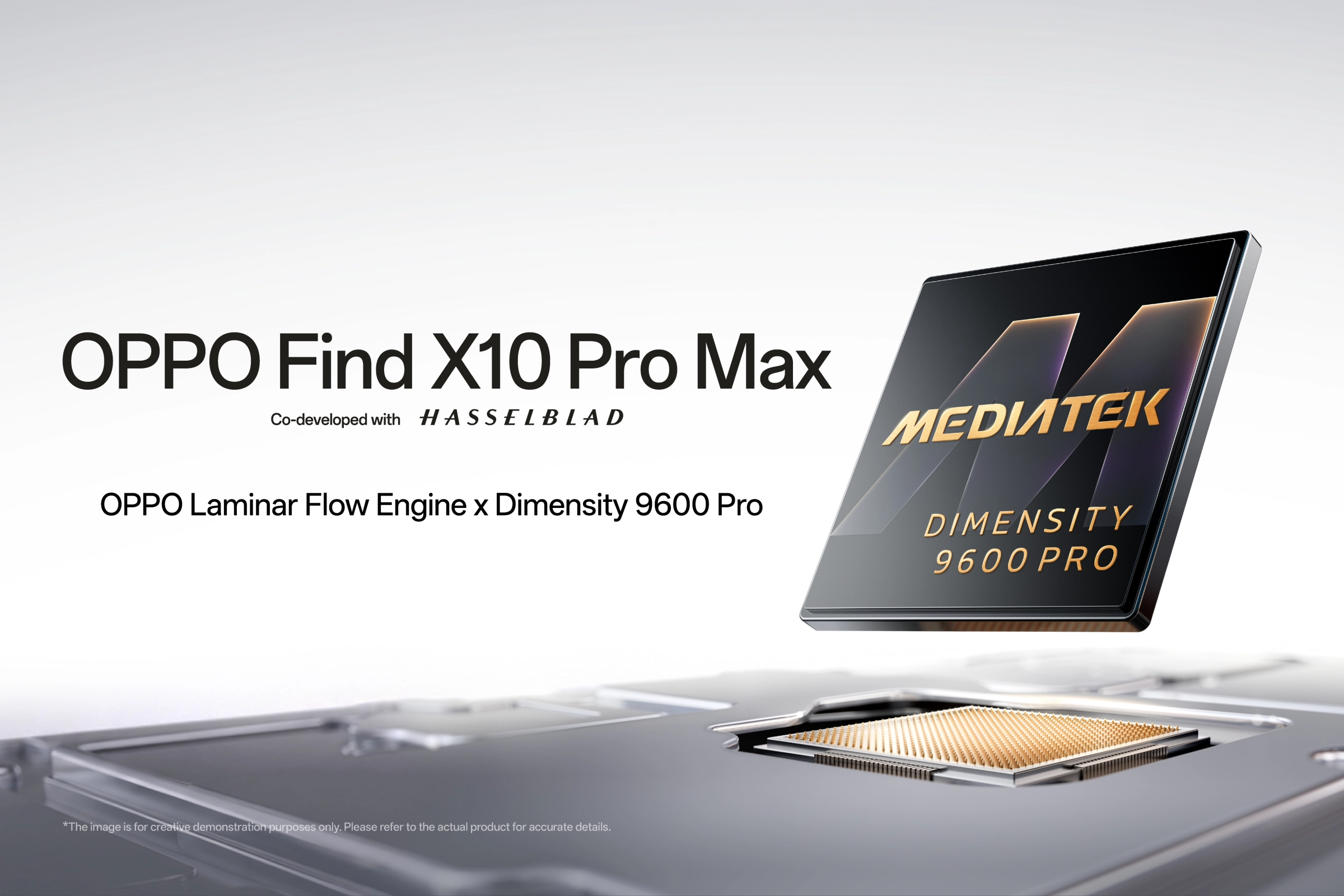

MediaTek officially launched the Dimensity 9600 Pro on September 15, 2026, moving its flagship phone platform to a new 2nm process and a fourth-generation All Big Core CPU. The headline hardware is a 2+3+3 design with two Arm C2-Ultra cores running up to 4.55GHz, six C2-Pro cores split into two clock/cache groups, LPDDR6 and UFS 5.0 support, an Arm Mali-G2 Ultra NX GPU, and a dual-NPU architecture. OPPO has already confirmed that the Find X10 Pro Max will be among the first phones to use the chip and will reach international markets.
That makes the Dimensity 9600 Pro one of the most important Android silicon launches of late 2026, but the biggest numbers still need context. MediaTek’s 17% single-core gain, 15% multi-core gain, 61% multi-core power reduction, 27% GPU uplift and AI improvements come from MediaTek lab testing on demo hardware. They are not independent retail-phone results. The real question is whether phone makers can turn the new process and architecture into sustained speed, lower heat and better battery life.
Dimensity 9600 Pro is MediaTek’s new flagship smartphone SoC announced September 15, 2026. It is MediaTek’s first 2nm flagship mobile platform and uses a 2+3+3 All Big Core CPU: two Arm C2-Ultra cores at up to 4.55GHz, three C2-Pro cores at up to 4.35GHz, and three lower-clocked C2-Pro cores at up to 3.1GHz. It supports LPDDR6, LPDDR5X and UFS 5.0, adds Mali-G2 Ultra NX graphics and dual NPUs, and introduces new imaging and connectivity capabilities. MediaTek says single-core performance rises up to 17% and multi-core power consumption can fall by 61% versus its previous flagship under its test conditions. OPPO Find X10 Pro Max is confirmed. Independent testing of retail phones is still required.
What is MediaTek Dimensity 9600 Pro?
Dimensity 9600 Pro is the top member of MediaTek’s newly announced 9600 series and is positioned for premium Android flagships. MediaTek describes it as a first-wave 2nm smartphone design, while OPPO specifically identifies the manufacturing technology used for Find X10 Pro Max as TSMC’s 2nm N2P process. TSMC says N2P is an enhanced member of its N2 family designed to improve performance and power characteristics over first-generation N2.
The chip combines CPU, GPU, NPU, ISP, modem, memory controller and other functions on one system-on-chip. That matters because a phone’s performance is not decided by CPU clock alone. Memory bandwidth, storage latency, thermal limits, scheduling, modem behavior and the OEM’s software can all change the final experience.
Why 2nm matters—and why the number alone tells you very little
“2nm” is a process-generation name, not a claim that every transistor feature is literally two nanometres wide. Moving to a newer process can improve transistor density, performance and efficiency, but the manufacturer decides how to spend that headroom. One phone maker may aim for lower power and cooler sustained operation; another may push higher clocks and accept similar heat for more performance.
The new 2+3+3 All Big Core CPU explained
MediaTek keeps its All Big Core strategy but changes the topology substantially. There are two Arm C2-Ultra cores with 2MB of L2 cache each, three higher-clocked C2-Pro cores with 1MB L2 each, and three lower-clocked C2-Pro cores with 512KB L2 each. The last group should not be casually relabeled “efficiency cores” because MediaTek and Arm still identify them as C2-Pro CPUs rather than traditional small cores.
The L2 cache totals 8.5MB. Add the official 16MB L3 cache and 10MB system-level cache and MediaTek’s 34.5MB platform-cache figure can be understood without double-counting. The design is intended to keep more data close to the compute engines while giving the scheduler more control over how work is distributed.
Two 4.55GHz C2-Ultra cores headline the CPU
The two C2-Ultra cores run at up to 4.55GHz. Three C2-Pro cores reach up to 4.35GHz, while the other three C2-Pro cores run at up to 3.1GHz. Arm describes C2-Ultra as its peak mobile CPU for responsiveness and single-thread work, while C2-Pro is designed to balance performance and efficiency for sustained workloads.
Compared with Dimensity 9500’s one C1-Ultra, three C1-Premium and four C1-Pro arrangement, this is more than a clock bump: the CPU generation and core mix have changed.
MediaTek claims 17% faster single-core performance
MediaTek says the new CPU delivers up to 17% higher single-core performance and up to 15% higher multi-core performance than its previous-generation flagship. It also advertises 37% better single-core power efficiency and a 61% reduction in multi-core power consumption under its test methodology.
The 61% multicore efficiency figure needs context
The 61% number is easy to misread. It does not mean a phone using Dimensity 9600 Pro will last 61% longer on a charge, and it does not mean every multi-core workload consumes exactly 61% less power. A smartphone’s total energy use includes the display, modem, radios, memory, storage, cameras and background software. Even within the SoC, real consumption changes with voltage, clock, workload and thermal state.
The more useful question is whether a production phone can hold strong performance for longer at a lower sustained power level. That requires long CPU loops, game sessions, surface-temperature measurements and battery-drain testing rather than a short benchmark burst.
LPDDR6 and UFS 5.0 may matter almost as much as the CPU
Dimensity 9600 Pro supports LPDDR6 10667 and LPDDR5X 10667 memory. MediaTek says LPDDR6 can deliver about 33% higher effective memory bandwidth at the same frequency versus its cited baseline. That extra bandwidth could help large games, computational photography and AI models move data more quickly, but it does not make every application 33% faster.
UFS 5.0 support is another first-wave addition. MediaTek advertises up to twice the read/write capability of its previous storage baseline. In a phone that actually ships with fast UFS 5.0 NAND and a good storage controller, the gains could show up in large app installs, file copying, game loading and AI-model loading. Chipset support alone does not guarantee the phone maker will use UFS 5.0.
G2-Ultra NX GPU targets up to 185fps gaming
The Arm Mali-G2 Ultra NX is a major architecture change. MediaTek claims up to 27% higher peak graphics performance, 24% lower power consumption at peak performance and up to 18% faster ray tracing versus the previous Dimensity flagship. It also advertises gaming scenarios above 185fps where the game, display, thermals and OEM implementation support them.
Arm’s G2-Ultra NX adds dedicated neural accelerators and a new ray-tracing unit. MediaTek builds on that with its Neural Graphics Architecture, which synchronizes GPU and NPU resources for tasks such as reconstruction and image enhancement. This should be viewed as a platform capability, not a promise that every existing game will immediately use neural rendering or hit 185fps.

Ray tracing and Neural Graphics explained
The chip supports hardware-accelerated OMM ray tracing and a ray-tracing pipeline capable of multi-material reflections. In practical terms, these features give developers more tools for realistic lighting and materials without relying entirely on conventional rasterization. Neural graphics adds AI-assisted reconstruction or enhancement to the graphics pipeline.
Adoption is the missing piece. A game engine or title needs to support the relevant features, and the phone still needs enough sustained thermal headroom to keep them useful during long sessions.
NPU 1090 brings a bigger push toward on-device agentic AI
MediaTek splits AI work across two NPUs. NPU 1090 handles heavier generative and agentic workloads, while Super Efficient NPU 2.0 is designed for low-power, always-on background tasks. The idea is sensible: a lightweight context or sensing task should not need to wake the same high-power engine used for a large language model.
MediaTek claims double the INT4 compute, 55% more token generation per watt and 51% faster LLM prefill performance for NPU 1090, while Super Efficient NPU 2.0 can cut power consumption by about 40% in its target workloads. Those are again manufacturer figures.
MediaTek also says the platform supports on-device models up to 30 billion parameters in suitable implementations. That does not mean every phone can load an arbitrary 30B model at full precision. Quantization, RAM capacity, memory bandwidth, storage, software, thermal budget and the model architecture all matter.
Imagiq 1290 adds support for 4K240 video
The Imagiq 1290 ISP supports camera sensors up to 200MP, 8K60 capture, 4K120 with electronic stabilization and up to 4K240 slow-motion output. MediaTek also advertises 4K60 HDR with content-aware semantic processing and other ISP-NPU features.
Those are chipset capabilities. A phone manufacturer must still select sensors, lenses, stabilization hardware, storage performance, thermals and camera software that can use them. A Dimensity 9600 Pro phone is therefore not automatically a 200MP or 4K240 phone.
5G Advanced, Wi-Fi 7 and Bluetooth 6.2
The integrated modem supports sub-6GHz 5G with 5CC downlink carrier aggregation across up to 350MHz and a quoted peak above 7.4Gbps in supported conditions. MediaTek also lists Wi-Fi 7 with Triple Band Triple Concurrency and up to 7.3Gbps theoretical capability, plus Bluetooth 6.2 with a dual Bluetooth engine.
Those peak rates are not everyday promises. Carrier spectrum, congestion, local regulation, router capability, antenna design and firmware determine what a user actually sees.
OPPO Find X10 Pro Max is already confirmed
OPPO’s own newsroom says Find X10 Pro Max will be among the first smartphones to use Dimensity 9600 Pro and will launch in international markets. That is stronger evidence than the earlier rumor cycle. OPPO has not yet announced the exact global release date or international pricing.
The Find X10 family is scheduled to be announced in China on September 22. OPPO’s lineup includes Find X10, Find X10 Pro Max and Find X10 E, but the September 22 China event should not be treated as the automatic worldwide retail date.
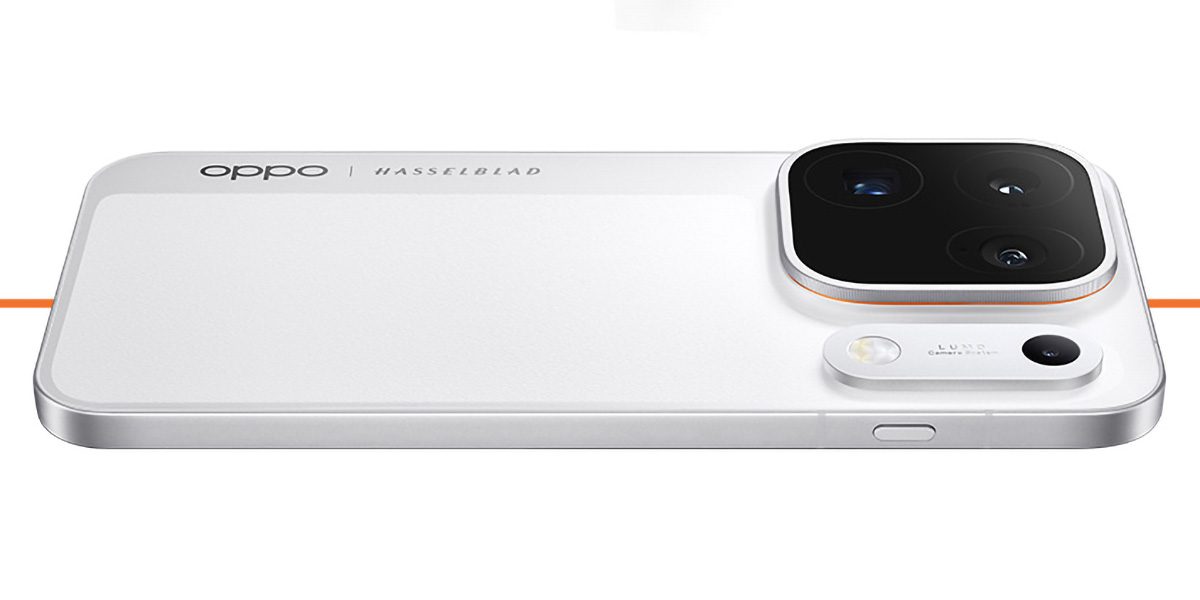
What OPPO’s Laminar Flow Engine adds
OPPO says Find X10 Pro Max will debut its Laminar Flow Engine, jointly developed with MediaTek. The company describes it as a system-scheduling and rendering approach intended to improve responsiveness, app launching, content loading and power behavior.
This is a useful reminder that two phones using the same SoC can behave differently. Cooling design, scheduler tuning, memory choice, storage, performance modes and the chassis all affect sustained results. If Find X10 Pro Max performs especially well—or poorly—the outcome cannot automatically be attributed to the Dimensity chip alone.
Dimensity 9600 Pro vs Dimensity 9500
| Feature | Dimensity 9600 Pro | Dimensity 9500 | Why it matters |
|---|---|---|---|
| Process | 2nm generation | TSMC N3P / 3nm generation | New node targets better performance-per-watt |
| CPU | 2× C2-Ultra + 3× high-clock C2-Pro + 3× lower-clock C2-Pro | 1× C1-Ultra + 3× C1-Premium + 4× C1-Pro | New Arm generation and new topology |
| Peak CPU | 4.55GHz | 4.21GHz Ultra core | Higher peak frequency, but sustained behavior matters more |
| Cache | 16MB L3 + 10MB SLC; 34.5MB including L2 | 16MB L3 + 10MB SLC | Large cache hierarchy reduces costly memory trips |
| Memory | LPDDR6 10667 or LPDDR5X 10667 | LPDDR5X 10667 | LPDDR6 can raise effective bandwidth |
| Storage | UFS 5.0 | 4-lane UFS 4.1 | Higher storage ceiling for large transfers and AI assets |
| GPU | Mali-G2 Ultra NX | Mali-G1 Ultra MC12 | New neural-graphics and ray-tracing architecture |
| AI | NPU 1090 + Super Efficient NPU 2.0 | NPU 990 + efficient NPU architecture | Separates heavy AI and always-on AI more explicitly |
| Camera ceiling | 200MP; up to 4K240 slow motion | 320MP; up to 8K60/4K120 EIS | Megapixel ceiling is not a camera-quality ranking |
| Wi-Fi / Bluetooth | Wi-Fi 7 / Bluetooth 6.2 | Wi-Fi 7 / Bluetooth 6.0 | Newer Bluetooth platform support |
Dimensity 9600 Pro vs Dimensity 9600M
MediaTek launched the 9600M alongside the Pro, but it is not simply a slower 9600 Pro. The official product page shows an older C1 CPU generation, LPDDR5X, UFS 4.1, Mali-G1 Ultra MC12 and NPU 990. Reuters reports that the 9600M uses TSMC’s 3nm process, while MediaTek’s current public 9600M specification page does not state the process node directly.
| Feature | Dimensity 9600 Pro | Dimensity 9600M |
|---|---|---|
| Process | 2nm | 3nm according to Reuters; not stated on MediaTek’s launch spec page |
| CPU generation | Arm C2 | Arm C1 |
| CPU layout | 2× C2-Ultra + 6× C2-Pro | 1× C1-Ultra + 3× C1-Premium + 4× C1-Pro |
| Memory | LPDDR6 / LPDDR5X 10667 | LPDDR5X 10667 |
| Storage | UFS 5.0 | 4-lane UFS 4.1 |
| GPU | Mali-G2 Ultra NX | Mali-G1 Ultra MC12 |
| NPU | NPU 1090 + Super Efficient NPU 2.0 | NPU 990 + efficient NPU |
| Bluetooth | 6.2 | 6.0 |
| Positioning | Top flagship | Broader premium / flagship tier |
Which phones will use Dimensity 9600 Pro?
| Phone | Brand | Market | Timing | Status |
|---|---|---|---|---|
| Find X10 Pro Max | OPPO | China + international markets | China series launch Sept. 22; global date TBA | Confirmed |
MediaTek says the first phones powered by Dimensity 9600 Pro and 9600M are expected within the current quarter. FrediTech will keep this list to confirmed products instead of promoting rumor-based model names into the confirmed table.
Does 2nm mean better battery life and cooler phones?
Potentially, but there is no one-to-one conversion from SoC efficiency to phone endurance. The display can dominate power during bright outdoor use; the modem can consume more energy in weak signal; camera recording, wireless radios and background software all contribute. A manufacturer can also spend process efficiency on higher sustained clocks instead of longer runtime.
- More sustained performance before throttling.
- Lower energy use during CPU-heavy workloads.
- Faster storage and AI-model loading when UFS 5.0 is actually fitted.
- Higher memory bandwidth when LPDDR6 is used.
- More capable ray tracing and neural graphics in supported games.
- More efficient separation between heavy generative AI and always-on AI tasks.
Still unproven: retail battery life, chassis temperature, sustained gaming FPS, real AI latency, modem efficiency and camera-processing quality.
What independent testing still needs to prove
When the first production phones arrive, short peak benchmarks should be only the starting point. The useful test plan includes Geekbench or equivalent CPU testing, long multi-core loops, sustained GPU workloads, 1% low frame rates, ray-tracing tests, power draw, surface temperature, app launch time, storage throughput, modem behavior and battery drain.
FrediTech should also compare the same benchmark versions and device performance modes. A reference-device score, a leaked benchmark and an OEM lab number are three different kinds of evidence.
How does it compare with Snapdragon and Apple silicon?
There is not enough like-for-like retail evidence to declare a winner. Qualcomm’s current flagship Android platform is Snapdragon 8 Elite Gen 5, officially listed on a 3nm process with an Oryon CPU, while Apple’s newly announced A20 Pro is also built on 2nm and uses a six-core CPU and seven-core GPU. Those platforms use different architectures, operating systems and test environments.
The meaningful comparison will come after shipping Dimensity 9600 Pro phones can be tested against current Snapdragon flagships and iPhone 18 Pro models under the same sustained workloads. Marketing percentage claims from different vendors should not be cross-compared as if they came from one laboratory.
Should you wait for a Dimensity 9600 Pro phone?
If you are already shopping for a top-tier Android phone and can wait until late September or the rest of the quarter, it is reasonable to see how the first 9600 Pro devices perform. The platform has meaningful architectural upgrades rather than just a new model number: 2nm, C2 CPUs, LPDDR6 capability, UFS 5.0, G2-Ultra NX and a more explicit dual-NPU design.
But buying solely because “2nm” is printed on the marketing page would be premature. A well-cooled Snapdragon phone can outperform a poorly tuned MediaTek phone, and the reverse is also possible. The final device matters more than the SoC label.
For broader context, FrediTech’s Redmi Note 17 Pro vs Pro Max guide shows how processor, memory and storage choices change value inside one product family. Our Galaxy S26 Ultra review provides a current Snapdragon flagship reference, while the Xiaomi 17 Ultra review offers another premium Android comparison point. For the wider direction of AI and 5G hardware, see FrediTech’s mobile technology trends guide. For a current example of how a lower-tier MediaTek platform behaves in a finished phone, see the Realme P4s 5G review. Readers focused on platform differences may also find our iOS vs Android comparison useful.
FrediTech verdict
The architecture change is substantial: two C2-Ultra cores, six C2-Pro cores, 4.55GHz peak frequency, LPDDR6 and UFS 5.0 support, a new G2-Ultra NX GPU and a dual-NPU setup. OPPO Find X10 Pro Max gives the platform a concrete first device rather than leaving it as theoretical silicon.
The strongest caution is equally clear. MediaTek’s 17%, 15%, 61%, 27% and AI figures remain manufacturer lab results. Real battery endurance, heat, gaming stability, camera processing and long-duration performance will decide whether 2nm is a meaningful user upgrade or mostly an impressive specification-sheet milestone.
Frequently Asked Questions
What is Dimensity 9600 Pro?
It is MediaTek’s September 2026 flagship smartphone system-on-chip, built around a new 2nm process, Arm C2 CPU cores, G2-Ultra NX graphics and dual NPUs.
Is Dimensity 9600 Pro 2nm?
Yes. MediaTek calls it a new 2nm design, and OPPO identifies the implementation for Find X10 Pro Max as TSMC N2P.
Who manufactures Dimensity 9600 Pro?
MediaTek designs the chip. OPPO’s announcement identifies TSMC’s 2nm N2P manufacturing process for the platform.
How fast is Dimensity 9600 Pro?
Its two C2-Ultra cores reach up to 4.55GHz. MediaTek claims up to 17% higher single-core and 15% higher multi-core performance versus its previous flagship, pending independent phone testing.
What is the CPU layout?
Two C2-Ultra cores, three higher-clocked C2-Pro cores and three lower-clocked C2-Pro cores in a 2+3+3 All Big Core design.
Does Dimensity 9600 Pro support LPDDR6?
Yes. It supports LPDDR6 10667 and LPDDR5X 10667. Phone makers still choose which memory to install.
Does it support UFS 5.0?
Yes. UFS 5.0 is supported, but an OEM must actually use compatible storage hardware for a buyer to receive that benefit.
What GPU does it use?
Arm Mali-G2 Ultra NX, combined with MediaTek’s Neural Graphics Architecture.
Does it support ray tracing?
Yes. MediaTek lists hardware-accelerated OMM ray tracing and a pipeline capable of multi-material reflections.
Can it run 185fps games?
MediaTek says the platform supports gaming scenarios above 185fps. Actual results require game support, a sufficiently fast display, suitable settings and enough thermal headroom.
What phones use Dimensity 9600 Pro?
At publication, OPPO Find X10 Pro Max is the first officially confirmed model in FrediTech’s device table.
Does OPPO Find X10 Pro Max use it?
Yes. OPPO officially confirmed Dimensity 9600 Pro and said the phone will reach international markets.
When will the first Dimensity 9600 Pro phone launch?
MediaTek says the first 9600-series phones are expected this quarter. OPPO’s Find X10 series China announcement is scheduled for September 22, while the exact global retail date is still unannounced.
What is Dimensity 9600M?
It is a separate premium 9600-series chip using C1-generation CPU cores, LPDDR5X, UFS 4.1, Mali-G1 Ultra MC12 and NPU 990 rather than the Pro’s newest C2/LPDDR6/UFS 5.0 platform.
Is Dimensity 9600M also 2nm?
MediaTek’s current public 9600M product page does not state a 2nm process. Reuters reports the 9600M uses TSMC 3nm, so FrediTech does not describe it as a 2nm chip.
Is Dimensity 9600 Pro faster than Snapdragon?
There is not enough same-version independent retail testing yet to make that conclusion. Cross-vendor marketing claims should not be treated as a common benchmark.
Does 2nm improve battery life?
It can improve SoC efficiency, but phone battery life also depends on the display, modem, radios, cooling, software and OEM performance targets.
Sources and Further Reading
- MediaTek — Dimensity 9600 Pro launch announcement
- MediaTek — Dimensity 9600 Pro product specifications
- MediaTek — Dimensity 9600M specifications
- MediaTek — Dimensity 9500 specifications
- OPPO — Find X10 Pro Max / Dimensity 9600 Pro confirmation
- Arm — C2 CPU and Mali G2-Ultra NX platform overview
- TSMC — N2 and N2P technology context
- Reuters — Dimensity 9600-series process and market context