

Lava will launch the Virat Curve in India on September 21, 2026 at 12:00 PM IST, with Flipkart already confirmed as a retail channel. The phone moves the Virat family into more premium-looking territory with a 6.67-inch 3D curved FHD+ AMOLED display, a rear Mini Display built into the camera area, MediaTek’s Dimensity 7100, a 6,000mAh battery and 45W wired charging. What Lava has not announced is just as important: the official India price and a clearly separated first-sale date are still missing.
That means this is still a launch preview, not a value verdict. The Virat Curve already has enough distinctive hardware to attract attention, but its final price will determine whether the curved AMOLED and rear display are useful differentiators or simply expensive additions. This FrediTech guide separates current Flipkart/Lava teaser facts from conflicting pre-launch specifications, adds buyer context, and leaves clear launch-day checkpoints for September 21.
Lava Virat Curve: Quick answer
The Lava Virat Curve launches in India on September 21 at 12 PM IST and will be sold through Flipkart. Official pricing is still unannounced. Current launch material shows a 6.67-inch 3D curved FHD+ AMOLED display with 120Hz refresh, a rear Mini Display, MediaTek Dimensity 7100, 6GB physical RAM plus up to 6GB virtual RAM, 128GB storage, a 6,000mAh battery with 45W charging, Android 16, IP64 protection and MIL-STD-810H testing. Heritage Indigo and Makrana Ivory are confirmed colors. The biggest items to recheck at launch are the official price, sale date, final RAM/storage standards, charger-in-box status and complete camera specification.
When does Lava Virat Curve launch in India?
Lava’s Virat Curve is scheduled for September 21, 2026 at 12:00 PM IST. The dedicated Flipkart launch material has been cited by FoneArena, Beebom and Gadgets 360, so the date, time and Flipkart availability are much firmer than the older leaks that circulated before the teaser went live. The remaining timing question is the first open-sale date: a launch presentation and a retail sale can happen on the same day, but they should not be treated as identical until Lava or Flipkart says so explicitly.
Launch
September 21, 2026
Time
12:00 PM IST
Price
Not announced
Retailer
Flipkart confirmed
Display
6.67-inch FHD+ AMOLED, 120Hz
Chip
Dimensity 7100
Battery
6,000mAh
Charging
45W wired
What will Lava Virat Curve cost?
Official India pricing has not yet been announced. FrediTech will update this same URL after the September 21 reveal with the official MRP, launch price, RAM/storage variants, bank offers, effective price and first-sale date. Third-party placeholder prices are not treated as official.
Price is the specification that will decide the phone’s position. Lava’s Virat V1 Pro 5G is currently listed around ₹15,999, while the Blaze Duo 3 can sit much higher depending on retailer. The Virat Curve adds a better display, faster charging and a more capable Dimensity platform than the V1 Pro, so a higher price would be unsurprising; the question is how far Lava can move upward before buyers start comparing it with faster phones, stronger cameras and longer software policies from larger rivals.
Where will Lava Virat Curve be sold?
Flipkart is confirmed. Lava’s own online store and offline retail availability should be checked again on launch day. Buyers should also distinguish the product page going live from actual orderable stock, because color availability, delivery PIN codes and launch offers can differ even when a phone is officially announced.
Lava Virat Curve confirmed specs at a glance
Confirmed or strongly teased
- September 21 launch at noon IST
- 6.67-inch curved FHD+ AMOLED, 120Hz
- Rear Mini Display
- Dimensity 7100 and 5G
- 6GB RAM + up to 6GB virtual RAM, 128GB storage
- 6,000mAh battery, 45W charging
- Android 16, IP64 and MIL-STD-810H testing
Verify or still unknown
- Official India price and first-sale date
- Final physical RAM standard
- Storage technology and microSD support
- 45W charger-in-box status
- Secondary rear-camera specification
- Complete 5G band list
- Exact Mini Display third-party app support
| Item | Status | Current position |
|---|---|---|
| Launch date | Confirmed | September 21, 2026 |
| Launch time | Confirmed | 12:00 PM IST |
| Price | Unknown | To be announced |
| First sale | Unknown | Do not assume launch day equals open sale |
| Flipkart | Confirmed | Launch microsite/retail channel |
| 5G | Strongly reported | Exact band list still needs final spec sheet |
| Main display | Confirmed | 6.67-inch 3D curved AMOLED, 2400×1080, 120Hz |
| Brightness | Manufacturer figure | Up to 1,100 nits peak |
| Rear Mini Display | Confirmed | Glanceable information and personalization |
| Processor | Confirmed | MediaTek Dimensity 7100 |
| Physical RAM | Confirmed | 6GB |
| RAM type | Conflicting reports | LPDDR5 in FoneArena/Beebom; LPDDR4X in 91mobiles |
| Virtual RAM | Confirmed | Up to 6GB; not equivalent to physical RAM |
| Storage | Confirmed | 128GB capacity |
| Storage type | Unknown | Do not infer UFS version from chipset capability |
| Battery | Confirmed | 6,000mAh |
| Charging | Confirmed | 45W wired |
| Charger included | Unknown | Verify September 21 |
| Main camera | Strongly reported | 50MP Sony; current sources converge on IMX752 |
| Front camera | Strongly reported | 8MP |
| Software | Confirmed/reported | Android 16, two OS upgrades, three years security |
| IP rating | Confirmed | IP64 |
| MIL-STD | Confirmed | MIL-STD-810H testing; not indestructible |
| Colors | Confirmed | Heritage Indigo, Makrana Ivory |
The 6.67-inch curved AMOLED is the main attraction
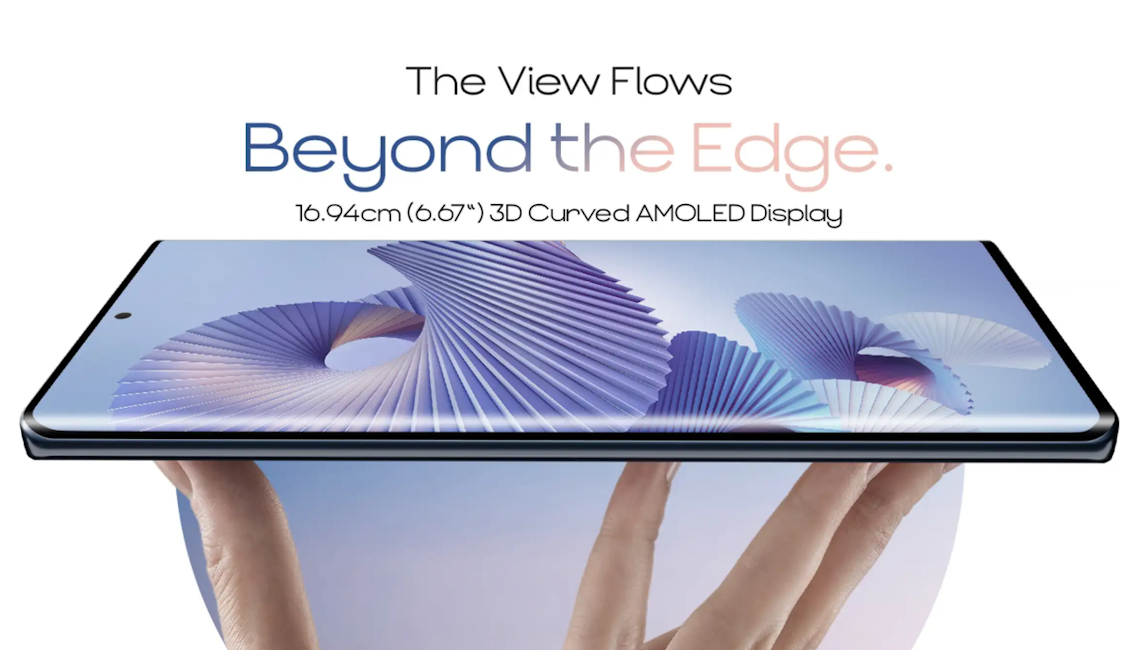
The main screen is a 6.67-inch 3D curved AMOLED with 2400×1080 resolution, up to 120Hz refresh and a claimed peak brightness of 1,100 nits. Compared with the HD+ LCD used by the Virat V1 Pro 5G, that is a substantial display upgrade on paper. AMOLED should deliver deeper blacks and higher contrast, while the curved edges give the phone a more premium visual profile. If you want more background on panel technology, FrediTech’s AMOLED technology guide explains why emissive OLED panels behave differently from LCDs.
Curved glass also creates trade-offs. Reflections can be more noticeable at the edges, accidental touch rejection matters more, cases have less material protecting the exposed sides, and screen replacement may be costlier than on a flat budget phone. None of those issues should be declared solved before hands-on testing. A 120Hz panel also does not mean every game or app will run at 120fps; refresh behavior depends on software, content and power settings.
What does the rear Mini Display actually do?
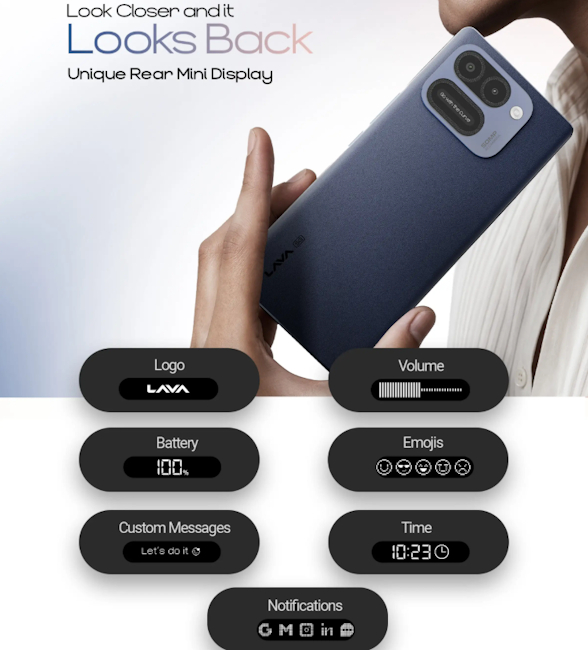
The Mini Display is a secondary information screen, not a second full smartphone display. Current Lava/Flipkart teaser material shows it being used for quick information and personalization such as time, battery level, volume, notifications, custom messages and emoji. There is not yet reliable evidence that it runs normal Android apps or offers full camera-preview, music-control, call-control or third-party widget support.
| Mini Display function | Status | Practical value | Launch-day test? |
|---|---|---|---|
| Clock/time | Confirmed | Quick glance without waking the main screen | Check always-on behavior |
| Battery level | Confirmed | Useful while charging or on a desk | Check update frequency |
| Notifications | Confirmed | Can reduce full-screen wakeups | Check which apps are supported |
| Volume | Confirmed | Simple status feedback | Check interaction options |
| Emoji | Confirmed | Mostly personalization | Check available library |
| Custom messages | Confirmed | Personalization and identification | Check character limits |
| Camera preview | Unknown | Could help rear-camera selfies if supported | Yes |
| Music controls | Unknown | Potential convenience | Yes |
| Call controls | Unknown | Potential desk use | Yes |
| Third-party apps | Unknown | Would determine long-term usefulness | Yes |
Is the Mini Display useful or mostly a design feature?
At this stage, it looks useful in narrow, glanceable situations rather than transformative. A quick battery readout, time display or notification indicator can be convenient when the phone is face-down, and Lava already has experience with secondary rear screens in products such as the Blaze Duo line. The real value depends on software depth: outdoor visibility, whether notifications from WhatsApp and other major apps are readable, whether users can disable it, how much battery it consumes and whether Lava expands features after launch.
Dimensity 7100 should target mainstream 5G performance
MediaTek’s Dimensity 7100 is a 6nm 5G platform built around four Cortex-A78 performance cores up to 2.4GHz and four Cortex-A55 efficiency cores up to 2.0GHz, with a Mali-G610 MC2 GPU. MediaTek positions it for mainstream phones rather than flagships. It supports 120Hz displays, LPDDR5 or LPDDR4X memory and UFS 3.1 at the platform level, but a chipset’s maximum capability does not prove which memory or storage standard Lava actually installs.
That distinction matters because storage and memory affect app launches and multitasking even when the processor is unchanged. Buyers should expect the Virat Curve to handle everyday Android, social apps, streaming and casual-to-moderate gaming comfortably if Lava’s thermal design is competent, but FrediTech will wait for retail-device testing before quoting Geekbench, AnTuTu, 3DMark, gaming frame rates or sustained-performance claims. For broader context on how flagship and mid-range chips differ, see our Dimensity 9600 Pro architecture analysis.
6GB RAM and 128GB storage: one detail still needs verification
The launch material consistently points to 6GB of physical RAM, up to 6GB of virtual RAM and 128GB of storage. Do not read that as a true 12GB RAM phone: virtual memory borrows storage space and is far slower than physical DRAM. It can help keep lightweight apps available in some conditions, but it does not double memory bandwidth or turn a 6GB configuration into a 12GB hardware configuration.
Specification check: FoneArena and Beebom currently list LPDDR5 RAM, while 91mobiles lists LPDDR4X. The final Lava product specification should settle that disagreement. Storage capacity is 128GB, but FrediTech is not assigning a UFS or eMMC standard until a primary final spec confirms it.
6,000mAh battery and 45W charging strike a practical balance
A 6,000mAh battery is a strong capacity for a phone with a curved AMOLED screen, and 45W charging is a meaningful step above the 18W charging of the Virat V1 Pro 5G. Lava also claims up to 660 minutes, or 11 hours, of YouTube playback under its test conditions. That number should remain a manufacturer claim: real endurance changes with 5G signal quality, display brightness, 120Hz use, Mini Display behavior, gaming, camera use and background apps.
Battery size alone does not guarantee better runtime than every rival. FrediTech’s recent POCO X8 Power comparison shows how aggressively battery capacity and charging are moving in 2026, while the OnePlus N6 Lite launch preview illustrates why price, network support and charging speed still matter alongside capacity. One launch-day detail remains important here: Lava should confirm whether the 45W charger is included in the box.
50MP Sony camera needs final sensor verification
Current Flipkart-based reporting identifies a 50MP Sony main camera, with Beebom, FoneArena and Gadgets 360 now converging on Sony IMX752. Reports also mention f/1.8 aperture and 2K video at 30fps, plus an 8MP selfie camera. That convergence is stronger than the earlier conflicting sensor references, but FrediTech will still verify the exact sensor and secondary rear-camera role against Lava’s final product page before treating every camera detail as settled.
Nothing in the pre-launch material justifies calling this a camera flagship. Dynamic range, skin tones, low-light quality, stabilization, shutter response and video processing require real photos and video from a retail unit. The rear Mini Display could become more useful if Lava enables camera-preview features, but current confirmed functions should not be expanded by analogy with other dual-screen phones.
Android 16 with two OS upgrades and three years of security
The Virat Curve is expected to ship with Android 16, and current Lava/Flipkart-based coverage says the phone will receive two major Android OS upgrades plus three years of security updates. That is a useful commitment for a price-sensitive phone, but its competitiveness depends on the final selling price. If the Virat Curve moves close to ₹20,000 or above, buyers should compare update duration with current Samsung, Motorola, OnePlus and other alternatives rather than judging Lava’s policy in isolation.
IP64 and MIL-STD-810H explained
IP64 is useful protection, but it is not waterproofing for submersion. The rating indicates strong dust protection and resistance to splashing water under specified test conditions; it is materially different from IP67 or IP68. Lava also says the phone has undergone MIL-STD-810H durability testing. That language should not be converted into “military-proof,” “drop-proof” or “indestructible.” Buyers should still use a case if edge protection matters, especially with a curved front panel.
AI Call Summary, translation and Vayu AI
Current teaser coverage lists AI Call Summary, AI Voice Translation, AI Circle Search and Lava’s Vayu AI assistant. These features may be genuinely useful, but the important details are not just the names. Launch-day testing should verify language support, whether processing is on-device or cloud-based, whether an internet connection or account is required, and whether any quotas apply. FrediTech will not describe the tools as offline, unlimited or permanently free unless Lava confirms those conditions.
Heritage Indigo and Makrana Ivory designs
Lava is showing the Virat Curve in Heritage Indigo and Makrana Ivory, paired with a vegan-leather rear finish. Teaser imagery gives the camera module and Mini Display a strong visual identity, while the curved front distinguishes it from the flatter Virat V1 models. Reports put the body around 8.68mm thick and 207g, which would make it substantial rather than especially light. Those dimensions should still be checked against the final specification page.
How Lava Virat Curve compares with existing Lava phones
The most useful comparison is not “Virat Curve versus every smartphone.” It is where the new phone sits inside Lava’s own lineup before its price is known. The Virat V1 Pro 5G is the lower-cost Virat reference, the Blaze Duo 3 shows Lava’s existing rear-display strategy, and the Agni 4 is a faster premium-mid-range reference with stronger silicon and charging. Current prices can move, so the figures below are a September 15 snapshot rather than permanent MSRPs.
| Model | Current/known price | Display | Chip | Battery / charging | Rear display |
|---|---|---|---|---|---|
| Lava Virat Curve | Not announced | 6.67-inch FHD+ curved AMOLED, 120Hz | Dimensity 7100 | 6,000mAh / 45W | Mini Display |
| Lava Virat V1 Pro 5G | ₹15,999 listed | 6.75-inch HD+ LCD, 120Hz | Unisoc T8200 | 6,000mAh / 18W | No |
| Lava Blaze Duo 3 | ₹24,999 listed on Beebom; retailer pricing varies | 6.67-inch FHD+ AMOLED, 120Hz | Dimensity 7060 | 5,000mAh / 33W | 1.6-inch rear AMOLED |
| Lava Agni 4 | About ₹29,999 on Flipkart | 6.67-inch 1.5K AMOLED, 120Hz | Dimensity 8350 | 5,000mAh / 66W | No |
What price would make the Virat Curve competitive?
Below ₹15,000: extremely aggressive. A curved FHD+ AMOLED, Dimensity 7100, 6,000mAh battery and 45W charging would put unusual pressure on budget 5G rivals. At this level, the remaining questions would be camera consistency, storage type and update execution.
₹15,000–₹17,999: potentially strong value if Lava confirms fast storage, sensible cameras and a charger in the box. This range would put the phone close to the Virat V1 Pro while making the display and chipset upgrades easy to explain.
₹18,000–₹20,000: competition becomes much tougher. Buyers can start demanding stronger camera hardware, faster storage and longer support. FrediTech’s Redmi 17C 5G guide and other current India coverage show how quickly specifications shift around this price zone.
Above ₹20,000: the Mini Display and curved screen must justify themselves against phones with faster processors, stronger cameras, 1.5K panels or longer software policies. Around the mid-₹20,000s, Lava’s own Blaze Duo 3 and discounted Agni models also become relevant.
These are value scenarios, not a prediction. The official price should replace this framework on launch day, and competitors should then be selected within roughly ₹2,500–₹3,000 of the real effective price. For another example of how launch price changes the buying conclusion, see FrediTech’s Realme P4s 5G buying guide.
Should you wait until September 21?
If you are considering a new Lava phone and do not need to buy immediately, waiting until September 21 is sensible because the missing price changes the entire comparison. A Virat V1 Pro buyer may prefer the cheaper known option if the Curve launches too high; a Blaze Duo 3 buyer may prefer the newer curved design if Lava undercuts it. The Mini Display alone is not enough reason to buy before we know the price, storage implementation and sale offer.
What FrediTech will check at launch
- Official India price, MRP, launch offers and effective price
- RAM variants, final LPDDR type and storage standard
- First-sale date and Flipkart stock timing
- microSD support, SIM arrangement and full 5G bands
- Whether a 45W charger is included in the box
- Exact Sony sensor and secondary rear-camera function
- Mini Display app support, camera preview, music/call controls and battery impact
- Warranty terms and Lava online/offline retail availability
FrediTech verdict
Preview verdict
The Lava Virat Curve already has enough distinctive hardware to stand out: the curved FHD+ AMOLED, rear Mini Display, Dimensity 7100, 6,000mAh battery, 45W charging and Android 16 are a credible mid-range combination. The Mini Display could add real convenience, but its software depth still needs testing. More importantly, the official price, memory/storage implementation and final camera details will decide whether this is a strong buy or simply the most premium-looking Virat phone. Until September 21, the correct conclusion is to watch the price rather than declare a winner.
Frequently Asked Questions
When does Lava Virat Curve launch?
It is scheduled to launch in India on September 21, 2026 at 12:00 PM IST.
What is Lava Virat Curve price in India?
Lava has not announced the official India price yet. It is expected to be revealed on September 21.
When will Lava Virat Curve go on sale?
Flipkart availability is confirmed, but FrediTech is treating the first open-sale date as unconfirmed until Lava publishes exact ordering timing.
Will Lava Virat Curve be available on Flipkart?
Yes. A dedicated Flipkart launch microsite has been reported and Flipkart is the confirmed online retail channel.
Does Lava Virat Curve support 5G?
Current launch reporting identifies it as a 5G smartphone powered by the Dimensity 7100. The complete supported-band list should be verified at launch.
How big is the Lava Virat Curve display?
It has a 6.67-inch 3D curved AMOLED panel with 2400×1080 resolution and up to 120Hz refresh rate.
Does Lava Virat Curve have a rear display?
Yes. A small Mini Display is integrated into the rear camera area for glanceable status information and personalization.
What does the Mini Display do?
Confirmed uses include time, battery level, volume, notifications, emoji and custom messages. Camera preview and third-party app support are not yet confirmed.
Which processor does Lava Virat Curve use?
It uses MediaTek’s Dimensity 7100, a 6nm 5G platform with four Cortex-A78 performance cores and four Cortex-A55 efficiency cores.
How much RAM does Lava Virat Curve have?
The confirmed configuration is 6GB physical RAM with up to 6GB virtual RAM. The physical RAM standard is still disputed across pre-launch databases.
How much storage does it have?
128GB storage is confirmed in current launch material. The exact storage technology and microSD support should be verified on September 21.
Does Lava Virat Curve have a 6,000mAh battery?
Yes. The phone is confirmed with a 6,000mAh battery.
How fast does Lava Virat Curve charge?
It supports 45W wired fast charging. Charger-in-box status still needs final confirmation.
What camera does Lava Virat Curve use?
Current Flipkart-based reporting points to a 50MP Sony main camera, with multiple current sources identifying IMX752, plus an 8MP selfie camera. FrediTech will recheck the exact rear setup at launch.
Is Lava Virat Curve waterproof?
No. IP64 is intended for dust and splash resistance under test conditions, not water submersion.
How many Android updates will it receive?
Current launch material says two major Android OS upgrades and three years of security updates.
Should I wait for Lava Virat Curve?
If you are already considering a Virat-series or similarly priced mid-range phone and can wait a few days, the September 21 price reveal is worth seeing before deciding.
Sources and Further Reading
- FoneArena: Lava Virat Curve launch and specifications
- Beebom: Lava/Flipkart teaser details and Mini Display
- Gadgets 360: India launch details and camera information
- MediaTek: Dimensity 7100 official platform specifications
- Beebom: Lava Virat V1 Pro 5G current pricing/specs
- Beebom: Lava Blaze Duo 3 current pricing/specs
- Beebom: Lava Agni 4 current pricing/specs