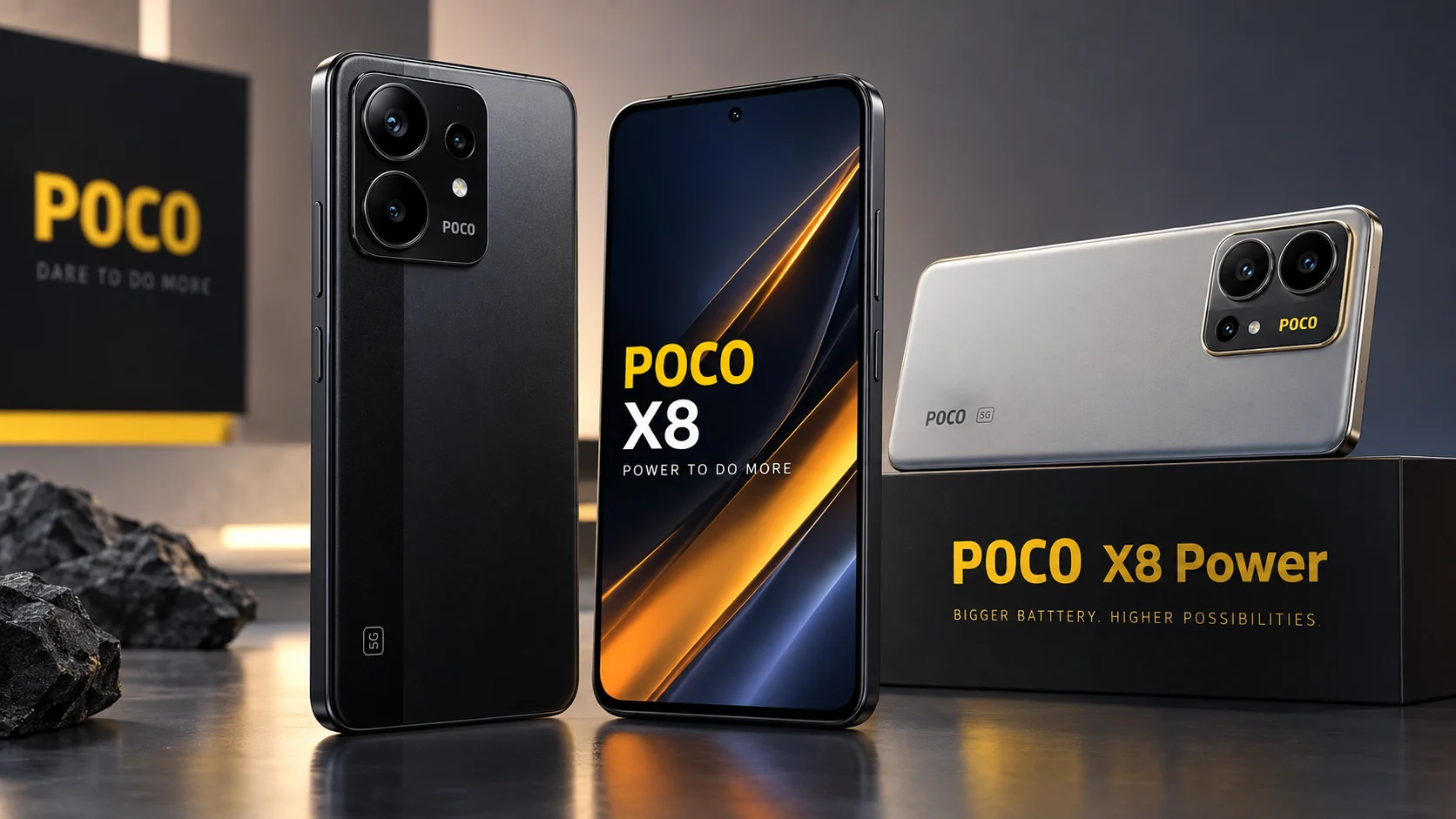

POCO X8 and POCO X8 Power are now on sale in India through Flipkart, with list prices starting at ₹29,999 and ₹35,999. The launch promotion can reduce the effective entry prices to ₹26,999 and ₹32,999 when the stated ₹2,000 coupon and a qualifying ₹1,000 bank or exchange benefit apply. The ₹6,000 model gap buys more than a name change: X8 Power moves to a 10,000mAh battery, 100W charging, Snapdragon 6 Gen 5-class platform, an 8MP ultrawide and a 32MP selfie camera. The standard X8 keeps the same broad 6.83-inch 1.5K AMOLED class and extensive ingress-resistance positioning, so mainstream buyers should decide whether those Power upgrades justify the extra cost rather than assuming the higher model is automatically better.
Table of contents
POCO X8 and X8 Power are now on sale in India
POCO introduced the pair on September 4 and opened the first India sale on September 11 at noon IST. Flipkart is the central online channel in the launch material. Because availability changes by configuration and color, FrediTech should only describe a model as “in stock” after a live check; the durable fact is that general sale has begun.
This is a transactional story rather than a launch recap. The important buyer questions are the checkout price after offers, how the two batteries and charging systems differ, whether the performance uplift matters and whether the Power camera upgrades are worth paying for. Launch-day banners can make the answer look simpler than it is because the lowest headline price may require specific coupon, bank or exchange conditions.
POCO X8 and X8 Power prices and launch offers
| Model | Configuration | List price | Possible effective price |
|---|---|---|---|
| POCO X8 | 6GB/128GB | ₹29,999 | ₹26,999 with qualifying offers |
| POCO X8 | 8GB/128GB | ₹32,999 | Offer-dependent |
| POCO X8 | 8GB/256GB | ₹35,999 | Offer-dependent |
| POCO X8 Power | 8GB/128GB | ₹35,999 | ₹32,999 with qualifying offers |
| POCO X8 Power | 8GB/256GB | ₹38,999 | Offer-dependent |
The table deliberately separates list price from potential effective price. A promotional total is only meaningful if the buyer actually qualifies. On Flipkart, the coupon component, bank-card eligibility and exchange bonus can be subject to different conditions. A shopper without the right card or a trade-in device may pay more than the headline number.
How the ₹3,000 launch saving actually works
The launch framework combines a ₹2,000 coupon with a further ₹1,000 benefit tied to a qualifying bank offer or exchange condition. Those components should not automatically be added twice if the retailer presents the bank and exchange routes as alternatives. The safest process is to open the exact configuration, apply the coupon, select the payment method or exchange option and verify the checkout total before describing the phone as a ₹26,999 or ₹32,999 device.
Exchange value is also separate from a fixed promotional bonus. The old phone’s market value can vary widely by model and condition. That means a buyer should compare the final amount paid—not a marketing graphic that mixes base price, coupon, bank discount and a generous trade-in estimate.
POCO X8 vs X8 Power: what does ₹6,000 extra get you?
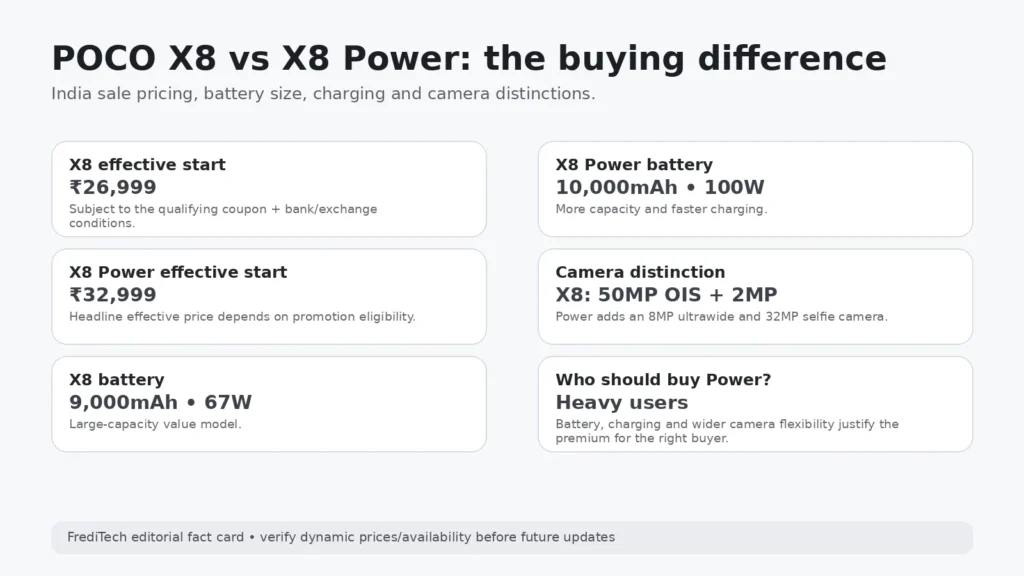
At the entry level, X8 Power is ₹6,000 above X8 before equivalent offers. The extra money primarily buys a larger 10,000mAh battery instead of 9,000mAh, 100W rather than 67W charging, a newer Snapdragon 6 Gen 5 platform rather than Snapdragon 6s Gen 4, an 8MP ultrawide instead of the X8’s basic 2MP secondary camera, and a 32MP rather than 16MP front camera.
The display and durability story is much closer, which is why the standard X8 has a strong value case. If a buyer will not use the ultrawide, rarely takes selfies, is satisfied with 67W charging and does not push games heavily, the Power model’s premium can buy features that sit idle. Conversely, a traveler or heavy user can benefit from almost every upgrade at once.
Battery: 9,000mAh vs 10,000mAh
Both capacities are unusually large for mainstream smartphones and use the newer high-density battery approach promoted across the X8 range. The Power adds another 1,000mAh—about 11% more nominal capacity than the X8. In theory that provides more reserve for long navigation sessions, gaming, hotspot use and travel days, but real endurance still depends on screen brightness, signal strength, refresh behavior, apps and chipset efficiency.
Reverse charging also matters because batteries this large can function as emergency power sources for earbuds or another phone. The standard X8 is already oversized enough that many users may finish the day with substantial charge remaining. The Power’s extra capacity becomes most valuable to people who routinely exhaust normal flagship batteries rather than buyers who simply want the biggest number available.
Charging: 67W vs 100W
The X8 supports up to 67W wired charging, while X8 Power raises the ceiling to 100W. Faster charging is especially useful on a 10,000mAh battery because a lower-wattage system can take longer to restore a large percentage. Maximum wattage is not the same as constant charging speed, however: phones taper power as the battery fills, and temperature, charger compatibility and battery-protection settings affect the curve.
A buyer should verify whether the appropriate charger is supplied with the India configuration and whether the advertised rate requires POCO’s own power adapter and cable. Independent charge-time tests are more useful than simply dividing capacity by wattage.
Snapdragon 6s Gen 4 vs Snapdragon 6 Gen 5
The Power model’s Snapdragon 6 Gen 5 positioning gives it more performance headroom for gaming, image processing and longer-term software workloads. The standard X8’s Snapdragon 6s Gen 4 remains aimed at mainstream daily use: messaging, video, social apps, navigation and lighter games. The difference may be hard to notice in simple tasks but more visible in sustained gaming, demanding multitasking and future application requirements.
Do not turn platform naming into a benchmark conclusion without tests. Thermal design, memory type, storage speed and software optimization can determine whether a theoretically stronger chip maintains its advantage after several minutes of heavy use.
Camera: X8 Power is much more versatile on paper
Both phones center on a 50MP main camera, with the standard X8 adding a basic 2MP secondary sensor and the Power adding an 8MP ultrawide. The practical difference is framing flexibility: an ultrawide can capture architecture, landscapes, groups and cramped interiors in a way a low-resolution auxiliary sensor cannot. The Power also doubles the front-camera resolution from 16MP to 32MP in the launch specifications.
That does not prove better image quality. Sensor size, lens aperture, stabilization, HDR processing, skin tones and low-light algorithms matter more than resolution alone. The Power simply offers a more versatile set of focal perspectives on paper. Buyers who mostly use the main camera may reasonably keep the ₹6,000.
Displays are much closer than the prices suggest
The two phones share the same broad display proposition: a large 6.83-inch-class 1.5K AMOLED panel with refresh rates up to 120Hz. That means the experience that dominates daily use—reading, streaming, browsing and social media—is not fundamentally reserved for the Power model. It is a major reason the cheaper X8 remains competitive.
Brightness claims should still be interpreted carefully because peak figures often describe small areas under specific HDR or sunlight conditions. Independent measurements of sustained full-screen brightness and color accuracy are more useful than marketing peaks.
Durability: both phones have unusually extensive IP ratings
The India launch material lists IP66, IP68, IP69 and IP69K-class protection alongside Gorilla Glass Victus 2. Collectively, those ratings signal strong laboratory resistance to dust, immersion and high-pressure/high-temperature water exposure under defined tests. They do not make the phones indestructible or suitable for deliberate underwater use.
Liquid-damage warranty terms can differ from the laboratory rating, seals can age and impacts can compromise protection. The useful takeaway is that POCO is putting more durability engineering into this price class than many rivals, not that the phones no longer need sensible care.
Software and update support
The X8 series ships with HyperOS 3 based on Android 16 in the supplied India baseline. For a phone expected to be used for several years, the update policy matters almost as much as the chipset. Buyers should verify the number of major Android/HyperOS upgrades and security-maintenance period for the exact India models, because regional support commitments can differ from global variants.
Software experience also includes preinstalled apps, notification behavior, background management and long-term performance. Those aspects are better judged after independent reviews rather than inferred from the OS version on the box.
POCO X8: who should buy it?
The standard X8 is the better fit for value-focused buyers who want a huge battery, the same broad AMOLED display class, strong ingress-resistance positioning and a capable main camera without paying for every upgrade. It is particularly sensible for streaming, social media, calls, navigation, general photography and lighter gaming.
It also makes sense when the ₹3,000 launch saving applies fully. If the buyer mainly uses the 50MP main camera and charges overnight, the missing ultrawide and slower 67W charging may have little practical impact.
POCO X8 Power: who should pay ₹6,000 more?
X8 Power is easier to justify for heavy gamers, travelers, delivery or field workers, hotspot users and anyone who frequently spends long periods away from a charger. Its 10,000mAh battery, 100W charging and stronger platform directly address those workloads. The ultrawide and higher-resolution selfie camera also make the premium more tangible for creators and video-call-heavy users.
The best reason to buy Power is cumulative: if you value battery, charging, performance and camera flexibility at the same time, ₹6,000 buys several upgrades. If you care about only one of them, the value case is weaker.
Which one gives better value?
For mainstream buyers, the standard X8 likely offers the stronger price-to-feature balance because it retains the large AMOLED display, very large 9,000mAh battery and strong durability story. X8 Power is the better device on paper, but “better” and “better value” are different questions.
If the actual checkout gap grows beyond ₹6,000 because one configuration loses a coupon or bank offer, the standard X8 becomes even more attractive. If both receive equivalent discounts and the buyer expects to keep the phone for several years, Power’s stronger chip and faster charging can justify the premium.
Should you buy now or wait?
- Buy now if the exact configuration is available, the full launch offer applies and you genuinely need a phone now.
- Buy X8 now if price matters more than camera variety and maximum charging speed.
- Buy X8 Power now if the larger battery, 100W charging, stronger chip and ultrawide solve real needs.
- Wait if your preferred color/storage is unavailable or the coupon has disappeared.
- Wait for independent battery, charging and performance tests if you are not in a hurry.
- Do not wait for a hypothetical future discount unless an actual sale is announced.
Relevant alternatives around ₹25,000–₹40,000
The X8 pair competes in one of India’s busiest price bands, where current devices from Nothing, OnePlus, Realme, Motorola, Samsung and iQOO can overlap depending on sale pricing. The X8 series is unusual mainly because it combines very large batteries, fast charging, a 1.5K AMOLED class and aggressive ingress-resistance ratings. A rival may beat it on camera processing, software policy or lighter weight, so compare the features you will actually notice.
Frequently asked questions
When did POCO X8 sales start in India?
General sales began September 11, 2026 at noon IST through Flipkart in the launch information.
What is the POCO X8 price in India?
The list price starts at ₹29,999; a qualifying launch combination can reduce the effective entry price to ₹26,999.
What is the POCO X8 Power price?
The Power starts at ₹35,999, with an eligible effective launch entry around ₹32,999.
How does the ₹3,000 launch saving work?
It combines a ₹2,000 coupon with a qualifying ₹1,000 bank or exchange benefit. Check the actual checkout conditions.
Which phone has the bigger battery?
X8 has 9,000mAh; X8 Power has 10,000mAh in the India launch specifications.
Which charges faster?
X8 Power supports up to 100W wired charging versus 67W on X8.
Which has the better camera setup?
X8 Power is more versatile on paper because it adds an 8MP ultrawide and a 32MP front camera.
Do both have AMOLED displays?
Yes, both are positioned around a 6.83-inch-class 1.5K AMOLED display with up to 120Hz refresh.
Which is better value?
For most mainstream buyers, X8 offers stronger raw value. Power makes more sense when its battery, charging, performance and camera upgrades are useful to you.
Sources and verification
- FrediTech POCO F9 Ultra vs F9 Pro — internal context for separating list and promotional prices.
- Flipkart and POCO India launch materials — current price, configuration and offer framework used in the published article.