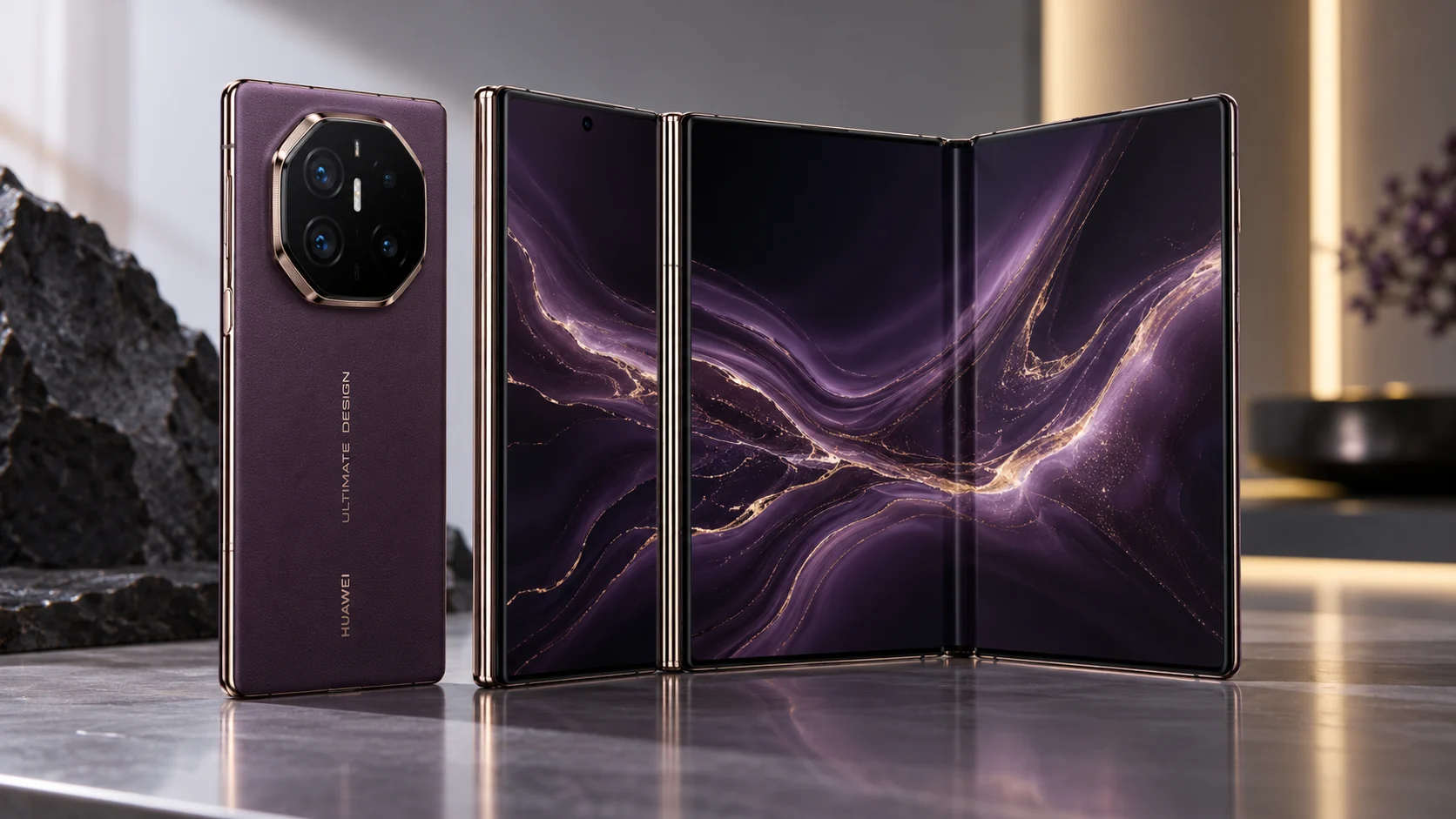

Huawei Mate XT 2 has moved from announcement to general sale in mainland China, turning the second-generation tri-fold from a launch-stage curiosity into a real buying decision. The regular range starts at CNY 19,999 for 16GB/256GB and extends through multiple 1TB configurations, including a higher-priced hardware privacy-display model. The phone combines Huawei’s new three-panel form factor, Kirin 9050 Pro, HarmonyOS 7, a 5,600mAh battery and IP58/IP59 ingress-resistance claims. The biggest caveat for FrediTech’s international readership is unchanged: Huawei has not announced a broad global release, so importing from China introduces software, carrier, warranty and repair questions that matter as much as the converted purchase price.
Table of contents
Huawei Mate XT 2 is now on sale in China
Huawei announced the Mate XT 2 on September 7 and moved it into regular mainland-China sale on September 12. That distinction matters because “announced,” “available to reserve” and “generally on sale” are not interchangeable. At publication time, the buying story is centered on Huawei’s China channels and authorized local retail rather than a global preorder program. FrediTech therefore avoids turning currency conversions into supposed U.S. or European prices.
The Mate XT 2 is also a useful example of why stock headlines need restraint. A complex, expensive foldable can sell through individual configurations without every model being universally scarce. Unless a retailer is checked live, the article should not manufacture a shortage narrative. The durable fact is that general sale has started in China; stock can vary by storage tier, color, privacy-display option and channel.
Huawei Mate XT 2 price and configurations
| Configuration | China price | What it changes |
|---|---|---|
| 16GB + 256GB | CNY 19,999 | Lowest entry price; same core tri-fold platform. |
| 16GB + 512GB | CNY 21,999 | More local storage for media and apps. |
| 16GB + 1TB | CNY 23,999 | High-capacity standard-display configuration. |
| 16GB + 1TB privacy display | CNY 24,999 | Adds Huawei’s hardware privacy-display feature. |
| 16GB + 2TB privacy display + stylus bundle | CNY 29,999 | Top-capacity package scheduled separately in the launch plan. |
Storage is not the only reason to pay more. The CNY 24,999 1TB variant is specifically relevant because it introduces the privacy-display hardware; buyers who simply need 1TB should not assume every 1TB unit includes that feature. Likewise, the later 2TB bundle should not be mixed into the regular September 12 price range as though it were the same retail configuration.
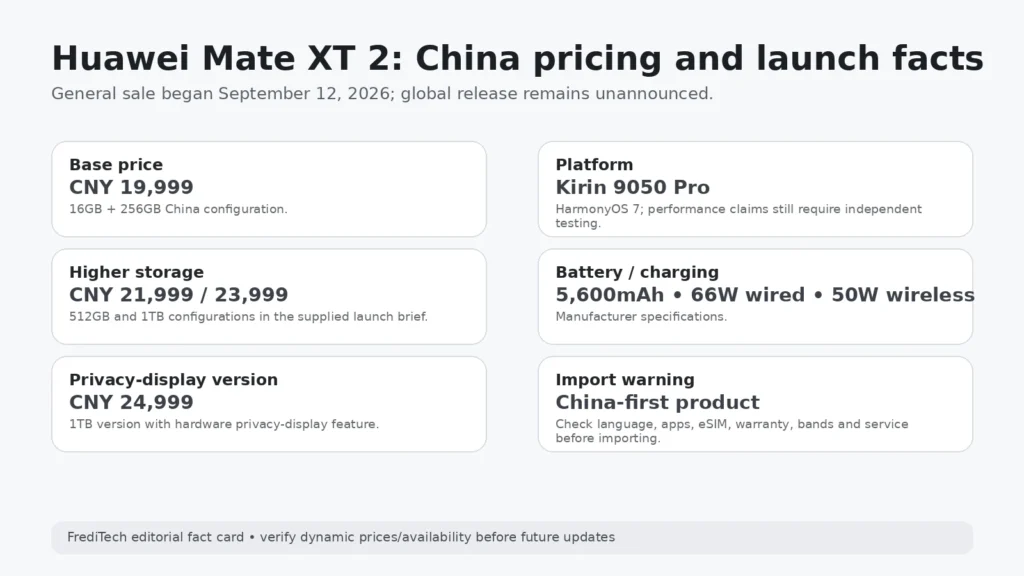
Mate XT 2 costs about 11.1% more than the preceding Mate XTs
Huawei’s previous Mate XTs started around CNY 17,999, while Mate XT 2 begins at CNY 19,999. The CNY 2,000 difference works out to roughly 11.1% relative to the predecessor’s entry price. That is a generational comparison, not evidence that Huawei simply raised the price of an unchanged phone by 11.1%. The hardware platform, display arrangement, chipset, software and durability positioning have changed.
Whether the higher starting point is justified cannot be answered from specifications alone. A buyer paying this much should care about hinge longevity, crease behavior, thermal performance, camera consistency, repairability and real battery endurance. Those areas need sustained independent testing, especially because a tri-fold has more moving parts and more flexible-display area than a conventional slab phone.
What changed with Huawei Mate XT 2?
The headline change is a revised tri-fold architecture that moves between a conventional folded-phone state and a large tablet-like workspace. Huawei combines it with a dedicated outer display, Kirin 9050 Pro, HarmonyOS 7, an optional privacy display, stronger ingress-resistance ratings and a revised camera/hinge package.
The new tri-fold design changes everyday usability
The Mate XT 2 is built around three usage scales. Folded, it behaves more like a conventional phone for messaging, navigation, calls and quick camera use. In an intermediate state it can provide a larger reading or multitasking area without opening to full size. Fully unfolded, the roughly 10.2-inch-class workspace is closer to a small tablet, making documents, split-screen apps, video and large web pages the reason to accept the added complexity.
The trade-off is mechanical. Two hinge lines and a large flexible panel create more possible stress points than a normal phone. Buyers should consider how often they would actually use the expanded state; if the device spends most of its life folded, a simpler foldable or flagship may be the more rational purchase.
Huawei’s privacy display is optional, not standard
Huawei’s privacy-display configuration is meant to reduce side-angle visibility when the feature is active. The practical use case is straightforward: someone reading work material, financial information, messages or travel documents in a crowded environment can make casual shoulder-surfing more difficult. Huawei describes the implementation as a hardware-level display feature rather than a simple darkening overlay.
That should not be confused with data security. A privacy display cannot replace a strong screen lock, account protection, encrypted messaging, app permissions or secure network behavior. It also changes the purchase decision because only specific SKUs include it. Buyers should verify the exact configuration instead of assuming the feature is present on every 1TB Mate XT 2.
Kirin 9050 Pro is one of the biggest technical changes
The Kirin 9050 Pro is central to Huawei’s performance story. The company positions the new platform around stronger CPU, graphics, AI and sustained-performance behavior, alongside software-level optimization for the folding interface. Huawei also promotes advanced graphics features and cooling improvements. Those claims are relevant, but they remain manufacturer claims until independent benchmarks establish peak performance, sustained gaming speed, thermal limits and efficiency.
For a tri-fold, sustained performance matters more than a single benchmark run. The large display encourages multi-window workloads, video editing, gaming and long productivity sessions. If heat forces aggressive throttling, the benefit of a faster chip can disappear. International buyers also need to care about application compatibility under HarmonyOS 7 rather than assuming benchmark scores translate directly into the same software experience as an Android flagship.
HarmonyOS 7 makes better use of the three-panel display
HarmonyOS 7 is designed to make the changing screen sizes useful rather than merely impressive. Huawei’s large-screen software supports multi-window layouts, content continuity and interface arrangements intended for the expanded canvas. A three-window workflow can be genuinely useful for research, messaging and documents, while stylus support on the relevant configuration can turn the device into a compact note-taking or annotation tool.
Mate XT 2 camera system explained
The supplied camera baseline combines a 50MP variable-aperture main camera, 40MP ultrawide and 50MP periscope telephoto, plus Huawei’s third-generation color-sensing system. On paper, that is a more complete camera package than many foldables, because it covers wide, standard and telephoto perspectives rather than treating photography as secondary to the folding mechanism.
The variable aperture can change how much light reaches the sensor and can influence depth of field, but hardware flexibility does not guarantee superior pictures. Processing, autofocus, motion handling, flare control and telephoto consistency all matter. Buyers should wait for independent samples before treating the camera specification as proof of best-in-class performance. FrediTech’s smartphone photography guide explains why sensor, lens and processing quality matter more than megapixels alone.
5,600mAh battery and charging
A 5,600mAh battery is substantial, but the Mate XT 2 also has an unusually large display area to power. Huawei lists 66W wired charging and 50W wireless charging, with reverse wireless charging for compatible accessories. Those figures should make top-ups convenient, but they do not answer the endurance question. Screen state, brightness, 5G usage, multitasking, camera work and background services can all change how long the phone lasts.
The useful buyer takeaway is to separate capacity from runtime. A 5,600mAh cell in a conventional phone and the same capacity behind a 10.2-inch-class unfolded OLED are not equivalent workloads. Independent battery tests should therefore include folded and unfolded use rather than quoting one mixed-use number.
IP58 and IP59 are important—but not a waterproof guarantee
The IP58/IP59 positioning is notable for a multi-hinge foldable because ingress resistance is difficult when a device contains moving mechanical interfaces. The ratings indicate defined laboratory protection against dust and water conditions, but they should not be translated into “waterproof.” Normal wear, impacts, contamination around hinge areas and service history can change real-world resistance.
A buyer should also check warranty language before assuming liquid exposure is covered. The sensible interpretation is that Huawei has engineered more resistance into a fragile category—not that a CNY 20,000-plus folding phone should be treated like an action camera.
Durability is still the biggest unanswered question
No specification can fully answer how two hinges and a large flexible display age over several years. The key long-term questions are hinge looseness, debris tolerance, crease development, ultra-thin-glass behavior, outer-surface scratching, impact resistance and parts availability. Huawei may publish laboratory folding-cycle or impact claims, but those remain controlled tests rather than proof of five years of daily ownership.
Repair cost is part of durability too. A device can survive ordinary use yet still be a risky purchase if replacing the flexible panel, hinge assembly or outer glass is prohibitively expensive outside its home market. That is one reason international buyers should not focus only on the purchase price.
Huawei Mate XT 2 global release: what we know
Huawei has not confirmed a broad international Mate XT 2 release at the time of this package. The company’s earlier trifold family later reached selected overseas markets, which shows that international expansion is possible, but historical precedent is not a launch schedule. There is no basis for inventing U.S., UK, European or Indian dates or prices.
For readers outside China, the best strategy is to wait for an official regional announcement if local warranty, payments, networks and app compatibility matter. A future global version could differ in software, supported bands, included services or price. Importing now gives earlier access, but also transfers more compatibility and after-sales risk to the buyer.
Should you import the Huawei Mate XT 2?
Network and SIM compatibility
Compare the exact China model’s 4G and 5G bands with your carrier, then check VoLTE, Wi-Fi calling and roaming support. Do not assume that a device attaching to a 5G network means every carrier feature will work. Physical-SIM and eSIM behavior also needs model-specific verification, particularly if you travel or switch providers frequently.
Software, apps and payments
HarmonyOS 7 is not the same software environment as an internationally sold Google-certified Android phone. Buyers who depend on Google Play, Google Wallet, Android Auto, specific banking apps, work-management software, DRM-heavy streaming or push-notification frameworks should verify each requirement rather than accepting a seller’s broad claim that “Android apps work.” Workarounds can change and may not be suitable for mission-critical services.
Warranty, repairs and import costs
Mainland-China warranty and service terms may not transfer cleanly to another country. A tri-fold also raises the stakes because hinge and display repairs require specialized parts. Add shipping, customs duties, VAT/GST, brokerage and possible return costs before comparing an importer price with a future local MSRP. The cheapest listing can be the most expensive ownership path if something fails.
- Confirm the exact model number and network bands.
- Verify physical-SIM/eSIM support with your carrier.
- Check essential apps, banking, payments, navigation and notifications.
- Ask who handles warranty claims and international return shipping.
- Price import taxes and insurance before paying.
- Confirm access to hinge, flexible-display and battery service.
Huawei Mate XT 2 vs Xiaomi 18 Fold: short context
The Mate XT 2 and Xiaomi 18 Fold target different versions of premium folding hardware. Huawei’s defining feature is the three-panel tablet-like workspace and its associated engineering complexity. Xiaomi’s competing foldable approach uses a different form factor and is positioned at a substantially lower China starting price. That makes a direct “which is better” verdict too simplistic without comparing the buyer’s preferred form factor, software, camera priorities and local availability.
FrediTech should keep the detailed comparison in a dedicated article rather than turning this availability guide into a second full review. Here, the key point is that Mate XT 2 charges a large premium for the tri-fold experience and Huawei ecosystem rather than competing purely on conventional flagship value.
Who should consider the Mate XT 2?
The strongest audience is luxury foldable enthusiasts, Huawei ecosystem users in China, multitaskers who genuinely use a tablet-sized canvas and early adopters willing to accept more mechanical and service complexity. It can also suit travelers or professionals who want one device to cover phone, reading, video and light productivity—provided their apps and networks are supported.
It is harder to recommend to international buyers who require Google-centric services, local warranty, predictable repair costs or independently proven long-term durability. Value-focused shoppers who rarely use a tablet-sized screen are also paying for engineering they may not exploit.
Frequently asked questions
How much does Huawei Mate XT 2 cost?
The China range starts at CNY 19,999 for 16GB/256GB, with higher storage and privacy-display configurations costing more.
When did the Mate XT 2 go on sale?
Huawei’s mainland-China general sale began September 12, 2026.
Where can I buy it?
The confirmed launch market is mainland China through Huawei and participating local retail channels.
What processor does it use?
The launch baseline identifies the Kirin 9050 Pro.
Does every Mate XT 2 have the privacy display?
No. The privacy display is tied to specific higher-priced configurations.
Does it have Google Play?
International Google-service compatibility should not be assumed on the China HarmonyOS 7 model. Verify the exact services you need before importing.
Is Mate XT 2 available globally?
No broad global release had been confirmed for this article.
Can I import it from China?
Yes through import channels, but buyers should verify networks, software, warranty, repairs, taxes and returns first.
Is it waterproof?
No. IP58/IP59 are laboratory ingress-resistance ratings, not a guarantee against all water or dust damage.
What is the biggest ownership risk?
Long-term flexible-display/hinge durability and international service support remain major unanswered questions.
Sources and verification
- Huawei China Mate XT 2 product page — product, design and launch context.
- Huawei specifications — hardware and configuration details.
- FrediTech smartphone photography guide — internal context on camera hardware and processing.