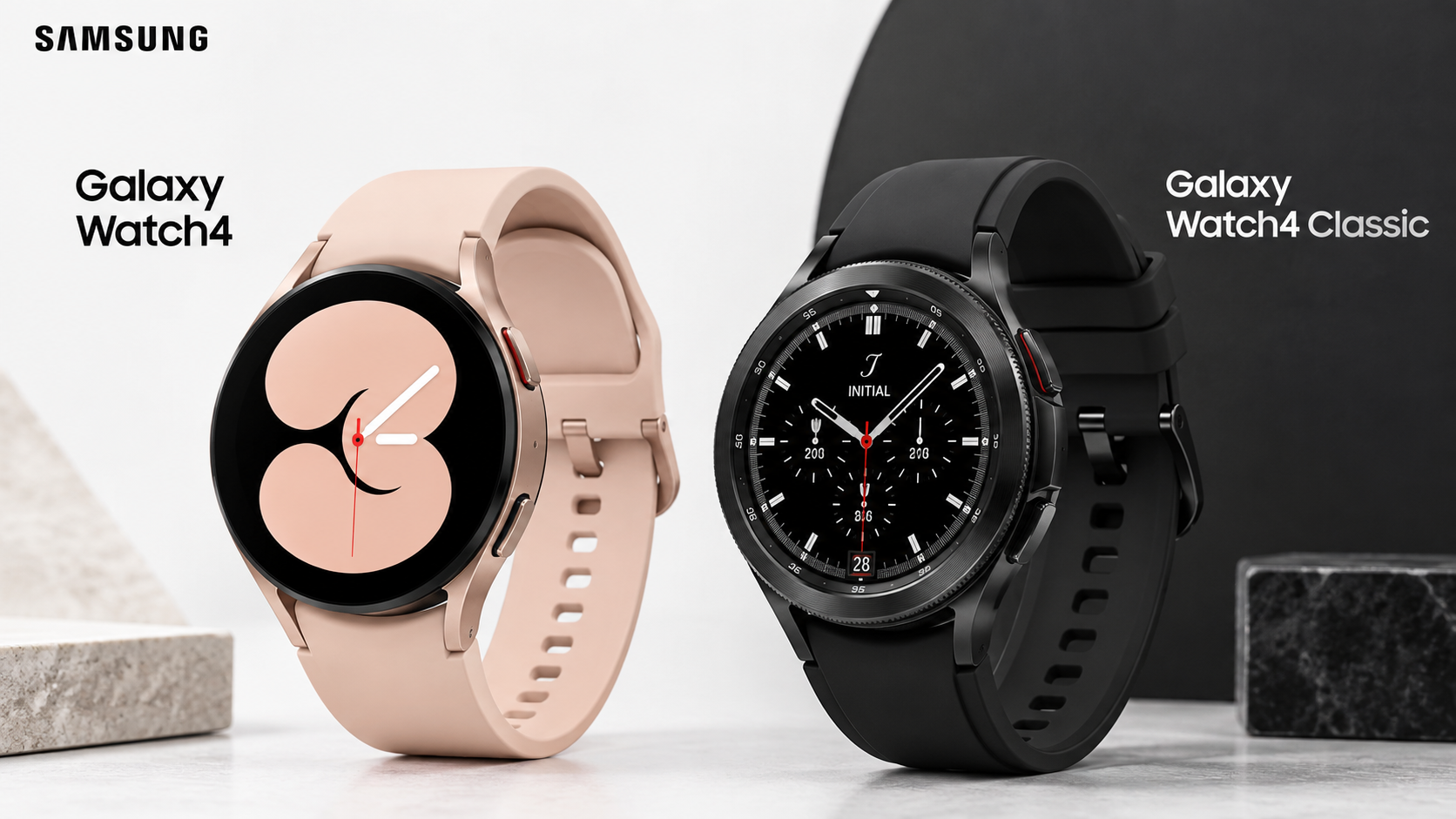

Samsung has removed the Galaxy Watch 4 and Galaxy Watch 4 Classic from its current regular wearable security-update scope. That is a meaningful lifecycle change, but it is not a shutdown notice. The watches still tell time, track workouts, receive notifications and can continue using supported apps and services. Samsung’s published Watch4 update history currently shows an August 25, 2026 release for the SM-R870 with the August 5 security patch; other Watch4/Classic variants can have different rollout dates. The practical consequence is forward-looking: owners should no longer expect routine future firmware and security maintenance. Existing owners can keep using a healthy, fully updated watch with sensible precautions, while the used/refurbished value proposition is now materially weaker because supported newer Galaxy Watches are available.
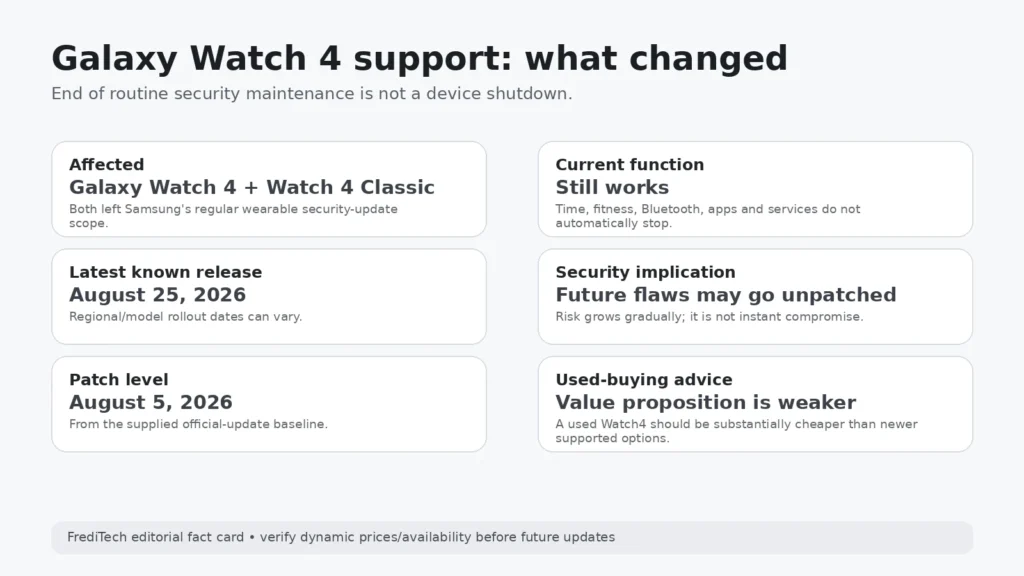
Table of contents
Samsung has ended routine Galaxy Watch 4 security support
Samsung’s Mobile Security update-scope page is the key evidence. The current quarterly wearable list begins with the Galaxy Watch5 generation and includes newer Watch models, while Watch4 and Watch4 Classic are absent. Samsung also notes that device lists can change as internal support or Wear OS support periods expire. That supports precise wording: the Watch4 series has left the regular security-update scope.
It does not support claims that Samsung has “bricked,” “shut down” or remotely disabled the devices. Software maintenance, app compatibility and hardware service are separate lifecycles. A regional Samsung service center may still repair some Watch4 variants even though routine firmware security maintenance has ended.
Galaxy Watch 4 final update: what Samsung’s history shows
For model SM-R870, Samsung’s official history currently lists build R870XXS2JZG3, AndroidWear 6.0, released August 25, 2026 with the August 5, 2026 security patch level. Watch4 Classic histories show the same patch level but different rollout dates for some model and regional variants. That is why the article should say “latest known official release in the cited history,” not claim every Watch4 worldwide received an identical package on the same day.
The series had already received One UI 8 Watch / Wear OS 6 before leaving routine security maintenance. Samsung originally committed to multiple major Wear OS/One UI Watch generations for the Watch4 family, and the device received several platform upgrades over its life. The end-of-support milestone is therefore better understood as the conclusion of a long lifecycle than as an abrupt withdrawal immediately after launch.
Your Galaxy Watch 4 will not suddenly stop working
Routine firmware support is not required for the watch to perform every basic task. Existing timekeeping, alarms, local watch faces, Bluetooth pairing, fitness tracking, notifications and installed applications can continue to function. Samsung Health and Google services do not automatically disappear on the date a device leaves the update list.
Individual apps and services have their own compatibility rules, however. A developer can eventually raise its minimum Wear OS or Google Play Services requirement, a payment provider can change eligibility, or a carrier can modify LTE provisioning support. Those future service changes should be reported when they actually happen rather than predicted as immediate consequences of Samsung’s security-policy change.
What actually changes when security support ends
The clearest change is that owners should no longer expect routine fixes for newly discovered firmware vulnerabilities. A smartwatch can interact with a Samsung account, Google account, paired smartphone, Bluetooth, Wi-Fi, LTE on cellular versions, notifications, health information, location and payment services. Unsupported firmware is not instantly compromised, but the probability that a future flaw remains unpatched generally increases as time passes.
Owners should also not expect new major Wear OS generations, new One UI Watch generations or regular platform feature drops. Samsung could theoretically issue an exceptional emergency patch, but the Watch4 family is no longer in the regular scope, so buyers should not plan around the hope of extraordinary support.
Is Galaxy Watch 4 still safe to use?
For an existing owner, continued use can be reasonable when the watch is on its latest available firmware, protected with a PIN or pattern, paired with an updated Android phone and used with trusted apps. Account security matters too: strong unique passwords, two-step verification or passkeys and regular review of Samsung/Google sessions reduce risk across the ecosystem.
The decision becomes more conservative for users who rely heavily on mobile payments, independent LTE, work notifications or sensitive accounts. Those use cases expose more valuable data and make long-term patch availability more important. Someone mainly tracking workouts, sleep and notifications may accept the support limitation for longer than someone using the watch as an always-connected wallet and communications device.


What Galaxy Watch 4 owners should do now
- Install the newest firmware offered to your exact model and region through Galaxy Wearable → Watch settings → Watch software update.
- Check the security/software information under the watch’s About/Software information menus.
- Keep the paired phone, Galaxy Wearable and Google Play components updated.
- Use a watch PIN or pattern, especially if payments are enabled.
- Use strong Samsung and Google account security, including two-step verification or passkeys where available.
- Remove unused watch apps and review permissions for location, microphone, contacts, health and notifications.
- Remove payment cards you no longer use.
- Plan a replacement based on security needs, battery condition and budget rather than panic-buying.
Will Samsung Health, apps and payments still work?
Current Samsung documentation continues to support Watch4-era hardware for Samsung Health/Health Monitor functionality, while Google Wallet’s smartwatch requirements remain compatible with the Watch4’s Wear OS generation where country, card, NFC and Play Services requirements are met. Samsung also continues to publish Watch4-oriented Samsung Pay setup guidance in supported regions.
That current status should be separated from long-term firmware support. A wallet service can remain functional on an unsupported device because payment tokens, app updates and server-side eligibility are managed separately. FrediTech should update the article if Samsung Health, Google Wallet, Samsung Wallet or Galaxy Wearable changes minimum requirements.
Should LTE Galaxy Watch 4 owners be more cautious?
LTE variants maintain their own cellular connection and can spend more time operating independently from the phone. That does not mean carriers automatically terminate service when Samsung ends routine security maintenance. Owners should verify current carrier provisioning, eSIM support, firmware version and network compatibility, especially before resetting or transferring the watch.
The extra caution is about exposure and dependence. A watch used for independent calls, messages and mobile payments carries more network-facing responsibility than a Bluetooth-only watch used mainly for step tracking. That can justify upgrading sooner even when the hardware still works.
Battery health may now matter as much as software
The Watch4 generation launched in 2021, so early units are around five years old. Lithium-ion batteries age through charge cycles and calendar time; some Watch4 units now have noticeably shorter endurance even if the software remains responsive. Buttons, displays, charging contacts and—on the Classic—the rotating bezel can also accumulate wear.
Support ending therefore arrives at a point when physical condition can already make replacement sensible. That does not mean every Watch4 battery is degraded. Owners should judge actual daily runtime, charging behavior and hardware wear instead of assuming age alone makes the watch unusable.
Is Galaxy Watch 4 still safe to buy used?
This is where the support change has the clearest buying impact. A used Watch4 can still make sense as a very inexpensive basic fitness/notification watch, especially if the battery is healthy and the seller offers returns. But the lack of routine security maintenance reduces its long-term value compared with supported watches.
It is a poor choice when its price approaches Watch5, Watch6, Watch FE, Watch7 or newer models. Buyers planning three to five more years of ownership, using payments heavily or expecting new platform features should start with hardware that remains inside Samsung’s security-maintenance window.
What price would make a used Watch4 worthwhile?
There is no universal dollar threshold because used prices vary by size, Classic versus standard, LTE versus Bluetooth, cosmetic condition and battery health. The correct approach is relative: compare the specific Watch4 listing with supported alternatives in the same market and condition. If Watch4 is only a small amount cheaper than Watch5 or Watch6-generation hardware, the newer model is usually the better long-term value.
A Watch4 needs a meaningful discount to compensate for the missing support runway. Buyers should also price potential battery replacement and remember that an exceptionally cheap LTE model is not a bargain if carrier activation is difficult or the battery cannot last a day.
Best upgrades from Galaxy Watch 4 in 2026
| Model | Why consider it | Who it suits |
|---|---|---|
| Galaxy Watch7 | Lower-cost newer Samsung option; still in current support scope. | Value-focused owners who want a modern replacement. |
| Galaxy Watch8 | Newer mainstream model with current support and updated design. | Most Watch4 owners seeking balance. |
| Galaxy Watch8 Classic | Physical rotating bezel and newer support runway. | Watch4 Classic owners who want familiar controls. |
| Galaxy Watch9 | Current mainstream generation with newer platform. | Buyers prioritizing longer forward runway. |
| Galaxy Watch Ultra2 | Rugged premium build, LTE/outdoor emphasis and larger battery. | Outdoor users who genuinely need the premium features. |
Watch5 remains supported today, but it is now the oldest generation on Samsung’s quarterly wearable list. That makes it safer than Watch4 in the short term, yet not automatically the best long-horizon upgrade. When prices overlap, a newer generation usually gives buyers more remaining support time.
Should you upgrade now or keep using Watch4?
Upgrade sooner if the battery is badly degraded, the watch is critical for payments or LTE, you want ongoing security patches, the hardware is physically worn or you intend to keep the replacement for several years. Continue temporarily if the watch still performs well, its battery is acceptable, you mainly use fitness/notifications and the cost of replacement would be burdensome.
There is no evidence-based “replace within 30 days” deadline. The sensible plan is gradual: secure the watch, keep supported components updated, monitor service compatibility and upgrade when the support limitation or aging hardware becomes materially relevant to your use.
Frequently asked questions
Has Samsung ended Galaxy Watch 4 support?
Samsung has removed Watch4 and Watch4 Classic from its current regular wearable security-update scope.
Does Galaxy Watch 4 still get security updates?
Routine updates should no longer be expected. An exceptional future patch is possible but should not be relied on.
What was the final Galaxy Watch 4 update?
For Samsung’s SM-R870 history, the latest known release is dated August 25, 2026 with the August 5 security patch.
Will Galaxy Watch 4 stop working?
No. Leaving the routine update list does not remotely disable the watch.
Is Galaxy Watch 4 still safe to use?
A fully updated unit can remain usable, but future unpatched vulnerabilities gradually increase security risk.
Can I still use Samsung Health?
Current compatibility continues; future app/service requirements can change independently.
Can I still use Google Wallet or Samsung Wallet?
Currently yes where the normal device, card and regional requirements are met.
Is Galaxy Watch 4 worth buying used?
Only when the price is substantially below supported alternatives and battery/condition are good.
Does Galaxy Watch 4 Classic still receive updates?
It has also left Samsung’s regular wearable security-update scope.
Which Galaxy Watch should I buy instead?
Watch8 is a balanced mainstream upgrade; Watch9 provides the newer platform, while Watch8 Classic suits rotating-bezel fans.
Sources and verification
- Samsung Mobile Security update scope — current wearable support list.
- Samsung Galaxy Watch4 SM-R870 update history — build and patch history.
- Samsung/Google support pages — current Samsung Health, payment and Wear OS compatibility context.