
Smartphone design changes more slowly than launch events make it seem, but meaningful shifts are happening in materials, camera layouts, foldables, device thickness, repairability and how hardware is shaped around larger batteries and on-device AI. The useful trends are the ones that improve comfort, durability or function—not cosmetic change for its own sake.
Quick Verdict
- Expect continued experimentation with foldables, thinner bodies and new materials, but battery and thermal limits still shape design.
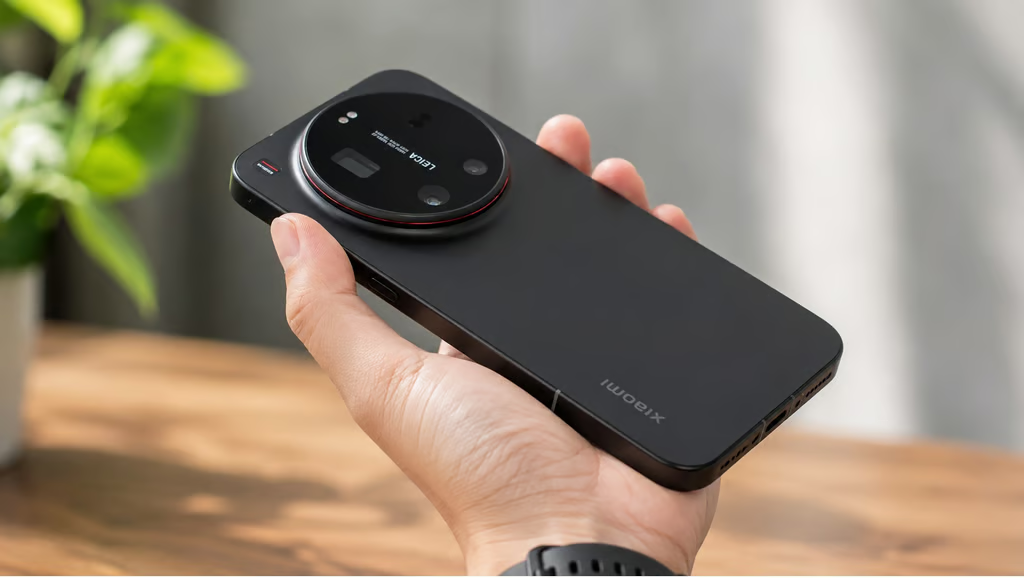
- Camera modules remain large because imaging hardware needs physical space; software alone has not removed that trade-off.
- Repairability, durability and ergonomics deserve as much attention as visual novelty.
Smartphones in 2025 will look and feel very different from today’s models. We’re seeing the push for larger, nearly bezel-less displays that wrap around edges, and the elimination of traditional notches, buttons, and ports in favor of in-display sensors and wireless solutionsdigitaltrends.comsuffolkgazette.com. New form factors – foldable, sliding, or even rollable screens – promise to change how we interact with our devices. In this article, we explore the emerging design trends shaping the next generation of smartphones: from advanced AI integration and connectivity to sustainable, modular construction and features trickling down to mid-range and budget phonessuffolkgazette.comtatlerasia.com.
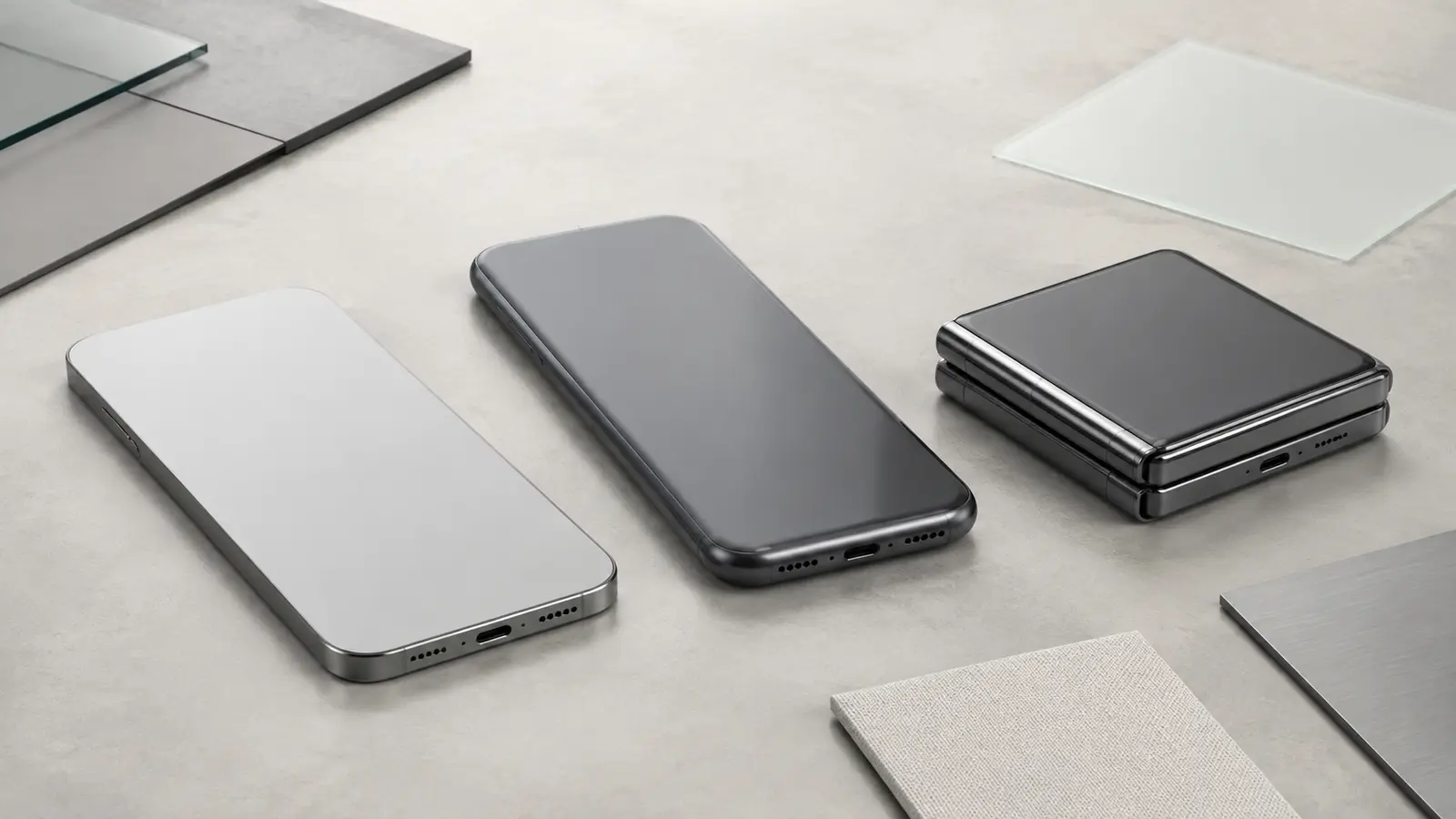
Figure: Future smartphone designs are moving toward edge-to-edge displays, touch-sensitive surfaces, and novel form factorsdigitaltrends.comsuffolkgazette.com.

Table of contents
AI-Powered Features and Interfaces
Artificial Intelligence (AI) will be deeply embedded in 2025’s smartphone designs, both in software and hardware. On the software side, built-in AI assistants will become more capable and context-aware. New on-device language models enable richer voice assistants: for example, Apple’s updated Siri now taps into Apple Intelligence across apps, using on-screen context to edit photos or summarize texttechcrunch.com. In essence, “Siri uses the context of the content you’re currently engaged with to provide an appropriate answer”techcrunch.com. Google’s Android phones similarly incorporate Gemini (Google’s large language model) for smarter voice commands and real-time servicessuffolkgazette.com. We can also expect AI to optimize system performance and UX: battery and storage management may become predictive, and cameras will use on-device AI for image processing. Real-time language translation during calls and chats is another expected featuresuffolkgazette.com.
Hardware design will reflect this AI focus too. Devices may include dedicated AI chips or Neural Processing Units (NPUs) under the hood for fast on-device inferencing. Smartphones are becoming part of a larger AI ecosystem, with seamless AR experiences (e.g. LiDAR for depth sensing, AR glasses integration) and better cross-device AI featurestechcrunch.comsuffolkgazette.com. Some high-end phones already pack multiple cameras and sensors for AI-driven photography; by 2025 even mid-range models will gain advanced camera systems and AI-enhancements. In fact, analysts note that by 2025 mid-range phones are adopting features once exclusive to flagships – such as advanced camera hardware, fast processors, and high-quality displaysnielseniq.com. This “flagship trickle-down” means even budget-conscious consumers will enjoy AI-powered photo enhancements and smooth multitasking on cheaper devices.
Innovative Form Factors and Displays
Manufacturers continue to push the boundaries of screen design. Foldable and dual-screen phones – which let a phone open into a tablet-sized display – are expected to become more common and practical by 2025digitaltrends.comnngroup.com. Nielsen Norman Group reports the market share of foldables rose from about 0.5% in 2021 to 1.6% in 2023, and is projected to near 5% by 2028. Rumors even suggest a foldable iPhone is in the works. Moreover, new form factors like rollable displays (screens that extend or retract) are on the horizon. These innovations let smartphones offer both large-screen productivity and pocketable convenience. As Digital Trends notes, “foldable displays will play a large role in the next era of smartphone design”digitaltrends.com.
Beyond foldables, designers are exploring buttonless, bezel-less designs. Advanced touch and gesture technologies (like ultrasound-based touch sensors) could eliminate physical buttons altogetherdigitaltrends.com. For example, new ultrasonic touch chips allow taps and slides on any phone surface (back or edges), enabling truly wraparound “waterfall” displays. As one expert explained: this tech “could allow designers to develop curved edges and waterfall screens that wrap glass right round the device, expanding the display surface”digitaltrends.com. The result is phones that might be entirely display on the front and sides, without a frame – maximizing screen area while improving aesthetics. This trend already started: we see curved “edge” screens and side-touch volume controls. By 2025, fully edge-wrapped screens and on-surface buttons seem within reach.
Even without foldables or exotic displays, 2025 phones will generally push screen quality. Expect widespread high-refresh-rate OLED or AMOLED panels (120Hz or higher for smooth animations) and ultra-high resolutions. HDR support will become even better for vivid colors in video. Eye comfort is also a focus: adaptive brightness and color temperatures that adjust to ambient light will be standard, along with more blue-light reduction options to lessen eye strainsuffolkgazette.com. Some devices may use tougher “sapphire glass” or ceramic for screen protection. Under-display cameras will improve too, making front cameras nearly invisible behind the screen in mainstream devices (we’ve seen early under-display cameras, and by 2025 they should be better and more common).
Connectivity and Ecosystems
Connectivity is a key design consideration for 2025 smartphones. 5G is now mature, and carriers worldwide will continue expanding 5G coveragesuffolkgazette.com. This will unlock new features: for instance, lag-free cloud gaming and AR/VR streaming. Many designs will incorporate Wi-Fi 6E/7 and Bluetooth LE for faster local links. Importantly, phones are becoming the hub for all our gadgets: smart home devices, wearable tech (smartwatches, earbuds, health sensors) and IoT appliances will interconnect, with the smartphone as the central controller. We’ll see design trends supporting this: dual-frequency antennas for reliable connections, ultra-wideband (UWB) sensors for precise device tracking, and possibly even built-in satellite connectivity for emergencies (a trend started by recent satellite SOS services in premium phones).
Another connectivity trend is the emphasis on ecosystems. Modern smartphones are designed to work seamlessly with tablets, laptops, and accessories. This could mean design choices like more robust pairing chips or even aesthetic cues that match other devices. For example, a 2025 flagship might share a design language with its company’s smart glasses or VR headset. In some cases, phones will ship with accessories as part of their design story: modular add-ons (like clip-on lenses or game controllers) could be sold as optional cases. All this influences smartphone shape (extra rails or connectors on the back) and software (UI accommodating external devices).
Sustainable and Modular Design
Environmental sustainability is becoming a major smartphone design factor in 2025. With millions of devices discarded annually, brands are under pressure to reduce e-wastesuffolkgazette.com. We will see a shift to eco-friendly materials and construction. Many phones will use recycled metals and plastics in their chassis or internal parts. For example, some companies (like Fairphone) have already pioneered 100% recycled aluminum framestatlerasia.com. Other potential materials include bio-based plastics or even renewable resources like bamboo composites (some concept phones have experimented with these). Even packaging is getting greener: expect phones delivered in minimal, recyclable packaging with natural-dye printing.
More important, phone designs will emphasize longevity. The industry is moving away from sealed, throwaway devices. Modular designs – where users can easily swap parts – are on the rise. This means using screws instead of glue, standardized connectors, and offering spare parts. For instance, Fairphone’s latest model is engineered for a ten-year lifespan: it uses no glue (so the display, battery, camera modules, and charging port can be individually replaced by the user)tatlerasia.com. It even comes with extended warranties and long-term software support. Other brands (like Apple and Samsung) are also making batteries and screens easier to replace, and committing to multi-year update support.
Such modularity and repairability directly influence design. You might see phones with slightly thicker frames to accommodate swappable modules or tool-access panels. Some mid-range phones already have removable back panels or snap-on camera units. Design for service means a phone might deliberately look more “utility” than sleek glass: visible screws, latch-release backs, or clip-on accessories could become features.
Environmental and regulatory pressures will also push sustainability. In regions tightening e-waste rules, phone makers may adopt even more changeable designs. With companies like Fairphone, HMD (Nokia brand), and others leading modular innovation, “the smartphone of the future may not just be smarter—it may also be more sustainable, more durable and more personalised.”tatlerasia.com. Even beyond modular phones, expect premium models to emphasize recycled components and ethical sourcing. For example, a 2025 flagship might tout that its body is made from 100% recycled aluminum or that its camera lens glass uses eco-friendly processing, reflecting a growing “green” design trendtatlerasia.com.
Mid-Range and Budget Innovations
By 2025 the cutting-edge design is trickling down to all price tiers. The mid-range market will continue its growth by offering “premium” features at more affordable pricesnielseniq.com. Many mid-range phones will use materials and aesthetics once reserved for flagships – metal or glass frames with slim bezels and high-end colors. Displays on mid-range devices will increasingly be high-quality AMOLEDs with 120Hz refresh rates, matching flagship smoothnessnielseniq.com. Advanced camera setups (triple-lens systems, periscope zoom) and AI photography tricks will become common even below $400.
A key strategy is using last year’s flagship designs to fill budget segments. Manufacturers often keep older flagship models in production as cheaper alternatives. NielsenIQ notes that a significant portion of revenue still comes from such older modelsnielseniq.com. These carry over the premium design – premium metal construction, flagship chips, large batteries – at a lower cost. For example, a year-old Galaxy S or iPhone often serves as the “high-end” offering of the mid-tier market. This extends the design life of polished frames and fine materials into lower price points.
Moreover, certain form factors will appear in budget lines. We expect the first affordable foldables in 2025, for instance a lower-cost clamshell device that folds but lacks some premium features (lower RAM or display resolution) to cut cost. Plastic-based foldables (cheaper than glass) might debut. Even modular accessories will reach mid-tier: clip-on camera lenses or decorative accessory backs could be marketed for cheaper models.
Real examples from Freditech’s coverage show this trickle-down. The OnePlus Nord 4 – listed among “best mid-range” devices – packs a 120Hz AMOLED display, a 5,000 mAh battery with fast charging, and a Snapdragon 7 Gen 2 chipfreditech.com. Similarly, Samsung’s popular Galaxy A-series (e.g. A54) offers AMOLED screens and high refresh rates at under $400freditech.com. These designs used to be flagship features, but by 2025 they’re standard in mid-range. Even ultra-cheap phones will improve: some $200 phones will add fingerprint scanners under the display and multiple cameras.
In short, good design won’t be limited to flagships. Budget and midrange phones will increasingly mimic the look and feel of premium devices, just with small compromises to cut price. This democratization of design means more users get sleek glass-backed phones and fluid UIs, regardless of budget.
Emerging Tech Trends
Beyond these core areas, other design trends are emerging. One is security by design: some phones may feature more advanced biometric integration (under-screen face recognition, on-device encrypted processors) that could change their shape or button layout (no fingerprint sensor cutouts, etc.). Health sensors (like tiny ECG or blood-oxygen sensors) might be built into phone edges or backs, subtly influencing the internal component placement.
Gaming-centric designs are influencing general phones too. Devices like the ASUS ROG series have popularized more rugged designs and side-mounted controlsdigitaltrends.comdigitaltrends.com. In 2025, even non-gaming phones might borrow such styling cues (e.g. shoulder triggers, larger vents for cooling, or RGB accents), especially on mid-tier “performance” models. Higher refresh-rate displays and advanced cooling systems (like vapor-chamber cooling) will trickle into mainstream, affecting thickness and weight.
Augmented Reality is another angle. If AR glasses gain traction, phones will act as hubs: they might have stronger graphics chips, better cameras for passthrough AR, and UWB for connecting to AR/VR headsets. Though AR headsets are separate devices, their ecosystem synergy affects phone design (e.g. having thicker rails for better antennas, or adding sensors like LiDAR for depth).
Finally, user personalization will be big. Brands may offer more customization – removable backs, changeable covers, or even color-changing materials. Beyond hardware, software design will allow users to theme their interface deeply. While not a “physical” design trend, the expectation of personalization (like choosing which notifications appear on always-on display) means hardware may include features like customizable side keys or programmable touch zones on the chassis.
Conclusion
In 2025, smartphone design is evolving on multiple fronts. Form factors will diversify (foldable, sliding, waterfall), materials will get tougher and greener, and features like AI assistants and 5G connectivity will be seamlessly integrated into the user experience. Even budget and midrange devices will look and feel premium, and companies will design for longevity and repair. The result will be phones that are more powerful, more eco-friendly, and more specialized for each user’s needs. As one industry analyst put it, “After a long period of advancement for the hardware inside our smartphones it’s time for some brave new styles for the outside”digitaltrends.com.
For real-world examples, check out Freditech’s reviews of the latest models. Our [Samsung Galaxy S25 review] highlights its premium aluminum-glass build and near-edge-to-edge displayfreditech.com, while our [iPhone 16 vs 16 Pro guide] shows how Apple uses aluminum vs stainless steel frames for different modelsfreditech.com. These articles illustrate exactly how 2025 design trends are shaping up in today’s devices.
As smartphone innovation accelerates, staying informed helps consumers choose the right device. For more on picking the best phone, see our [Smartphone Buying Guide 2025] for key features to consider. The phone of 2025 is sure to surprise and delight with cutting-edge design – and the changes are already underway in flagship and budget models alike.
FAQ
What are the mobile app design trends for 2025?
Mobile app design in 2025 focuses on personalization, AI integration, voice-first UX, dark mode enhancements, and micro-interactions. Minimalist interfaces continue to dominate, while gesture navigation and augmented reality features grow in popularity. Developers are adopting a “design for all devices” mindset, emphasizing seamless UX across foldables, tablets, and wearables.
What is the forecast for smartphones in 2025?
According to IDC and Counterpoint Research, global smartphone shipments are expected to grow modestly in 2025, with over 1.4 billion units shipped. Foldable phones are projected to make up 5–6% of sales. Mid-range and budget smartphones will adopt flagship features like 120Hz displays and AI-enhanced cameras.
What new phones are coming in 2025?
Some highly anticipated 2025 phones include the Samsung Galaxy S25 Ultra, Apple iPhone 17 series, Xiaomi 15 Ultra, and OnePlus 13 Pro. Additionally, foldable models like the Google Pixel Fold 2 and more affordable clamshell foldables from Chinese brands are set to enter the market.
What will replace smartphones in 5 years?
Experts predict that smartphones may evolve into wearable or ambient computing devices. AR smart glasses and AI-powered earwear are contenders, with companies like Meta, Apple, and Samsung investing heavily in spatial computing and mixed-reality headsets. However, smartphones will likely remain dominant through 2030 while these alternatives mature.
What are the design trends in 2025?
Design trends include bezel-less displays, foldable and rollable screens, eco-friendly materials (like recycled aluminum), and portless bodies with in-display sensors. Color-shifting backs, customizable cases, and improved haptics also enhance the user experience. Modular phones are gaining ground for sustainability and repairability.
What is the most used app in 2025?
As of mid-2025, WhatsApp remains one of the most used apps globally, followed by Instagram, TikTok, and Telegram. However, AI-enhanced productivity apps like ChatGPT mobile and Google Gemini Assistant are rapidly climbing the ranks due to integration into work and daily life.
What will phones look like in 2026?
Smartphones in 2026 are expected to be thinner, with wraparound displays, no physical buttons, and completely portless bodies. In-display cameras, AI processors, and satellite connectivity will be standard in premium models. Foldables will look sleeker, with improved hinge tech and durability.
Which mobile brand is best in 2025?
Samsung and Apple remain industry leaders, with Xiaomi, OnePlus, and Google gaining ground. Samsung leads in foldables, while Apple dominates in software ecosystem. Xiaomi is notable for delivering flagship features at competitive prices, especially in the Asian market.
What will phones be like in 10 years?
By 2035, phones may shift to wearables or implanted devices, using AI and AR interfaces instead of traditional touchscreens. Experts foresee “invisible UI,” spatial computing, and holographic displays replacing today’s rectangular slabs. Energy-harvesting materials could extend battery life indefinitely.
Which app will replace TikTok in 2025?
While TikTok remains dominant in short-form video, platforms like YouTube Shorts, Instagram Reels, and new AI-curated video apps are growing. Some newer apps like “Clash” and “Lemon8” have gained attention in Gen Z circles, but no single app has yet dethroned TikTok globally.
How much does it cost to create an app in 2025?
Costs range from $5,000 to $300,000+ depending on complexity. A basic app with limited functionality may cost under $20,000, while AI-integrated, cross-platform, or enterprise-grade apps (e.g., Uber, TikTok-style platforms) can exceed $200,000. Use of no-code/low-code tools has reduced entry-level costs for MVPs.
Which app has 1 billion downloads?
Many apps have surpassed 1 billion downloads, including WhatsApp, Facebook, Instagram, Messenger, YouTube, TikTok, and Google Chrome. These apps dominate global usage due to cross-platform support and consistent user engagement.