
Quick verdict
Pixel 8 Pro favors a larger screen, longer zoom and Google’s AI-assisted photography. iPhone 15 Pro favors compact design, faster performance, video and Apple ecosystem continuity.
Table of contents

Introduction
The Google Pixel 8 Pro and Apple iPhone 15 Pro both launched in 2023 at a U.S. starting price of $999. They remain useful comparison points in 2026, but neither is a current-generation flagship, so price, condition and remaining support now matter as much as launch specifications.
The Pixel emphasizes a larger display, 5× telephoto camera and Google’s computational-photography and call tools. The iPhone emphasizes compact premium hardware, sustained performance, video recording and integration with Apple devices. This guide compares those practical strengths without assuming one platform is best for everyone.
For more options, browse our smartphone review archive.
Pixel 8 Pro vs iPhone 15 Pro: Quick Comparison
| Feature | Google Pixel 8 Pro | Apple iPhone 15 Pro | Winner |
|---|---|---|---|
| Display | 6.7-inch OLED, 120Hz, up to 2,400 nits peak brightness | 6.1-inch Super Retina XDR OLED, 120Hz, up to 2,000 nits outdoor brightness | Pixel 8 Pro for size and brightness |
| Performance | Google Tensor G3, 12GB RAM, AI-focused performance | A17 Pro chip, 8GB RAM, stronger CPU and GPU performance | iPhone 15 Pro |
| Cameras | 50MP main, 48MP ultra-wide, 48MP 5x telephoto | 48MP main, 12MP ultra-wide, 12MP 3x telephoto | Pixel 8 Pro for still photography and zoom |
| Video | Strong 4K video, 10-bit HDR, Video Boost support | Excellent 4K video, ProRes, Log, Dolby Vision, strong stabilization | iPhone 15 Pro |
| Battery | 5,050mAh battery, faster full charging | Smaller battery, but excellent efficiency and standby life | Pixel 8 Pro by capacity; close in daily use |
| Software | Android 14, Pixel AI tools, 7 years of updates | iOS 17, Apple ecosystem, long software support | Depends on platform preference |
| Best For | Photography, AI tools, Android customization, big-screen users | Performance, video, Apple ecosystem, compact premium design | Depends on your needs |
Design and Build Quality
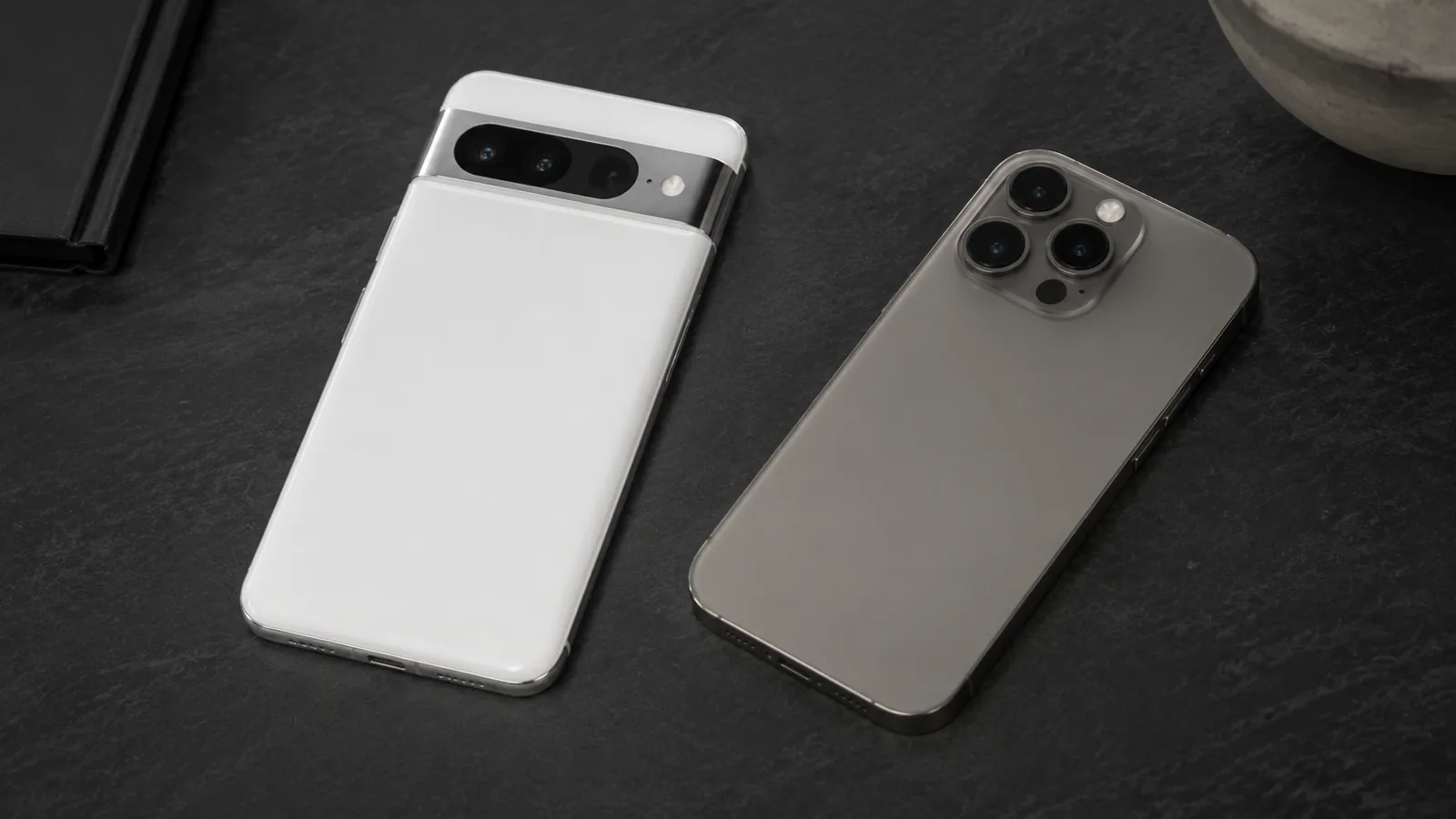
The iPhone 15 Pro and Google Pixel 8 Pro showcase two very different design philosophies. The iPhone uses a compact titanium body with a refined camera bump, while the Pixel 8 Pro uses a larger body, matte glass back, and Google’s signature horizontal camera bar.
When it comes to design and build, these phones take different approaches while both offering a premium feel. Google’s Pixel 8 Pro features a matte glass back, an aluminum frame, and the now-iconic horizontal camera visor stretching across the rear. The camera bar is not just a design statement; it also helps the phone lie more evenly on flat surfaces compared to phones with corner camera bumps. TechRadar highlights the Pixel 8 Pro’s larger size, camera bar design, and premium build in its comparison. Read TechRadar’s Pixel 8 Pro vs iPhone 15 Pro comparison.
The Pixel 8 Pro also includes a unique temperature sensor on the back near the camera array. It is a niche feature, but it adds to the Pixel’s experimental personality. In hand, the Pixel feels substantial because it is physically larger and heavier than the iPhone. The Pixel 8 Pro measures 162.6 × 76.5 × 8.8 mm and weighs about 213 g, while the iPhone 15 Pro is more compact at 146.6 × 70.6 × 8.3 mm and about 187 g.
Apple’s iPhone 15 Pro has a more conventional design, but it still feels highly premium. Apple introduced a titanium alloy frame on the iPhone 15 Pro, making it lighter than older stainless-steel Pro models while still feeling durable. The titanium finish gives the device a refined brushed-metal look and helps reduce the heavy feel that some users noticed on previous Pro iPhones.
Both phones use tough front and rear glass, and both carry an IP68 water and dust resistance rating. The Pixel uses Gorilla Glass Victus 2, while Apple uses Ceramic Shield on the iPhone. In day-to-day use, both are built to handle normal wear, light splashes, and accidental exposure to dust or moisture.
Aesthetically, the choice is subjective. The Pixel 8 Pro looks bold, modern, and unmistakably Google. The iPhone 15 Pro looks compact, polished, and refined. Apple’s Action Button is another important hardware change, replacing the old mute switch with a programmable button that can launch shortcuts, open the camera, turn on the flashlight, or trigger Silent Mode. iMore notes the Action Button as one of the iPhone 15 Pro’s standout hardware differences. Read iMore’s iPhone 15 Pro vs Pixel 8 Pro buying guide.
Color options also differ. Google offers the Pixel 8 Pro in colors such as Bay, Obsidian, and Porcelain. Apple offers the iPhone 15 Pro in titanium-inspired finishes such as Black Titanium, White Titanium, Blue Titanium, and Natural Titanium. In summary, build quality is excellent on both. The Pixel emphasizes personality, AI identity, and a larger body, while the iPhone focuses on premium materials, compact comfort, and Apple’s polished design language.
Display
The display is one area where the Pixel 8 Pro has a clear advantage on paper. Google equipped the Pixel 8 Pro with a 6.7-inch OLED screen that is sharp, expansive, and extremely bright. It uses a 2992 × 1344 resolution, LTPO technology, and a smooth 120Hz adaptive refresh rate. That means scrolling, animations, and supported games look fluid, while the display can also reduce its refresh rate to save power.
The Pixel 8 Pro’s screen also reaches up to 2,400 nits peak brightness, making it one of the brightest smartphone displays of its generation. This is useful for outdoor visibility, HDR content, and photography in bright conditions. TechRadar notes that the Pixel 8 Pro arguably has the better display specs compared with the iPhone 15 Pro. Read TechRadar’s display comparison.
The iPhone 15 Pro features a smaller 6.1-inch Super Retina XDR OLED display. It has a 2556 × 1179 resolution, supports ProMotion up to 120Hz, and reaches up to 2,000 nits for outdoor brightness. While it is smaller and slightly less bright on paper, Apple’s display calibration remains excellent. Colors are natural, contrast is rich, HDR playback is strong, and the Always-On Display is implemented in a polished way.
The biggest practical difference is size. The Pixel 8 Pro’s 6.7-inch screen is better for watching videos, gaming, editing photos, reading, and multitasking. The iPhone 15 Pro’s 6.1-inch screen is easier to use with one hand and fits more comfortably in smaller pockets. The Pixel uses a small punch-hole selfie camera, while the iPhone uses Dynamic Island, which takes more space but also works as an interactive software feature for calls, timers, music, and background activities.
Overall, both displays are excellent. The Pixel 8 Pro wins for size, brightness, and immersive viewing. The iPhone 15 Pro wins for compact usability, color consistency, and Dynamic Island integration. If you want a bigger screen, choose Pixel. If you prefer a smaller premium phone, choose iPhone.
Performance and Software
Under the hood, Apple and Google take very different approaches. The iPhone 15 Pro is powered by Apple’s A17 Pro chip, a 3nm processor paired with a powerful 6-core GPU. This chip is one of the strongest smartphone processors of its generation and gives the iPhone a clear advantage in raw performance, graphics, gaming, video editing, and long-term speed.
The Google Pixel 8 Pro uses Google’s Tensor G3 chipset. Tensor G3 is not built to win every benchmark battle. Instead, it is designed around machine learning, computational photography, voice processing, smart calling features, and Google’s AI tools. In daily use, the Pixel 8 Pro still feels fast and smooth, helped by 12GB of RAM and Android’s 120Hz interface.
TechRadar’s comparison notes that the A17 Pro outperforms Tensor G3 in raw CPU and GPU output, especially in demanding workloads. Read TechRadar’s performance comparison. In practical terms, the iPhone 15 Pro is the better device for high-end gaming, 4K video editing, and apps that require maximum processing power. The Pixel 8 Pro is still excellent for everyday tasks, but its advantage is more about intelligence and convenience than raw speed.
On the software side, the choice is largely about iOS vs Android. The iPhone 15 Pro runs iOS, offering a polished ecosystem with iMessage, FaceTime, AirDrop, Apple Watch integration, iCloud, and strong app optimization. The Pixel 8 Pro runs a clean version of Android, giving users deeper customization, Google Assistant features, Call Screen, Recorder transcription, and early access to Google updates.
Software support is strong on both devices. Google promises 7 years of OS and security updates for the Pixel 8 Pro, which is a major step forward for Android longevity. Apple does not always state the exact support window in the same way, but iPhones are known for long-term software updates. Either phone should remain useful and secure for years.
In summary, the iPhone 15 Pro wins in raw power, while the Pixel 8 Pro wins in Google-powered smart features and customization. For gamers and creators, the iPhone is stronger. For users who want smarter calling, photo editing, and AI conveniences, the Pixel has an edge.
Camera Capabilities
Both Google and Apple have built strong reputations for smartphone photography, and these two phones represent some of the best camera systems available in 2024. On paper, the Google Pixel 8 Pro has more versatile hardware, while the iPhone 15 Pro counters with Apple’s excellent image processing and class-leading video recording.
Pixel 8 Pro Camera System
- 50MP main wide camera
- 48MP ultra-wide camera
- 48MP telephoto camera with 5x optical zoom
- 10.5MP front camera
iPhone 15 Pro Camera System
- 48MP main wide camera
- 12MP ultra-wide camera
- 12MP telephoto camera with 3x optical zoom
- 12MP TrueDepth front camera
The Pixel’s biggest hardware advantage is its 5x optical telephoto lens. The iPhone 15 Pro has a 3x telephoto lens, while the 5x zoom was reserved for the larger iPhone 15 Pro Max. This means the Pixel 8 Pro is better for long-range subjects such as wildlife, travel scenes, buildings, and stage events. Android Authority’s camera comparison highlights the Pixel 8 Pro’s strong zoom hardware and overall consistency. Read Android Authority’s camera shootout.
The main cameras on both phones are excellent. The iPhone outputs detailed 24MP images by default, while the Pixel often outputs 12MP images using pixel binning and Google’s computational photography. The Pixel tends to produce high dynamic range, strong shadow recovery, and sharp detail. The iPhone often delivers warmer tones, natural skin rendering, and a polished look that many users prefer straight from the camera.
Low-light performance is strong on both devices. Google’s Night Sight remains one of the best night photography modes, while Apple’s Night Mode is consistent and natural. Digital Trends found the Pixel 8 Pro slightly ahead overall in its still-photo comparison, while the iPhone 15 Pro had advantages in certain categories such as portraits, selfies, and video. Read Digital Trends’ camera comparison.
Video is where the iPhone 15 Pro continues to shine. It supports excellent 4K recording, Dolby Vision HDR, ProRes, Log video, Cinematic Mode, Action Mode, and strong stabilization. The Pixel 8 Pro has improved greatly with features such as 10-bit HDR video and Video Boost, but Apple still has the stronger reputation for consistent smartphone video.
In summary, the Pixel 8 Pro is slightly more versatile for still photography, especially zoom and AI editing. The iPhone 15 Pro is better for video and natural-looking consistency. If you shoot more photos, Pixel may be more exciting. If you shoot lots of video, iPhone is the safer choice.
Battery Life and Charging
Battery life is strong on both phones, but the Pixel 8 Pro has the larger battery on paper. It carries a 5,050mAh battery, while the iPhone 15 Pro has a smaller battery capacity. However, Apple’s A17 Pro chip and iOS optimizations help the iPhone compete surprisingly well in daily use.
Google claims 24+ hour battery life for the Pixel 8 Pro under typical usage, while Apple rates the iPhone 15 Pro for up to 23 hours of video playback. In real-world mixed use, both phones can comfortably last a full day for most users. TechRadar notes that both phones can get through a day of normal usage without much difficulty.
Charging is slightly better on the Pixel. The Pixel 8 Pro supports up to 30W wired charging with a compatible USB-C PD charger, while the iPhone 15 Pro reaches roughly 27W peak wired charging. The Pixel can also reach a full charge faster in many tests. Both devices support wireless charging, but the iPhone supports MagSafe, which gives it a strong accessory ecosystem. The Pixel supports Battery Share, allowing it to wirelessly charge small accessories such as earbuds.
The switch to USB-C on the iPhone 15 Pro is a major convenience. Both the Pixel 8 Pro and iPhone 15 Pro now use the same cable standard, making charging and accessory compatibility easier than before. The iPhone 15 Pro also supports USB 3 data speeds with the correct cable, which is useful for transferring large ProRes video files.
In summary, Pixel 8 Pro has the technical battery and charging advantage, while the iPhone 15 Pro remains highly efficient and reliable. Heavy users may prefer the Pixel’s bigger battery, but most users will be satisfied with either phone.
Special Features and AI Smarts
Special features are where the Pixel 8 Pro and iPhone 15 Pro feel very different. Google uses AI to make the Pixel feel futuristic, while Apple focuses on polish, privacy, ecosystem integration, and hardware-software refinement.
Google Pixel 8 Pro AI Features
- Magic Editor: Lets users move subjects, adjust backgrounds, and make advanced photo edits with simple taps. Wired covered Google’s AI photo features and how they change mobile editing. Read Wired’s Pixel 8 AI feature coverage.
- Best Take: Helps improve group photos by letting you choose better facial expressions from similar shots.
- Audio Magic Eraser: Reduces distracting sounds in videos, such as wind, crowd noise, or background interruptions.
- Call Screen: Lets Google Assistant screen unknown calls and show real-time transcripts.
- Recorder transcription: Converts voice recordings into text, making it useful for meetings, interviews, and notes.
- Assistant integration: Pixel phones offer some of the deepest Google Assistant and AI integrations available on Android.
iPhone 15 Pro Special Features
- Action Button: A programmable button that can trigger Silent Mode, Camera, Flashlight, Voice Memo, Focus, Shortcuts, and more.
- Dynamic Island: Turns the camera cutout into an interactive area for calls, timers, music, sports updates, AirDrop progress, and background activities.
- Face ID: Uses 3D facial recognition with dedicated hardware for secure unlocking and authentication.
- LiDAR Scanner: Helps with AR apps, depth sensing, and low-light autofocus.
- Apple ecosystem: Works seamlessly with AirPods, Apple Watch, Mac, iPad, AirDrop, iCloud, FaceTime, and iMessage.
- Pro video tools: Supports ProRes, Log video, and professional workflows that content creators may value.
In comparing special features, the Pixel 8 Pro feels more futuristic. Magic Editor, Best Take, Audio Magic Eraser, and Call Screen can genuinely change how you use your phone day to day. The iPhone 15 Pro feels more refined and cohesive, especially if you already use other Apple devices.
If you want the latest AI photo editing and smart calling tools, the Pixel 8 Pro has the advantage. If you want a polished premium experience with stronger ecosystem benefits, the iPhone 15 Pro is the better fit.
Price and Value in 2026
Both phones launched at $999 for 128GB in the United States. That historical parity does not describe today’s market: remaining new stock, renewed devices, carrier restrictions and warranty coverage can create large price differences.
The Pixel 8 Pro offers the larger screen, longer optical reach and a support commitment through 2030. The iPhone 15 Pro offers stronger peak performance, excellent video, a compact titanium design and Apple ecosystem integration.
For a used or renewed device, verify battery health, storage, carrier lock, water or repair history, return terms and security-update eligibility. Choose the phone that fits your platform and use case, then compare like-for-like condition.
Prices, seller, warranty and device condition can change. Compare the listing details before buying.
Affiliate disclosure: FrediTech may earn a commission from qualifying purchases at no extra cost to you.Conclusion: Which Should You Buy?
Choose the Pixel 8 Pro for its larger display, 5× telephoto camera, Google-exclusive call tools and computational photography. Choose the iPhone 15 Pro for its compact size, faster A17 Pro performance, excellent video and Apple ecosystem integration.
There is no universal winner. In 2026, the better purchase is the one with the stronger combination of current price, verified condition, warranty and remaining support for your needs.
Sources and Related Reading
For launch specifications and support context, see Google’s Pixel 8 Pro announcement, Google’s seven-year update policy, and Apple’s iPhone 15 Pro technical specifications.
You may also find our smartphone photography guide useful when comparing camera systems.