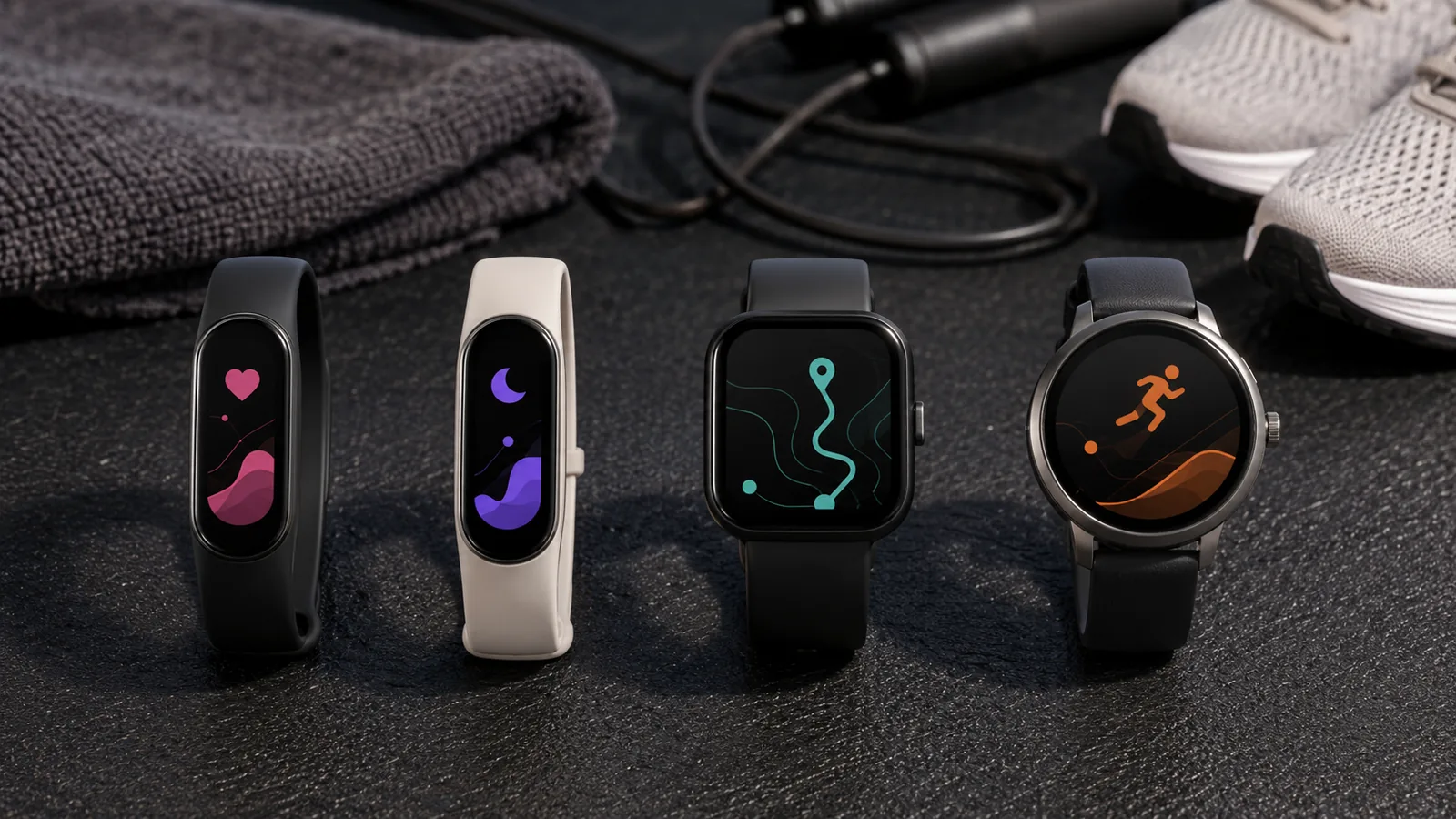

Fitness trackers are most useful when they make activity, sleep and training trends easier to understand without pretending every metric is clinical. Comfort, battery life, ecosystem fit and sensor consistency matter more than feature count alone.
Quick Verdict
- Best for: readers comparing wearables by comfort, battery, ecosystem and real features.
- Focus on: support life, sensor usefulness, battery condition and fit for your activities.
- Watch for: wellness metrics are not automatically equivalent to clinical measurements.
Table of contents
Introduction
Fitness trackers and wearables have become indispensable companions for health-conscious individuals and tech enthusiasts alike. As we enter 2025, these devices have evolved far beyond simple step-counters. Modern fitness trackers pack advanced sensors and smart features that monitor everything from heart rate and sleep quality to blood oxygen levels and even stress. They can help motivate us to move more, sleep better, and live healthier lives – and the data backs it up. In fact, research has shown that using activity trackers encourages people to walk up to 40 minutes more per day (about 1,800 extra steps), leading to significant benefits like lower weight and improved fitness over timesciencedaily.com. With the market exploding (global wearable shipments have grown over 1500% since the mid-2010s, reaching hundreds of millions of units annually), there’s a dizzying array of options available in 2025.
So, which fitness tracker is right for you? This ultimate guide cuts through the noise by focusing on the top-performing, top-rated trackers of 2025. We’ll highlight the standout devices – from versatile all-rounders to specialized wearables – and delve into what makes each unique. You’ll discover devices that exemplify the cutting-edge of wearable tech: think trackers with medical-grade heart sensors, AI-driven coaching, advanced sleep tracking, and even stylish form factors like rings and pendants. Let’s jump in!
(Before we dive into specific products, if you’re curious about broader trends in health wearables – like how AI and new sensors are shaping the future – check out our feature on The Future of Wearable Health Tech: Innovations Shaping a Healthier Tomorrow, which offers a deep look at where this industry is headed.)

Choosing the Right Fitness Tracker: Key Factors to Consider
With so many options on the market, choosing a fitness tracker can feel overwhelming. It helps to break down your decision by considering a few key factors. Here’s a step-by-step guide to finding the perfect wearable for your needs:
- Define Your Health and Fitness Goals: Start by identifying what you want from a tracker. Are you aiming to lose weight, train for a marathon, or simply become more active daily? Different devices excel at different things. For example, serious runners or cyclists might prioritize built-in GPS and advanced performance metrics, while someone focused on wellness might value sleep tracking and guided breathing for stress. Clarifying your goals will narrow the field to trackers with the features that matter most to you.
- Decide on Form Factor – Band, Watch or Ring: Fitness wearables come in various shapes: the classic wrist band, more full-featured smartwatches, or even smart rings and clip-on devices. Bands (like the Fitbit Charge series or Xiaomi Mi Band) are usually slim, lightweight, and oriented mostly around fitness metrics. Smartwatches (like an Apple Watch or Garmin watch) are bulkier but offer big displays and smartphone-like capabilities (notifications, apps). Rings (like the Oura Ring) and others are discreet and stylish, focusing on specific metrics like sleep or recovery. Think about what form you’ll actually wear consistently – comfort and design are important for adherence.
- Compatibility with Your Phone & Ecosystem: Ensure the tracker you choose works well with your smartphone’s OS and other devices. For instance, the Apple Watch integrates exceptionally with iPhones (but not Android), whereas Fitbits, Garmins, and others are generally cross-platform. Check the companion app’s quality too – a lot of the experience lives in the app where you view your stats and progress. A robust app (with social challenges, insights, etc.) can enhance motivation. Also consider ecosystem benefits: do you want to sync data with Apple Health or Google Fit? If you’re deep into one ecosystem, picking a compatible tracker makes things seamless.
- Key Features and Sensors: Make a list of must-have features. Common considerations:
- Heart Rate Monitoring: Virtually all trackers now have optical heart rate sensors for continuous HR tracking. But check accuracy and extras – some newer devices can even measure ECG (electrocardiogram for heart rhythm) or blood pressure (a few advanced watches offer cuff-less BP estimateswired.com). If you have health concerns or want clinical-grade data, those features could be vital.
- GPS & Activity Tracking: If you run, bike, or hike and want precise distance and pace info without carrying your phone, choose a tracker with built-in GPS. Many Garmin and higher-end watches include this. More affordable bands might use “connected GPS” (piggybacking off your phone). Likewise, ensure the device supports your preferred activities (e.g., swimming – look for waterproof with at least 5 ATM rating, specialized modes for yoga, cycling, etc.).
- Sleep and Recovery Tracking: Most trackers record sleep, but some provide deeper analysis (sleep stage breakdowns, a sleep score, smart alarms). Devices like Oura or Fitbit with advanced sleep algorithms can identify REM, deep sleep, and even give readiness scores each morning. If improving sleep or managing recovery is a goal, favor those with proven sleep tracking accuracy (studies found the Oura Ring, for instance, to be one of the most accurate in consumer sleep stage trackingsleepreviewmag.com).
- Battery Life: Battery can range from ~1 day on feature-rich smartwatches to up to a week or more on simpler bands or specialized devices. Think about your tolerance for charging. If you hate taking devices off, a longer battery (5-7 days) may be crucial. For example, Garmin’s watches often boast multi-day battery life, whereas an Apple Watch might need nightly charging.
- Water Resistance: If you’ll wear it in the shower, pool, or ocean, check the waterproof rating. Many trackers are water-resistant to 50 meters (5 ATM) which is fine for swimming. Some even track swim metrics (laps, stroke type).
- Advanced Metrics & Coaching: Higher-end wearables now offer metrics like VO2 max, training load, recovery time, stress monitoring, skin temperature, and more. Some have virtual coaches or daily workout suggestions (Garmin’s new AI-based coaching, Fitbit’s Daily Readiness score, etc.). These can be really useful if you’re training or want actionable insights rather than raw data.
- Budget and Subscription Costs: Finally, factor in your budget. Excellent fitness bands can be found under $100, mid-range trackers/watch hybrids in the $100–$250 range, and premium smartwatches from $300 up to $600+. Also note some brands have subscription services: e.g., Fitbit Premium (for deeper analytics and workouts), WHOOP’s model (which requires a monthly subscription), etc. Check if the tracker’s full feature set works without a subscription. It’s important to avoid surprises – for instance, Fitbit locks some advanced features behind Premium (like detailed wellness reports and some training programs)techadvisor.com, and WHOOP’s strap essentially only comes with a membership. If you’d rather not have recurring costs, opt for brands that give all features free with purchase (Garmin, most others) or at least consider the subscription’s value in your decision.
By evaluating these factors step-by-step, you’ll home in on the ideal tracker that fits your lifestyle. Now, with those in mind, let’s explore the top fitness trackers and wearables of 2025 that are earning rave reviews and helping people crush their health goals.
Top Fitness Trackers and Wearables of 2025
In this section, we’ll highlight some of the best fitness trackers of 2025 – spanning simple bands to advanced smartwatches and innovative wearables. These picks are based on performance, features, user reviews, and expert rankings. For each, we’ll discuss what makes it stand out (its primary strengths, any weaknesses), and who it’s best suited for. Let’s jump into our top picks:
1. Fitbit Charge 6 – Best All-Round Fitness Tracker
The Fitbit Charge 6 earns the crown as one of the top all-round fitness trackers in 2025, and for good reason. This device strikes an ideal balance between features, accuracy, and price, making it perfect for everyday users who want to improve their health without the bulk of a full smartwatch. The Charge 6 looks like a slim wrist band but is packed with capabilities:
- Comprehensive Health Tracking: It continuously tracks your heart rate, steps, distance, calories burned, and floors climbed. Fitbit improved the heart rate accuracy significantly – thanks to a new algorithm borrowed from Google’s Pixel Watch, the Charge 6’s heart monitoring during HIIT and intense exercise is up to 60% more accurate than beforeblog.google. You also get 24/7 heart-rate variability monitoring, resting heart rate trends, and high/low heart rate alerts. The Charge 6 can take spot readings of blood oxygen (SpO₂) at night and even offers ECG scans for atrial fibrillation detection (a rarity in band-style trackers).
- Advanced Exercise and GPS: Unlike its predecessors, the Charge 6 features built-in GPS, so you can map outdoor runs, walks, or bike rides without your phone. It supports 40+ exercise modes (including new ones like HIIT, strength training, and more). A standout is its ability to connect to gym equipment and fitness apps – the Charge 6 can sync live heart rate to machines from NordicTrack, Peloton, Concept2 rowers, etc., via Bluetooth, displaying your heart rate on the machine’s screen. This is super motivating during workouts. The device is water-resistant to 50m, so swimming is on the menu too.
- Google Integration & Smart Features: Now that Fitbit is part of Google, the Charge 6 comes with helpful Google tools on the wrist. It’s the first tracker that lets you use Google Maps navigation and Google Wallet for contactless payments right from the device. Imagine finishing a run and being able to buy a smoothie with just your fitness band – no phone or wallet needed. It also has YouTube Music controls, so you can play/pause or skip songs on your phone (or compatible services) from your wrist. These additions make the Charge 6 feel smart and connected, blurring the line between tracker and smartwatch. Plus, you still get smartphone notifications, timers, alarms, and Fitbit Pay (Wallet takes that over).
- Battery Life: The Charge 6 boasts up to 7 days of battery on a charge (though using GPS regularly will reduce this). In testing, it comfortably lasts 5–6 days with mixed usage – far better than most full smartwatches, meaning less hassle charging.
- Fitbit App and Premium: Fitbit’s app remains one of the most user-friendly and motivating platforms. You get a daily Stress Management Score, a Sleep Score each morning (Fitbit’s sleep tracking is among the most accurate for a wrist wearableouraring.com), and even a new Daily Readiness Score (for Premium users) which tells you if you should push hard or take it easy based on recovery. While some advanced analytics (like detailed personalized insights, guided workouts, and meditation sessions) require an optional Fitbit Premium subscription, the Charge 6 is fully functional without it. Many users find Premium worthwhile for the extra programs, but it’s not mandatory.
In short, Fitbit Charge 6 is the versatile workhorse of fitness trackers. It’s attractive, affordable, and platform-agnostic (works with both Android and iOS). It nails the fundamentals – accurate activity and heart tracking – and layers on useful extras like on-wrist payments and notifications. Unless you need on-device music storage or a large watch screen, the Charge 6 offers perhaps the most bang for your buck in 2025. It’s an ideal choice for casual to intermediate fitness enthusiasts who want to improve their health, stay motivated with data, and maybe leave their phone behind on workouts. No wonder it’s often our top pick in fitness tracker roundups, consistently ranking high for its blend of features and ease of use.
2. Apple Watch Series 9 (and Ultra 2) – Best Fitness Smartwatch
For those who want a fitness tracker that doubles as a powerful smartwatch, the Apple Watch Series 9 is the gold standard – especially if you’re an iPhone user. Apple’s watches have always led in overall smart features, and in recent generations they’ve become serious fitness and health devices as well. The Series 9 (released late 2024) and the rugged Apple Watch Ultra 2 (for extreme sports/outdoor enthusiasts) together cover the high-end of wearable tech:
- Comprehensive Health Sensors: The Apple Watch packs just about every sensor available: continuous heart rate with ECG capability, blood oxygen (SpO₂) measurements, an advanced accelerometer/gyroscope for fall and crash detection, and even a wrist temperature sensor (introduced in Series 8) that can aid cycle tracking and wellness monitoring. It doesn’t measure blood pressure or glucose (no mainstream smartwatch does yet), but it offers alerts for irregular heart rhythm (AFib), high/low heart rate notifications, and now even monitors for signs of elevated stress (via Heart Rate Variability trends). It was also the first wearable to get FDA-cleared ECG and one of the first with a cleared atrial fibrillation detection algorithm – speaking to its medical-grade ambition.
- Fitness and Exercise Tracking: The Apple Watch is excellent for tracking workouts. The built-in GPS is highly accurate, and the Workout app supports a huge range of activities from running, cycling, HIIT, yoga, swimming (50m water resistant), to hiking and more. Runners benefit from new features like personalized running form metrics and race predictions. The watch gives real-time pace, splits, cadence, and heart zones during exercise. With watchOS updates, Apple added advanced metrics like VO2 max estimation, Cardio Fitness level classifications, and even a feature similar to Fitbit’s readiness score called Recovery (in Apple’s Fitness+ service). One notable improvement in the Series 9 is the S9 chip, which allows on-device Siri processing – meaning you can ask your watch for health data (“How many steps have I done today?”) and get an immediate answer, even offline. The watch also syncs with gym equipment via GymKit and can connect to Bluetooth accessories like heart rate chest straps or cycling cadence sensors.
- Battery Life and Charging: Historically, Apple Watch’s limitation was battery life – about 18 hours per charge on earlier models, meaning daily charging. The Series 9 can stretch slightly beyond a day (Apple quotes 18 hours normal or up to 36 hours in Low Power mode). While that’s shorter than typical fitness bands, many users charge it conveniently (e.g., while showering or at the desk). The Apple Watch Ultra 2, with its larger battery, addresses this for power users – it gets 2-3 days per charge under normal use, and can go up to 60 hours in an extended low-power setting (great for multi-day hikes). The Ultra also has dual-frequency GPS for extra accuracy, which hikers and marathoners love.
- Smartwatch Features: As a full smartwatch, Apple Watch does it all: calls, texts, notifications, hundreds of apps (from Strava to Spotify to mindfulness apps). It has music storage/streaming (you can pair AirPods and listen phone-free while running). The Series 9’s display is bright and always-on; the Ultra 2’s display is even brighter (up to 3000 nits, very legible in sun). Both have the new Double Tap gesture – you can tap your index and thumb together to control the watch one-handed (useful while exercising). Apple’s ecosystem offers deep integration – your watch can unlock your Mac, act as a viewfinder for your iPhone camera, or automatically sync Apple Fitness+ workouts. For many, it also replaces traditional watches with countless customizable watch faces and bands.
- Coaching and Insights: The Apple Watch’s Activity Rings (Move, Exercise, Stand) are famously addictive and motivational – closing your rings becomes a daily game. It also offers monthly challenges tailored to your usage, and awards/badges for milestones. With watchOS 10 and beyond, Apple is introducing more insights: for example, it can now detect if you’re in daylight enough (important for mood and circadian rhythm) and give nudges to get sunlight. The watch’s sleep tracking, while not as detailed as Fitbit or Oura by default, now gives sleep stage breakdowns and integrates with the Health app for longitudinal trends. And if you use Apple’s Fitness+ service (subscription), you get guided workouts that sync metrics to your watch in real-time – like having a trainer on your wrist.
The Apple Watch Series 9 is ideal for someone who wants everything on their wrist – top-notch fitness tracking and a fully capable smartwatch. It’s especially compelling for iPhone users due to the seamless integration. The downsides: it’s pricier (starting around $399 for Series 9, and $799 for Ultra 2) and battery life is shorter than simpler trackers. Also, some features require being in Apple’s ecosystem (an Android user should look elsewhere, e.g., Garmin or Fitbit). But for those invested in Apple or who want the most advanced wearable, it’s hard to beat. In fact, the Apple Watch Ultra 2 has even bridged the gap to dedicated sports watches – with its robust titanium build, long battery, and features like a depth gauge and backtrack navigation, it’s even targeting hikers, divers, and endurance athletes (Apple added satellite SOS to it, similar to Garmin’s satellite devices).
In summary, the Apple Watch in 2025 offers cutting-edge wearable technology with fitness tracking that rivals dedicated fitness brands, plus the versatility of a mini-computer on your wrist. It’s a shining example of how far wearables have come – from counting steps to potentially saving lives (several reports exist of Apple Watch detecting heart issues or calling 911 in accidents). If budget allows and you want the ultimate fitness smartwatch, Apple Watch Series 9 (or Ultra 2 for the adventurers) is a top pick.
(Pro Tip: If you’re not an iPhone user or want an alternative, check out Garmin’s smartwatches like the Venu series or Samsung’s Galaxy Watch6 – they offer many similar features in their respective ecosystems, with Garmin leaning more fitness-first and Samsung offering a strong Android-compatible smartwatch.)
3. Garmin Venu X1 – Best for Serious Athletes & Training
Garmin is a name synonymous with fitness tracking, especially for athletes who value detailed metrics and rugged reliability. In 2025, one of Garmin’s standout offerings is the Garmin Venu X1, a powerful fitness smartwatch that caters to both the casual user and the serious athlete. (Note: Garmin’s lineup is extensive – from the Fenix and Forerunner series for hardcore athletes to simpler Vivofit bands. The Venu X1 sits in between, blending smartwatch style with Garmin’s training prowess.) Here’s why the Venu X1 shines:
- Sleek Design, Big AMOLED Display: The Venu X1 breaks from Garmin’s traditional “outdoorsy” look by offering a thin, stylish design and a gorgeous 2-inch AMOLED displayfreditech.com. It’s only 7.9mm thick and weighs around 40g, making it one of Garmin’s lightest watches – very comfortable for 24/7 wear (even sleep tracking). Despite the slim profile, Garmin didn’t skimp on premium materials: it has a sapphire crystal screen and a titanium caseback for durabilityfreditech.com. The big, bright screen is perfect for viewing detailed stats, maps, and notifications with ease.
- Advanced Fitness & Sports Features: Garmin is known for serious training tools, and the Venu X1 is packed with them:
- Multi-band GPS ensures highly accurate tracking of runs, rides, and hikes, even in challenging environments. Garmin’s all-systems GNSS mode yields excellent route precision.
- Support for topographical maps and offline navigation on-wrist (particularly useful for hiking or trail running). The X1 includes topo maps, something usually seen on Garmin’s high-end Fenix line.
- A suite of performance metrics: Training Readiness, Training Load, VO2 max, Recovery Time, Endurance Score, hill scores – if it can be measured, Garmin likely measures it. The Venu X1 even has Garmin’s new Active Intelligence features (an AI-driven insight system) that can suggest optimal workouts and recovery windows based on your historical data. Reviewers note that Garmin’s suggestions feel like having a coach that actually adapts to your condition.
- Garmin Connect app gives you granular data analysis. While it may not be as “pretty” as Fitbit’s app, it’s incredibly thorough. For example, Connect shows charts of your heart rate zones per workout, cadence, stride length, stress levels, Body Battery (energy) throughout the day, and even menstrual cycle tracking. One big plus: no subscription needed – all metrics and analytics are included free.
- With ANT+ and Bluetooth, it connects to a host of external sensors: chest HR straps, cycling power meters, cadence sensors, etc., which serious athletes appreciate.
- Sports modes galore: Running (with detailed dynamics if using Running Dynamics Pod), cycling, swimming (5 ATM water resistance), strength (it can auto-count reps), HIIT, skiing, golf (with course maps), yoga, and more. The Venu X1 also introduced a built-in LED flashlight (handy for night runs or finding gear in the dark) and on-device music storage (up to 650 songs or use Spotify playlists offline).
- Battery Life: Garmin devices generally outlast others, and the Venu X1 is no exception. Even with the always-on AMOLED and daily GPS use, it manages 5-6 days per charge (Garmin advertises ~6 days smartwatch mode, 20 hours GPS). If you use more conservative settings or the battery saver mode, you can stretch it further. This means you can track sleep and health continuously without worrying about nightly charging.
- Focus on Recovery & Health: Beyond workouts, the Venu X1 monitors health metrics like all-day stress (via HRV), sleep stages (Garmin improved sleep tracking accuracy, though it’s still catching up to Fitbit/Oura in some studies). It calculates a Body Battery score (0–100) that integrates sleep, stress, and activity to tell you how much energy reserves you have – a great way to decide if you should train hard or rest on a given day. The watch also offers breathwork and relaxation activities for stress management.
- Garmin Pay and Smart Features: It has Garmin Pay for contactless payments, smart notifications for calls/texts (you can respond with quick replies if on Android, or just view if on iPhone), and some app integrations (like music apps, weather, calendar). While it’s not aiming to replace an Apple Watch in terms of app ecosystem, it covers the common needs well. The interface is now more user-friendly with a revamped widget glance system introduced in Garmin’s 2023 update, and you can download custom watch faces or data fields via Garmin’s Connect IQ store.
The Garmin Venu X1 is an excellent choice for fitness enthusiasts and athletes who want rich data and training features in a device that’s also stylish for daily wear. It’s basically Garmin saying you can have your cake and eat it – a watch that looks as good in the office or a night out as it does on the track. It’s especially great for Android users who might not opt for an Apple Watch, or anyone who finds value in Garmin’s no-subscription model and reliable hardware (their devices are known for durability – the sapphire/titanium build on X1 reinforces that).
One thing to note: Garmin’s strength is in fitness; its smartwatch capabilities, while improving, are not as extensive as Apple or Samsung (for example, you won’t be typing messages or taking calls on the wrist with ease). But Garmin knows its audience – those who prioritize training and insight. As one reviewer quipped, the Venu X1 is like having a personal trainer, but in a slim watch form.
(If you’re deep into marathon training or triathlons and want even more battery or mapping, you might look at the Garmin Fenix 8 series or Forerunner 970. However, those are bulkier and pricier. The Venu X1 covers 95% of what most users need, in a much sleeker package.)
4. Oura Ring (Gen 3) – Best Non-Wrist Fitness Tracker
Who says a fitness tracker has to go on your wrist? The Oura Ring challenges that notion and has carved out a niche as one of the most innovative wearables – all in the form of a sleek ring on your finger. The latest generation (Gen 3) of the Oura Ring is a favorite for those particularly interested in holistic health, recovery, and sleep tracking. Here’s why the Oura Ring stands out:
- Discrete and Stylish: Oura is essentially a unisex ring available in different finishes (silver, black, gold, etc.), and it looks like a normal piece of jewelry. If you don’t enjoy wearing watches or bands 24/7, the Oura Ring is a comfortable and discrete alternative. It’s lightweight (~4-6 grams) and you quickly forget you’re wearing a tracker at all – no screen, no notifications, nothing to distract you.
- Advanced Sensors in a Ring: Despite its tiny size, the Oura Ring is packed with sensors: optical heart rate sensors, infrared LEDs, temperature sensors, and an accelerometer. It continuously measures your heart rate (including a refined HRV during sleep), tracks your respiration rate, and even measures your body temperature deviations. It was one of the first wearables to show illness signals – e.g., an elevated nighttime temperature could hint you’re getting sick.
- Best-in-Class Sleep Tracking: One of Oura’s biggest claims to fame is its sleep tracking accuracy. Multiple independent studies have found Oura’s sleep stage classification and overall sleep detection to be among the most accurate of consumer devices, in some cases approaching the gold standard of polysomnography for certain metrics. The ring provides a detailed sleep analysis each morning: total sleep, sleep efficiency, time in each stage (Light, Deep, REM), latency (how quickly you fell asleep), and timing. It then synthesizes this into an easy-to-understand Sleep Score (0–100). Users often praise that Oura’s sleep insights helped them improve habits (like consistent bedtimes or reducing late caffeine) to boost their sleep score.
- Recovery and Readiness: Complementing the sleep data, Oura offers a Daily Readiness Score. This score (also 0–100) is like a measure of how recovered and prepared your body is for exertion on that day. It takes into account your sleep quality, recent activity, HRV balance, and resting heart rate. For example, if you had poor sleep and your resting HR was elevated overnight, Oura might give a low readiness score and recommend taking it easy. Conversely, a high score means you’re primed for a good workout. Athletes and high performers love this feature as it helps prevent overtraining and encourages listening to your body. In fact, one peer-reviewed study found Oura Ring’s HRV and RHR measurements to be the most accurate among tested wearables for tracking recoveryouraring.com.
- Activity and Heart Rate: The Oura Ring does track daily activity (steps, calories, active time) and it will auto-detect some activities (like walks or runs). However, it’s not primarily designed for exercise tracking. It lacks GPS and doesn’t have a display or connected app to show real-time stats during a workout. So if you are doing a gym session or run, you can log it in the app or pair the ring with Apple Health/Google Fit for activity data, but you won’t be replacing a running watch with Oura. Think of Oura as more of a 24/7 health monitor than a dedicated sport tracker.
- Battery Life and App: The ring lasts about 4-7 days per charge, and charges in a small dock in ~60-80 minutes. The companion Oura app (on your phone) is beautifully designed – with intuitive dashboards for Readiness, Sleep, and Activity. It offers insights and suggestions, like “Your body temperature was higher last night, take time to recover” or “Nice work hitting your activity goal, it improved your readiness.” Keep in mind, Oura (Gen 3) introduced a membership model – the hardware is purchased (around $299), and to get the most from it, there’s a $5.99/month subscription for advanced metrics and insights. New buyers get a free trial for 6 months. The membership gives you full access to trends, advanced content like guided meditations, and detailed data. While some users dislike the subscription, Oura has consistently added features (recently blood oxygen sensing for breathing disturbances, and period prediction for women using temperature trends).
- Accuracy and Validation: Oura has done well in validation studies. For example, one study found the ring’s average heart rate measurement during sleep had only about 1 beat per minute difference from medical grade ECG. Its HRV readings also correlate strongly with ECG. That level of accuracy in such a small form factor is impressive.
The Oura Ring is ideal for people who are focused on overall wellness, recovery, stress, and sleep – whether you’re an athlete wanting to optimize training or someone simply aiming to improve energy and health. It’s also a great solution if you don’t like wrist wearables or cannot wear them at work (some jobs with uniform/dress code restrictions). Plenty of users wear Oura in addition to an Apple Watch or Garmin – using Oura for the deep recovery insights and their watch for active workout tracking.
It’s worth noting: the Oura Ring lacks a screen and notifications, which some might see as a downside, but others view as a positive – it’s unobtrusive and distraction-free. You won’t be tempted to check messages or time on it; it just quietly does its job and syncs to your phone.
In conclusion, the Oura Ring exemplifies cutting-edge wearable technology in a unique form. By focusing on accurate night-time and recovery metrics, it provides a lens into aspects of health that many other trackers gloss over. If you want arguably the best sleep tracker on the market and a device that acts like your personal wellness guardian, Oura Ring is highly recommended.
5. WHOOP Strap 4.0 – Best for Continuous Recovery Monitoring

If you’ve followed professional sports or elite fitness circles, you may have heard of WHOOP – a platform that’s all about measuring strain, recovery, and sleep to unlock peak performance. The WHOOP Strap 4.0 is the latest version of their screenless wrist (or arm) band, and it’s earned a reputation as a top choice for athletes and data-driven fitness folks. Here’s what sets WHOOP apart:
- Recovery First Approach: Similar to Oura, WHOOP’s philosophy is centered on balancing Strain (activity load) and Recovery. Every day, you get a Recovery Score (0–100%) that’s derived from your heart rate variability (HRV), resting heart rate, respiratory rate, and sleep performance. This score is color-coded (green, yellow, red) to indicate if you’re ready to perform or need rest. Many athletes live by this – if WHOOP says you’re in the red (poor recovery), you might dial back training to prevent injury or fatigue. WHOOP’s recovery assessment is quite sophisticated, and like Oura, it’s validated by research showing correlations with training outcomes.
- Strain Coach and Workout Analysis: WHOOP quantifies all exertion as Strain on a 0–21 scale. The more your cardiovascular system works, the higher the strain. It’s not just counting steps or time; it’s analyzing elevated heart rate duration and intensity. The WHOOP app has a Strain Coach feature: it will suggest an optimal target strain for the day based on your recovery. For example, if you’re fully recovered (green), it might suggest a strain of e.g. 14 for the day – encouraging you to push harder with a workout. It also warns if you’re accumulating too much strain relative to recovery.
- Continuous Heart Rate and Calorie Burn: The strap measures heart rate 24/7 with medical-grade accuracy. It doesn’t have a display, but it syncs to the app continuously. During workouts, you can either let WHOOP auto-detect (it does for many activities like running, cycling, swimming, etc.), or you can integrate with other apps and devices. WHOOP 4.0 also introduced BLE Heart Broadcast, meaning you can broadcast your HR to devices like Peloton or Garmin watch. Essentially, WHOOP can act as a HR strap for other platforms. It calculates calories burned and average heart rate for activities too.
- Sleep and Health Monitoring: WHOOP provides detailed sleep staging, sleep consistency info, and a Sleep Score (similar concept to others). It also will give sleep coaching – telling you how much sleep you need to aim for, based on your strain and desired performance level tomorrow. Additionally, WHOOP tracks certain health metrics: it will display trends in your HRV, RHR, respiratory rate, and skin temperature. Notably, early in the COVID-19 pandemic, WHOOP gained attention for detecting breathing rate increases that flagged possible illness in users. The 4.0 strap also added a Pulse Oximeter for blood oxygen and a skin temperature sensor. All this feeds into their algorithms to gauge recovery and potential illness.
- Always-On Wear, Various Ways: WHOOP is designed to be worn all the time – including showering, workouts, and sleeping. The strap is lightweight and has no screen, so it’s very comfortable. It’s also modular – WHOOP has something called “Any-Wear” technology: you can take the sensor and wear it in special WHOOP garments (like a smart compression sleeve, shorts, sports bra) if you don’t want it on your wrist. This is great for sports where a wrist strap is inconvenient. The battery lasts ~4-5 days, and WHOOP cleverly includes a battery pack that slides on the strap so you can charge it while wearing (so you truly never have to take it off).
- Membership Model: WHOOP is unique in that you don’t buy the device outright – you subscribe to WHOOP (monthly or annual membership). The hardware is “free” with the membership (though effectively you’re paying for it via the subscription). The subscription (~$30/month standard, often discounted with longer commitments) covers the continuous analytics, cloud storage of your data, and regular app feature updates. WHOOP provides a lot of analysis – weekly and monthly performance reports, team features (comparing data with friends or teammates), etc. The membership model isn’t for everyone, but many users feel the value in the depth of insight and the responsive improvements WHOOP delivers. It’s akin to having a coach and data scientist monitoring your vitals around the clock.
- Data Privacy and Use: It’s worth mentioning WHOOP takes privacy seriously and also partners with researchers and sports teams. Many pro athletes (LeBron James, for one) have been spotted wearing WHOOP. Some workplaces even use WHOOP for wellness programs. As a user, you own your data and can export it. The platform can connect with Apple Health or Strava, for example, to sync workouts out if you want.
The WHOOP Strap 4.0 is best suited for people who are very invested in improving performance or health through understanding their body’s signals. It’s not an entry-level tracker – it gives a ton of information and requires some commitment to derive full benefit. But if you’re the kind of person who loves to analyze metrics or wants to truly optimize training cycles, WHOOP is arguably unmatched. It has been called “the secret weapon” of many athletes because it can reveal trends (like consistently low recovery before an injury or noticing when lifestyle tweaks improve HRV).
Because there’s no screen or “smartwatch” functions, WHOOP won’t appeal to someone who wants a do-it-all wearable. It deliberately does not distract you – in fact, some appreciate that there’s no clock on it, reinforcing that it’s purely a sensor.
In 2025, WHOOP continues to rank highly in lists of best fitness trackers for serious athletes, and the 4.0 version’s enhancements (smaller size, more sensors) have only solidified its place. The main trade-off is the cost of membership. But consider that many people pay for a coach or training service – WHOOP is like having one that watches your body 24/7 at a fraction of that cost.
These are just a handful of the top fitness trackers and wearables in 2025. Honorable mentions should be given to devices like the Xiaomi Smart Band 10 (a budget-friendly tracker that offers a bright display and solid basics around ~$50), and the Samsung Galaxy Watch6 for Android users wanting a smartwatch with good fitness features (including ECG and blood pressure in some regions). Additionally, hybrids like the Withings ScanWatch merge classic watch looks with health tracking (ECG, SpO₂) and might appeal to those who want something more traditional-looking.
The landscape of wearables has something for everyone: from minimalist rings and straps to feature-packed smartwatches. The best choice ultimately depends on your personal goals and preferences. Next, we’ll address some common questions to further guide you in making an informed decision.
Frequently Asked Questions (FAQ)
Which fitness tracker is the best in 2025?
There isn’t a one-size-fits-all answer – the “best” fitness tracker depends on your needs and priorities. However, here are a few top picks by category:
- Best Overall: The Fitbit Charge 6 is often cited as the best all-around fitness tracker for most people. It’s reasonably priced and offers a comprehensive feature set (24/7 heart rate, ECG, built-in GPS, excellent sleep and activity tracking) in a slim, comfortable band. It works with both Android and iOS and has an easy-to-use app with strong community and motivation features.
- Best Smartwatch for Fitness: The Apple Watch Series 9 (or Ultra 2 for extreme athletes) is the top choice if you want a full smartwatch that’s also a fitness powerhouse. It has the most polished user experience and tightest integration with apps, along with advanced health sensors (ECG, blood oxygen, etc.). Keep in mind it requires an iPhone.
- Best for Serious Athletes: Garmin wearables are widely considered best-in-class for training and outdoor use. The Garmin Venu X1 strikes a great balance of style and substance, while models like the Garmin Fenix 8 or Forerunner 970 are top picks for marathoners, triathletes, and hikers who need robust build, long battery, and in-depth performance metrics.
- Best Non-Wrist Tracker: The Oura Ring Gen 3 is the leader outside of wrist-worn devices, exceptional for sleep and recovery tracking with a super discreet form factor.
- Best Budget Tracker: If you’re on a budget, the Xiaomi Smart Band 10 (or Mi Band series) offers impressive value – a bright OLED display, heart rate and SpO₂ tracking, and long battery life, often under $50.
- Each of these excels in different ways. To choose the best for you, consider whether you want a device mainly for health monitoring, sports and training, or as a general lifestyle companion. Our guide above breaks down leading options in each category.
What’s the difference between a fitness tracker and a smartwatch?
A fitness tracker is typically a band or wearable focused primarily on health and exercise metrics – steps, heart rate, calories, sleep, etc. It often has a simple display (or none at all) and a long battery life. A smartwatch includes fitness tracking features but also extends functionality to things like notifications, apps, phone calls, music control, and more advanced interactive displays. Key differences:
- Design: Fitness trackers are usually more compact, slim, and lightweight. Smartwatches are larger, with big color screens (often resembling a traditional watch face or even larger).
- Features: Both can track activities and health metrics, but smartwatches offer broader capabilities. For example, an Apple Watch or Samsung Galaxy Watch lets you install apps, reply to messages, use voice assistants, view maps, etc. Most fitness trackers have more limited interfaces and are focused on showing you your stats (steps, heart rate, maybe notifications in a basic format).
- Battery Life: Fitness trackers generally have longer battery life (because they have smaller or no color screens and fewer power-hungry components). It’s common for trackers to last 5–10 days per charge. Smartwatches, with their vibrant displays and powerful processors, often need charging every 1–3 days (e.g., an Apple Watch is daily, while a Garmin smartwatch can be several days, and some hybrids like Withings can go weeks by sacrificing screen tech).
- Use Case: If you primarily want to monitor fitness and health – and prefer simplicity – a fitness tracker might be sufficient and more comfortable for 24/7 wear. If you want your wearable to double as an extension of your smartphone (for productivity, entertainment, communication) as well as track workouts, then a smartwatch is more suitable.
- In short, all smartwatches are fitness trackers, but not all fitness trackers are full-fledged smartwatches. The lines are blurring, though: many devices, like the Fitbit Versa or Garmin Venu, try to offer a bit of both. Decide what functions you’ll actually use. Some people find they don’t need a big watch screen or phone apps on their wrist and prefer a slimmer tracker; others love having one gadget that does it all.
Can fitness trackers measure blood pressure or ECG?
Some advanced wearables can measure things like ECG (electrocardiogram) or blood pressure to an extent, but it’s important to set expectations:
- ECG: Yes, a few consumer devices can record a single-lead ECG. Notably, the Apple Watch (Series 4 and later) has an FDA-cleared ECG app that can detect signs of atrial fibrillationfreditech.com. Fitbit’s Sense and Charge 5/6 also have ECG capability, as does the Samsung Galaxy Watch (when enabled in certain regions). These ECG features typically require you to hold your fingers on the device’s electrodes for 30 seconds, and they produce a waveform and rhythm classification (normal sinus vs. AFib)freditech.com. They are surprisingly accurate for single-lead, but of course not as comprehensive as a 12-lead clinical ECG. They’re very useful for spot-checking heart rhythm if you feel palpitations or have a condition.
- Blood Pressure: No wrist tracker measures blood pressure via an inflatable cuff like a traditional monitor. However, some smartwatches use PPG sensor algorithms to estimate blood pressure. Samsung Galaxy Watches (Watch 5/6) have this feature, but it requires calibration with a real cuff and is not FDA-approved (it’s more for wellness) – and is limited to certain countries. Another example: a proprietary device like the Huawei Watch D actually has a tiny inflatable cuff in the band to measure BP more traditionally. But mainstream trackers like Fitbit, Garmin, etc., do not measure blood pressure. There is research ongoing – an MIT study suggests future wearables might use sensors and AI for cuffless BPmedicalfuturist.com, but at 2025 it’s not widely available or highly accurate yet. If blood pressure tracking is crucial for you, it’s best to use a proper at-home BP monitor (some can sync readings to your phone to combine with your fitness data).
- Blood Oxygen (SpO₂): This isn’t blood pressure, but worth noting – many modern trackers (Fitbit, Garmin, Apple, etc.) include a pulse oximeter to measure blood oxygen saturation. They typically use it during sleep to flag potential issues like sleep apnea (oxygen dips). But these aren’t medical-grade either; they’re good for spotting trends.
- In summary, while top-tier wearables have impressive sensor tech, they are not replacements for medical devices. They can provide helpful insights – e.g., alerting you to an irregular heart rhythm, which you’d then get evaluated by a doctor – but you wouldn’t want to make major health decisions solely from a tracker’s BP reading or ECG without confirmation. Use these features as an added layer of information. Always follow up with proper medical measurements if something seems off.
How accurate are fitness trackers for calories and heart rate?
Heart rate accuracy on quality trackers is generally good now, but it can vary with conditions:
- In steady activities (like walking, jogging, cycling), most wrist trackers from reputable brands are quite accurate for heart rate – often within 5% of a chest strap or ECG for average HRucd.ie. For example, a Stanford study found wearables measured heart rate within 5% of reference in 6 out of 7 devices testedmed.stanford.edu. Devices like the Apple Watch, Garmin’s Elevate sensor, Fitbit’s PurePulse, etc., have improved greatly. During intervals or very high intensity with rapid changes, wrist sensors can lag or get noisy readings – a chest strap is still gold standard for precise HR during those conditions.
- Darker skin tones, tattoos, or loosely worn bands can affect optical HR accuracy a bit, but newer sensors and algorithms have mitigated this (some studies show slight differences, but companies have tuned devices to be more inclusive in readings).
- Calories: Calorie burn is an estimation based largely on heart rate and personal data (age, weight, etc.). Trackers use algorithms (like Metabolic Equivalent of Task) to convert activity into calorie estimates. They’re reasonably good for aerobic activities – in the Stanford study mentioned, heart rate was accurate, but calorie expenditure was not. In fact, calorie estimates were off by 20% or more on average in many devicesaim7.com. That’s significant – e.g., it might say 300 kcal when you actually burned 240, or vice versa. Some devices overestimate, some underestimate. They tend to struggle the most on weight training or non-steady state exercise. So, use calorie counts as ballpark figures. They can be useful to compare relative burn between days or sessions on the same device, but don’t treat them as exact.
- Steps and distance: Pedometer accuracy is usually within ~5% if worn correctly, though it may undercount steps when your arms aren’t moving (e.g., pushing a stroller) or overcount from other repetitive motions. Distance is good if GPS is used; if based on step count and stride length, it’s an estimate.
- Sleep stages: Trackers do well at identifying sleep vs wake (often >90% agreement with lab tests), but specific REM vs deep vs light stage classifications are estimates. Devices like Oura and Fitbit correlate fairly well with lab polysomnography on broad metrics, but the sleep stage breakdown is an approximation (useful for personal trend, but not a medical evaluation).
- In essence, fitness trackers are accurate enough to be useful for personal health trends and motivation. They shine in consistency – e.g., you can trust if your resting heart rate is going down over weeks, or if you burned more calories today than yesterday, according to the device’s own scale. The absolute numbers have error margins. Heart rate is usually quite reliable for most uses (especially at moderate effort). Calorie counts should be taken with a grain of salt. If you need very accurate calorie or heart measurements (say for medical reasons or elite training), consider using chest HR monitors and doing metabolic testing. For day-to-day wellness and general fitness, trackers give a good picture – just remember they’re tracking tools, not diagnostic instruments.
Are fitness trackers worth it for improving health?
For many people, yes, fitness trackers can be worth it as a tool to encourage healthier habits and provide valuable feedback. Here’s why:
- Increased Activity: Research has consistently shown that using a fitness tracker tends to increase users’ physical activity levels. Simply having step counts and daily goals can motivate you to take more walks or climb more stairs. A comprehensive review found that wearing an activity tracker can lead to about 40 more minutes of walking per day on average, which translated to roughly 1,800 additional steps and an extra ~300 calories burned per week. Over months, that contributed to modest weight loss (~1kg over 5 months on average without other interventions). While 1kg might sound small, remember that these were not weight loss programs – they were simply people moving more thanks to trackers.
- Accountability and Consistency: Trackers give you immediate feedback and a sense of accountability. The act of seeing your progress (or lack thereof) each day can drive behavior change. For example, if your tracker shows you only got 4,000 steps by evening, you might be inclined to take an after-dinner walk to hit 8,000. Those little choices add up. Many devices also let you connect with friends or participate in challenges, tapping into social accountability and support.
- Better Understanding of Your Body: Trackers can reveal patterns that help you improve your lifestyle. You might discover you’re only sleeping 6 hours when you thought you got 7, prompting you to prioritize an earlier bedtime. Or you might notice your heart rate spikes a lot under stress at work, encouraging you to practice breathing exercises. Some users have caught health issues early – e.g., noticing an unusually high resting heart rate and later finding it was due to illness or overtraining. The biofeedback element of trackers – seeing real data on heart rate, HRV, etc. – can also reinforce positive habits like meditation or regular exercise as you observe improvements (e.g., a lower resting HR over time indicates improved fitness).
- Weight Management: While calorie counts aren’t perfect, having an estimate of output and input (if you log food) can aid in weight management. Even if off by some margin, the tracker’s calorie trend (burning more than consuming, or vice versa) can guide adjustments. Some people find success by aiming to hit calorie burn targets or step goals as part of their weight loss plan. And simply knowing how much (or how little) you move can correct misperceptions – studies have shown people often overestimate their activity; trackers give an objective measure to work with.
- Habits and Heart Health: Closing daily rings or streaks can gamify healthy habits. Over time, consistent physical activity tracked by these devices is linked to improved cardiovascular health, better blood sugar control, and more. They won’t do the work for you, but they are effective coaches. As one cardiologist put it, “the best exercise is the one that gets done” – and trackers help ensure it gets done by nudging you.
- Of course, a tracker is only as useful as the user makes it. It’s not a magic device that will automatically make you fit – but it is a powerful tool to educate, remind, and motivate. Many users report feeling more in tune with their health and empowered to make changes because of the awareness their wearable provides. In short, if you commit to using the insights to drive action, a fitness tracker is absolutely worth it for improving health. It can be the spark that gets you off the couch and striving for those daily goals. And even small increases in activity or slight improvements in sleep can yield meaningful health benefits over time. The key is consistency – and that’s exactly where trackers excel in helping.
Author: Wiredu Fred – A professional tech writer and certified personal trainer with over 8 years of experience in reviewing fitness technology. Fred has tested dozens of wearables, from basic pedometers to high-end smartwatches, and has a background in exercise science. He contributes expert analysis that combines technical know-how with practical fitness insights, helping readers select the best devices to support their health journeys. Fred’s work is guided by the latest research (EEAT principles) and a passion for how technology can motivate positive lifestyle changes.
Bottom Line
A wearable is a good buy when it fits comfortably, lasts long enough between charges and provides features you will actually use. Current support and battery condition matter more in 2026 than launch-year prestige.