Third-party test evidence Tests run 6–8 July; results announced 27 August 2026 · Research checked 28 August 2026
TÜV Rheinland Italia measured 4.2332kWh, 4.4026kWh and 4.7542kWh reaching the high-voltage battery of one Aptera test vehicle across three sunny-day configurations. Those are useful energy measurements. Aptera’s “about 47 miles” headline is a separate conversion based on its efficiency target—not an EPA, WLTP or independently driven range result.
The report supports Aptera’s claim that its body-integrated solar array can add meaningful daily energy under favorable sun. It does not prove that every owner will gain 47 miles a day, nor does it certify production range, efficiency or durability. Treat 4.7542kWh as the strongest measured result and 47 miles as an estimated outcome.
What TÜV Rheinland measured
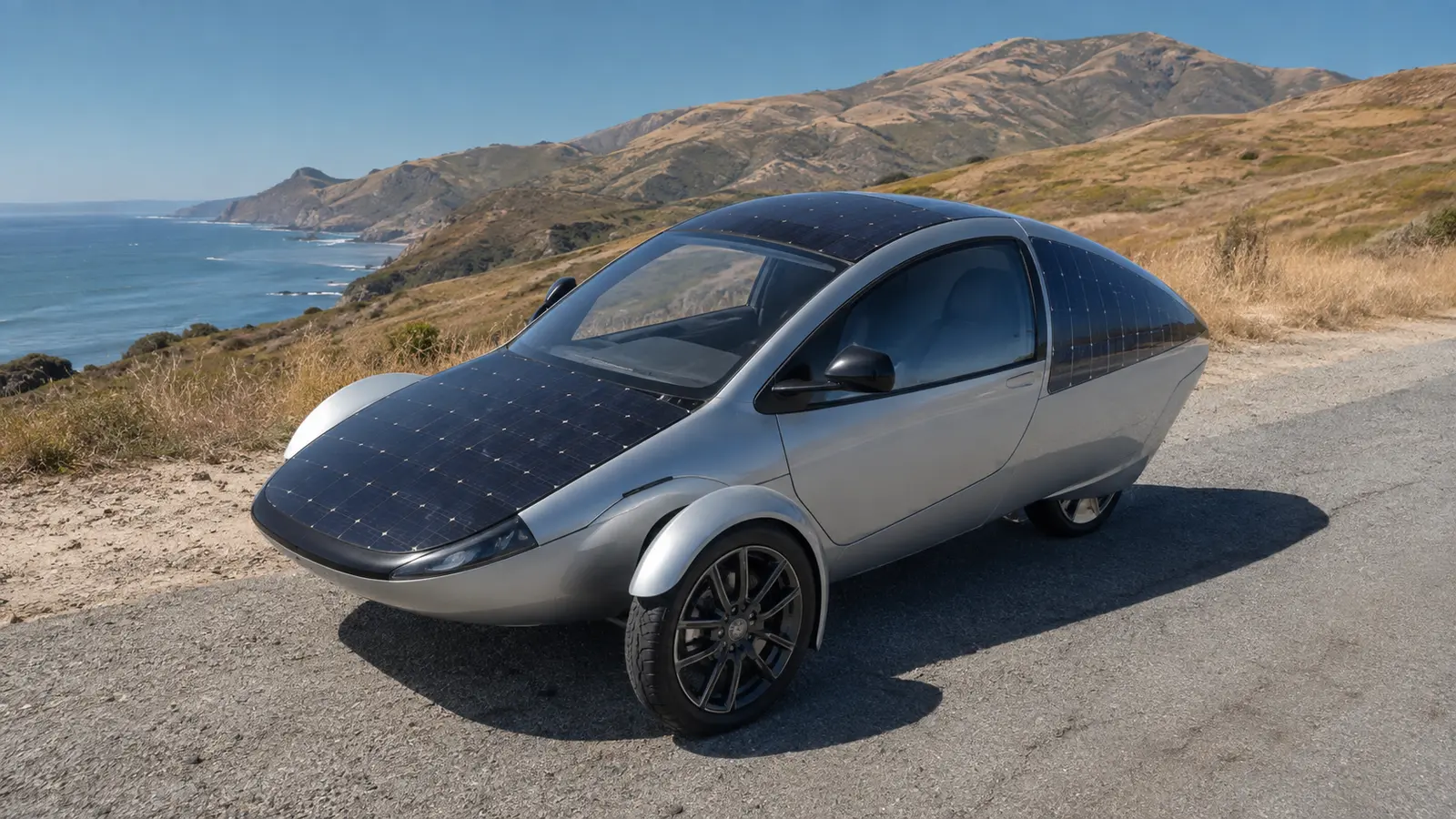
The test used a manufacturer-selected Aptera Atlas 1 sample at Aptera’s Carlsbad, California facility. TÜV Rheinland Italia instrumented the vehicle to measure solar irradiance and energy delivered on the high-voltage line. The three experiments took place on 6, 7 and 8 July 2026.
The first test kept the vehicle closed at a fixed position and orientation. The second kept it closed but changed orientation. The third changed orientation with the hatch open. The reported energy delivered to the high-voltage battery was 4.2332kWh, 4.4026kWh and 4.7542kWh respectively.
| Date | Configuration | Measured battery energy | What it establishes |
|---|---|---|---|
| 6 July | Closed, fixed position and orientation | 4.2332kWh | One-day yield in the first controlled setup |
| 7 July | Closed, changing orientation | 4.4026kWh | Higher yield in a different sun-tracking setup |
| 8 July | Hatch open, changing orientation | 4.7542kWh | Best measured energy among the three days |
The best result was approximately 12.3% higher than the lowest. That variation is a reminder that orientation, exposed solar area and daily irradiance matter. The report does not present the three figures as identical repeat trials under perfectly matched sunlight.
How Aptera turns 4.7542kWh into “47 miles”
Energy and range are related through vehicle efficiency. Dividing 4.7542kWh by 47 miles implies about 0.101kWh per mile, or roughly 10.1kWh per 100 miles. Aptera’s unusual three-wheel shape and low-mass design target exceptionally low consumption compared with conventional EVs.
The test measured electrical energy entering the battery; it did not drive the vehicle for 47 miles on a standardized cycle. To establish actual range from that energy, an independent test would need to measure consumption with representative tires, weather, speed, accessories, passengers and road conditions.
It is Aptera’s translation of the measured solar energy using its efficiency expectation. It should be written as an estimate or manufacturer claim, never as independently verified daily driving range.
If a vehicle consumed 15kWh/100 miles, 4.7542kWh would correspond to about 31.7 miles before accounting for usable-energy and operating differences. At 20kWh/100 miles it would represent about 23.8 miles. Those examples show why measured kWh is the durable fact and miles depend on the final vehicle.
What the test report does—and does not—prove
The use of independent measurement equipment and a published report is stronger evidence than a company simulation alone. The report identifies instruments, experimental configurations and measured output, giving readers a basis to separate energy collection from publicity language.
Its scope remains narrow. One manufacturer-selected vehicle was tested at the manufacturer’s facility over three days. The report applies to that sample. It does not authorize use of a TÜV certification mark, certify mass-production consistency or establish years of panel durability.
Supported by the report
- The tested vehicle delivered 4.2332–4.7542kWh to its high-voltage battery on the stated days.
- Orientation and configuration affected daily yield.
- Testing used documented instrumentation and irradiance measurement.
- Solar charging reached the traction battery, not merely an accessory battery.
Not established by the report
- EPA, WLTP or real-road miles added.
- Annual energy in every climate and parking pattern.
- Production-vehicle range, price, delivery or warranty.
- Long-term output after heat, hail, scratches or aging.
How much solar energy could an owner gain?
Real yield depends on solar irradiance, latitude, season, cloud cover, shade, parking direction, dust, panel temperature and how long the vehicle sits outside. A garage protects the car but prevents solar collection. Trees and buildings can shade only part of the array yet reduce the output of connected cells.
Owners in sunny climates with outdoor daytime parking are most likely to approach strong results. High-mileage drivers may use every solar kWh without eliminating plug-in charging. Low-mileage commuters could theoretically offset a larger portion of weekly driving, but seasonal variation makes a wall outlet or public charger a necessary backup.
Questions a production review should answer
- Energy gained per day across summer, winter, cloud and partial shade.
- Difference between dashboard estimate and metered battery energy.
- Effect of dirt and cleaning on panel output.
- Repair cost after body-panel or solar-cell damage.
- Parasitic losses while the vehicle manages solar input.
- Whether the mobile app shows transparent historical generation data.
Does this change the Aptera buying decision?
The test reduces uncertainty around whether the integrated array can deliver several kWh under good conditions. That is encouraging for reservation holders. It does not change the unanswered consumer essentials: final price, production scale, delivery schedule, crash compliance, service coverage, battery warranty, insurance and measured road range.
Solar should be treated as energy supplementation rather than the only charging system. Even 4.75kWh is small relative to the battery of a conventional long-range EV, though it can be significant in an unusually efficient vehicle. A standard outlet may add more energy overnight and works regardless of weather.
How to compare Aptera with a normal EV
| Factor | Aptera concept advantage | Conventional EV advantage |
|---|---|---|
| Daily energy | Can collect energy while parked in sun | Predictable plug-in charging |
| Efficiency | Very low consumption target | More independent production data available |
| Practicality | Compact and aerodynamic | Four wheels, more seats and conventional service |
| Evidence | Published solar-energy test | EPA/WLTP ratings and mature owner datasets |
Seasonal yield and annual-energy scenarios
One bright July day cannot establish a yearly average. Solar energy is highest when days are long, irradiance is strong and the panels are unshaded. Winter, high latitudes and cloud reduce collection. Panel temperature also matters: photovoltaic cells generally lose efficiency as they become hotter.
A useful owner dashboard should report energy in watt-hours or kilowatt-hours, not only “solar miles.” Energy allows comparison across software updates and driving styles. Owners could then calculate annual contribution by summing daily production and comparing it with metered charging.
Illustrative—not predicted—annual math
If a vehicle averaged 2kWh of solar input a day for 365 days, that would equal 730kWh a year. At Aptera’s implied target of about 10.1kWh/100 miles, the arithmetic corresponds to roughly 7,200 miles. At 15kWh/100 miles, it corresponds to about 4,867 miles. These examples show sensitivity to efficiency; they are not forecasts for any location.
Real annual modeling needs local weather files, parking behavior and measured production losses. A driver who parks indoors at work may collect far less than a vehicle left outside, even in the same city.
Why the open-hatch configuration matters
The highest result came from a configuration with the hatch open and changing orientation. That can expose additional solar area or improve angle to the sun, but it may not represent normal secure parking. Owners will not leave a hatch open in rain, public spaces or unattended lots.
The closed-vehicle results—4.2332 and 4.4026kWh—may therefore be more representative of practical parked use under those test days, though even those setups involved fixed or changed orientation. Reporting all three prevents the maximum from erasing the test conditions.
A stronger follow-up test program
- Test multiple production-intent vehicles to measure sample variation.
- Repeat closed-vehicle tests through seasons and several climates.
- Park in ordinary orientations without manual sun optimization.
- Measure partial shade, dirt, heat and panel aging.
- Report solar energy at the panel, controller and battery to expose losses.
- Drive standardized city and highway cycles using only measured solar energy.
- Publish production battery, tire and accessory configuration.
EPA or WLTP testing would address total vehicle range, not necessarily solar miles. A separate transparent protocol can connect solar energy with measured consumption while making weather repeatable enough for comparison.
Repairability and insurance implications
Integrating cells into exterior panels turns body damage into an electrical repair question. Buyers should know whether a scratched or cracked panel can be isolated, repaired locally or must be replaced as a large assembly. Insurers need parts prices and safe procedures.
Panel output can decline without stopping the vehicle. Diagnostics should identify failed sections and report production honestly. Warranty terms need a capacity or output threshold, test procedure and duration—similar in clarity to a traction-battery warranty.
Who benefits most from vehicle-integrated solar?
Apartment residents without dedicated charging could gain useful energy from outdoor parking, although they still need reliable backup charging. Remote workers with low daily mileage may offset more of their use. Road trippers benefit less from collection during fast travel and more from long sunny stops.
Solar is least valuable for shaded garages, high-mileage highway use and cloudy winters. The technology should be evaluated against the owner’s parking reality rather than citywide sunshine averages.
Final evidence assessment
The report is a useful step because it publishes real high-voltage energy measurements. The most accurate headline is “up to 4.7542kWh measured in one test day.” Aptera’s 47-mile translation is plausible only if the production vehicle achieves roughly 10.1kWh/100 miles in the relevant use. Wait for standardized range and long-term solar testing before converting this result into a purchase guarantee.
Questions readers are asking
Did TÜV prove Aptera gains 47 miles a day?
No. TÜV measured energy delivered to the battery. Aptera converted the best result to about 47 miles using its efficiency target; no standardized driving test covered those miles.
What was the highest measured result?
4.7542kWh reached the high-voltage battery in the third experiment on 8 July 2026.
Was this a production certification?
No. The report applied to one test sample and did not authorize a TÜV certification mark for the production vehicle.
Will owners get the same solar energy?
Not necessarily. Sun, season, shade, orientation, cleanliness, temperature and vehicle configuration can change yield substantially.
Sources and research method
FrediTech reviewed the TÜV report and Aptera-issued result announcement. Calculated efficiency examples are transparent arithmetic, not new test findings.