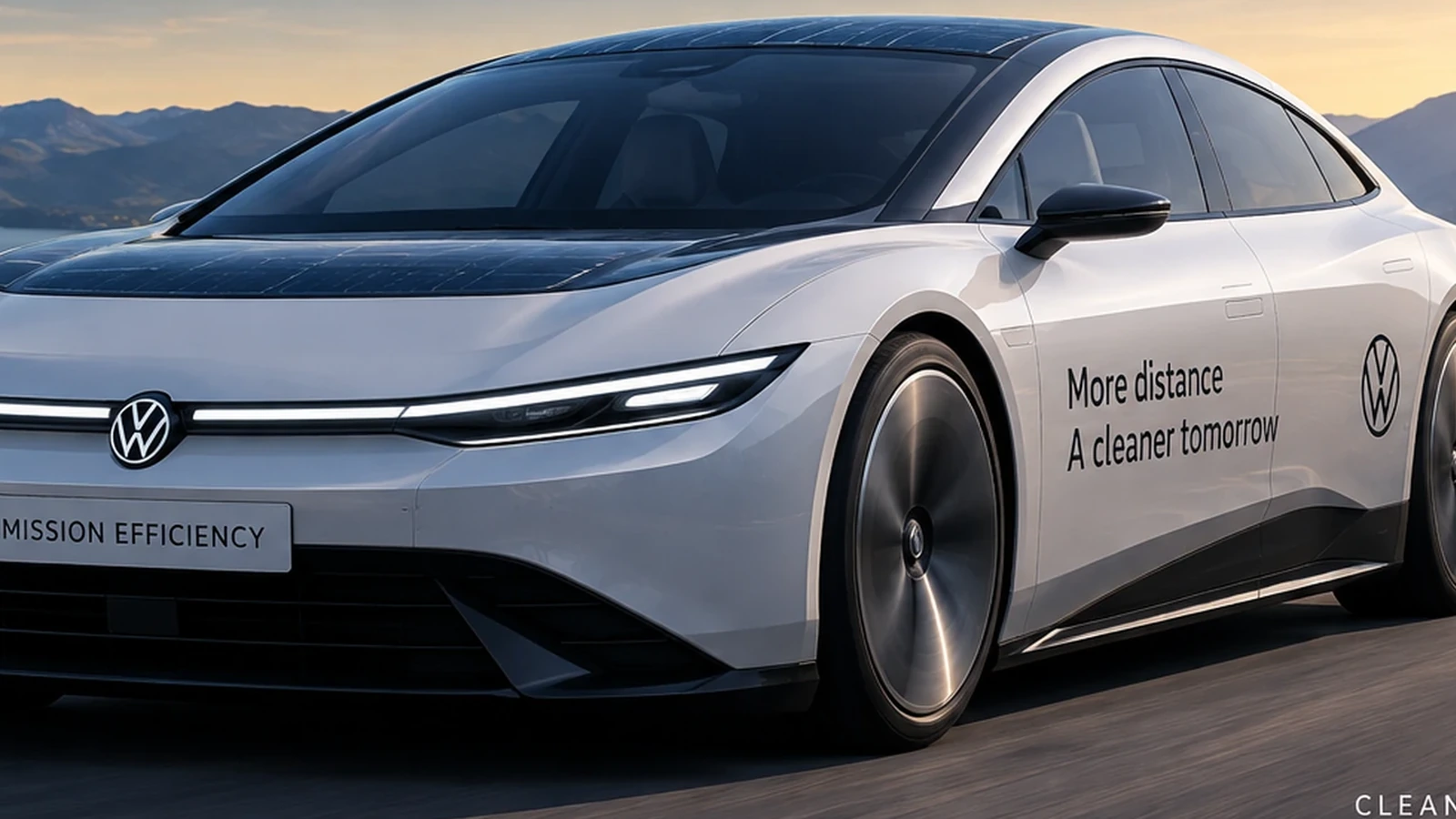
Volkswagen Mission Efficiency is a near-production electric concept built to answer a different EV question: what happens if engineers attack energy demand as aggressively as manufacturers usually attack battery size? Volkswagen documented a 1,278.36 km journey from Wolfsburg to Vienna at a reported 6.89 kWh/100 km excluding charging losses, but that distance was not completed on one charge. The 54.9 kWh battery was recharged once during the trip. Including charging losses, Volkswagen reports 7.51 kWh/100 km.
The engineering headline is equally striking: a claimed drag coefficient of 0.158, combined with a 2.08 m² frontal area, a low body, covered aerodynamic details and an MEB+ front-wheel-drive powertrain related to the ID. Polo. Yet this is not a showroom car. Volkswagen labels Mission Efficiency a concept vehicle and has announced no retail price, order book or production launch. The useful question is therefore not “when can I buy it?” but “which of these efficiency ideas could migrate into normal electric Volkswagens?”
Volkswagen Mission Efficiency: Quick answer
Volkswagen Mission Efficiency is a concept vehicle, not a production EV for sale. Volkswagen says it achieved a Cd of 0.158, 6.48 kWh/100 km in an idealised efficiency run, 6.89 kWh/100 km on a 1,278.36 km documented road journey excluding charging losses, and 7.51 kWh/100 km including those losses. The same car carries a published WLTP consumption figure of 8.4 kWh/100 km. Its 54.9 kWh NMC battery was charged once during the 1,278 km journey, so the trip distance is not a single-charge range figure. Mission Efficiency is based on MEB+ technology and uses a 99 kW APP290 motor, but Volkswagen has made no production commitment for the complete car.
What is Volkswagen Mission Efficiency?
Mission Efficiency is Volkswagen’s extreme-efficiency technology demonstrator. The company describes it as “near-production” because much of the underlying electrical architecture comes from production-oriented MEB+ hardware rather than from an unrelated laboratory drivetrain. Its front-mounted APP290 permanent-magnet synchronous motor produces 99 kW (135 PS) and 264 Nm, while a 54.9 kWh net NMC battery uses cell-to-pack construction. The car is front-wheel drive.
“Near-production” should not be confused with “production ready.” The concept’s low silhouette, lightweight structures, narrow rear track, extensive aerodynamic work and specialist composite materials are exactly the kinds of measures that may be modified, simplified or omitted when a manufacturer has to balance cost, repairability, crash packaging, visibility, interior space, manufacturing speed and customer preferences.
No, it did not travel 1,278 km on one charge
No, Volkswagen did not drive 1,278 km on one charge. The documented route covered 1,278.36 km from Wolfsburg through Poznań and Olomouc to Vienna. Volkswagen says the 54.9 kWh battery was charged once during the journey. Average speed was 67.72 km/h, maximum speed during the trip was 138 km/h, and the car displayed a manufacturer-reported 164 km of remaining range on arrival.
This distinction matters because the published consumption figures themselves make the point. Multiplying 1,278.36 km by 6.89 kWh/100 km gives about 88.1 kWh of vehicle-side energy for the trip. Using the grid-inclusive 7.51 kWh/100 km figure gives about 96.0 kWh. Both are well above the car’s 54.9 kWh usable battery capacity, which is consistent with Volkswagen’s statement that the battery was recharged once.
The four efficiency numbers you need to understand
| Figure | Test context | What it includes | Consumer relevance |
|---|---|---|---|
| 6.48 kWh/100 km | Idealised efficiency run | Constant 68 km/h, no uphill gradients, auxiliary consumers such as A/C switched off | Engineering limit under deliberately favourable conditions |
| 6.89 kWh/100 km | 1,278.36 km documented road journey | Vehicle-side energy; excludes charging losses | More representative than the ideal run, but still a special documented drive |
| 7.51 kWh/100 km | Same documented road journey | Includes charging losses | Useful for understanding electricity drawn from the grid |
| 8.4 kWh/100 km | WLTP | Standardised regulatory test framework | Best like-for-like number for comparison with production EVs using WLTP |
What does 6.48 kWh/100 km actually mean?
The 6.48 figure is Volkswagen’s idealised efficiency result, not an everyday motorway result. Volkswagen says the car was held at a constant 68 km/h, the route avoided uphill gradients and auxiliary loads such as air conditioning were switched off. Each of those choices reduces energy demand.
Aerodynamic drag rises rapidly with speed, and the power required to overcome that drag rises even faster. A steady 68 km/h therefore places much less aerodynamic demand on a car than sustained 120–130 km/h motorway driving. A level route also removes repeated climbing loads; although an EV can recover some energy while descending, regenerative braking is not lossless. Turning off climate control removes another meaningful load, particularly in very hot or cold weather.
Why the ideal test was unusually favorable
| Test | Speed behavior | Terrain | Climate/auxiliaries | Charging losses | Purpose |
|---|---|---|---|---|---|
| Ideal run | Constant 68 km/h | No uphill gradients | A/C and selected auxiliaries off | Not the headline measure | Show best achievable efficiency under controlled favourable conditions |
| Documented road run | 67.72 km/h average; 138 km/h maximum | Real multi-country road route | Road-use context | Published both excluding and including losses | Demonstrate efficiency outside the idealised run |
| WLTP | Standardised cycle | Standardised test framework | Regulated test procedure | Use official homologation definition | Like-for-like regulatory comparison |
The 1,278 km road test is more useful—but still needs context
The road journey is more informative than the idealised 6.48 kWh/100 km run because it used real roads over a long distance. Volkswagen says the car travelled from its Wolfsburg development centre via Poznań in Poland and Olomouc in the Czech Republic to Vienna, Austria. The average speed of 67.72 km/h is important context: this was not 1,278 km of continuous high-speed autobahn driving.
The road result is nevertheless remarkable. Volkswagen reports 6.89 kWh/100 km excluding charging losses. For perspective, Volkswagen currently quotes the production ID. Polo at roughly 13–15 kWh/100 km depending on version. Volkswagen also says Mission Efficiency uses more than 30% less energy than the ID. Polo above roughly 80 km/h under comparable conditions, and claims that at about 140 km/h the prototype consumes roughly what an ID. Polo uses at 100 km/h. Those comparisons are manufacturer claims, not independent FrediTech test data.
6.89 vs 7.51 kWh/100 km: Why charging losses matter
The difference between 7.51 and 6.89 kWh/100 km is 0.62 kWh/100 km. The grid-inclusive number is about 9% higher than the vehicle-side figure. That does not mean every EV loses exactly 9% during charging. Losses vary with charger type, power level, battery temperature, state of charge, conversion electronics and auxiliary loads.
But the distinction is valuable because the number on an EV’s trip computer often reflects energy leaving the battery, while a household electricity bill reflects what was drawn from the wall. Over 1,278.36 km, FrediTech’s arithmetic gives about 88.1 kWh vehicle-side and about 96.0 kWh grid-side, a difference of roughly 7.9 kWh.
Volkswagen also publishes an 8.4 kWh/100 km WLTP figure
How a 0.158 drag coefficient changes EV efficiency
Volkswagen’s Cd 0.158 claim is central to the project. Drag coefficient describes how effectively a shape moves through the air, but it is only part of the aerodynamic picture. A vehicle also has a frontal area—the amount of body presented to the oncoming air stream. Mission Efficiency’s published frontal area is 2.08 m².
Multiplying Cd by frontal area gives a drag-area figure of approximately 0.329 m². That FrediTech calculation is useful because a physically larger vehicle with an excellent Cd can still generate more drag than a smaller car with a slightly worse coefficient. CdA combines shape efficiency and size into one more informative number.
How Volkswagen made the body so aerodynamic
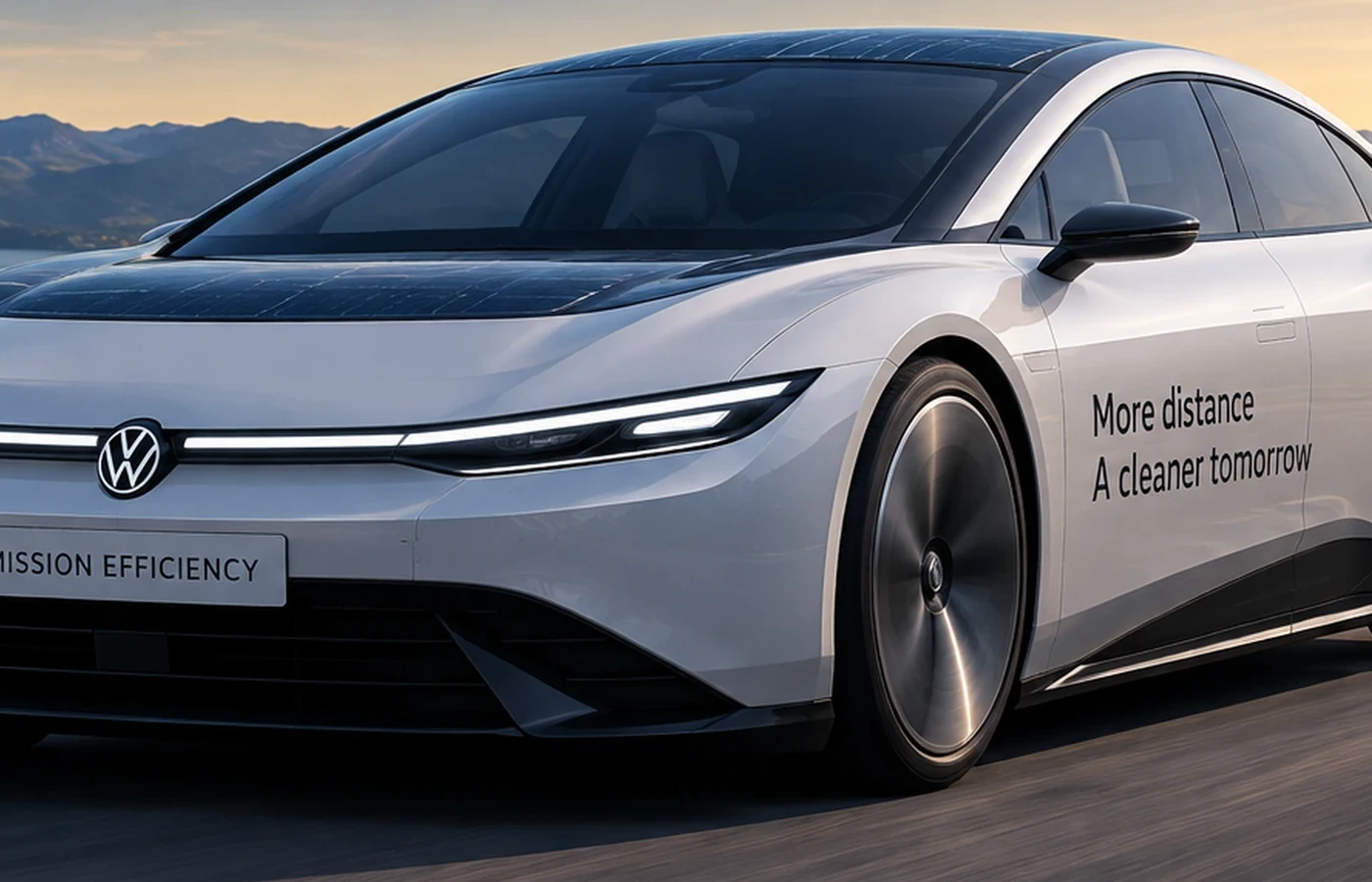
Volkswagen’s published material highlights an elongated teardrop-like body, a nearly enclosed underbody, optimised cooling airflow, reworked rear-wheel areas, aerodynamic axle covers and patented rim deflectors. The rear track is approximately 170 mm narrower than the ID. Polo reference, helping the body taper toward the rear and reducing wake size.
Wheels are particularly difficult aerodynamically because they rotate, sit inside turbulent arches and disturb pressure around the body sides. Rim deflectors and wheel covers can reduce that disturbance. A smooth underbody similarly limits turbulence beneath the car, which matters increasingly as speed rises.
A 54.9 kWh battery shows why efficiency can matter more than sheer capacity
Mission Efficiency’s battery is modest by modern long-range-EV standards: 54.9 kWh net. Volkswagen says it uses NMC chemistry and cell-to-pack construction, with technology related to the ID. Polo. The prototype’s usable amount was increased through software compared with Volkswagen’s production configuration, so readers should not assume an identical usable capacity will appear in an ID. Polo.
The drivetrain comes from production-oriented MEB+ technology
The car uses Volkswagen’s MEB+ platform architecture with front-wheel drive and the APP290 permanent-magnet synchronous motor. Output is 99 kW and torque is 264 Nm. Official performance is deliberately ordinary: 0–100 km/h in 9.0 seconds and a 160 km/h top speed. This is not a sports-EV exercise; acceleration is secondary to minimising energy demand.
105 kW charging looks modest—but efficiency changes the equation
Mission Efficiency supports up to 105 kW DC charging and 11 kW AC charging. Those numbers are not class-leading, but the car illustrates why charging speed cannot be judged only by peak kilowatts. If one vehicle needs 12 kWh to travel 100 km and another needs 20 kWh, adding the same 20 kWh of battery energy yields much more driving distance in the efficient vehicle.
The solar roof helps, but it does not power the car by itself
Volkswagen lists a 370 W photovoltaic system integrated into the roof and rear glass. The solar energy supports auxiliary electrical consumers, reducing how much those systems draw from the traction battery. Volkswagen estimates the system could contribute up to around 30 km of additional range per day depending on season, location and weather.
“Up to” is doing important work. Solar output changes with cloud cover, shading, orientation, latitude, daylight hours and temperature. A 370 W array is not a continuous propulsion source, and buyers should not read the 30 km estimate as a daily guarantee.
Why this is called “near-production” even though you cannot buy it
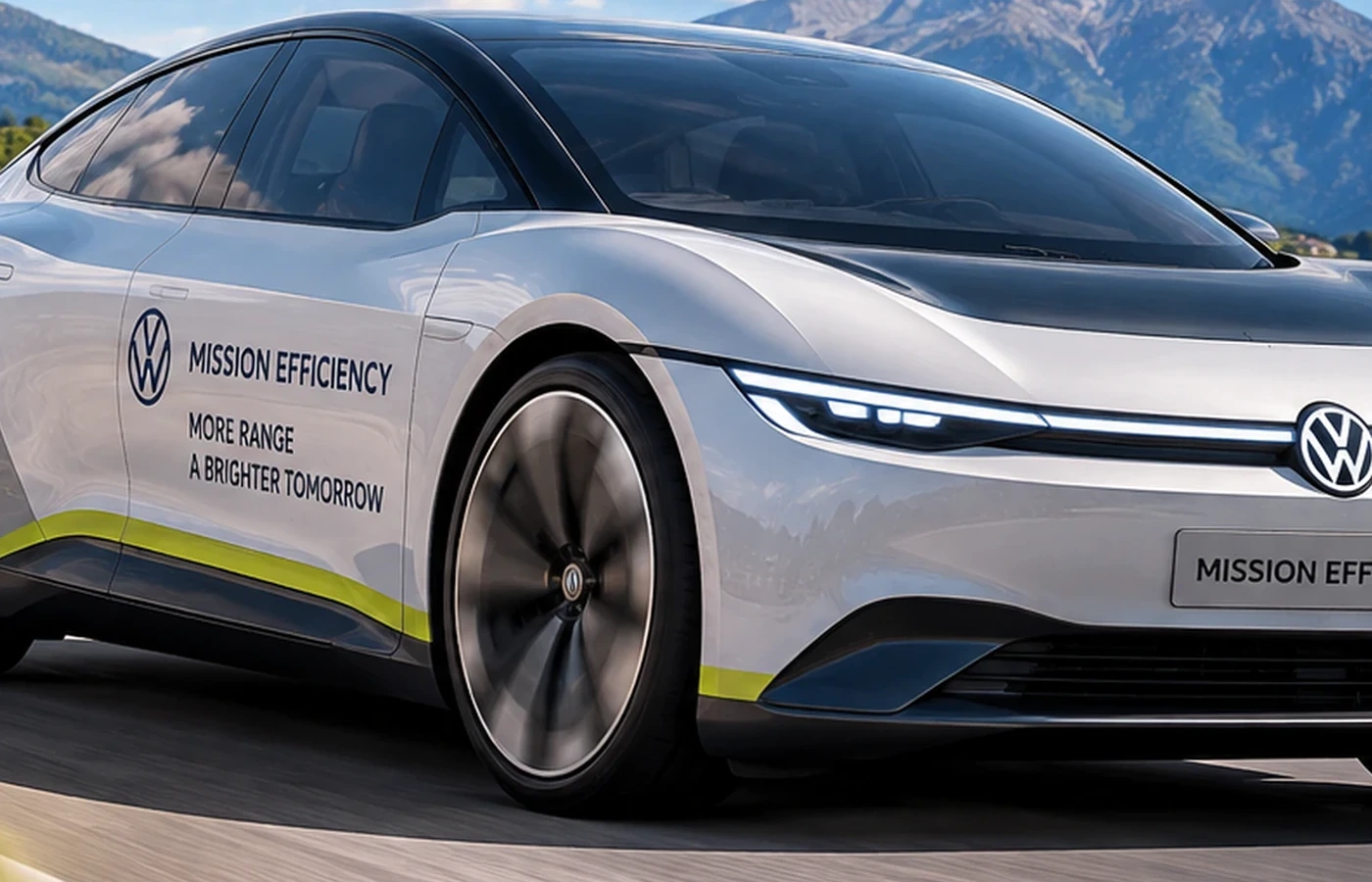
The phrase describes the relationship between experimental body engineering and production-oriented hardware. The motor, battery architecture and MEB+ platform provide a technical bridge to upcoming mass-market Volkswagens. The complete vehicle, however, also uses expensive lightweight materials and unusual packaging. Volkswagen mentions self-supporting aluminium structures and carbon-fibre/aramid composite body components—materials that may be harder to justify at mainstream volumes.
The concept also uses a 2+2 layout rather than a conventional four-seat family-car arrangement. Luggage capacity is a useful 481 litres, but Volkswagen says the rear seats are intended for occupants up to about 1.60 m tall. That makes the car far more practical than a one-seat efficiency racer, yet still shows the compromises required by its low roofline.
What could make it into future Volkswagen EVs?
The most transferable ideas are not necessarily the dramatic body shape. Underbody airflow management, wheel deflectors, cooling-air control, low-loss electrical components, drivetrain optimisation and energy-management software can migrate into normal cars without making them look like laboratory prototypes. The same is true of lessons around battery packaging and the relationship between thermal management and energy use.
For broader market context, FrediTech’s Range Rover Electric guide shows the opposite packaging challenge: a large, high-riding luxury EV has far more frontal area to push through the air. Our Lucid Gravity review and best luxury electric SUVs guide also illustrate why efficiency improvements are valuable even when buyers still demand large cabins and SUV proportions.
Why a production SUV probably will not match these numbers
Mainstream buyers often prefer taller crossovers with easier entry, more headroom, more ground clearance and a commanding seating position. Those preferences increase frontal area and usually make the ideal low teardrop silhouette harder to achieve. Wider tyres and large open wheels can also raise aerodynamic and rolling losses.
For more mainstream EV context, see FrediTech’s Volkswagen ID.4 review, Honda Prologue EV guide and Ford Mustang Mach-E coverage.
How Mission Efficiency compares with efficient production EVs
For a fair comparison, the correct Mission Efficiency number is its 8.4 kWh/100 km WLTP figure—not the 6.48 ideal-run figure. Hyundai currently lists the IONIQ 6 at 13.5 kWh/100 km combined in its European technical data, depending on configuration. Volkswagen lists current ID. Polo variants in roughly the 13–15 kWh/100 km range. Those production cars must satisfy ordinary manufacturing, cabin, safety, tyre and usability requirements.
| Vehicle | Status | Standardised consumption | Battery context | Test standard |
|---|---|---|---|---|
| Volkswagen Mission Efficiency | Concept; not for sale | 8.4 kWh/100 km | 54.9 kWh net | WLTP |
| Hyundai IONIQ 6 | Production EV | 13.5 kWh/100 km (published European figure) | 63/84 kWh configurations | WLTP |
| Volkswagen ID. Polo | Production EV | About 13–15 kWh/100 km depending version | Varies by version | WLTP |
What Mission Efficiency tells us about future EV batteries
The most interesting implication is not that every future EV should chase a 0.158 Cd. It is that reducing consumption can be an alternative to endlessly increasing pack size. If a future compact EV needs fewer kilowatt-hours per 100 km, engineers can choose between maintaining today’s battery size for greater range or shrinking the pack while maintaining useful range.
A smaller pack can potentially reduce mass, material use, cost and the time required to add a given percentage of range. None of those benefits is automatic—battery pricing, chemistry, manufacturing and customer expectations still matter—but the direction is significant.
What Volkswagen’s record does not prove
- It does not prove that Mission Efficiency has a 1,278 km single-charge range.
- It does not mean consumers can order the prototype.
- It does not show that a normal production Volkswagen will achieve 6.48 kWh/100 km.
- It does not mean air-conditioning or heating has negligible energy impact.
- It does not mean motorway driving at 120–130 km/h will reproduce the ideal-run result.
- It does not mean every MEB+ EV will achieve comparable efficiency.
- It does not guarantee the solar system will add 30 km every day.
- It does not prove that future Volkswagen production cars will use carbon/aramid body structures.
- It does not establish a retail price or production launch date.
Volkswagen Mission Efficiency specifications
| Vehicle type | Near-production electric concept / technology demonstrator |
|---|---|
| Production status | Not for sale; no production commitment announced |
| Platform | MEB+ |
| Drive | Front-wheel drive |
| Motor | APP290 permanent-magnet synchronous motor |
| Power | 99 kW (135 PS) |
| Torque | 264 Nm |
| Battery | 54.9 kWh net, NMC, cell-to-pack |
| AC / DC charging | 11 kW AC / 105 kW maximum DC |
| Drag coefficient | 0.158 Cd |
| Frontal area | 2.08 m² |
| Calculated CdA | ≈0.329 m² (FrediTech calculation) |
| WLTP consumption | 8.4 kWh/100 km |
| Idealised run | 6.48 kWh/100 km |
| Documented road drive | 6.89 kWh/100 km excluding charging losses |
| Grid-inclusive road drive | 7.51 kWh/100 km including charging losses |
| Solar system | 370 W photovoltaic system |
| Dimensions | 4,775 mm L × 1,744 mm W × 1,392 mm H |
| Wheelbase | 2,700 mm |
| Seats / cargo | 2+2 / 481 litres |
| 0–100 km/h / top speed | 9.0 s / 160 km/h |
| Documented route | 1,278.36 km; average 67.72 km/h |
| Price | Not applicable — concept not for sale |
FrediTech verdict
Mission Efficiency is most valuable as evidence that EV engineering cannot be reduced to battery capacity. Volkswagen has combined aerodynamics, low mass, an efficient drivetrain and strict energy management to show how dramatically consumption can fall. The 0.158 Cd and 6.89 kWh/100 km documented road-drive figure are exceptional manufacturer-reported results, but they come from a highly specialised body and carefully optimised vehicle.
The 6.48 kWh/100 km result is even more specialised because it was achieved at a constant 68 km/h, with no uphill gradients and with auxiliary loads such as air conditioning switched off. That is an engineering benchmark, not an owner-consumption promise.
The strongest takeaway is therefore simple: Mission Efficiency matters more as an argument for using less energy than as an argument for building ever-larger batteries. If Volkswagen can transfer even part of its aerodynamic, wheel-flow, drivetrain and energy-management work into mass-market MEB+ vehicles, future EVs may be able to deliver useful range with smaller, lighter and potentially less expensive battery packs. Until Volkswagen announces a production derivative, however, Mission Efficiency remains a technology demonstrator—not a car buyers can order.
Frequently Asked Questions
What is Volkswagen Mission Efficiency?
It is a near-production electric concept and technology demonstrator based on Volkswagen’s MEB+ architecture.
Can I buy Volkswagen Mission Efficiency?
No. Volkswagen labels it a concept vehicle and says it is not for sale.
Did it travel 1,278 km on one charge?
No. The 54.9 kWh battery was recharged once during the 1,278.36 km documented journey.
What does 6.48 kWh/100 km mean?
It is Volkswagen’s idealised efficiency result at a constant 68 km/h, without uphill gradients and with selected auxiliary consumers such as air conditioning switched off.
What is the road-drive efficiency?
Volkswagen reports 6.89 kWh/100 km excluding charging losses and 7.51 kWh/100 km including them.
What is the WLTP consumption?
Volkswagen publishes 8.4 kWh/100 km WLTP.
What is the drag coefficient?
Volkswagen reports Cd 0.158.
Why does frontal area matter?
Cd describes shape efficiency, but total aerodynamic drag also depends on how much frontal area the vehicle presents to the air.
What battery does it use?
A 54.9 kWh net NMC lithium-ion battery using cell-to-pack construction.
How fast can it charge?
Volkswagen lists 11 kW AC charging and up to 105 kW DC charging.
Does the solar roof drive the car?
No. Volkswagen says the 370 W photovoltaic system supports auxiliary electrical consumers; its range contribution depends heavily on conditions.
Will the exact car enter production?
Volkswagen has announced no production commitment for the complete Mission Efficiency vehicle.