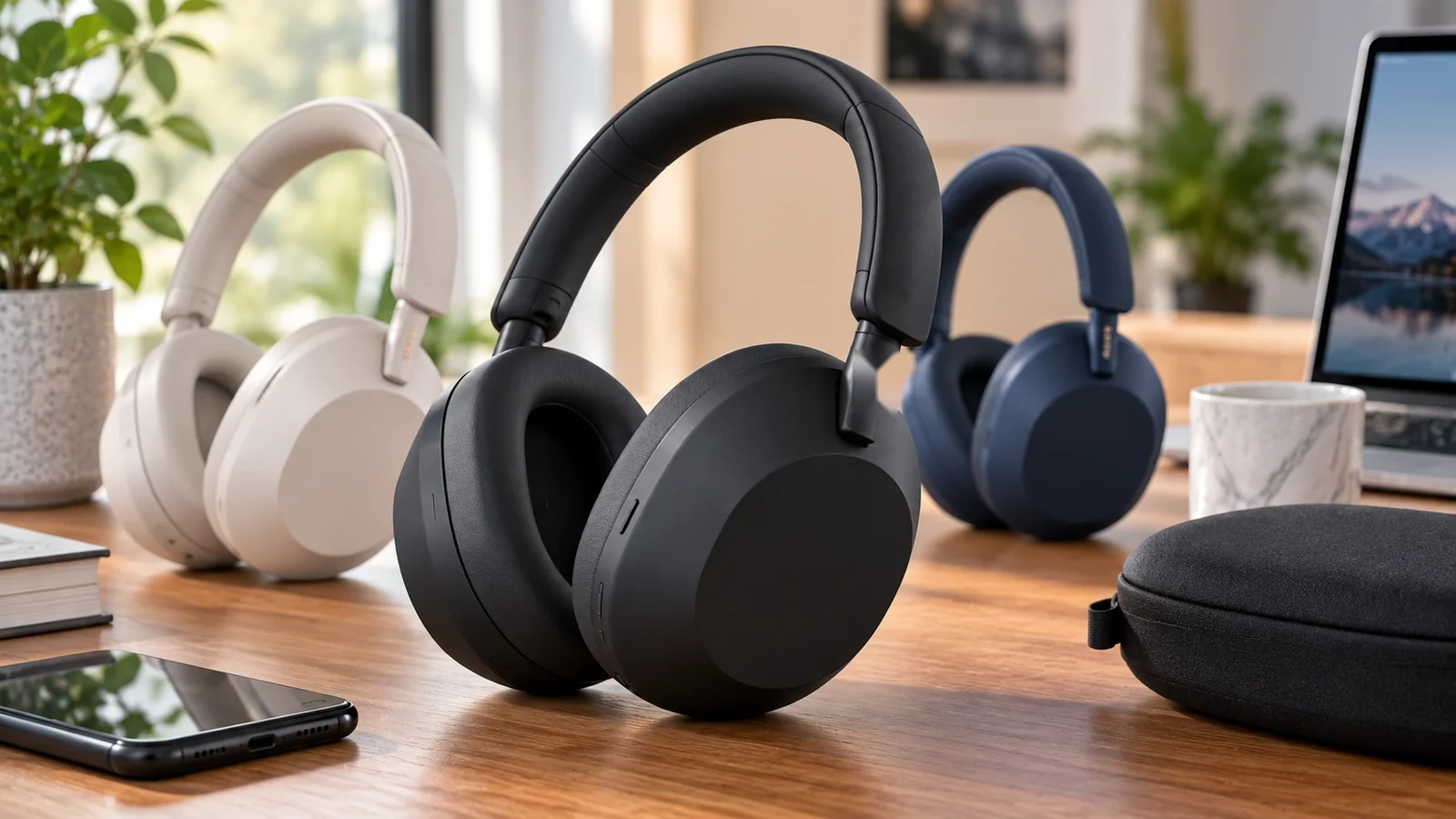

Updated September 2026: The Sony WH-1000XM5 is no longer Sony’s newest flagship over-ear headphone, but it remains relevant because its price has fallen well below the newer WH-1000XM6. Sony currently lists the WH-1000XM5 at $299.99 in the US, down from its $399.99 launch-era list price, while major retailers are hovering around the same $298–$300 level. At that price, the XM5 is still a strong option for travelers, commuters and remote workers who prioritize noise cancellation, comfort, multipoint Bluetooth and a mature app experience. Its biggest compromises in 2026 are the non-folding design, lack of a published IP water-resistance rating, and the fact that newer premium rivals now offer newer connectivity, folding designs or longer battery life.
Prices and availability were checked in September 2026 and may change by retailer and region.
Table of contents
Quick Verdict: Sony WH-1000XM5 in 2026
Best for: frequent travelers, commuters, office users and buyers who want strong ANC without paying current flagship pricing.
Consider it if: you can buy it around $300 or less and value Sony’s mature noise-cancelling, EQ and multipoint features.
Skip it if: you want a folding design, an IP-rated workout headphone, the newest Bluetooth features, or the XM6 is only slightly more expensive where you shop.
Biggest strengths: excellent ANC, comfortable lightweight fit, useful Sound Connect customization, LDAC support and solid call performance.
Main compromises: non-folding earcups, no published IP rating, 30-hour ANC battery life that is now ordinary rather than class-leading, and older Bluetooth 5.2 hardware.
Sony WH-1000XM5 Price in 2026
Price checked: September 2026. Sony’s US store currently lists the WH-1000XM5 at $299.99, reduced from $399.99, and Best Buy is listing it at about $298. That means the practical US street price is now roughly $300 before shorter promotional discounts. The previous $198 deal attached to this article’s original version was a temporary promotion, not the normal 2026 price, so buyers should not assume that figure is always available.
The price gap matters because Sony’s newer WH-1000XM6 is currently $459.99 direct from Sony. At roughly $160 less, the XM5 becomes much easier to justify if your priorities are ANC, calls and everyday listening rather than owning Sony’s newest design and processing platform. Our WH-1000XM6 vs WH-1000XM5 comparison goes deeper into what the newer model changes.
At $350–$400, the XM5 is much less compelling because newer products crowd that price band. Around $300, it competes directly with Sennheiser’s Momentum 4 and often undercuts Bose’s latest QuietComfort models. Below $275 during a verified sale, it becomes particularly attractive. Because headphone promotions can change daily, compare the checkout price rather than relying on a headline deal.
Sony WH-1000XM5 Key Specifications
| Specification | Sony WH-1000XM5 |
|---|---|
| Type | Closed-back, over-ear wireless headphones |
| Driver | 30mm dynamic driver |
| Bluetooth | Bluetooth 5.2 |
| Codecs | SBC, AAC, LDAC |
| Multipoint | Yes, two devices simultaneously |
| Noise cancellation | Adaptive ANC with eight microphones and Auto NC Optimizer |
| Ambient mode | Yes, including Quick Attention |
| Battery | Up to 30 hours with ANC; up to 40 hours with ANC off |
| Quick charge | About 3 hours of listening from 3 minutes with compatible USB-PD charging |
| Charging | USB-C |
| Wired listening | Yes, detachable 3.5mm cable; passive operation supported |
| Weight | Approx. 8.82 oz / 250g |
| Companion app | Sony | Sound Connect |
| Spatial feature | 360 Reality Audio where supported |
| Foldability | Ear cups swivel but do not fold inward |
| Water resistance | No published IP water/sweat rating |
| Colors | Black, Platinum Silver, Midnight Blue, Smoky Pink; availability varies by region |
These core specifications are still competitive, but the age of the platform is visible. Bluetooth 5.2 remains reliable, yet the newer XM6 moves to Bluetooth 5.3 and adds LC3 support. The XM5 still covers the formats most buyers use—SBC and AAC for broad compatibility and Sony’s LDAC for higher-bitrate Android playback.
Design and Comfort in 2026
The WH-1000XM5 remains pleasantly light at about 250g. Sony uses a slim headband, soft synthetic ear cushions and a stepless adjustment mechanism. The low weight matters on flights and long work sessions because heavy premium headphones can become tiring even when their padding is excellent.
The design’s biggest practical weakness is portability. Unlike the older WH-1000XM4 and the newer XM6, the XM5 does not fold inward. Its ear cups rotate flat, but the supplied case occupies more bag space than a folding headphone case.
Build quality is mostly plastic, which helps keep the weight down but does not feel as substantial as metal-heavy alternatives such as AirPods Max. The XM5 should also be treated as a lifestyle/travel headphone rather than a workout model. Sony does not publish an IP sweat- or water-resistance rating for the WH-1000XM5, so gym use, heavy rain and wet conditions are not its natural environment.
Sound Quality
The WH-1000XM5 has a warm, consumer-friendly tuning with substantial bass, smooth mids and enough treble detail for everyday listening. The important point is that sound preference is subjective: listeners who prefer a neutral studio-style balance may want to reduce the low end, while listeners who enjoy electronic, hip-hop and pop may appreciate the fuller bass presentation.
Sony gives you useful control through the Sound Connect app. The EQ can reshape the tonal balance, while DSEE Extreme is intended to improve perceived detail in compressed audio. Android users can take advantage of LDAC on compatible devices; iPhone users are limited to AAC because Apple devices do not support LDAC. That does not make the XM5 a poor iPhone headphone—AAC is stable and widely used—but Apple-focused buyers may prefer the tighter ecosystem integration of AirPods Max.
Wired listening remains a useful advantage. Sony includes a detachable stereo mini-jack cable, and the XM5 can operate passively when powered off. That is helpful on airplanes, with older laptops, or when the battery is empty. For music, podcasts and movies, the XM5 remains versatile enough that sound quality is unlikely to be the reason most 2026 buyers reject it.
Active Noise Cancellation
Noise cancellation is still one of the XM5’s strongest reasons to buy. Sony combines the HD Noise Cancelling Processor QN1 and Integrated Processor V1 with eight microphones. Auto NC Optimizer adjusts cancellation according to fit and environmental conditions, while Ambient Sound lets outside sound back in when you need awareness.
Independent testing remains favorable. RTINGS, which retested the model in 2026, continues to rate the XM5’s ANC performance very highly for travel and office use. It is particularly effective at reducing the steady rumble and general cabin noise that make flights and bus trips tiring, while also suppressing much of the chatter and higher-frequency office noise around you. Irregular voices and sudden sounds are always harder for ANC systems than steady low-frequency noise, so no premium headphone creates complete silence.
For a broader explanation of how to judge ANC rather than relying on marketing terms, see FrediTech’s noise-cancelling headphones buying guide and our updated best noise-cancelling headphones in 2026.
Call Quality and Microphones
Sony uses four beamforming microphones for voice pickup plus processing designed to isolate speech from background noise. The result remains suitable for phone calls, Zoom or Teams meetings, and general remote-work use. Like most Bluetooth headphones, microphone quality is still more compressed than a dedicated USB microphone or a strong wired headset, but the XM5 is convenient when you need one pair of headphones for music and meetings.
Indoor calls are the easiest case. Outdoors, wind and traffic create more difficult conditions, although Sony’s processing can reduce a significant amount of surrounding sound. Buyers who spend most of their day in calls should compare microphone samples from current competitors rather than assuming all premium ANC headphones sound identical.
Battery Life and Charging
Sony rates the WH-1000XM5 for up to 30 hours of continuous music with noise cancellation on and up to 40 hours with ANC off. RTINGS measured roughly 27 hours in its continuous-playback testing, which is reasonably close to Sony’s ANC claim while illustrating that real-world duration depends on volume, codec, temperature, calls and feature use.
Quick charging remains convenient: with a compatible USB Power Delivery charger, Sony says about three minutes of charging can provide around three hours of listening. A full charge is rated at approximately 3.5 hours. The battery is good enough for long-haul travel and several workdays, but it no longer leads the category. Sennheiser’s Momentum 4, for example, is rated for up to 60 hours with ANC.
Connectivity and Sony Sound Connect Features
The XM5 supports Bluetooth 5.2 and multipoint pairing with two devices. That is especially useful if you work on a laptop while keeping a phone connected for calls. Sony’s September 2026 support documentation still describes the “Connect to 2 devices simultaneously” option inside the Sony | Sound Connect app.
Sound Connect also handles EQ, Ambient Sound Control, noise-cancelling preferences, DSEE settings, firmware updates and 360 Reality Audio setup on supported services. The headphone works with Android, iPhone, Windows and macOS; the main platform difference is codec support and how deeply the headphones integrate with each ecosystem.
If you are shopping more broadly, FrediTech’s best wireless headphones for 2026 compares over-ear options across different priorities and price bands.
What Has Aged Well — and What Hasn’t
What has aged well
- Noise cancellation: still excellent for commuting, flights and office noise.
- Comfort: the 250g weight and soft ear cushions remain competitive.
- App and EQ: Sony continues to support the XM5 through Sound Connect.
- Multipoint: two-device pairing remains genuinely useful for phone-and-laptop users.
- LDAC: still valuable for compatible Android devices.
- Calls: the beamforming microphone system remains practical for work.
What has not aged as well
- Portability: the non-folding design takes more bag space than several rivals.
- Water resistance: there is no published IP rating for sweat or rain protection.
- Battery leadership: 30 hours with ANC is solid, but newer rivals can go substantially longer.
- Connectivity age: Bluetooth 5.2 and the lack of LC3 show the XM5’s generation.
- Full-price value: around $400, the XM5 is too close to newer premium models; its appeal depends heavily on discounting.
Sony WH-1000XM5 Pros and Cons
Pros
- Excellent ANC
- Comfortable and lightweight
- Useful multipoint support
- LDAC plus flexible EQ
- Good calls and meeting performance
- Wired passive listening
- Much better value around $300
Cons
- Does not fold inward
- No published IP rating
- Battery life trails some rivals
- No aptX family support
- Older Bluetooth platform than XM6
- Less compelling when priced near newer flagships
Best Sony WH-1000XM5 Alternatives in 2026
The XM5 now sits in a crowded market. These alternatives make the most sense depending on what you value.
Sony WH-1000XM6: Best newer Sony alternative
The WH-1000XM6 costs $459.99 direct from Sony in September 2026. It adds Sony’s newer QN3 processor, a 12-microphone system, Bluetooth 5.3, LC3 support and—importantly for travelers—a folding design. Battery life remains up to 30 hours with ANC, so the upgrade is more about ANC processing, calls, connectivity and portability than a battery revolution. Choose XM6 if you want Sony’s latest platform and the price gap is acceptable; choose XM5 if saving roughly $160 matters more.
Bose QuietComfort Ultra Headphones (2nd Gen): Premium ANC rival
Bose lists the QuietComfort Ultra Headphones (2nd Gen) at $449. They combine strong noise cancellation, multipoint, Bose Immersive Audio and up to 30 hours of battery life. They are a logical alternative for buyers who prioritize ANC and comfort but prefer Bose’s tuning and controls. The disadvantage is price: at current figures they cost roughly $150 more than the XM5. FrediTech’s Bose QuietComfort Ultra guide covers the generation differences in more detail.
Sennheiser Momentum 4 Wireless: Best for battery and sound-focused buyers
Sennheiser currently lists the Momentum 4 Wireless at $299.95 in the US, almost exactly matching the XM5. Its standout advantage is battery life: up to 60 hours with ANC. It also supports aptX Adaptive in addition to AAC and SBC. The XM5 generally makes more sense if your priority is Sony’s ANC ecosystem and LDAC, while Momentum 4 is compelling for long battery life and listeners who prefer Sennheiser’s sound approach.
AirPods Max (USB-C): Best for deep Apple ecosystem integration
Apple’s USB-C AirPods Max remains $549 with up to 20 hours of listening time with ANC. It is substantially more expensive and heavier than the XM5, but Apple users may value effortless device integration, Personalized Spatial Audio and USB-C lossless audio support. For buyers who simply want effective ANC at a lower cost, the Sony remains easier to justify.
Bose QuietComfort Headphones (2nd Gen): Comfort-first alternative
Bose’s 2026 QuietComfort Headphones (2nd Gen) launched at $359. They add Bose TrueSpatial features while keeping the line’s comfort-focused design. If comfort and a folding travel form factor matter more than Sony’s LDAC support, they deserve a look; at about $60 more than the current XM5, the decision is close enough to compare fit and features directly.
WH-1000XM5 vs Current Alternatives: Quick Comparison
| Headphones | Typical current price* | ANC | Battery claim | Multipoint | Best for |
|---|---|---|---|---|---|
| Sony WH-1000XM5 | About $298–$300 | Excellent | 30h ANC | Yes | Value premium ANC |
| Sony WH-1000XM6 | $459.99 | Yes, newer system | 30h ANC | Yes | Newest Sony features |
| Bose QC Ultra 2nd Gen | $449 | Premium ANC | 30h | Yes | ANC and comfort |
| Sennheiser Momentum 4 | $299.95 | Adaptive ANC | Up to 60h | Yes | Battery and sound |
| AirPods Max USB-C | $549 | Yes | Up to 20h | Apple switching | Apple ecosystem |
*US prices checked in September 2026; retailer promotions and regional pricing can change.
Who Should Buy the WH-1000XM5 in 2026?
- Frequent travelers: the ANC and 30-hour battery remain highly practical for flights.
- Commuters: strong noise reduction and Ambient Sound work well on trains and buses.
- Remote workers: multipoint pairing makes it easy to move between laptop audio and phone calls.
- Students: discounted XM5 pricing can deliver premium ANC without current flagship cost.
- Android users: LDAC and Sony’s app customization are useful advantages.
- Deal-focused buyers: when the XM5 drops clearly below $300, its value improves sharply.
Who Should Skip It?
Skip the XM5 if you need compact folding headphones, sweat resistance for workouts, the longest possible battery life, or newer Bluetooth features such as LC3. Apple users who want the tightest ecosystem integration may prefer AirPods Max despite its higher price. Buyers who prioritize 60-hour endurance should consider Momentum 4, while Sony fans who value the newest ANC processing and folding portability should look at the XM6.
If your budget is firmly below $300, also check FrediTech’s best headphones and earbuds under $300 before assuming an older flagship is automatically the best deal.
Is the Sony WH-1000XM5 Still Worth It in 2026?
The answer depends primarily on price. At roughly $300, the WH-1000XM5 remains a sensible premium ANC purchase because its core strengths have aged well: noise cancellation, comfort, multipoint, LDAC, call quality, wired backup and a mature app. At $350 or more, the value case weakens quickly because newer headphones offer folding designs, newer Bluetooth platforms, stronger battery figures or updated ANC systems.
Your ecosystem matters too. Android users can make full use of LDAC. iPhone users still get reliable AAC, ANC and multipoint, but AirPods Max offers deeper Apple integration. Travelers should weigh the XM5’s strong ANC against its larger non-folding case. Sound-focused buyers should compare the XM5 and Momentum 4 directly rather than assuming one tuning is universally better.
In short, the XM5 has shifted from “current flagship” to “discounted premium alternative.” That is not a bad place to be. The hardware is mature, Sony still sells it directly, support and firmware remain active, and the reduced price gives it a clearer role alongside newer models.
Frequently Asked Questions
Is the Sony WH-1000XM5 still worth buying in 2026?
Yes when the price is around $300 or lower and you prioritize ANC, comfort, multipoint and LDAC. It is less compelling near its old $399.99 list price.
What is the Sony WH-1000XM5 price in 2026?
Sony US lists it at $299.99 in September 2026, and Best Buy is around $298. Temporary promotions may be lower.
How long does the WH-1000XM5 battery last?
Sony rates it for up to 30 hours of music with ANC on and up to 40 hours with ANC off. Real-world endurance varies with volume, codec, temperature and features.
Is the WH-1000XM5 good for flights?
Yes. Strong ANC, pressure optimization, long battery life and wired listening make it well suited to air travel, although its non-folding case takes more space.
Can the WH-1000XM5 connect to two devices?
Yes. Sony supports multipoint connection to two devices simultaneously through Sound Connect settings.
Does the WH-1000XM5 work well with iPhone?
Yes. It supports AAC and the Sony Sound Connect app on iPhone. iPhone does not support Sony’s LDAC codec, so that specific advantage is mainly for compatible Android devices.
What is the best alternative to the Sony WH-1000XM5?
The XM6 is the obvious newer Sony option; Bose QC Ultra 2nd Gen is a premium ANC rival; Momentum 4 is especially strong for battery life; AirPods Max suits Apple-first buyers.
Final Verdict
The Sony WH-1000XM5 is no longer the premium headphone to buy simply because it is Sony’s newest model. In 2026, it makes sense for a different reason: discounted value. Its ANC remains excellent, its 250g design is comfortable, the microphone system works well for everyday calls, Sound Connect is mature, and 30-hour ANC battery life is still enough for travel and work.
The compromises are clearer than they were at launch. It does not fold inward, has no published IP water-resistance rating, and newer competitors offer longer battery life or newer connectivity. Sony’s own XM6 is also a meaningful upgrade in processing, microphones and portability.
That makes price the deciding factor. Around $300—or lower during a verified sale—the WH-1000XM5 deserves to stay on a 2026 premium-headphone shortlist. If it climbs close to $400, compare the XM6, Bose and other newer options before buying.
I appreciate the update on the headphone deals! The drop to $198 for the WH-1000XM5 is impressive and seems like a great opportunity for anyone in the market for noise-canceling headphones.