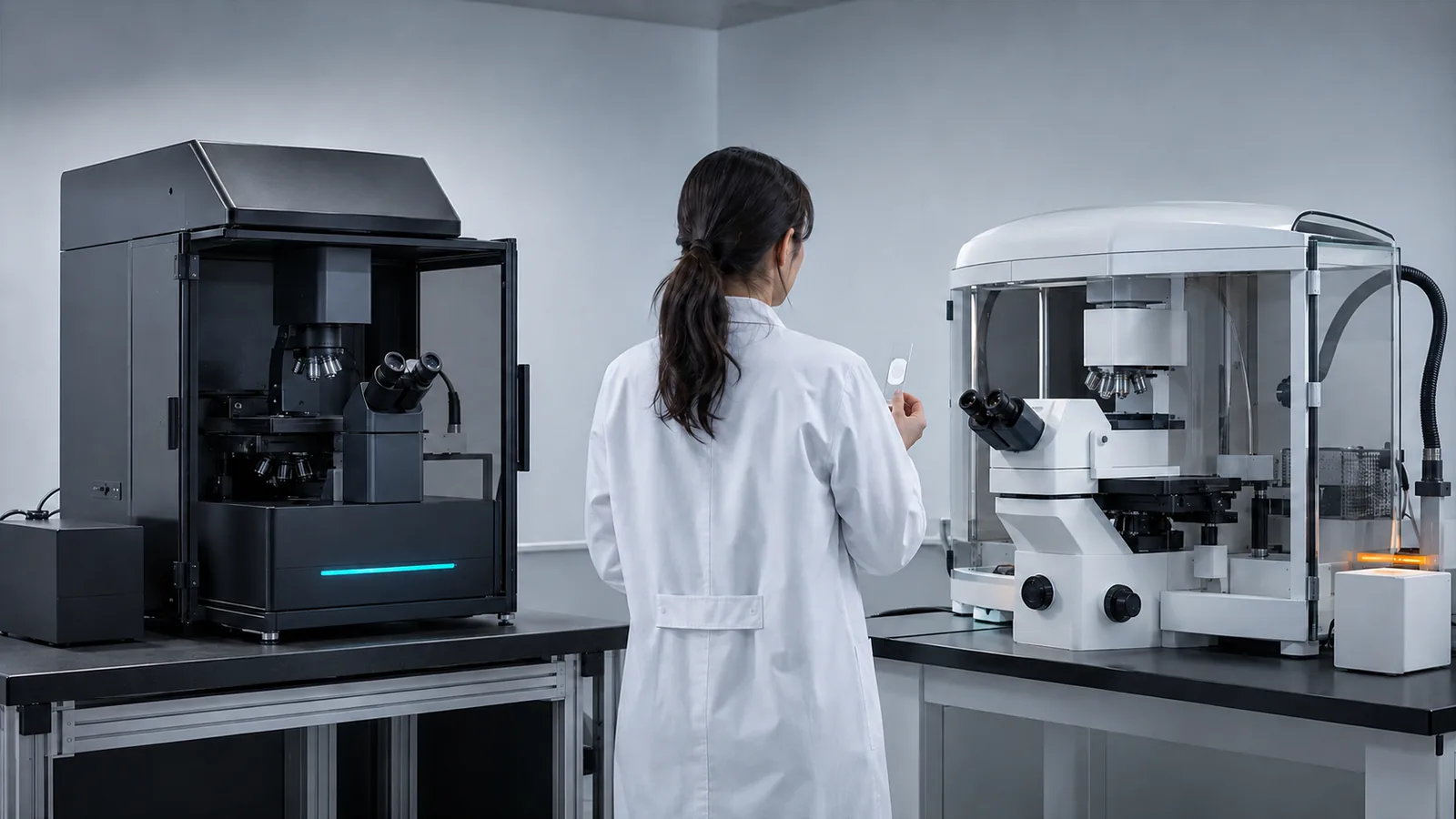


2026 status: This is a legacy-platform comparison, not a comparison of the newest microscopes from each manufacturer. Nikon lists the A1 and A1 HD25 confocal families as discontinued and points users to the AX / AX R with NSPARC as the current replacement. ZEISS has also moved beyond the LSM 880 generation; its current high-end family includes the LSM 990, while LSM 900/980 systems remain important installed-base platforms. The comparison below is therefore most useful for labs maintaining existing systems, evaluating used equipment, reproducing older methods, or deciding whether an upgrade is justified.
Quick verdict
A well-maintained Nikon A1/A1R or ZEISS LSM 880/980 can still produce publishable confocal data in 2026. The A1R remains notable for straightforward resonant high-speed imaging, while Airyscan-equipped ZEISS LSM systems remain attractive when enhanced resolution and light efficiency matter. For a new capital purchase, however, the more relevant comparison is Nikon AX/AX R with NSPARC versus ZEISS LSM 910/990—not Nikon A1 versus an older LSM.
Table of contents
Introduction
Confocal microscopy remains a core tool for fluorescence imaging because optical sectioning rejects much of the out-of-focus light that reduces contrast in widefield images. Nikon’s A1 family and ZEISS’s LSM family helped define modern point-scanning confocal workflows across cell biology, neuroscience, pathology research, developmental biology and shared imaging facilities.
The important change in 2026 is that the original Nikon A1 comparison can no longer be presented as a contest between two current flagship platforms. Nikon explicitly lists the A1 and A1 HD25 families as discontinued products. The A1R HD25 specifications remain valuable because thousands of experiments and published methods were built around them, but Nikon’s current point-scanning architecture is the AX/AX R family. On the ZEISS side, LSM 880 and LSM 980 remain highly relevant reference points, while newer systems such as LSM 910 and LSM 990 extend Airyscan, spectral multiplexing and multimodal imaging.
That makes this article a legacy comparison with a 2026 decision layer. Rather than pretending an A1R HD25 is a current flagship, we will separate historical capabilities from current upgrade paths and focus on the questions that matter now: Is an installed A1 or LSM still useful? What are the practical differences in speed, spectral imaging and enhanced resolution? What should a used-equipment buyer verify? And when does it make more sense to move to a current Nikon AX/AX R or ZEISS LSM 910/990?
Understanding Confocal Microscopy
A laser-scanning confocal microscope focuses excitation light into a small spot and uses a pinhole in the detection path to reject much of the fluorescence originating outside the focal plane. By scanning the focused spot across the specimen, the microscope builds an optical section with improved contrast. Repeating the process at different Z positions produces a stack that can be reconstructed into a three-dimensional volume.
For conventional visible-light confocal imaging, useful lateral resolution is typically on the order of a few hundred nanometres and depends on wavelength, numerical aperture, sampling and pinhole settings. In practice, detector sensitivity, objective quality, sample preparation, photobleaching, acquisition speed and signal processing can matter just as much as the theoretical diffraction limit. This is why two systems with similar nominal resolution can behave differently for live cells, dim fluorophores or large tiled specimens.
Nikon A1/A1R Legacy Overview
The Nikon A1 family became a widely used point-scanning confocal platform and evolved through versions including the A1R and the later A1 HD25/A1R HD25. Its strengths included integration with Nikon microscope stands, NIS-Elements control, spectral detection options, resonant scanning on A1R configurations, and a large field of view on the HD25 generation.

Legacy capabilities that still matter
- High-resolution raster acquisition: Nikon’s published A1 HD25 specifications list galvano-scanned images up to 4096 × 4096 pixels.
- Fast resonant imaging: the A1R HD25 resonant scanner is specified at 30 frames per second at 512 × 512 pixels and 60 fps at 256 × 256 pixels, with faster line-oriented modes for specialized experiments.
- Large field of view: the HD25 generation supports a 25 mm field on compatible Ti2-E configurations, useful for large samples and reducing the number of tiles required.
- Spectral imaging: the optional A1-DUS spectral detector provides 32 channels across 400–750 nm with selectable spectral resolution, supporting lambda scans and linear unmixing.
- Integrated workflows: NIS-Elements supports Z-stacks, time-lapse, multipoint acquisition, colocalization, spectral unmixing, FRAP/FLIP and related confocal workflows.
These are still useful capabilities for an installed system. A1/A1R hardware did not suddenly become incapable when Nikon replaced it. If a microscope is aligned, its lasers and detectors are healthy, the objectives suit the application, and the acquisition computer remains stable, it can still generate excellent routine confocal data.
What changed: Nikon now directs new buyers to AX / AX R. The current platform extends the concept with up to 8192 × 8192 galvano scanning, 2K resonant scanning, a 25 mm field, more flexible detector configurations, and the NSPARC spatial-array detector, which Nikon specifies at 100 nm lateral resolution under stated conditions. That current context should not be attributed to the older A1 itself.
Historical real-world relevance
The A1’s longevity is part of why a legacy comparison remains useful. University core facilities and research institutes used A1 systems for brain tissue, cultured cells, developmental specimens and long time-lapse experiments. Those published methods are still encountered today, and a lab reproducing an older protocol may need to understand the exact A1 detector, scanner, objective and NIS-Elements configuration that generated the original data.
ZEISS LSM Legacy Overview
ZEISS LSM is a broader family rather than a single microscope. Legacy and installed-base systems include generations such as LSM 710, 780, 800, 880, 900 and 980, with capabilities varying substantially by detector and option package. For the closest comparison with late-generation Nikon A1R HD25 hardware, the most useful reference points are Airyscan-equipped LSM 880 and LSM 980 configurations.
Airyscan and spectral detection
One correction to older summaries is important: Airyscan and the spectral detector are not the same detector. Airyscan uses a spatial detector array to capture information from the Airy pattern and reconstruct an image with improved resolution and signal-to-noise. ZEISS’s spectral detector architecture is a separate path used for flexible emission collection and spectral unmixing.
With LSM 880/980-generation systems, Airyscan became a major differentiator because it provided enhanced-resolution confocal imaging without requiring a completely separate super-resolution microscope. ZEISS documentation for LSM 980 with Airyscan 2 lists super-resolution modes around 120 nm under specified conditions, while multiplex modes trade resolution and sampling strategy for greater speed.
Current ZEISS context: In 2026 ZEISS markets newer LSM 910 and LSM 990 systems. The LSM 990 expands the platform with Airyscan-based super-resolution down to 90 nm under ZEISS’s stated conditions, Lightfield 4D options, and advanced spectral multiplexing. ZEISS also states that LSM 990 can be configured with a 32-channel GaAsP detector plus additional side/NIR detectors and can cover 380–900 nm for spectral workflows. These are current-generation capabilities and should not be retroactively assigned to an LSM 880.
ZEN software and installed-base value
ZEISS ZEN remains the core software environment for acquisition and analysis across the LSM ecosystem. On a legacy system, the practical question is less whether ZEN is “better” than NIS-Elements and more whether the microscope’s installed ZEN version, licenses, acquisition computer and device drivers remain supportable. A used system can be optically excellent but operationally frustrating if the buyer receives incomplete licenses, an unsupported control computer, or proprietary modules that cannot be transferred.
Head-to-Head Legacy Comparison: Nikon A1 vs ZEISS LSM
| Area | Nikon A1 / A1R HD25 | ZEISS LSM 880 / 980 era | 2026 interpretation |
|---|---|---|---|
| Market status | Nikon lists A1 and A1 HD25 families as discontinued. | Older LSM generations remain common in installed bases; ZEISS now markets newer LSM 910/990 systems. | Excellent legacy systems can still be useful, but do not compare them as if both were current flagships. |
| Conventional confocal | Strong point-scanning performance with up to 4096 × 4096 galvano acquisition on HD25. | Strong point-scanning confocal performance; exact capabilities depend heavily on model and detector package. | For routine fluorescence, sample preparation and detector condition often matter more than brand. |
| Fast live imaging | A1R resonant scanner: 30 fps at 512 × 512 and 60 fps at 256 × 256 in Nikon’s published specification. | LSM 980 Airyscan 2 introduced multiplex modes that can acquire rapidly while balancing resolution and field of view. | Do not assume ZEISS is inherently slower; compare the exact acquisition mode and resolution you will use. |
| Enhanced resolution | A1 itself does not contain Nikon’s current NSPARC array detector. | Airyscan-equipped 880/980 systems can provide enhanced-resolution confocal imaging around the 120 nm class under specified conditions. | Current Nikon AX/AX R with NSPARC and ZEISS LSM 910/990 are the fairer new-purchase comparison. |
| Spectral imaging | Optional 32-channel A1-DUS, 400–750 nm, with fine spectral sampling. | Spectral configurations vary by generation; later LSM systems offer highly flexible lambda acquisition and unmixing. | Confirm the detector actually installed on a used system; the model name alone is not enough. |
| Software | NIS-Elements. | ZEN. | Training, license transfer, workstation compatibility and facility standardization are more important than subjective UI preference. |
| Biggest legacy risk | Discontinued hardware, older control computer/software, service and parts availability. | Age/configuration dependent; Airyscan and software licenses can materially affect value. | A cheap used microscope can become expensive if a laser, detector, scanner or licensed module needs replacement. |
Optical performance and image quality
For conventional point-scanning confocal imaging, both platforms can produce high-quality optical sections when correctly aligned and paired with suitable objectives. The old claim that one brand is automatically sharper than the other is too simplistic. Resolution depends on numerical aperture, wavelength, pinhole, sampling, refractive-index matching, aberrations and processing as much as the logo on the scan head.
The clearer legacy distinction is the availability of Airyscan on ZEISS LSM 880/980 configurations. That provided a practical enhanced-resolution path within the LSM workflow. Nikon A1 could be combined in an imaging ecosystem that also used separate super-resolution modalities, but the A1 confocal head itself is not equivalent to Nikon’s current NSPARC array detector. In 2026, that distinction matters because Nikon’s successor platform now offers its own spatial-array confocal route.
Speed and Throughput for Live Imaging
The A1R’s resonant scanner remains one of the easiest legacy specifications to understand: Nikon lists 30 fps at 512 × 512 and 60 fps at 256 × 256 for the A1R HD25. That makes it useful for fast live-cell dynamics, provided the experiment can tolerate the signal, sampling and photobleaching trade-offs associated with high-speed acquisition.
Older comparisons often understated ZEISS speed by comparing Nikon’s resonant mode with a slow ZEISS galvano mode. Airyscan 2 and multiplex strategies changed that picture. LSM 980 documentation includes multiple parallelized modes designed for faster live imaging, with speed depending on whether the user prioritizes super-resolution, confocal resolution, field of view or a smaller region of interest. The practical lesson is to compare the mode you will actually run, not a single headline frame-rate number.
For high-throughput work, Nikon A1 HD25’s 25 mm field can still be an advantage on compatible stands because a larger field reduces the number of tiles required for some samples. Both ecosystems can automate multiposition, Z-stack and time-lapse acquisition when equipped with motorized stages and appropriate software modules.
Software and Ease of Use
NIS-Elements and ZEN are both mature environments for microscope control, acquisition and analysis. Each can handle routine multichannel acquisition, Z-stacks, time-lapse, tiling, multiposition experiments and analysis workflows. For a new user, training quality and local facility protocols usually matter more than claims that one interface is universally easier.
Legacy systems add another layer: the acquisition computer and software license are part of the microscope. Nikon’s published A1 HD25 control specifications refer to older Windows environments, which is an important 2026 consideration for security, networking and replacement PCs. A buyer should verify whether the existing NIS-Elements license can be rehosted and whether Nikon supports the exact controller and interfaces. The same principle applies to an older ZEISS LSM: verify ZEN version, module licenses, hardware keys, acquisition boards, camera/scanner interfaces and supported operating system before money changes hands.
Reliability, Service and Maintenance
High-end confocal microscopes are modular systems containing lasers, scanners, detectors, motorized stages, control electronics, objectives and computers. Their reliability cannot be judged from the scan head alone. A ten-year-old system with documented preventive maintenance can be a better research tool than a newer but poorly maintained microscope.
Nikon’s discontinued-products page still directs A1 owners toward service/parts information, but public pages do not guarantee that every component will remain available in every region. Confirm support with the local Nikon organization before buying a used A1. For older ZEISS LSM systems, perform the same check with ZEISS or the local service organization, especially for lasers, Airyscan modules, scanner electronics and legacy acquisition computers.
Do not buy from the model name alone. Two “A1R” or “LSM 880” systems can differ dramatically in lasers, detector types, objectives, stage, environmental control, spectral modules, Airyscan, photomanipulation hardware and software licenses. Ask for the complete configuration and a recent service report.
Cost and Value Considerations in 2026
There is no single reliable 2026 price for a Nikon A1 or ZEISS LSM because new high-end systems are quotation-based and used values depend heavily on configuration, age, service history, software licensing, included objectives, installation and warranty. Older articles that give a fixed “$400,000–$700,000” range or a universal annual-service percentage should be treated as rough historical anecdotes, not current purchasing guidance.
For a legacy purchase, calculate total cost to become operational: purchase price, deinstallation, specialist shipping, reinstallation, vibration table or enclosure if needed, laser condition, detector health, workstation, software licenses, preventive maintenance, calibration, training and the probability of a major repair. A used system is only a bargain if the parts and support needed to keep it productive are realistically available.
2026 Legacy Buying Checklist
- Identify the exact scan head and scanner: A1 vs A1R, HD25 or earlier; ZEISS LSM model and scan module.
- Inventory every laser line and request measured output/power stability, not simply a list of nominal wavelengths.
- Confirm detector configuration: standard PMT, GaAsP, spectral detector, Airyscan, transmitted detector and any NIR options.
- Inspect objectives individually for type, NA, correction collar, immersion medium, damage, fungus and delamination.
- Check the stage and focus system for repeatability, drift and compatibility with the intended environmental chamber.
- Verify the acquisition computer, interface cards, controller boxes, software version and transferable licenses.
- Ask for service history, error logs, last preventive maintenance and the name of the organization that will support the instrument after relocation.
- Run your own sample before purchase when possible: a familiar fluorescent standard plus a real specimen reveals much more than a showroom image.
- Test multichannel registration and Z stability if quantitative colocalization, 3D imaging or long time-lapse work is important.
- Compare against current systems before committing. A heavily refurbished legacy instrument can approach the cost of a more supportable current platform once installation and service are included.
When to Keep the Legacy System—and When to Upgrade
| Situation | Practical 2026 action |
|---|---|
| Your A1/A1R or LSM is stable, supported and already meets the resolution/speed your assays require. | Keep using it. Reproducibility and staff familiarity can be more valuable than a newer spec sheet. |
| You need to reproduce older studies acquired on the same platform. | Keep access to the legacy instrument if possible; matched optics and acquisition behavior can simplify method continuity. |
| The control PC is failing, licenses cannot be transferred, or critical electronics are no longer supportable. | Plan an upgrade. Operational risk can outweigh the low book value of an old microscope. |
| Your science now depends on spatial-array confocal super-resolution, broader spectral multiplexing or much larger/faster datasets. | Evaluate current systems. Nikon AX/AX R with NSPARC and ZEISS LSM 910/990 are more relevant than extending an A1 indefinitely. |
| You are considering a low-priced used system with no recent service report. | Do not buy on price alone. Require a functional demonstration and written service/parts assessment. |
Conclusion
Nikon A1 vs ZEISS LSM is still a useful comparison in 2026—but only when it is framed as a legacy comparison. Nikon A1/A1R systems remain capable point-scanning confocals with proven resonant-speed, spectral and large-field options. Airyscan-equipped ZEISS LSM systems from the 880/980 era remain strong for enhanced-resolution confocal imaging and flexible multimodal workflows. Neither platform should be judged solely by a headline resolution or frame-rate figure.
For an existing microscope, the right question is whether it continues to produce the data your lab needs with acceptable uptime and support. For a used purchase, configuration, serviceability and software licensing matter as much as optics. And for a new system purchase, move the comparison forward: Nikon’s current AX/AX R with NSPARC and ZEISS’s current LSM 910/990 family provide capabilities that did not exist when the original A1-versus-LSM discussion was written.
Best next step: take your own representative sample and acquisition protocol to the vendors or imaging core. Compare signal-to-noise, bleaching, acquisition time, registration, Z stability and analysis workflow using the same biological question—not just the manufacturer’s demo slide.
Frequently Asked Questions
Is the Nikon A1 still a current microscope in 2026?
No. Nikon lists the A1 Confocal Series and A1 HD25 LFOV Confocal Series as discontinued and identifies AX / AX R with NSPARC as the current replacement family. Existing A1 systems can still be scientifically useful, but new buyers should treat them as legacy equipment and confirm service and parts availability.
What is the main legacy difference between Nikon A1R and ZEISS LSM with Airyscan?
The A1R is especially notable for its dedicated resonant scanning path and straightforward high-speed acquisition. Airyscan-equipped ZEISS LSM systems add spatial-array detection and reconstruction for enhanced-resolution confocal imaging. The exact comparison depends on the A1/LSM configuration rather than the family name alone.
Can an A1R still be useful for live-cell imaging?
Yes. Nikon specifies 30 fps at 512 × 512 pixels and 60 fps at 256 × 256 for the A1R HD25 resonant scanner. If the system is well maintained and the experiment does not require newer detector technology, it can still be a capable live-cell platform.
Does Nikon have a current alternative to ZEISS Airyscan?
Nikon’s current AX / AX R systems can be equipped with the NSPARC spatial-array detector. Nikon specifies 100 nm lateral and 300 nm axial resolution under stated NSPARC conditions. This is a current-generation comparison; it should not be described as a feature of the older A1 itself.
What replaced the ZEISS LSM 880 generation?
ZEISS continued the LSM family through systems including LSM 900/980 and now markets newer LSM 910/990 platforms. The LSM 990 combines Airyscan, advanced spectral multiplexing and optional Lightfield 4D capabilities, so it represents a different generation from the LSM 880 used in many older comparisons.
Should I buy a used Nikon A1 or older ZEISS LSM?
Only after a configuration and serviceability audit. Test lasers, detectors, scanners, stage, focus stability, objectives, acquisition computer and software licenses; confirm local parts/service support; and compare the total installed cost with a current system. A low purchase price does not automatically mean low total cost of ownership.
Official Sources and Further Reading
- Nikon discontinued products: A1-series status and replacement family
- Nikon A1 HD25 / A1R HD25 official specifications
- Nikon AX / AX R with NSPARC official specifications
- ZEISS LSM 990 official product page
- ZEISS Airyscan official overview
- ZEISS LSM Spectral Multiplex official overview
Related reading: Best Confocal Microscopes for Neuroscience Research · Live Cell Imaging: Tips for Success in Microscopy · Confocal Microscopy in Cancer Research: Techniques and Applications