
A list of top-selling EVs can become outdated quickly, so this guide treats sales rankings as a dated market snapshot rather than a permanent leaderboard. The more useful buying question is why certain models sell strongly and whether their range, charging, price and ownership support fit your needs.
Quick Verdict
- Best for: understanding current U.S. EV demand while comparing practical buying factors.
- Focus on: recent sales data, range, charging access, pricing, incentives, service and model availability.
- Watch for: monthly rankings can shift quickly, so always note the period covered by the sales figures.
Table of contents
What to Know in 2026
Cox Automotive's July 2026 market monitor said Tesla remained the U.S. EV volume leader and that the Model Y alone accounted for roughly 37% of new EV sales that month. Sales rankings should therefore be labeled by month or quarter rather than presented as timeless. Official source.

Introduction: the US EV market after a volatile 2025
Electric cars remained mainstream globally in 2025, but the United States followed a different path from Europe and China. The International Energy Agency’s Global EV Outlook 2026 reports that worldwide electric-car sales exceeded 20 million in 2025—about one-quarter of all new cars sold. US electric-car sales were roughly 1.5 million, slightly below 2024, and represented just under 10% of annual new-car sales.
This guide uses full-year 2025 model rankings as the latest complete comparison baseline and adds an August 2026 market note. The Tesla Model Y and Model 3 remained the two highest-volume US EVs, while the Chevrolet Equinox EV, Ford Mustang Mach-E, Hyundai Ioniq 5 and Honda Prologue broadened the mainstream market. Model-level totals from third-party market trackers are estimates because not every manufacturer publishes US deliveries by model.
Understanding the EV Boom in the USA
Market and policy drivers
US sales rose during the first three quarters of 2025 as some buyers accelerated purchases ahead of the federal clean-vehicle tax credits ending after September 2025. The IEA reports that fourth-quarter electric-car sales then fell 45% year over year, offsetting much of the earlier growth. That timing matters when comparing 2025 totals with early 2026 results.
Consumer Motivations
EV adopters cite lower running costs, reduced maintenance, technological sophistication and environmental benefits as key motivators. With average gasoline prices fluctuating and the availability of fast chargers increasing across the country, many drivers view EVs as both eco-friendly and financially prudent. The selection of high-range models also addresses the old worry of range anxiety – as we will see, several top sellers now exceed 300 miles on a single charge.
Top-Selling EVs: Sales Data and Why They’re Popular
This section presents the leading EVs by 2025 U.S. sales, drawing on data from InsideEVs and Electrek. Each subsection explains the vehicle’s sales figures, range, powertrain and notable features to clarify why consumers are choosing it.
Tesla Model Y – America’s EV Superstar
The Tesla Model Y retained its crown as the best-selling EV in 2025. Cox Automotive estimates that Tesla sold more than 357,000 Model Y units in the U.S. that year insideevs.com. Electrek reports that this equated to roughly 28% of all U.S. EV sales. Its popularity stems from several factors:
- Range & performance: The Long Range variant offers up to 357 miles of EPA-estimated driving range. A low center of gravity and dual-motor AWD deliver quick acceleration and confident handling.
- Charging ecosystem: Tesla’s Supercharger network remains the most extensive and reliable fast-charging system in the U.S.
- Software & updates: Regular over-the-air updates improve efficiency, safety and entertainment features.
- Practicality: The compact-crossover form factor offers roomy cargo space and a panoramic glass roof.
Related review: Tesla Model Y 2025/2026 Refresh Specs
Chevrolet Equinox EV – the Budget Long-Range SUV
- Powertrain & battery: All trims use an 85 kWh battery. The front-wheel-drive, FWD version, 213 hp, delivers 319 miles of EPA-estimated range, while the all-wheel-drive, AWD version, 288 hp, offers 285 miles. Its moderate power output and large battery contribute to excellent efficiency.
- Fast charging: With an 11.5 kW on-board AC charger and 150 kW DC fast-charging, the Equinox can add about 77 miles in 10 minutes.
- Value: The base 2LT FWD trim starts at about $41,900 and still offers the 319-mile range greencars.com, making it one of the most affordable long-range EVs. This price point attracted buyers seeking a practical family SUV without Tesla’s premium costs.
Related review: Chevrolet Equinox EV 2026/2027 Buying Guide
Ford Mustang Mach-E – Performance Crossover
- Sporty dynamics: The Mach-E borrows styling cues from the Mustang sports car and offers various performance levels. Higher trims deliver over 480 hp and 0–60 mph times under 4 seconds.
- Range options: Models range from about 250 miles to 312 miles depending on battery and drivetrain. Though not as long-ranged as the Equinox or Model Y, this is still sufficient for most daily and weekend trips.
- BlueCruise hands-free driving: Ford’s driver-assistance system allows hands-free driving on pre-mapped highways – a unique feature at its price point.
Hyundai Ioniq 5 – Futuristic Design and Efficiency
The Hyundai Ioniq 5 registered 47,039 U.S. sales in 2025. The 2025 model year received upgrades that improved both range and charging speed. According to GreenCarReports, the Standard Range battery grows to 63 kWh, while the Long Range pack increases to 84 kWh. RWD models deliver up to 318 miles of range, and dual-motor models range between 259 and 290 miles greencarreports.com. Prices start at $43,975. Key selling points:
- Ultra-fast charging: Built on Hyundai’s E-GMP platform with an 800 V architecture, the Ioniq 5 can charge from 10% to 80% in about 18 minutes on a 350 kW DC fast-charger.
- Distinctive design: Retro-inspired styling, pixelated LED lights and a spacious interior with reclining rear seats make it stand out in traffic.
Honda Prologue – GM Platform Meets Honda Styling
Honda’s first mass-market EV, the Prologue, recorded about 39,194 units in 2025. Developed on GM’s Ultium platform, the Prologue shares underlying hardware with the Equinox EV but wears Honda styling and tuning. The Honda News release lists the EX and Touring trims, single-motor FWD, with an EPA range of 308 miles, while the dual-motor AWD versions have 294 miles, and the range-topping Elite AWD offers 283 miles hondanews.com. MSRP starts around $48k. Buyers value:
- Familiar Honda design: The Prologue blends SUV practicality with Honda’s minimalist cabin design.
- Battery and range parity with the Equinox: As the Prologue shares the 85 kWh battery, its range matches the GM sibling.
Ford F-150 Lightning – Electrified Pickup Power
As the first mass-produced electric pickup from a major manufacturer, the F-150 Lightning sold 27,307 units in 2025. Despite facing supply constraints, it remains popular due to:
- Utility & towing: The Lightning offers up to 563 hp and the ability to tow 10,000 pounds, demonstrating that EVs can meet the demands of work-truck customers.
- Range: Standard-range versions provide about 230 miles, while extended-range models reach 320 miles. The Platinum trim still offers around 300 miles kbb.com.
- Pro Power onboard: Owners can power tools or even a house during outages using the truck’s battery.
Rivian R1S – Luxury Off-Road SUV
Rivian’s R1S three-row SUV sold 24,852 units in 2025. As a startup automaker, Rivian carved out a niche for adventurous families and off-road enthusiasts. Edmunds lists the R1S’s EPA estimated range between 258 and 410 miles depending on battery size and motor configuration. Highlights include:
- Adventure-ready: With adjustable air suspension, quad-motor AWD, and plenty of ground clearance, the R1S handles off-road trails without emissions.
- Luxurious cabin: Sustainable vegan leather, panoramic glass roof and a 7-seat layout cater to premium buyers.
- Performance: The quad-motor version provides up to 835 hp and blinding acceleration.
Chevrolet Blazer EV – Sporty Crossover with Ultium Power
The Chevrolet Blazer EV sold 22,637 units in 2025. Built on the same Ultium platform as the Equinox and Prologue, it offers sportier styling and optional performance variants. According to vehicle specifications, the Blazer EV is available with 85 kWh or 102 kWh batteries. EPA ranges include approximately 279 miles for the 85 kWh AWD version, 324 miles for the 102 kWh RWD version and 294 miles for the 102 kWh AWD version. Customers appreciate:
- Design: Muscular lines, aggressive front fascia and available RS trims evoke the Blazer’s heritage.
- Range choice: Buyers can prioritize either performance, AWD, or maximum range, RWD, thanks to multiple battery sizes.
- Ultium energy sharing: GM’s vehicle-to-load, V2L, features allow powering tools or appliances from the battery.
Volkswagen ID.4 – Mainstream Electric Crossover
The Volkswagen ID.4 recorded 22,373 units sold. While we lacked access to 2025-specific data, EVSpecifications provides insight into the ID.4’s EPA range: the 2023 ID.4 Standard and Pro variants deliver up to 275 miles evspecifications.com. Later model years introduced improved batteries and software updates that push the range closer to 291 miles. Reasons for its popularity:
- Entry-level pricing: The base ID.4 remains one of the most affordable EVs on sale, qualifying for federal and state incentives.
- Interior versatility: A spacious cabin, sliding rear seats and optional all-wheel drive make it a practical family vehicle.
- European quality: Volkswagen uses sustainable materials and intuitive infotainment, appealing to mainstream buyers.
Cadillac Lyriq – Luxury and Technology
The Cadillac Lyriq sold 20,971 units. As Cadillac’s first dedicated EV, it signals General Motors’ high-end electric future. According to publicly available specifications, the Lyriq uses 95.7 kWh or 102 kWh batteries and has an EPA-rated range of 303–326 miles for regular models; the high-performance Lyriq-V variant is rated at 285 miles wikipedia.org. Buyers are drawn to:
- Luxury cabin: Premium materials, 33-inch curved OLED screen and 19-speaker AKG audio deliver a high-end experience.
- Super Cruise: Cadillac’s hands-free driving system works on more than 400,000 miles of North American roads.
BMW i4 – Sporty Sedan with German Engineering
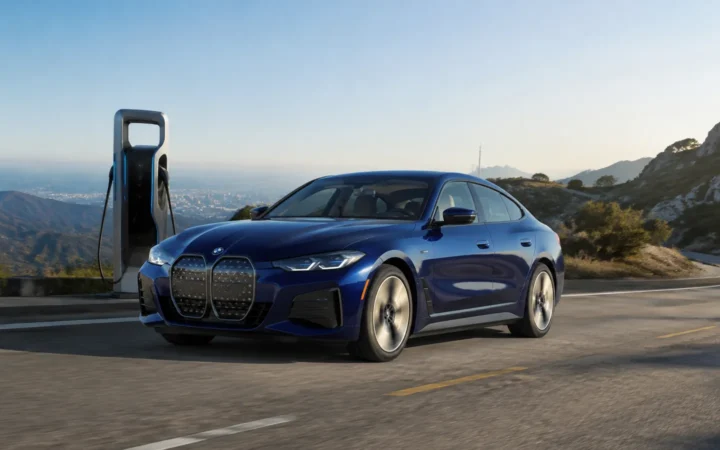
Completing the top-ten list is the BMW i4, which sold 20,114 units. BMW offers several i4 variants; the eDrive40 focuses on range, about 307 miles, and the M50 emphasises performance with 536 hp and around 270 miles range. Customers appreciate:
- Driving dynamics: The i4 retains BMW’s rear-wheel-drive handling and adaptive suspension.
- Infotainment: The latest iDrive 8.5 system with curved display brings advanced navigation and integrated apps.
Market Trends and Implications
Tesla’s Dominance but Growing Competition
Tesla still commands roughly 46% of the U.S. EV market, selling over 589,000 vehicles in 2025 electrek.co. Yet, the company’s share is gradually declining as other automakers launch competitive models. General Motors took second place with 169,887 EVs, buoyed by the Equinox EV and Blazer EV. Ford, Hyundai and Honda are also expanding their line-ups.
Slower US growth, strong global momentum
The IEA estimates that electric cars accounted for just under 10% of US new-car sales in 2025, with total volume around 1.5 million. Globally, sales grew by about 20% to more than 20 million. For 2026, the IEA expects close to 23 million electric cars worldwide, or nearly 30% of all new-car sales, but US demand remains sensitive to prices, incentives and model availability.
Range and Battery Technology Improvements
Consumer hesitancy about range is diminishing as new EVs consistently surpass 300 miles per charge. Innovations such as silicon anodes, solid-state batteries and 800 V architectures are accelerating charging times and energy density. For example, Hyundai’s Ioniq 5 uses an 800 V system allowing ultra-fast charging, while GM’s Ultium platform modular battery packs enable long range and power sharing across vehicles. Looking ahead, solid-state batteries could push ranges beyond 400 miles with shorter charging times.
Step-by-Step Guide: Choosing the Right EV for You
Selecting an EV can feel daunting due to the variety of models, powertrains and price points. Here’s a structured approach to simplify the process:
- Define your use case. Consider daily commuting distance, weekend travel and whether you need towing or cargo capacity. For example, if you frequently tow or haul equipment, a Ford F-150 Lightning or Rivian R1S may suit your needs. For city commuting, a compact crossover like the VW ID.4 or Hyundai Ioniq 5 might suffice.
- Set a budget. EV prices vary widely – from the Chevy Equinox EV starting around $42k to the Cadillac Lyriq near $60k. Factor in potential savings from tax credits and lower fueling/maintenance costs. Some states offer additional rebates.
- Assess range requirements. Determine your typical daily mileage. A range of 250–300 miles covers most use cases. The Tesla Model Y, 357 mi, or Model 3, 363 mi, will suit long-distance drivers, while the Equinox EV, 319 mi, offers excellent value. For occasional long trips, ensure access to fast-charging networks.
- Check charging infrastructure. Evaluate your access to home charging, Level 2, and proximity to DC fast chargers. Tesla owners benefit from the extensive Supercharger network, but other networks like Electrify America, EVgo and ChargePoint are rapidly expanding.
- Compare features. Consider driver-assistance systems, such as Tesla Autopilot, Ford BlueCruise and Cadillac Super Cruise, infotainment interfaces, cargo space, warranty coverage and available software updates. Also look at unique extras such as the F-150 Lightning’s Pro Power feature or the Equinox’s low entry price.
- Test drive and research reviews. Before finalizing, schedule test drives to gauge comfort, visibility and performance. Read professional reviews and owner feedback. At Freditech, we’ve explored performance EVs like the Tesla Roadster, which rockets to 60 mph in 1.9 seconds and boasts a 620-mile range freditech.com, and plug-in hybrids like the BYD Song L DM-i, offering a 200 km electric range and 1,630 km combined range, demonstrating the breadth of electric mobility options freditech.com.
- Plan for ownership. Consider installation of a home charger, insurance costs, resale value and service availability. Some automakers provide comprehensive warranties on batteries, often 8 years/100,000 miles, and free over-the-air updates.
Following these steps ensures you select an EV that matches your lifestyle and budget while maximizing the benefits of electric driving.
Future Outlook – What’s Next for EVs?
EV technology is evolving rapidly. Several trends will shape the next few years:
- Solid-state batteries: Many automakers are investing in solid-state batteries, which promise higher energy density, faster charging and improved safety. Prototypes from Toyota and BMW suggest commercial introduction by the late 2020s.
- Vehicle-to-grid, V2G: Beyond powering homes, vehicle-to-home, EVs will increasingly offer V2G capabilities, enabling owners to sell energy back to the grid, smooth demand peaks and earn income.
- Autonomous driving: As driver-assistance systems mature, more EVs will offer Level 3 and Level 4 autonomy, allowing hands-free operation on larger portions of highways. Regulatory approval remains the biggest hurdle.
- Affordable models: Several manufacturers plan sub-$30k EVs to appeal to budget-conscious buyers. GM is rumored to launch a new compact EV below the Equinox price point.
- Charging standard consolidation: The North American Charging Standard, NACS, pioneered by Tesla, is being adopted by Ford, GM and others. This will simplify connectors and accelerate infrastructure expansion.
Conclusion
The U.S. EV market is flourishing despite temporary sales slowdowns. Tesla’s Model Y dominates with unrivalled sales and range, yet competitors like the Chevy Equinox EV, Hyundai Ioniq 5 and Ford F-150 Lightning are carving out niches with competitive pricing, innovative features and strong ranges. The broader trend shows EVs moving from early-adopter territory into mainstream, with policy support, technological improvements and a growing charging network all playing pivotal roles.
When choosing an EV, evaluate your driving patterns, budget, and feature preferences. The steps outlined above will guide you toward a vehicle that not only meets your needs but also contributes to a cleaner and more sustainable transportation future. Keep an eye on upcoming innovations like solid-state batteries and V2G, which will further enhance the EV ownership experience. To explore more models and reviews, visit our in-depth analyses on Freditech.
August 2026 data note and sources
Sales tables in this article use 2025 as the latest complete model-ranking year. Manufacturer reporting practices differ, so totals attributed to market trackers are estimates rather than audited registration counts.
- IEA Global EV Outlook 2026: trends in electric cars — US 2025 volume, annual share and the fourth-quarter decline.
- IEA Global EV Outlook 2026: executive summary — global 2025 sales and share.
- IEA 2026 market outlook — projected 2026 global sales.
Frequently Asked Questions About Top-Selling EVs in the USA
What is the top selling EV in the USA?
The Tesla Model Y is currently the top-selling electric vehicle in the United States. Its strong combination of driving range, advanced technology, spacious interior and access to Tesla’s Supercharger network has made it one of the most popular EVs among American buyers.
Who is the biggest seller of EVs?
BYD and Tesla are the world’s largest EV manufacturers. BYD leads global EV sales volume when plug-in hybrids are included, while Tesla remains the leading brand for fully electric battery-powered vehicles in many international markets.
Which EV led US sales in the latest complete year?
The Tesla Model Y led the latest complete full-year US ranking used in this guide (2025). Partial 2026 figures can change as manufacturers revise reports, so the article distinguishes complete-year rankings from year-to-date estimates.
Which is the most selling EV car?
Globally, the Tesla Model Y has become one of the highest-selling electric vehicles in history. In China and several international markets, BYD’s electric models such as the Song Plus EV and Dolphin are also among the strongest-selling EVs worldwide.
What are the top 3 electric cars?
The top electric cars often vary by market and category, but some of the most highly rated and best-selling models include the Tesla Model Y, known for long range, fast charging and advanced software; the Hyundai Ioniq 5, praised for futuristic design, comfort and ultra-fast charging; and the BYD Seal, popular for affordability, strong technology and premium features.
Why is BYD better than Tesla?
BYD has strengths in battery manufacturing, affordability and production scale. The company produces many of its own components, including Blade batteries, which helps lower costs and improve efficiency. BYD also offers a wider range of affordable EVs in global markets. Tesla, however, still leads in software integration, autonomous-driving technology and charging infrastructure in many regions.
Who sold more EVs than Tesla?
BYD has surpassed Tesla in total electrified vehicle sales when plug-in hybrid vehicles are included. However, Tesla remains one of the world’s leading sellers of fully electric battery EVs and continues to dominate several premium EV markets globally.
What are the top 5 EV companies?
Some of the leading EV companies globally include Tesla, BYD, Hyundai Motor Group, Volkswagen Group and General Motors. These companies lead through innovation, battery technology, manufacturing scale and expanding EV lineups.
Why is BYD not sold in the US?
BYD currently has limited passenger EV sales in the United States due to import tariffs, political trade restrictions and strong competition from established automakers. The company mainly focuses on electric buses and commercial vehicles in the U.S. market while expanding passenger EV sales in Europe, Asia, South America and other global regions.
Bottom Line
Sales volume is useful context, but popularity is not a substitute for fit. Use current market data to identify proven options, then compare range, charging, space, price and service support for your own driving.