Confirmed network milestone 10,000th station opened 28 August 2026 · Research checked 28 August 2026
BYD says its Flash Charging network has reached 10,000 stations in China, while next-generation hardware can deliver as much as 1,500kW per connector. The headline is important, but it does not mean every BYD—or every other EV—can charge at 1.5MW. Vehicle voltage, battery chemistry, charging curve, temperature and station sharing determine what reaches the battery.
The milestone makes ultra-fast charging a credible ecosystem advantage for compatible BYD vehicles in China and signals serious international ambition. Existing EV owners should focus on local station locations and their car’s maximum DC input, not the charger cabinet’s headline rating. A 1,500kW post cannot make a 150kW car charge ten times faster.
Table of contents
BYD’s 10,000-station milestone
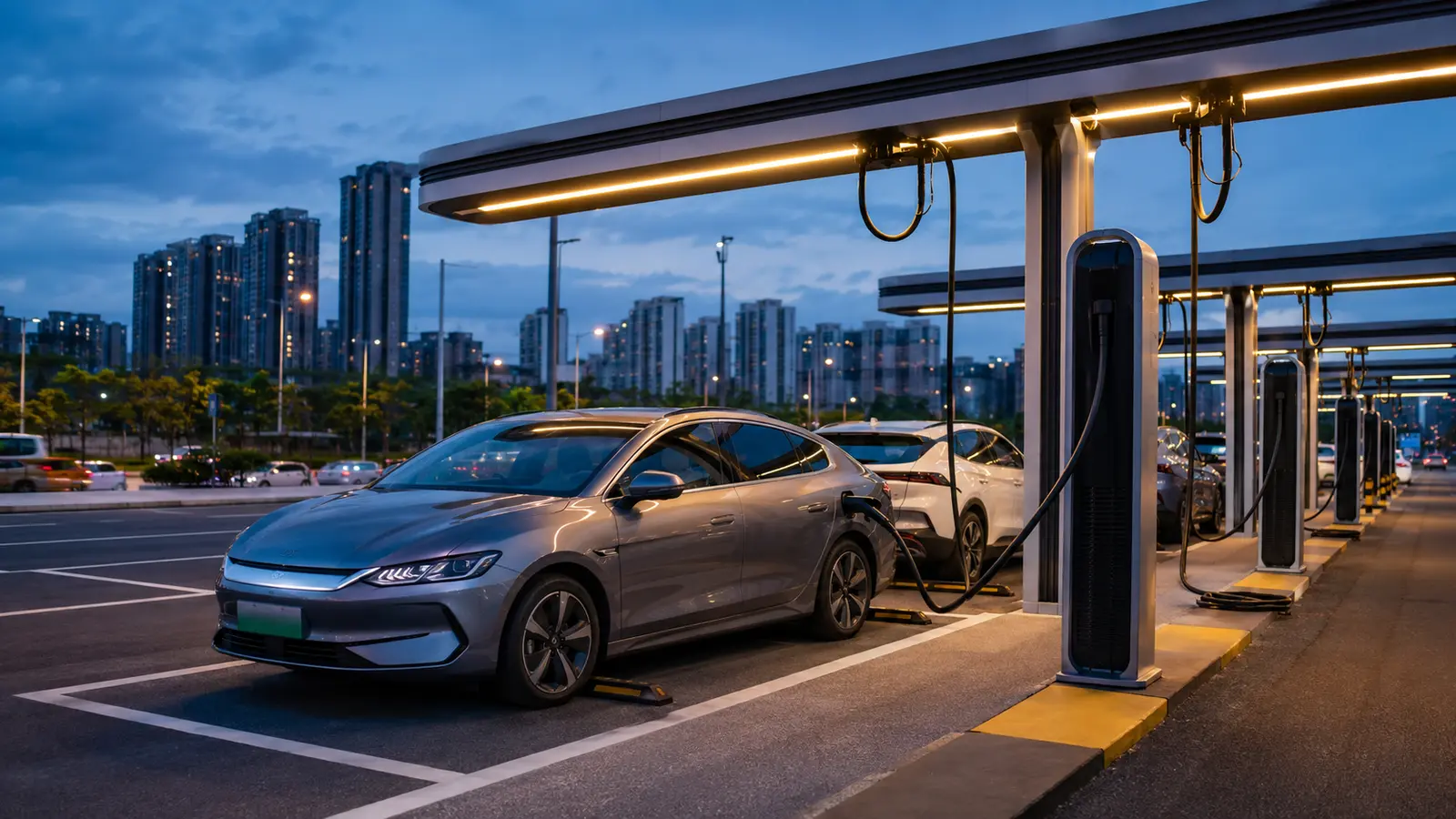
The 10,000th Flash Charging station opened in Shenzhen’s Longhua district on 28 August 2026. According to the milestone figures reported from BYD, the network doubled from 5,000 to 10,000 stations in under five months and had delivered roughly 210 million kWh to 1.83 million users. Nearly one-third of those users reportedly drove vehicles from other brands.
Those totals describe network activity, not a typical charging session. Dividing 210 million kWh by 1.83 million users produces approximately 115kWh per reported user across the measured period, but it does not reveal repeat visits, energy per session or charging cost. The more useful buyer questions are coverage along regular routes, uptime, queueing, payment access and vehicle compatibility.
| Metric | Reported figure | Important context |
|---|---|---|
| Stations in China | 10,000 | Station count is not the same as connector count |
| Network energy | 210 million kWh | Cumulative figure; period and session mix matter |
| Users | 1.83 million | May include repeat customers under one account |
| Other-brand users | Nearly one-third | Access does not guarantee maximum charging speed |
| Next-generation output | Up to 1,500kW per connector | Only compatible vehicles can use extreme power |
What does a 1,500kW charger actually mean?
Power is the rate at which energy can move. A 1,500kW—or 1.5MW—connector has a peak output ten times the 150kW rating common on many fast-charging EVs. The station, cable, connector, cooling and grid connection must support that output, but the car remains the final gatekeeper.
BYD’s earlier Super e-Platform announcement described a 1,000V, 1,000A system and 1MW mass-produced charging, claiming 400km of range in five minutes for a compatible Han L. The newer 1,500kW hardware is reported as the next generation. These are manufacturer platform claims under favorable conditions, not a universal performance standard across the fleet.
A battery normally accepts its highest rate only through part of the charge window. Power tapers as state of charge rises or temperatures move outside the optimal range. The time to add useful energy—such as 10–80%—is more informative than a momentary peak.
BYD says compatible second-generation Blade Battery vehicles can move from 10% to 97% in nine minutes. That is unusually broad and fast, but it remains a manufacturer claim until repeated in independent tests across temperatures, vehicles and busy sites. It also cannot be compared directly with another brand’s 10–80% claim without adjusting the energy window and battery capacity.
Why charging this fast is difficult
- Heat: high current produces thermal stress in cables, cells and connectors.
- Battery acceptance: cell chemistry and pack design set safe power limits.
- Grid demand: one 1.5MW session can rival the load of a substantial commercial site.
- Shared power: a station may dynamically distribute capacity across occupied posts.
- Preconditioning: the vehicle may need to warm or cool its pack before arrival.
- State of charge: arriving near full usually produces much lower power.
Which cars support BYD Flash Charging?
Compatibility has two levels. Many standards-compatible EVs may be able to plug in and receive ordinary DC power, which helps explain non-BYD use. Only vehicles built around the required high-voltage battery and charging architecture can approach the platform’s headline speed.
BYD identifies compatible new-generation vehicles through its Super e-Platform and Blade Battery rollout. Exact model, software, connector and market certification must be checked locally. In Brazil, reporting around the planned deployment identifies the Denza Z9 GT as the current compatible vehicle. That does not establish universal 1,500kW access for every trim or future import.
Compatible new-generation BYD
Potentially receives the network’s defining short charge times when battery temperature, station output and state of charge align.
Older BYD or another brand
May use a station at the lower limit set by the vehicle and communication standard. Expect the car’s normal maximum, not the post’s maximum.
Owners should find the vehicle’s peak DC rating, typical 10–80% time and charging curve. A car that peaks at 230kW can still benefit from a reliable high-capacity site because power is less likely to be constrained, but the battery will not suddenly accept 1,500kW.
China, UK and Brazil rollout
China remains the mature network. Fast growth matters because charging convenience comes from density as much as speed: drivers need sites near motorways, cities and routine destinations, not only a demonstration station. Station count should eventually be paired with connector count, uptime and transparent pricing to judge coverage quality.
BYD has built initial UK Flash Charging sites and plans 300 by the end of 2026, according to the current rollout information. Brazil is targeted for approximately 1,000 units by the end of 2027, although no confirmed first-site opening date was included in the source reviewed. Plans can change because permits, utility connections, land and equipment delivery differ by location.
| Market | Status | Limit to remember |
|---|---|---|
| China | 10,000-station milestone reached | Check live maps, fees and connector availability |
| United Kingdom | First sites built; 300 planned by year-end | Planned count is not yet completed coverage |
| Brazil | About 1,000 units planned by end of 2027 | No first-site date confirmed in reviewed material |
| Other markets | No universal schedule | Do not infer availability from a global platform announcement |
What EV buyers should check before relying on the network
- Whether the vehicle’s exact model and model year support the required platform.
- Local connector standard, app, roaming and payment requirements.
- Price per kWh, time-based charges and idle fees.
- Actual station output when several connectors are occupied.
- Battery preconditioning and route-planner integration.
- Warranty language covering frequent high-power charging.
- Alternative chargers if the Flash Charging site is busy or unavailable.
Extreme charging can reduce travel stops, but home charging remains cheaper and easier for many owners. A buyer with overnight parking may use 1.5MW sites only on long journeys. Fleet, taxi and high-mileage users can gain more because minutes saved at each stop accumulate into meaningful working time.
What this means for EV charging competition
BYD’s scale pressures vehicle and charging competitors to improve the complete system rather than a single specification. That includes battery architecture, thermal management, navigation, station operations and grid storage. A network built by a carmaker can also strengthen customer lock-in if the fastest experience is reserved for its newest vehicles.
For consumers, competition is helpful only when prices remain transparent and slower vehicles are not excluded. BYD’s reported use by other brands suggests broader utility, but independent uptime and access data would make the public-network value easier to assess.
Station economics, grid demand and shared power
A 1.5MW connector is only one part of a station. A site with several simultaneous sessions could require multi-megawatt utility capacity, on-site batteries or dynamic limits. Operators may install cabinets capable of a high aggregate output while allowing one vehicle to receive the maximum only when other bays are quiet.
That distinction affects queues. Ten connectors do not guarantee ten concurrent 1.5MW sessions. A good public listing should show connector count, maximum per connector, total site capacity and live availability. Drivers should also see price before plugging in, including idle or congestion fees.
On-site battery storage can charge slowly from the grid and discharge rapidly into vehicles, reducing peak utility demand. It adds capital cost, conversion losses and battery maintenance. Solar can offset some energy but is unlikely to supply a busy megawatt hub by itself. The commercial model must balance utilization with expensive grid infrastructure.
Metrics that matter more than a launch ceremony
- Uptime and successful-session rate.
- Median and 90th-percentile queue time.
- Average power by compatible vehicle class.
- Transparent price per kWh and any time fees.
- Number of connectors rather than station sites alone.
- Repair response after cable, coolant or payment failures.
- Accessible bay design and around-the-clock safety.
Battery health and repeated ultra-fast charging
Modern battery-management systems limit power to protect cells, and BYD designs the compatible pack for its charging platform. Even so, buyers should look for independent degradation data over hundreds of high-power cycles. Laboratory claims, fleet history and warranty thresholds provide different levels of assurance.
Drivers do not need to avoid every fast charge. Home AC charging remains practical for routine use, while Flash Charging can serve road trips or commercial duty. Following vehicle preconditioning guidance and avoiding unnecessary long waits at very high state of charge can support predictable performance.
A practical road-trip comparison
Compare minutes added for the distance actually needed, not 0–100%. If a compatible car adds several hundred kilometers in one stop, the route planner, charger location and restroom time may become the limiting factors. A slower car with denser reliable coverage can still complete a journey faster than a headline-leading car with one inconvenient site.
Before buying for the network, plan two real long routes. Check Flash Charging locations, backup operators, opening hours and winter conditions. A network advantage is strongest when it overlaps the journeys you make, not the country-level station total.
Final assessment
Reaching 10,000 stations gives BYD a tangible charging advantage in China and a base for overseas expansion. The spectacular nine-minute claim applies to compatible next-generation vehicles in suitable conditions, not the average EV. Buyers should prioritize route coverage, price, reliability and their car’s charging curve before treating megawatt output as a must-have feature.
Questions drivers are asking
Can any EV use a BYD Flash Charging station?
Some stations reportedly serve other brands, but access and connector compatibility vary. Every car remains limited by its own DC charging hardware and software.
Will a 150kW EV charge at 1,500kW?
No. The vehicle requests power within its safe limit. A 1,500kW-capable station does not override a car’s approximately 150kW maximum.
Is 10–97% in nine minutes independently proven?
It is a BYD claim for compatible second-generation Blade Battery vehicles. Independent repeat testing is needed across temperatures and real public sites.
Are 1,500kW chargers available worldwide?
No. China has the established network. UK and Brazil expansion is planned, while timing and coverage elsewhere remain market-specific.
Sources and research method
FrediTech distinguished BYD’s official platform claims from reported network milestones and future rollout plans. All speeds are peaks or manufacturer claims unless expressly stated otherwise.