Table of contents
What San Francisco launched
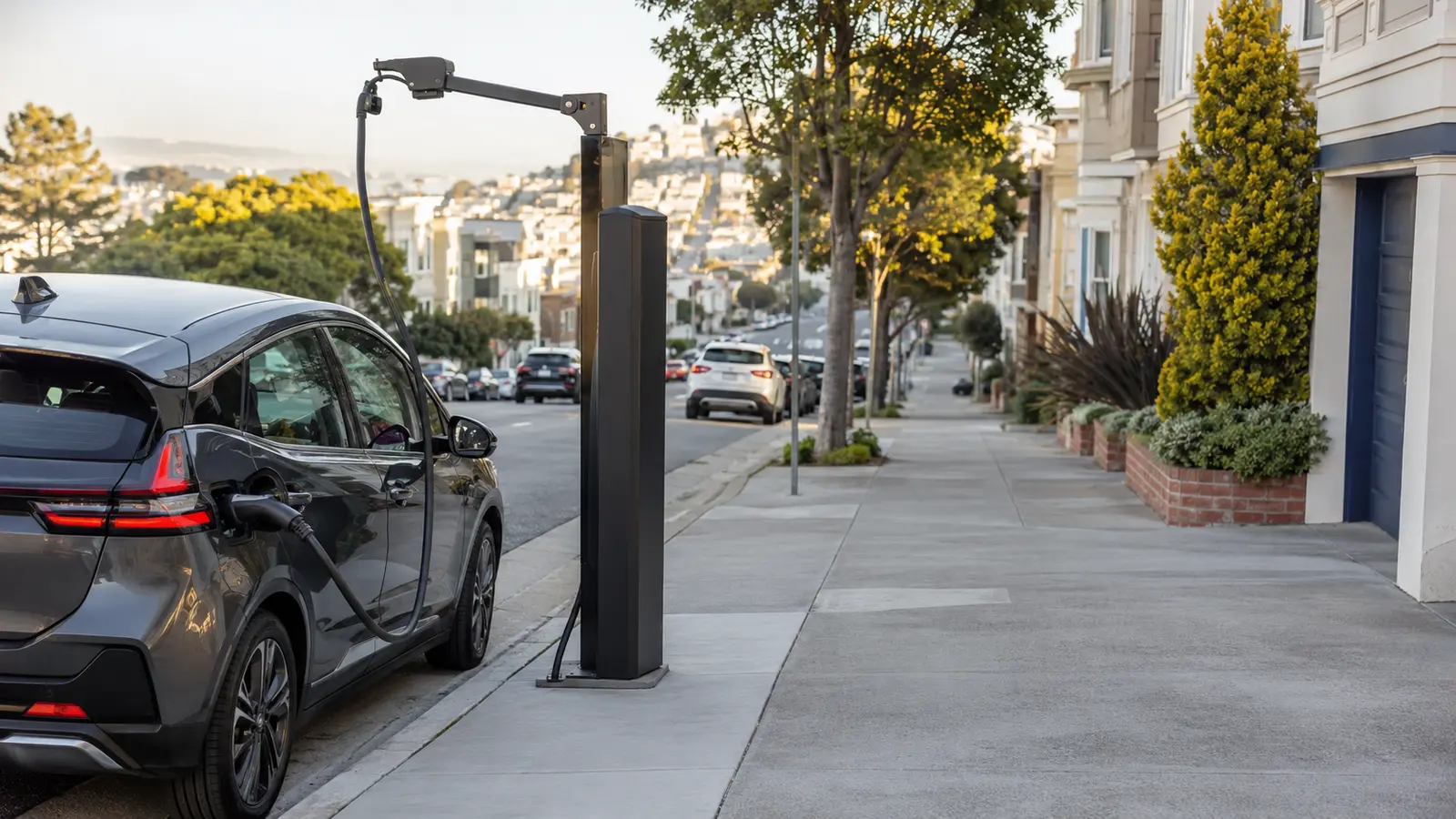
San Francisco’s permanent curbside EV charging permit program creates a route for qualified charging operators to install public chargers in the street right of way. It is designed especially for renters and multifamily residents without private garages. The chargers will be shared, first-come-first-served infrastructure—not private spaces assigned to nearby households.
City target: 100 curbside chargers by 2030. Important limitation: the permit program is live, but the city has not announced universal charging prices, power levels or a complete list of operating sites.
Why curbside charging matters
Home charging is one of an EV’s biggest conveniences, but that advantage is unevenly distributed. A driver with a private garage can plug in overnight; a renter in an older apartment building may depend on fast chargers or garage-based public stations. San Francisco already has more than 1,300 public off-street chargers, mostly in garages, yet those locations do not always reproduce the simplicity of charging near home.
The curbside program uses public space to narrow that gap. Properly designed chargers can give residents a slower, neighbourhood-based option while avoiding informal extension cords across sidewalks. The program also requires accessible charging stations and stalls, making clearance and usability part of the permit process rather than an afterthought.
| Question | Confirmed answer |
|---|---|
| Who installs chargers? | Qualified vendors/operators approved through the city process |
| Are spaces private? | No. Chargers are public and first come, first served |
| Can a car remain after charging? | Active charging is required; all posted parking rules still apply |
| How many are planned? | 100 chargers across neighbourhoods by 2030 |
| Is every site operating now? | No complete operating-site list or immediate citywide availability was announced |
| What will a session cost? | No universal tariff has been published |
| What power level? | Technology and available electrical service can vary by site |
How the permit process works
An operator needs two different approvals:
- Curbside Operator Permit: authorizes a provider to operate curbside charging infrastructure and apply for individual sites.
- Curbside Site Permit: authorizes installation at a specific location after steps including neighbourhood outreach, utility verification and a public hearing.
This distinction matters to residents. The program is not permission for an individual homeowner or tenant to mount a private wallbox at the curb or run a personal cable across the sidewalk. Site selection and operation are handled through qualified providers and public review.
Parking rules do not disappear
- The space is not reserved for a particular resident.
- The vehicle must be actively charging.
- Street-cleaning, time limits and Residential Parking Permit rules still apply.
- A charger does not guarantee that a nearby space will be free.
- Accessible stalls and equipment must remain usable as designed.
Drivers should read the posted sign at each location rather than assuming one citywide time limit. Charging etiquette also matters: move the vehicle when the permitted session or charging need is complete, report damaged connectors and do not stretch a cable across a pedestrian route.
Where the electricity can come from
SFMTA identifies several service routes. Hetch Hetchy Power can energize qualifying sites through the city-owned grid in applicable areas or through wholesale distribution using PG&E infrastructure. CleanPowerSF can supply generation in most areas while PG&E distributes the electricity. New CleanPowerSF accounts are automatically enrolled in its Green service, with an optional SuperGreen service based on 100% California-certified renewable energy.
PG&E’s Rule 29 EV Power Ready and Rule 16 pathways can also apply. The practical route depends on available capacity, ownership, site design and utility engineering. This is why the city does not promise one charger type or speed for every curb.
Charging speed and cost: what remains unknown
The launch page does not publish a uniform connector power, session fee, idle charge, membership requirement or payment method. Curbside neighbourhood charging is often associated with Level 2 AC equipment, but FrediTech will not assign a speed until a specific site and operator confirm it.
For buyers, kilowatts matter because they determine how much range can be added during a legal parking window. A 7kW charger and an 11kW charger may deliver very different energy depending on the vehicle’s onboard AC limit. Final site guides should therefore list charger output, connector type, network, price per kWh or minute, idle fees, access hours and payment options.
What residents should do now
- Follow SFMTA’s official program page for approved operators and site hearings.
- Submit location feedback through announced city or operator channels rather than installing private equipment.
- Compare nearby garage chargers and fast chargers while curbside coverage grows.
- Check an EV’s AC charging limit before choosing it for street-based charging.
- Review apartment charging rights and building options; curbside charging is one solution, not the only one.
What operators and neighbourhoods should evaluate
- Pedestrian and wheelchair clearance
- Cable management that avoids trip hazards
- Street-cleaning and loading-zone conflicts
- Transformer and service capacity
- Lighting, vandal resistance and repair response
- Transparent pricing and contactless payment
- Utilization data and fair neighbourhood distribution
The best installation is not necessarily the one closest to a particular applicant. It must work for the public realm, utility network and multiple vehicle types over time.
How this could affect EV buying decisions
The program improves the long-term case for an EV among residents without off-street parking, but it should not yet be treated as guaranteed home charging. A prospective buyer should map existing reliable chargers, calculate weekly energy needs and consider winter, commute and parking patterns before purchase.
Efficient EVs need fewer charging hours for the same distance, while vehicles with higher AC acceptance can use a powerful curbside unit more effectively. Battery range remains useful, but dependable access and charging frequency are often more important than chasing the largest pack.
FrediTech assessment
San Francisco’s permanent permit structure is a meaningful infrastructure step because it addresses renters and multifamily residents directly. The 100-charger target is modest relative to the city, and the buyer impact depends on where equipment appears, how it is priced and whether it remains reliable. For now, the most useful story is the rules and rollout—not a claim that curbside charging is already available on every block.
Frequently asked questions
Can a resident reserve a curbside charger?
No. SFMTA says the chargers are shared public infrastructure and first come, first served.
Can a homeowner run a cable across the sidewalk?
This program does not authorize informal private cables. Qualified operators must obtain operator and site permits, including utility and public-review steps.
How much will charging cost?
The city has not announced a single universal price. Operator and site terms will need to be checked individually.
Are 100 chargers already installed?
No. One hundred is the city’s goal for qualified-vendor installations by 2030.