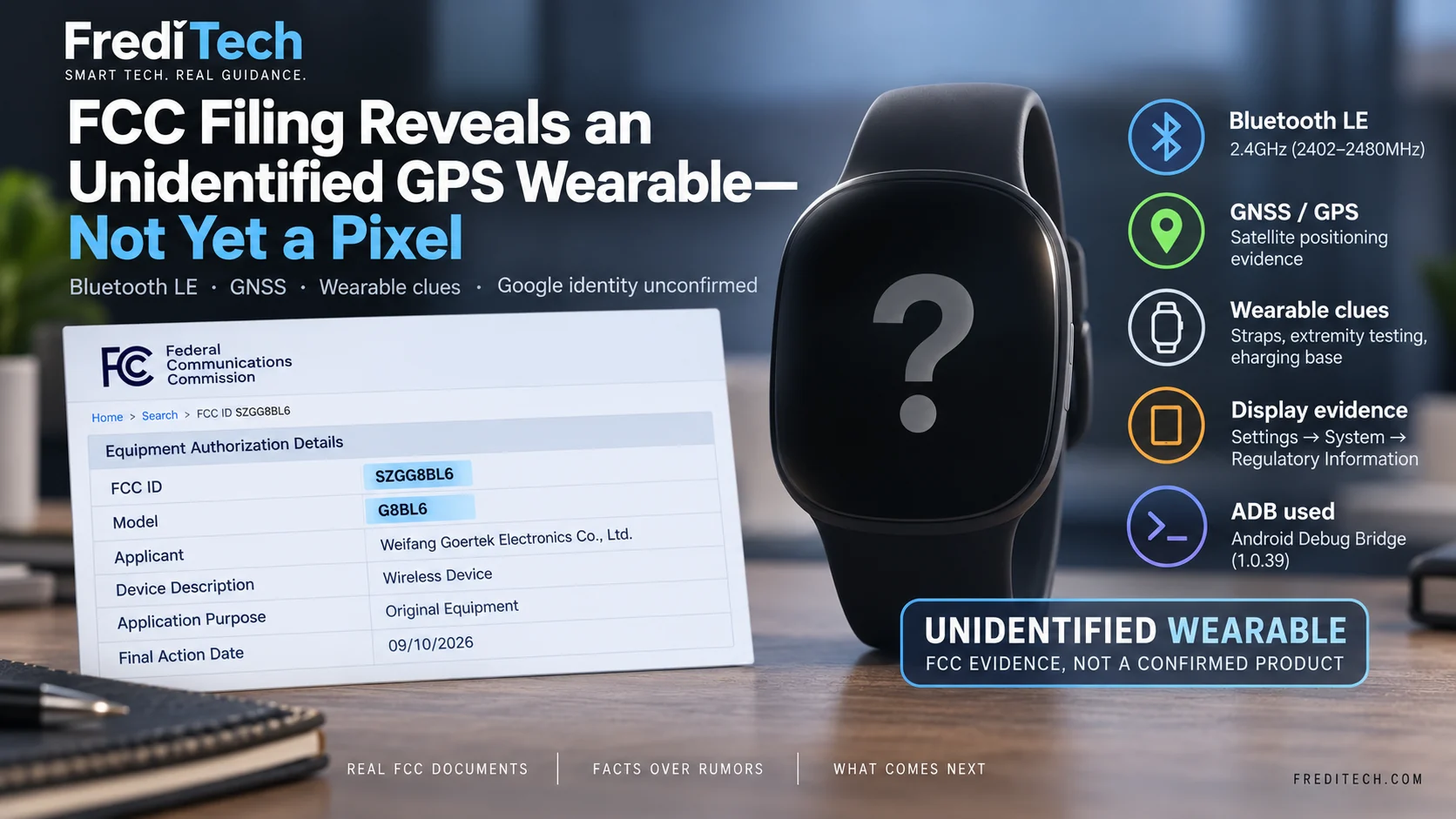

An FCC authorization from Weifang Goertek Electronics Co., Ltd. has revealed an unidentified device with a surprisingly wearable-like test profile. The filing carries FCC ID SZGG8BL6, model G8BL6, received final action on September 10, 2026 and is described only as a “Wireless Device.” Public test materials directly show Bluetooth Low Energy operation and list GNSS, while other documents reference different straps, zero-distance extremity RF exposure, a charging base, an electronic regulatory-information menu and ADB 1.0.39 during engineering tests. Those clues make a wrist-worn connected device a strong inference. They do not identify Google, Fitbit, Pixel or Wear OS. External photos, internal photos and the user manual remain scheduled for public release on March 9, 2027 unless confidentiality changes.
What the G8BL6 FCC filing actually confirms
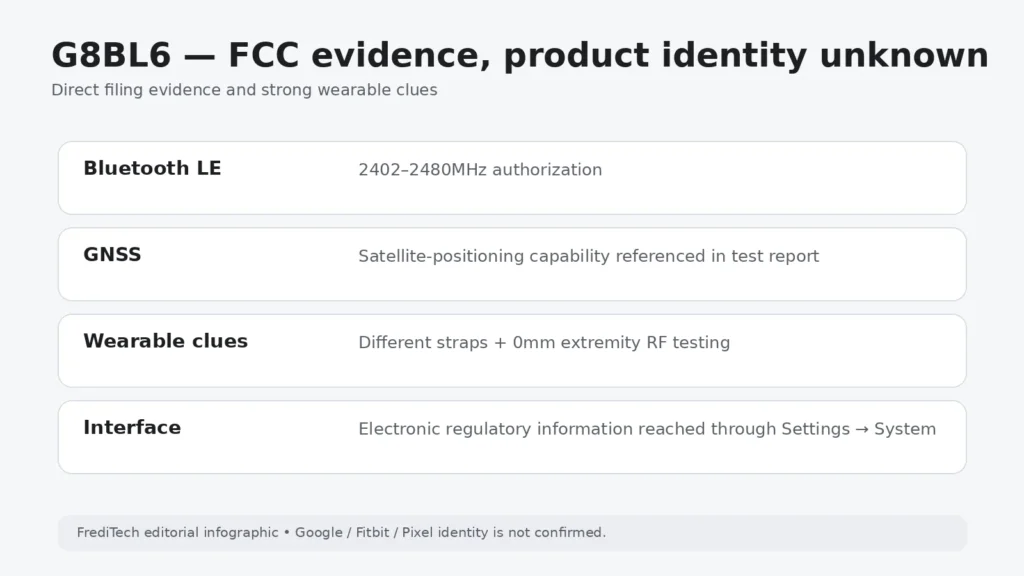
The regulatory record identifies Weifang Goertek Electronics as the applicant, G8BL6 as the model, “Wireless Device” as the equipment description and Original Equipment as the application purpose. The visible authorization covers Bluetooth Low Energy in the 2.4GHz band, including the 2402–2480MHz channel range in the test report.
The Sporton test documentation also lists “Bluetooth-LE and GNSS” in the general specification section. That is direct evidence of satellite-positioning capability, although it does not establish which GNSS constellations—GPS, Galileo, GLONASS, BeiDou or others—the final implementation supports.
Why G8BL6 appears to be a wrist-worn device
The FCC does not call G8BL6 a smartwatch, but the test setup contains several independent clues. The Bluetooth report says different straps were verified. The RF exposure document evaluates the device under an “Extremity” condition at 0mm separation. Another setup references a charging base. Taken together, those details are far more consistent with wrist-worn hardware than with a conventional phone accessory.
This distinction—direct evidence versus inference—is critical. “The test report references straps” is a fact. “Therefore it is likely worn on the wrist” is a strong inference. “Therefore it is a Pixel fitness tracker” is speculation until branding or software evidence becomes much stronger.
Bluetooth LE and GNSS point to a low-power connected wearable
Bluetooth Low Energy is common in wearables because it can maintain phone pairing and synchronize small amounts of data with relatively low power draw. Depending on the final product, it could support notifications, sensor synchronization or configuration, but the radio itself does not tell us which of those consumer functions exist.
GNSS is more revealing because it enables satellite positioning without relying continuously on the phone. In a wearable context that could support running, walking, cycling or route recording. It still does not prove fitness tracking; specialized outdoor hardware, safety devices and other portable products can use GNSS too.
A display appears likely from the FCC e-label instructions
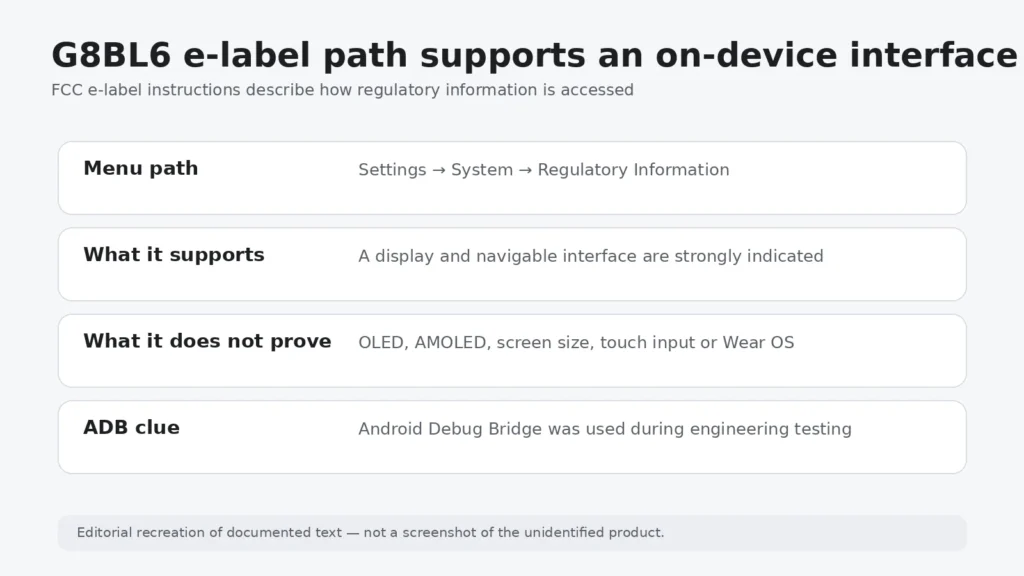
The public e-label exhibit instructs the user to navigate from the Home screen through Settings → System → Regulatory Information. That strongly suggests G8BL6 has a display and a navigable software interface because the regulatory data is shown electronically on the device.
The evidence stops there. It does not reveal OLED versus LCD, screen size, resolution, shape or touch capability. Buttons could theoretically navigate a display, and regulatory menu conventions can be reused across Android-derived products.
ADB is an Android clue—but not proof of Wear OS
The Bluetooth test report references adb version 1.0.39 being used on a notebook to put the test unit into engineering modes for channel selection, output power, data rate and continuous transmission. Android Debug Bridge is part of the Android development/tooling ecosystem, so this is a legitimate Android-related clue.
It is not enough to claim Wear OS. Engineering firmware can expose ADB even when the final retail interface is specialized, heavily customized or based on a different user-facing layer. ADB also does not establish who owns the product. The correct formulation is that Android-related engineering tooling was used during FCC testing.
Why some analysts think Google or Fitbit could be involved
Several circumstantial clues line up in a way that makes a Google connection worth investigating. Goertek has a history as a major electronics manufacturer and has been associated with Google hardware such as Pixel Buds. The G8BL6 model-code style resembles identifiers used across some Google products, and the Settings → System → Regulatory Information path resembles Pixel Watch documentation. Add ADB, GNSS and wrist-oriented testing, and the theory becomes understandable.
None of those clues independently identifies the customer. Contract manufacturers work with multiple brands, model-code patterns are not unique trademarks and Android-style menu hierarchies can be shared. A plausible theory should not be promoted into a commercial name.
Why FrediTech is not calling this a Pixel or Fitbit yet
The public FCC record never names Google, Fitbit, Pixel or Wear OS. The applicant is Goertek and the device description is generic. Crucial identity-revealing exhibits—external photos, internal photos and the manual—are still confidential. Until a stronger source ties G8BL6 directly to Google, labeling it “Pixel” would turn circumstantial evidence into a false fact.
FrediTech would increase confidence if Google appears in official support/regulatory material, a manual carries Google/Fitbit branding, a Bluetooth SIG entry is conclusively linked, Play/Wear OS certification identifies the model, a retailer database connects the code to a commercial product, or public FCC photos reveal unmistakable branding.
Could it be a fitness tracker?
A fitness tracker is a plausible category because straps, extremity testing, GNSS, Bluetooth LE and a display all fit that hardware class. Built-in GNSS would be especially useful for runners or cyclists who want route data without carrying a phone. The currently visible filing does not list heart-rate, SpO2, ECG, temperature or motion sensors, however, so health tracking cannot be assumed.
Google’s current wearable strategy provides context but not identity. A screen-equipped GNSS device would differ materially from a screenless tracker, and it could sit anywhere from a simple sports band to a compact smartwatch.
Could it be a simpler GPS smartwatch?
That possibility also fits the evidence. A display, wrist straps, GNSS, Bluetooth, charging base and Android-related engineering tools are all compatible with a small GPS watch. What is less obvious is the broader radio set: the currently visible G8BL6 authorization emphasizes Bluetooth LE, and this article did not identify Wi-Fi or cellular certification in the same filing.
That wording must remain careful. Absence from the visible filing is not definitive proof that the finished product lacks Wi-Fi or LTE. A companion filing, modular radio authorization or later certification could exist.
Could G8BL6 belong to another Goertek customer?
Yes. This possibility should remain explicit because Goertek designs and manufactures wearables and other electronics for multiple customers. Enthusiast interest in Google can create confirmation bias, where every Android-related clue is interpreted in one direction. The FCC evidence itself leaves the customer open.
Development/reference hardware is another possibility. FCC authorization can apply to products that are delayed, changed, used in limited contexts or never widely commercialized. Certification is a prerequisite for many U.S. radio products, not a guarantee of a consumer launch.
Why the missing Wi-Fi and cellular evidence matters
A full flagship smartwatch commonly uses more radios than Bluetooth alone, especially when it supports Wi-Fi or standalone LTE. The visible G8BL6 record does not currently expose those radios, which makes a simpler tracker or GPS wearable plausible. But the filing scope cannot be converted into a definitive negative specification.
This is exactly where regulatory literacy helps: a filing tells us what was submitted and tested under that authorization. It does not necessarily reveal every subsystem a final commercial product might contain through other approvals.
Possible product categories: what fits the evidence?
| Possibility | Why it fits | What is missing |
|---|---|---|
| Fitness tracker | Straps, BLE, GNSS, display/interface and extremity testing | No confirmed health-sensor list or brand. |
| Simple GPS smartwatch | Screen/interface, GNSS, Bluetooth, charging base, ADB clue | No confirmed Wear OS, Wi-Fi, LTE, microphone or speaker. |
| Sport/activity wearable | GNSS and wrist-oriented test setup suit outdoor tracking | No confirmed accelerometer, heart rate or workout software. |
| Development/reference hardware | Engineering tools and generic FCC identity are compatible with pre-production hardware | No public evidence that it is only reference hardware. |
| Product for another Goertek customer | Goertek manufactures for multiple brands | Customer identity is confidential/unknown. |
What remains unknown about G8BL6
The public filing does not establish the commercial name, brand, price, release date, target markets, operating system, screen size or technology, processor, memory, storage, battery capacity, battery life, health sensors, NFC, payments, microphone, speaker, water resistance, dimensions, colors or final band sizes. It also does not establish Google Assistant/Gemini, Fitbit integration or Wear OS. Leaving those fields blank is a strength, not a weakness: the article is more useful when it separates regulatory facts from things the FCC has not disclosed.
The missing information is exactly why the March 2027 exhibits matter. External and internal photos plus the manual can resolve multiple questions at once, but until then a product database that assigns a commercial name is not stronger evidence than the FCC itself.
External photos and manual are hidden until March 2027
The FCC index schedules key short-term-confidential exhibits for public availability on March 9, 2027. Those materials include external photographs, internal photographs and the user manual, along with selected setup images. They could reveal case shape, display geometry, buttons, straps, charging design, sensors, branding and the intended user workflow.
Until legitimate exterior imagery becomes public, FrediTech should not publish a realistic AI render and label it G8BL6. An abstract wearable silhouette is acceptable for editorial illustration only when it is clearly identified as generic and not presented as the hidden product.
March 9, 2027 is not a launch date
A confidentiality-expiration date only tells us when certain FCC exhibits are currently scheduled to become public. A product can launch before that date, be announced earlier, have confidentiality extended, be delayed or never reach mass retail. Treating March 9 as a release date would be a fundamental regulatory-reporting error.
Is Google making a fitness tracker?
Google may continue developing additional wearable hardware, and G8BL6 gives analysts legitimate reasons to investigate that possibility. But this specific FCC record does not identify Google as the customer and does not name Fitbit. The evidence supports “possible Google-adjacent clues,” not “Google fitness tracker confirmed.”
If the identity is eventually confirmed, this page can be updated without changing the evergreen G8BL6 URL. Until then, search-friendly Google/Fitbit language should remain in question form and be answered with the evidence boundary.
Frequently asked questions
What is G8BL6?
An unidentified “Wireless Device” filed with the FCC by Weifang Goertek Electronics under FCC ID SZGG8BL6.
Who makes G8BL6?
Goertek is the FCC applicant; the final commercial customer or brand is not confirmed.
Is G8BL6 a Google wearable?
Not confirmed.
Is it a Fitbit?
Not confirmed; Fitbit is not named in the public filing.
Is it a Pixel device?
No current FCC evidence establishes Pixel branding.
Does G8BL6 have GPS?
The test report lists GNSS, indicating satellite-positioning capability; exact constellations are not disclosed.
Does it run Wear OS?
Not confirmed. ADB is an Android-related engineering clue, not proof of retail Wear OS.
Why was ADB used?
The test report says it was used to control engineering radio modes during FCC testing.
When will photos become public?
The current FCC schedule points to March 9, 2027 unless confidentiality changes or images emerge legitimately earlier.
When will G8BL6 launch?
Unknown. FCC final action is a regulatory milestone, not a retail date.
Sources and verification
- FCC ID SZGG8BL6 filing/index — applicant, model, description and authorization data.
- FCC Bluetooth LE test report — BLE range, GNSS, straps, charging base and ADB test use.
- FCC RF exposure and e-label exhibits — extremity testing and Settings → System → Regulatory Information path.
- Goertek official materials and reputable technical analysis — manufacturing context and Google/Fitbit theory, clearly separated from FCC facts.