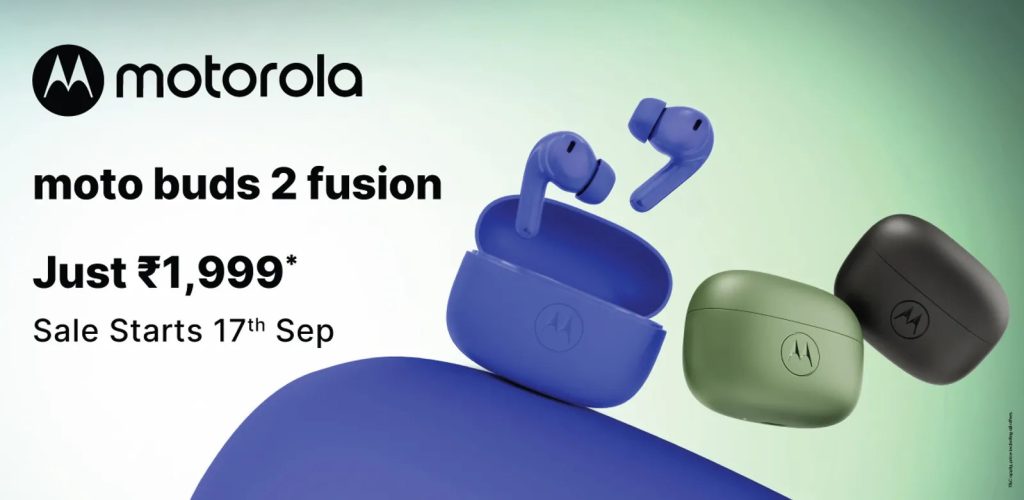

Motorola has launched the Moto Buds 2 Fusion in India at an introductory ₹1,999, with sales beginning September 17 through Motorola India, Flipkart and participating retailers. The headline feature is adaptive active noise cancellation rated by Motorola at up to 55dB, backed by six microphones, Bluetooth 6.0 multipoint, wear detection and a claimed 53 hours of total playback. That puts the new earbuds directly against vivo Buds, which also cost ₹1,999 but do not provide conventional listening ANC.
On paper, Motorola has packed more noise-control features into the same price. But an ANC specification cannot tell you how much traffic, speech or wind will actually disappear, and a larger 12.4mm driver does not automatically produce better sound. This FrediTech launch analysis therefore separates hardware facts from manufacturer claims, compares Moto and vivo feature-for-feature, and shows where independent listening, call and battery testing is still needed.
Moto Buds 2 Fusion: Quick answer
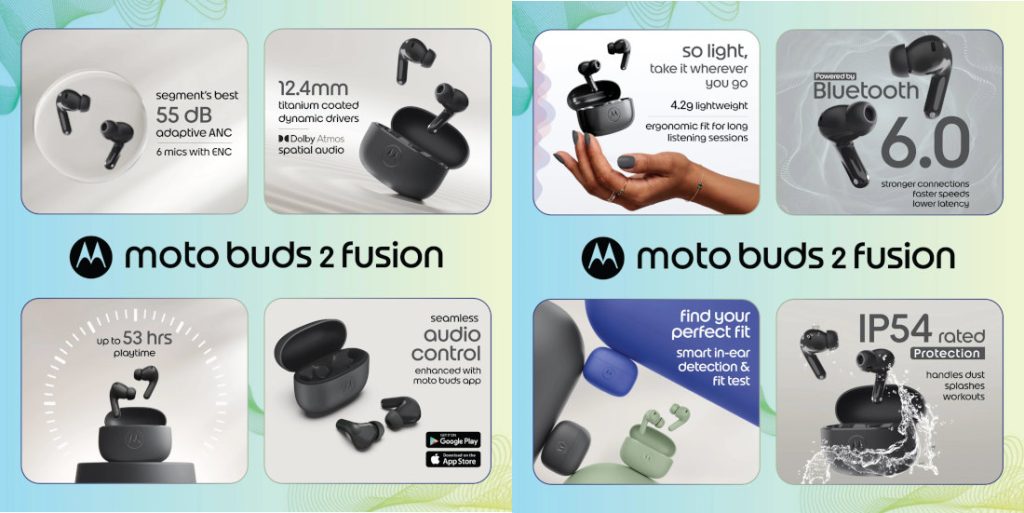
Moto Buds 2 Fusion cost ₹1,999 as an introductory India price and go on sale September 17 through Motorola, Flipkart and participating retailers. They combine a 12.4mm titanium-coated dynamic driver with adaptive ANC that Motorola rates at up to 55dB, Transparency Mode, six microphones, AAC/SBC codecs, Bluetooth 6.0 multipoint and smart wear detection. Motorola claims up to 13 hours from the earbuds and 53 hours with the case. The earbuds are IP54 rated while the case is IPX2. At the same ₹1,999, vivo Buds are lighter and make strong battery and gaming claims, but they lack conventional listening ANC. Independent tests are still needed before judging sound, ANC, microphones or real battery endurance.
Moto Buds 2 Fusion price and sale date in India
India price
₹1,999
Price type
Introductory
Sale date
September 17
Channels
Motorola / Flipkart / retail
Former selling price: none — this is a new product. Motorola has not specified when the introductory price will end. Flipkart may display an MRP or temporary checkout offer, but neither should be rewritten as a historical selling price without evidence that the product previously sold at that amount.
The ₹1,999 positioning is aggressive because it lands in a segment where many products offer call noise reduction but not true active listening noise cancellation. Buyers shopping on September 17 should still verify the seller, stock, delivery location and final checkout price. FrediTech will keep this same URL current if Motorola changes the introductory price or adds other channels such as Amazon.
₹1,999 is an introductory price—not a discount from an older price
“Introductory price” means Motorola has chosen ₹1,999 for the launch period and may revise it later. It does not establish a previous transaction price. That distinction matters because a large crossed-out MRP can make a new product look as though it has already been discounted from a price consumers actually paid. Until Motorola establishes a normal post-launch selling price, the clean comparison is simply ₹1,999 versus other earbuds currently selling near ₹2,000.
Moto Buds 2 Fusion specifications at a glance
Driver
12.4mm titanium-coated
ANC
Up to 55dB claim
Microphones
6 total
Bluetooth
6.0, multipoint
Codecs
AAC / SBC
Battery
Up to 53h combined claim
| Specification | Moto Buds 2 Fusion | What it means |
|---|---|---|
| India price | ₹1,999 introductory | New product; duration of introductory price not stated |
| Sale date | September 17, 2026 | Motorola India, Flipkart and participating retail |
| Driver | 12.4mm titanium-coated dynamic | Driver size alone does not establish sound quality |
| Audio tuning | Motorola proprietary tuning | Not advertised as Sound by Bose |
| Codecs | AAC, SBC | No LDAC, LHDC or aptX listed |
| Spatial Audio | Supported; Dolby Atmos compatibility advertised | Experience can depend on the connected source device |
| ANC | Adaptive ANC, up to 55dB claim | Manufacturer maximum; real attenuation varies |
| Transparency | Yes | Feeds external sound through microphones |
| Microphones | 6 total, 3 per earbud | Used for ANC and call processing |
| Call noise processing | CrystalTalk AI ENC | Different from listening ANC |
| Bluetooth | 6.0 | Dual-device connection and low-latency mode |
| Wear detection | Yes | Automatic playback behavior should be verified in use |
| Fit test / EQ | Via Moto Buds app | App also handles controls and firmware |
| Earbud battery | 62mAh each | Up to 13h manufacturer claim |
| Case battery | 532mAh | Up to 53h total manufacturer claim |
| Fast charge | 10 min → up to 3h | Manufacturer claim |
| Weight | 4.2g per earbud | Light on paper; comfort remains personal |
| Ingress protection | IP54 buds / IPX2 case | Neither is for swimming or submersion |
| Colors | Tap Shoe, Laurel, Surf The Web | Pantone-curated finishes |
How good could 55dB adaptive ANC actually be?
Motorola advertises adaptive ANC of up to 55dB, which is unusually ambitious at ₹1,999. The number should not be read as “55dB of every outside sound disappears.” ANC is strongest against predictable low-frequency noise such as engines, buses, aircraft cabin rumble and HVAC systems. Human speech, wind and sudden transient sounds are harder, and the ear-tip seal changes the result before the algorithm even starts working.
Manufacturer claim — independent testing needed. The 55dB figure is Motorola’s advertised maximum under its test conditions. FrediTech will not rank it directly against 45dB or 50dB claims from another brand without matched measurements across the same frequencies, fit and environment.
The practical review checklist is more useful: how much fan or traffic rumble remains, whether voices become less distracting, whether wind triggers artifacts, and whether adaptive mode reacts smoothly when the environment changes. For a deeper explanation of what ANC can and cannot do, see FrediTech’s noise-cancelling headphones buying guide.
Transparency Mode and six microphones explained
Transparency Mode does the opposite of ANC: the microphones intentionally feed outside sound into the earbuds so you can hear announcements, conversations or nearby traffic without removing them. Naturalness matters more than a feature checkbox; poor ambient modes can introduce hiss, exaggerate wind or make voices sound processed.
The six-microphone layout also supports CrystalTalk AI environmental noise cancellation for calls. That is not the same system as listening ANC. ANC reduces what the wearer hears, while call ENC tries to isolate your voice for the person on the other end. Motorola having six microphones versus vivo’s four does not automatically mean better call quality. Street, café and wind recordings are needed.
12.4mm titanium drivers: Bigger does not automatically mean better
Each Moto Buds 2 Fusion earpiece uses a 12.4mm titanium-coated dynamic driver with Motorola’s own tuning. A larger diaphragm can move substantial air, but driver diameter alone cannot predict bass control, vocal clarity, treble extension, distortion, imaging or soundstage. Housing acoustics, DSP, fit and tuning can matter just as much.
Motorola also advertises Spatial Audio with Dolby Atmos compatibility. That should not be confused with a Bluetooth codec, and it may depend on the phone and content source. Independent listening should assess the default tuning before sound effects, then repeat with EQ or spatial processing enabled.
AAC and SBC are the main codec compromise
Codec check: current Moto Buds 2 Fusion specifications list AAC and SBC. No LDAC, LHDC or aptX codec is listed. That does not mean the earbuds must sound bad, but it matters to buyers specifically seeking a higher-bitrate Bluetooth codec or Hi-Res wireless marketing.
This is one reason the more expensive Moto Buds 2 family still has a role. The Fusion model prioritizes a broad feature set at ₹1,999, whereas Moto Buds 2 adds dual-driver hardware and LHDC support. Sound quality still has to be heard, not inferred from a codec logo.
Bluetooth 6.0 and multipoint are strong features at ₹1,999
Bluetooth 6.0 is paired with dual-device connectivity, letting the earbuds remain connected to a phone and laptop and switch when a call or playback session takes priority. Multipoint is more useful than a newer Bluetooth version number by itself because it changes daily workflow. Motorola also lists a low-latency gaming mode, but it has not supplied a Fusion-specific latency figure that can be compared cleanly with vivo’s advertised 42ms mode.
53-hour battery claim sounds excellent—but check the conditions
Motorola claims up to 13 hours from the earbuds and 53 hours combined with the 532mAh case. Those are maximum laboratory figures, not guaranteed listening times. ANC, volume, Spatial Audio, codec, calls, environmental temperature and firmware all affect endurance. The primary product material available to us does not expose a complete enough battery-test footnote to reproduce every condition, so the safer interpretation is “up to” rather than an expectation for every user.
Manufacturer claim — independent testing needed. FrediTech will want separate runs with ANC off, ANC on, AAC, roughly 50% volume, calls and fast charging. A 53-hour case total is most useful only when the underlying conditions are known.
10 minutes charging adds up to three hours of playback
Motorola says 10 minutes of USB-C charging can provide up to three hours of listening. Again, that is a manufacturer claim and should be tested with a repeatable volume and feature state. No wireless-charging support should be assumed; the documented charging route is USB Type-C.
Wear detection and fit testing add useful convenience
Smart in-ear detection is a notable convenience feature at this price because it can automate playback when a bud is removed or reinserted. The Moto Buds companion app also provides an ear-tip fit test, EQ, Bass Boost, control customization, firmware and settings. A fit test is not just cosmetic: a better seal can improve bass response and ANC performance.
IP54 earbuds, but the case is only IPX2
The earbuds themselves are rated IP54 for specified dust and splash resistance, which is appropriate for commuting and workouts but does not make them waterproof for swimming or showering. The charging case is only IPX2, so it deserves more protection from rain and spills. Do not treat the bud rating as though it applies to the case.
Moto AI and Qira need compatible Motorola devices
Basic Bluetooth audio, calls, AAC/SBC and touch controls are broadly useful across compatible phones. App functions such as EQ, fit testing and firmware depend on the Moto Buds app, while Moto AI, Qira and other deeper integrations can depend on compatible Motorola hardware. That same ecosystem caveat applies to vivo: ordinary Bluetooth works broadly, but some Spatial Audio, gaming, pop-up and camera-control features are tied to supported vivo or iQOO devices.
Moto Buds 2 Fusion vs vivo Buds: Same price, different strengths
| Feature | Moto Buds 2 Fusion | vivo Buds | What matters |
|---|---|---|---|
| Price | ₹1,999 introductory | ₹1,999 | Direct same-price comparison |
| Driver | 12.4mm titanium-coated dynamic | 10mm dynamic | Size does not decide sound quality |
| Listening ANC | Adaptive, up to 55dB claim | No conventional ANC | Major Moto feature advantage for commuters |
| Transparency Mode | Yes | No conventional ANC transparency system | Useful for awareness |
| Microphones | 6 total | 4 total | Mic count alone does not decide call quality |
| Call noise processing | CrystalTalk AI ENC | Dual-Mic AI Call Noise Cancellation | Both target outgoing-call clarity |
| Bluetooth | 6.0 | 6.1 | Version number alone does not improve sound |
| Multipoint | Yes, dual-device | Yes, dual-device | Good laptop + phone convenience |
| Codecs | AAC, SBC | AAC, SBC | Neither offers a premium codec in current specs |
| Earbud battery claim | Up to 13h | Up to 12h | Conditions differ |
| Total battery claim | Up to 53h | Up to 50h | Too close to declare a winner without matched tests |
| 10-min fast charge | Up to 3h | Up to 4h | vivo claims the longer quick top-up |
| Weight per bud | 4.2g | 3.8g | vivo is 0.4g lighter; comfort is still subjective |
| Wear detection | Yes | No, per independent review | Convenience advantage for Moto |
| IP rating | IP54 buds / IPX2 case | IP54 buds | Neither is for submersion |
| Spatial Audio | Yes; Dolby Atmos compatibility | Yes; multiple soundscapes | Implementations differ |
| Gaming | Low-latency mode; exact number not stated | 42ms under supported conditions | vivo publishes a clearer latency target |
| Ecosystem extras | Moto AI / Qira on compatible Motorola devices | DeepX, pop-up, camera and gaming extras on compatible vivo/iQOO | Phone brand affects full feature access |
Motorola has ANC; vivo does not
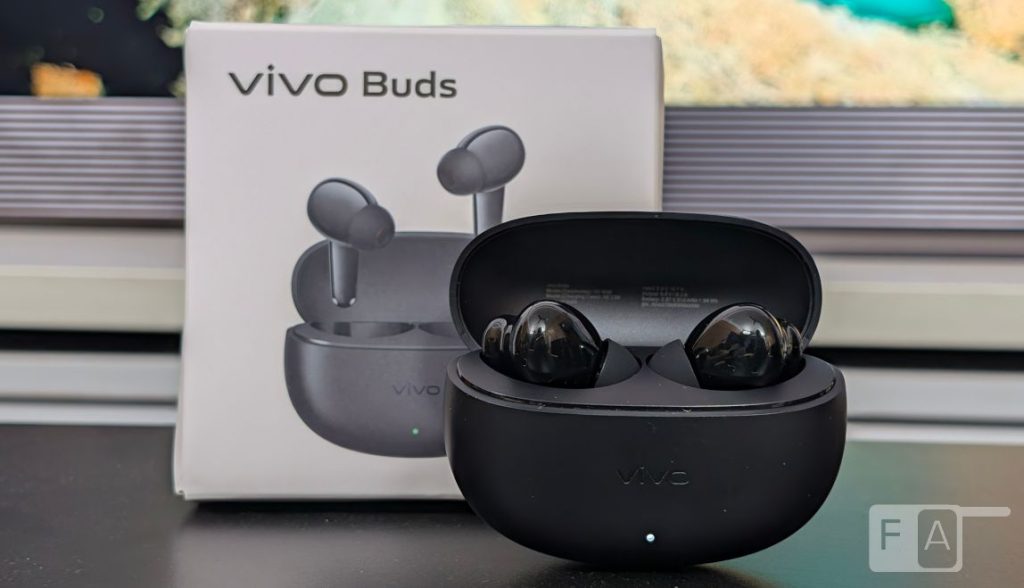
This is the biggest functional difference. vivo Buds use AI call noise cancellation to improve what your caller hears, but FoneArena’s independent review confirms they do not have conventional active noise cancellation for the listener. If your main problem is bus, train or office noise while listening to music, Moto Buds 2 Fusion have the more relevant hardware feature on paper.
vivo Buds fight back with lighter weight and a stronger quick-charge claim
vivo Buds weigh 3.8g per earbud versus 4.2g for Moto, a difference of 0.4g per side. That makes vivo lighter on paper, although nozzle shape, tips and ear anatomy often matter more than four-tenths of a gram. vivo also claims up to four hours of playback from a 10-minute charge, versus Motorola’s three-hour claim.
Which pair has better battery life?
The headline numbers are 13/53 hours for Moto and 12/50 hours for vivo, but that is too small a gap to call a meaningful victory when the test conditions are not identical. vivo publishes a useful baseline for its playback claim: AAC codec, 50% volume and sound effects off. Motorola’s maximum should be treated as a lab claim until an equally detailed methodology or independent matched test is available.
FoneArena’s vivo review reported battery life close to the 12-hour single-charge claim at about 50% volume. Moto Buds 2 Fusion have only just launched, so comparable independent endurance data is not yet available. For buyers who care about battery more than ANC, the two look close enough that charging habits and real ANC-on endurance will matter more than three hours on the box.
Which pair is better for calls?
vivo has an early evidence advantage because FoneArena has already reviewed it and found the AI-backed call noise reduction effective, including against wind. Motorola’s six-mic CrystalTalk setup sounds promising, but it has not yet earned the same independent proof. A fair test needs quiet-room, street, café, wind, normal phone-call and video-call samples. Six microphones versus four is not a result by itself.
Which is better for gaming?
vivo advertises a 42ms low-latency mode under supported conditions and compatible vivo/iQOO devices. Motorola advertises a low-latency gaming mode but does not provide a Fusion-specific latency number in the launch material checked. That gives vivo the clearer published target, not an automatic real-world win. Game engine, phone, codec and wireless environment can all change perceived delay.
Moto Buds 2 Fusion vs Moto Buds 2: Is paying ₹1,000 more worthwhile?
Motorola currently lists Moto Buds 2 around ₹2,999, roughly ₹1,000 above Fusion. The main reasons to spend more are its 11mm + 6mm dual-driver arrangement and LHDC support, not a stronger headline ANC number: both families are advertised up to 55dB. Fusion actually carries the larger battery claims at up to 13/53 hours versus roughly 11/48 hours for Moto Buds 2.
| Model | Current price | Drivers | Codecs | ANC claim | Battery claim |
|---|---|---|---|---|---|
| Moto Buds 2 Fusion | ₹1,999 introductory | 12.4mm dynamic | AAC / SBC | Up to 55dB | 13h / 53h |
| Moto Buds 2 | ₹2,999 current Motorola listing | 11mm + 6mm dynamic | AAC / SBC / LHDC | Up to 55dB | 11h / 48h |
| Moto Buds 2 Plus | ₹5,499 current Motorola listing | 11mm dynamic + Knowles balanced armature | AAC / SBC / LHDC | Up to 55dB | 9h / 40h |
Moto Buds 2 Plus adds the strongest hardware story—Knowles balanced-armature hardware and Sound by Bose tuning—but it is in a different price tier. If premium codec support matters, Fusion is intentionally the compromise. If ANC and everyday convenience matter more, Fusion’s lower price is easier to justify.
Best ANC earbuds under ₹2,000? The live competition matters
Moto Buds 2 Fusion are one of the most notable new ANC options around ₹2,000, but “best” requires more than the largest manufacturer dB figure. A September 15 live-market check shows several relevant alternatives between roughly ₹1,500 and ₹2,500. Current listed prices can change daily, so treat these as a shopping snapshot rather than permanent MSRPs.
| Current option | Listed price checked | ANC claim | Battery claim | Other points |
|---|---|---|---|---|
| Moto Buds 2 Fusion | ₹1,999 introductory | Up to 55dB adaptive | Up to 53h | Multipoint, wear detection, IP54 buds |
| boAt Nirvana Ion ANC | About ₹1,999 | 32dB | Up to 120h | Ambient mode, BT 5.3, IPX4 |
| Noise Alt Buds | About ₹1,999 | Up to 35dB | Up to 50h | 13mm driver, BT 5.3 |
| realme Buds T310 | About ₹2,239 | Up to 46dB | Up to 40h | Spatial Audio, BT 5.4, IP55 |
| CMF Buds 2a | About ₹2,499 | Up to 42dB | Up to 35.5h | Transparency, BT 5.4, IP54 |
Those ANC numbers were not measured under one standardized test, so they should not be turned into a ranking. Our existing CMF Buds Neo buying guide and Belkin SoundForm ANC comparison show why fit, tuning, app quality and real use can matter as much as a headline attenuation claim. For another budget audio reference, see the Soundcore P42i buying guide.
Who should buy Moto Buds 2 Fusion?
Choose Moto Buds 2 Fusion if…
- Listening ANC and Transparency Mode are priorities.
- Wear detection and fit testing matter to you.
- You regularly switch between a phone and laptop.
- You use compatible Motorola devices and value Moto ecosystem extras.
- AAC/SBC codec support is sufficient for your listening.
Choose vivo Buds if…
- Lighter 3.8g earbuds are a priority.
- You use compatible vivo/iQOO hardware and want its ecosystem features.
- The documented 42ms gaming mode matters.
- The four-hour quick-charge claim is more useful to you.
- You do not need conventional listening ANC.
Who should spend more on Moto Buds 2?
Consider Moto Buds 2 if you specifically want LHDC and the dual-driver arrangement and are comfortable paying roughly ₹1,000 more at current Motorola pricing. Fusion is not a “worse Moto Buds 2” in every respect; it has longer headline battery claims and the same 55dB ANC ceiling on paper. The trade is mainly premium audio hardware and codec support versus price.
Readers following higher-end ANC products can also compare how features scale in FrediTech’s Soundcore Liberty 5 Pro coverage. New form factors are evolving too, as our Galaxy Buds On leak analysis shows, while products such as Plaud One AI earbuds push the category toward AI-focused use cases rather than pure audio.
FrediTech verdict
Launch verdict
At the same ₹1,999 price, Moto Buds 2 Fusion have the stronger on-paper feature set for buyers who actually need active noise cancellation. Adaptive ANC, Transparency Mode, six microphones, wear detection, multipoint and a 53-hour maximum battery claim are unusually comprehensive at this price. The main compromise is codec support: AAC and SBC are the only codecs currently listed, while buyers seeking LHDC or other premium-codec options need to spend more.
vivo Buds still make sense for buyers who prioritize lighter earbuds, a clearly specified 42ms gaming mode on compatible devices, strong independently observed battery life and the longer four-hour quick-charge claim. The final verdict on Moto cannot be settled from specifications alone: ANC effectiveness, sound tuning, microphone quality, comfort and real ANC-on endurance still need independent testing.
Frequently Asked Questions
What is Moto Buds 2 Fusion price in India?
The introductory India price is ₹1,999.
When do Moto Buds 2 Fusion go on sale?
Sales begin September 17, 2026.
Where can I buy Moto Buds 2 Fusion?
Motorola says they will be sold through Motorola India, Flipkart and leading or participating retail stores.
Is ₹1,999 the permanent price?
Motorola calls ₹1,999 an introductory price and has not stated a guaranteed end date in the launch evidence checked.
Do Moto Buds 2 Fusion have ANC?
Yes. They include adaptive active noise cancellation.
How much ANC do Moto Buds 2 Fusion offer?
Motorola advertises up to 55dB adaptive ANC. That is a manufacturer maximum and real-world attenuation varies by fit, frequency and environment.
Do they have Transparency Mode?
Yes. Transparency Mode uses the microphones to feed external sound into the earbuds for awareness.
How many microphones do Moto Buds 2 Fusion have?
Six total, with three microphones per earbud.
Which Bluetooth codecs are supported?
Current specifications list AAC and SBC.
Do Moto Buds 2 Fusion support LDAC or LHDC?
No LDAC or LHDC support is listed for the Fusion model in current specifications.
Do they support multipoint?
Yes. Motorola lists dual-device connectivity so the earbuds can remain connected to two compatible devices.
How long does the battery last?
Motorola claims up to 13 hours from the earbuds and up to 53 hours total with the charging case. Actual life depends on ANC, volume and other settings.
How fast do Moto Buds 2 Fusion charge?
Motorola claims a 10-minute charge can add up to three hours of playback.
Are Moto Buds 2 Fusion waterproof?
No. The earbuds are IP54 rated and the case is IPX2; neither rating is intended for swimming or submersion.
Do they support wear detection?
Yes. Smart in-ear detection is included, while exact pause/resume behavior should be confirmed in normal use.
Do Moto AI features work on every phone?
No. Basic Bluetooth functions work broadly, but Moto AI, Qira and deeper ecosystem integrations can require compatible Motorola devices.
Are Moto Buds 2 Fusion better than vivo Buds?
Moto has the stronger on-paper feature set for buyers who need listening ANC and wear detection. vivo is lighter, has a longer quick-charge claim and already has independent evidence for battery and call performance. A final sound-quality verdict needs Moto testing.
Are Moto Buds 2 Fusion the best ANC earbuds under ₹2,000?
They are a strong on-paper contender at ₹1,999, but FrediTech will not call them the best before comparing real ANC, sound, microphones and battery against current rivals.
Sources and Further Reading
- Motorola India: Moto Buds 2 Fusion product page
- FoneArena: Moto Buds 2 Fusion India launch, price and specifications
- vivo India: vivo Buds official specifications and battery footnotes
- FoneArena: independent vivo Buds review
- Digit: current ANC earbuds under ₹2,500 market check
- Motorola India accessories: current Moto Buds 2 / Buds 2 Plus pricing
- Motorola India: Moto AI compatibility context