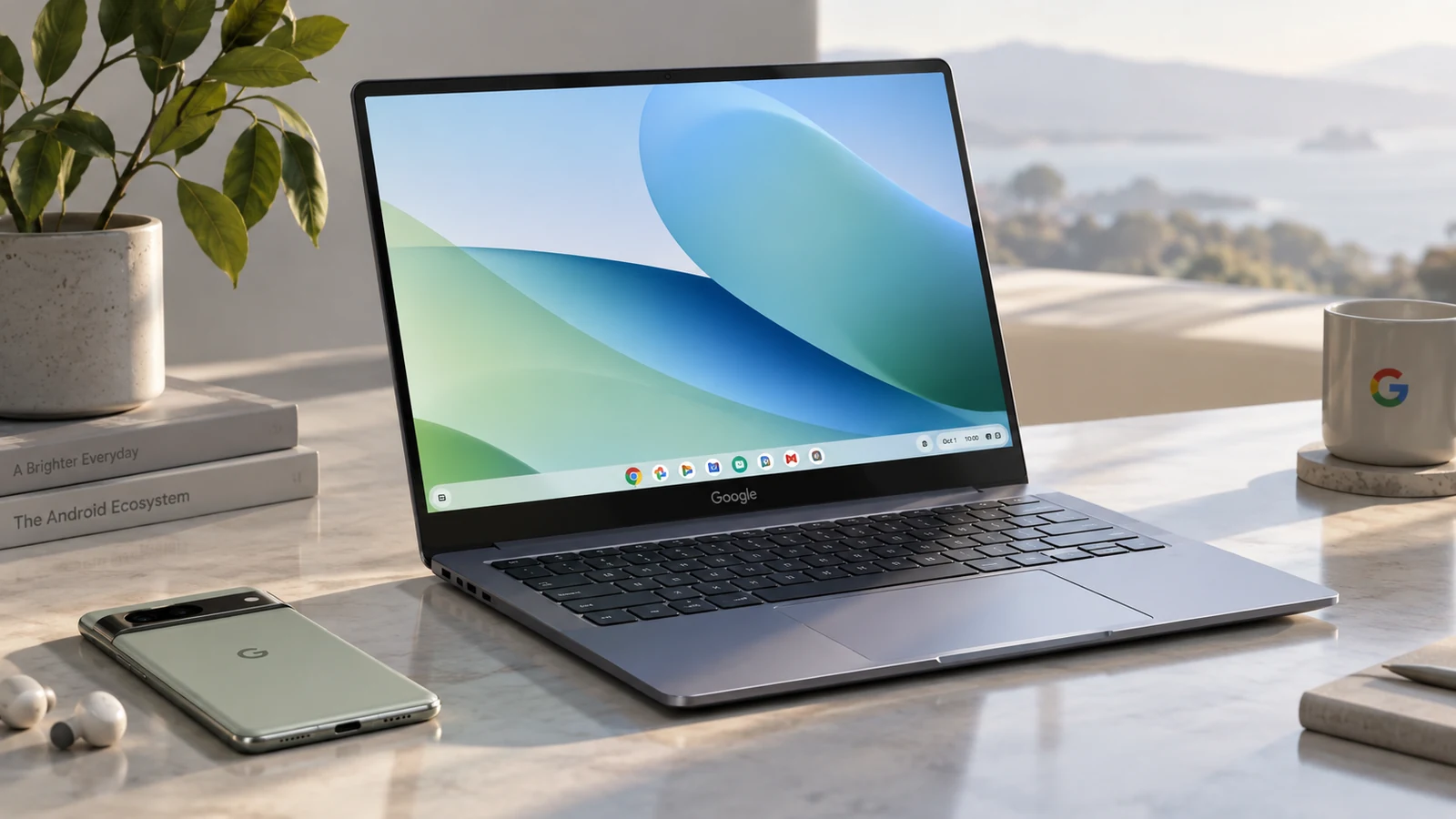

Googlebook preorders are scheduled to begin September 21, 2026 at 9 a.m. ET, according to the Google email sent to people who registered for updates. The most important buyer clarification is that Googlebook is not one Google-manufactured laptop: it is a new Google-defined laptop category with initial hardware from Acer, Asus, Dell, HP and Lenovo. Google has confirmed the platform and its headline Gemini features, but a universal price, the complete preorder model list, detailed configurations, shipping dates and comprehensive country availability are still missing.
Preorders: September 21, 2026
Time: 9 a.m. ET
First-wave brands: Acer / Asus / Dell / HP / Lenovo
Price: Not announced
Complete exact model list: Not announced
Shipping: Not announced
Markets: Not comprehensively announced
Googlebook is not one laptop. Google describes it as a new category of flagship laptops that brings together Android and ChromeOS technologies around Gemini Intelligence. Individual OEM models can differ substantially in processor, display, memory, ports, battery, size, price and warranty.
Googlebook preorders: Quick answer
Googlebook preorders are scheduled to open September 21, 2026 at 9 a.m. ET. Google has named Acer, Asus, Dell, HP and Lenovo as the first hardware partners. Googlebook itself is a laptop category, not one universal Google-made notebook, and Google positions it as bringing together the best of Android and ChromeOS technologies around Gemini Intelligence. Official platform features include Magic Pointer, Create My Widget, Cast My Apps and Quick Access. Google’s current footnotes say Magic Pointer/Create My Widget require internet access and are 18+, while Cast My Apps and Quick Access require setup and a phone running Android 17 or later. Prices, the full preorder model lineup, configurations, ship dates and comprehensive market availability remain unannounced.
When do Googlebook preorders begin?
The first firm commercial milestone is Monday, September 21. Google’s update email, reproduced by 9to5Google and other outlets, specifies 9 a.m. ET. The current U.S. Googlebook landing-page search result also carries “Pre-order September 21,” while the underlying page still contains older “fall 2026” language in places. That is why FrediTech is treating September 21 as the preorder opening—not as the shipping date.
A preorder means an OEM or retailer can begin accepting orders or reservations under its own terms. It does not prove that the laptop ships that day, that stores have same-day pickup, or that every participating manufacturer opens orders at the same moment in every country.
Googlebook preorder time by U.S. time zone
| Preorders | September 21, 2026 |
|---|---|
| Time | 9 a.m. ET (Google email; 9 a.m. EDT on that date) |
| First-wave brands | Acer, Asus, Dell, HP, Lenovo |
| Universal Googlebook price | Not announced |
| Complete Sept. 21 model list | Not announced |
| Shipping dates | Not announced |
| Full country availability | Not announced |
On September 21, the U.S. is observing daylight saving time. Google’s 9 a.m. ET corresponds to 9 a.m. EDT, 8 a.m. CDT, 7 a.m. MDT and 6 a.m. PDT. Buyer-facing pages should still repeat Google’s published “9 a.m. ET” wording first.
Googlebook is a laptop category—not one Google-made laptop
Google’s own launch post calls Googlebook a “new category of laptops.” Google supplies the platform vision, software experience, Gemini features, Android ecosystem integration and the Googlebook branding framework. Hardware partners build the actual notebooks.
That distinction prevents a major buying mistake. There is no single universal Googlebook CPU, RAM capacity, screen, battery or price. A 14-inch HP model could differ dramatically from an Acer, Lenovo, Asus or Dell Googlebook at the same launch. Buyers need to compare the exact OEM model rather than assuming the Googlebook badge guarantees identical hardware.
Don’t buy the category. Compare the individual model. Before paying, verify the exact manufacturer, model number, processor, memory, storage, display, ports, weight, battery estimate, warranty, ship date and final checkout price.
Which companies are making Googlebooks?
Google officially names Acer, Asus, Dell, HP and Lenovo as first-wave manufacturers. “First wave” does not mean all five will necessarily offer the same number of models, open preorders in every market simultaneously or ship on the same date.
There is one useful piece of additional OEM evidence as of September 15: HP’s own support system has pages for an HP Googlebook 14 inch 14c-cf0000. That confirms HP has at least one named Googlebook support family in its infrastructure. It does not yet prove that this exact model will be orderable on September 21, nor does the support page supply a preorder price or ship date.
| Brand | Google-confirmed partner? | Official model evidence | Price | Preorder page | Ship date | Markets | Last checked |
|---|---|---|---|---|---|---|---|
| Acer | Yes | Complete Sept. 21 lineup not announced | Not announced | Not confirmed | Not announced | Not announced | Sep. 15, 2026 |
| Asus | Yes | Complete Sept. 21 lineup not announced | Not announced | Not confirmed | Not announced | Not announced | Sep. 15, 2026 |
| Dell | Yes | Complete Sept. 21 lineup not announced | Not announced | Not confirmed | Not announced | Not announced | Sep. 15, 2026 |
| HP | Yes | HP support identifies “HP Googlebook 14 inch 14c-cf0000”; Sept. 21 preorder status not confirmed | Not announced | Not confirmed | Not announced | Support pages exist in multiple regions; preorder markets not confirmed | Sep. 15, 2026 |
| Lenovo | Yes | No final preorder model confirmed in the sources checked | Not announced | Not confirmed | Not announced | Not announced | Sep. 15, 2026 |
How much will Googlebooks cost?
There is no single “Googlebook price” because Googlebook is a category rather than one SKU. As of this check, Google has not announced universal pricing and the complete model-level price list is not available.
Treat leaked retailer placeholders and reported Lenovo specifications separately from confirmed preorder products. The useful price question on September 21 will be: what does this exact Acer/Asus/Dell/HP/Lenovo model cost in this configuration and market? FrediTech should not publish a guessed starting price such as $999 without a manufacturer or retailer page that clearly supports it.
Googlebook: What Google has confirmed and what remains unknown
| Item | Status | What we know |
|---|---|---|
| Preorder date | Confirmed | September 21, 2026 |
| Preorder time | Confirmed via Google email | 9 a.m. ET |
| OEM partners | Confirmed | Acer, Asus, Dell, HP, Lenovo |
| One Google-manufactured universal model | Not applicable | Googlebook is a multi-OEM category |
| Universal price | Not announced | Pricing will be model-specific |
| Complete preorder model list | Not announced | HP has an official Googlebook 14 support page, but that does not prove Sept. 21 preorder availability |
| CPU / GPU / RAM / storage | Model-specific | Do not generalize across Googlebooks |
| Display / battery / ports | Model-specific | Await each OEM configuration |
| Shipping date | Not announced | Preorder is not shipping |
| Country availability | Not comprehensively announced | Check each OEM and local Googlebook page |
| Magic Pointer | Confirmed | Gemini actions from selected on-screen content |
| Create My Widget | Confirmed | Custom widgets generated from prompts |
| Cast My Apps | Confirmed | Phone apps accessible from Googlebook; setup + Android 17+ phone required |
| Quick Access | Confirmed | Phone files accessible through Googlebook; setup + Android 17+ phone required |
| Chromebook replacement | Not announced | Google continues to describe Googlebooks and Chromebooks separately |
What exactly is a Googlebook?
Google introduced Googlebook in May as a new category of flagship laptops built around Gemini Intelligence, premium hardware and close Android-phone integration. Its launch post says Google is bringing together the best of Android—including Google Play apps and a modern OS designed for intelligence—with ChromeOS technologies such as the Chrome browser.
That does not mean “Googlebook is just ChromeOS with a new name,” and it is also too simplistic to call it “Android stretched onto a laptop.” Google is presenting it as a distinct laptop experience that uses parts of both ecosystems and a new Android-centered technology stack.
For broader context on traditional ChromeOS laptops, see FrediTech’s Best Chromebooks for Schools and Colleges in 2026 and Ultimate Chromebook Buying Guide.
Googlebook combines Android and ChromeOS technologies
Google’s wording is deliberately platform-level. Android contributes modern app and device-integration technologies; ChromeOS contributes browser and laptop experience technologies. Googlebook then layers Gemini Intelligence across that experience.
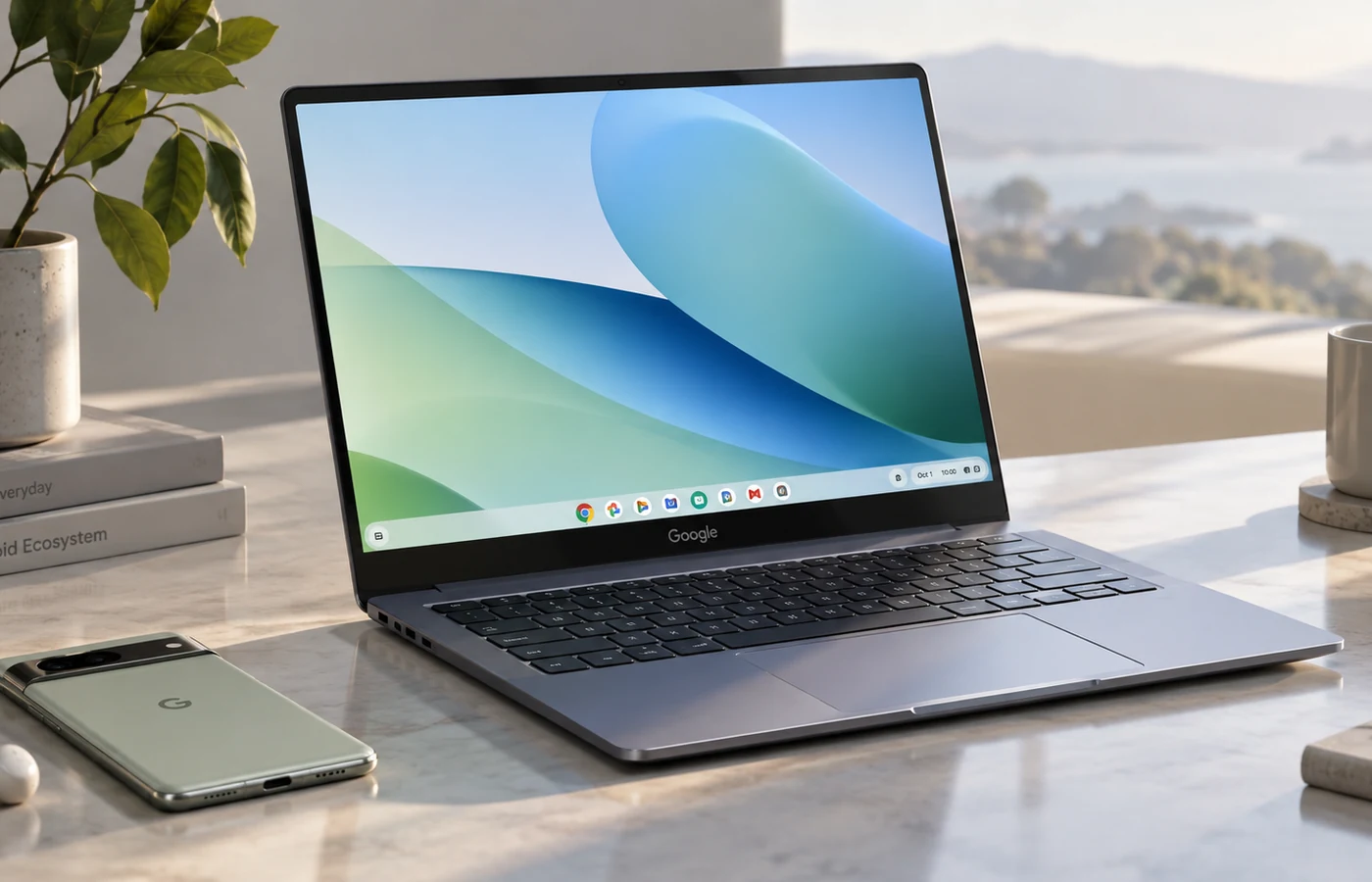
Hardware remains OEM-specific. Google’s promise of premium craftsmanship and a distinctive Glowbar is a platform/branding statement, not proof that every model will use the same chassis, display panel, CPU or port layout.
Googlebook vs Chromebook: What’s different?
| Area | Googlebook | Chromebook |
|---|---|---|
| Category | New flagship/premium laptop category | Established ChromeOS laptop category |
| Platform positioning | Brings together Android and ChromeOS technologies around Gemini Intelligence | Runs ChromeOS and emphasizes simplicity, speed and efficiency |
| Apps | Google Play/Android app ecosystem is central to Google’s positioning | ChromeOS app/web experience, including Android-app support on compatible devices |
| Gemini focus | Core product identity; Magic Pointer and Create My Widget highlighted | Gemini features exist on current Chromebooks/Chromebook Plus, but Googlebook is positioned as the new flagship experience |
| Phone integration | Cast My Apps and Quick Access are signature features | Existing Chromebook/Android integrations differ from the new Googlebook experience |
| Hardware positioning | Premium/flagship; multiple OEM designs | Ranges from budget to premium |
| Manufacturers | Acer, Asus, Dell, HP, Lenovo in first wave | Multiple established OEMs |
| Chromebook support status | Does not imply Chromebook discontinuation | Google still markets and supports Chromebooks |
Google has not announced that Chromebooks are discontinued. Its official Googlebook FAQ still describes Chromebooks separately as ChromeOS devices built around simplicity, speed and efficiency. FrediTech should therefore describe Googlebook as a new premium category rather than a confirmed Chromebook replacement.
Gemini Intelligence is the central software pitch
Google positions Gemini Intelligence as the umbrella experience that makes Googlebook different. The company says it brings personal and proactive assistance into the laptop interface and powers features such as Magic Pointer and Create My Widget.
Marketing phrases such as “Intelligence is the new spec” should remain attributed to Google. They are positioning language, not an independent performance benchmark. Until production hardware is tested, FrediTech should not infer that Gemini features are faster, more accurate or more useful than competing AI-PC experiences.
What Magic Pointer does
Magic Pointer lets a user select something on screen and then ask, compare or create with Gemini. Google demonstrates contextual actions around content such as dates, images and objects. This is one of the most distinctive Googlebook interaction ideas because the AI is tied to what the pointer is already indicating.
Google’s current footnote is important: internet access is required, users must be 18 or older, results can vary and visual-match results may vary. FrediTech should not describe Magic Pointer as an offline feature or as guaranteed to understand every item selected on screen.
Create My Widget brings AI-generated desktop widgets
Create My Widget lets users prompt Gemini to build a custom desktop widget. Google’s examples include trip information, countdowns and personalized dashboards. The May announcement also says Gemini can connect to Google services such as Gmail and Calendar to assemble information.
That should be described as a permission-dependent workflow. It does not mean Googlebook automatically reads every email, event or personal file without user setup, supported services and account permissions.
Googlebook works closely with Android phones
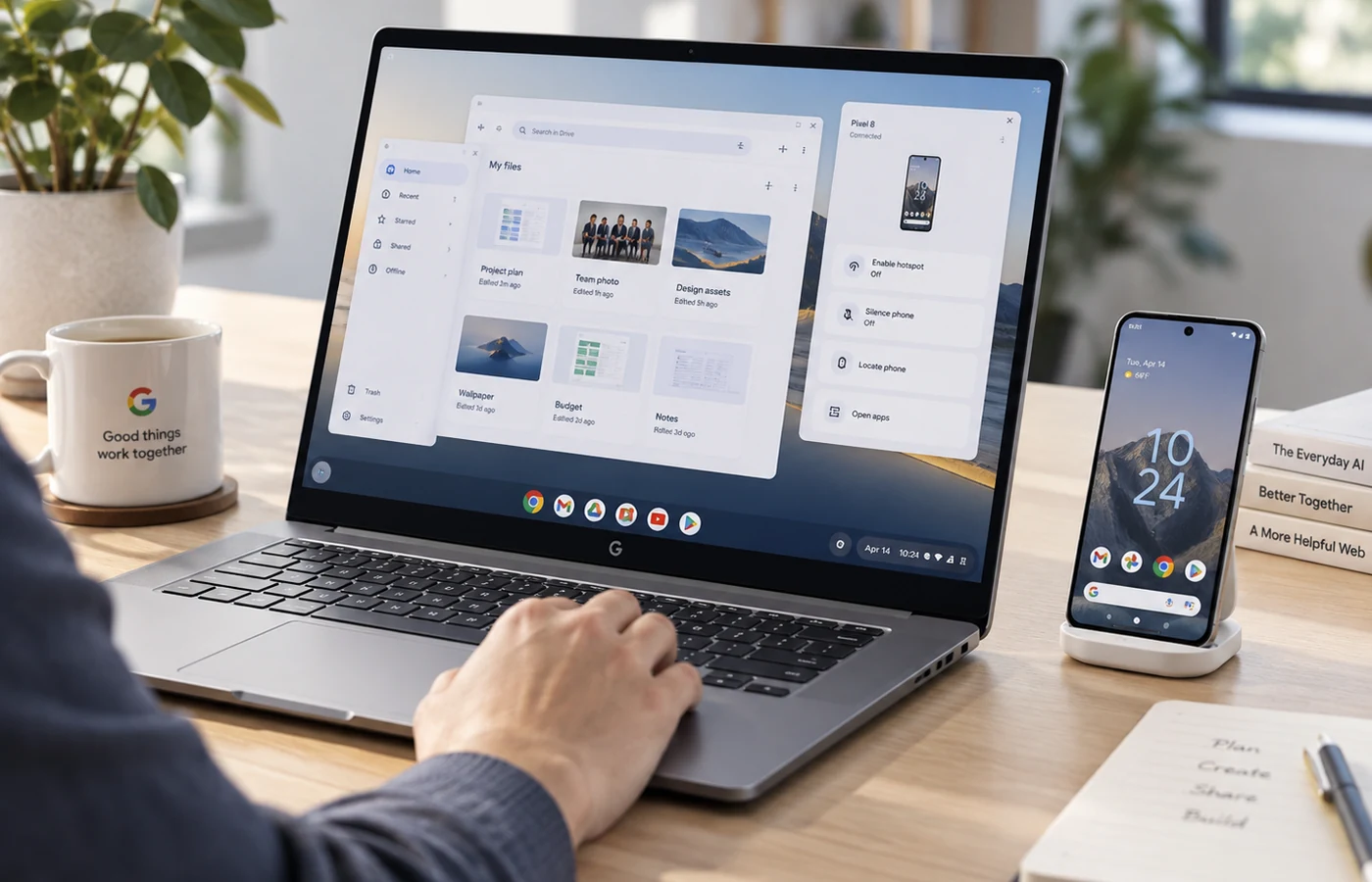
Cross-device integration is another major part of the platform pitch. Google shows Googlebook working with an Android phone so users can bring phone apps and phone files into the laptop workflow without treating the two devices as isolated computers.
For a broader look at current Android 17-era feature delivery and regional requirements, see FrediTech’s September Android Drop 2026.
Cast My Apps explained
Cast My Apps is designed to let users open phone apps from the Googlebook without separately installing those apps on the laptop. Google’s May examples include interacting with a mobile app during laptop work without reaching for the phone.
Final app compatibility, performance, phone-brand requirements, account requirements and connectivity behavior still deserve hands-on verification. Google’s current public footnote establishes setup plus Android 17 or later; it does not prove that every Android 17 phone and every app will behave identically.
Quick Access explained
Quick Access is designed to make files on the Android phone appear accessible from the Googlebook file browser. Google says users can view, search or insert phone files without a manual transfer workflow.
That could be particularly useful for photos, downloads and documents created on the phone, but buyers should wait for model-level and phone-level testing of speed, offline behavior, supported file types and permissions.
Why some features require Android 17 or later
Some phone-integration features require Android 17. Google’s current Googlebook footnote says Cast My Apps and Quick Access require setup and a phone running Android 17 or above. This requirement applies to those cross-device functions; it does not mean the Googlebook itself is unusable without an Android 17 phone.
| Feature | What it does | Official status | Internet required? | Android 17 phone required? | Known limitations |
|---|---|---|---|---|---|
| Gemini Intelligence | Umbrella AI experience across Googlebook | Confirmed | Feature-dependent | No for the laptop generally | Capabilities and availability can vary |
| Magic Pointer | Select on-screen content to ask, compare or create with Gemini | Confirmed | Yes | No | 18+; results may vary; visual-match results may vary |
| Create My Widget | Build a custom widget by prompting Gemini | Confirmed | Yes for Gemini-generated behavior | No | Results may vary; connected Google apps depend on permissions and account setup |
| Cast My Apps | Use phone apps from the laptop without separately installing them | Confirmed | Connectivity required | Yes, Android 17+ | Setup required; final phone/OEM compatibility still needs hands-on verification |
| Quick Access | Access phone files from the Googlebook file browser | Confirmed | Connectivity required | Yes, Android 17+ | Setup required; service/account requirements may apply |
What Google still has not told buyers
Confirmed: September 21 preorder date, 9 a.m. ET timing from Google’s email, five first-wave OEM partners, the Googlebook category, Gemini Intelligence, Magic Pointer, Create My Widget, Cast My Apps and Quick Access.
Still unknown or model-specific: complete preorder model list, universal pricing, CPU/GPU options, RAM, storage, displays, ports, battery life, webcams, weight, chargers, shipping dates, retailer availability, final warranty terms and full country availability.
Country availability tracker
| Market | Current official signal | Sept. 21 preorder confirmed locally? |
|---|---|---|
| United States | Current Googlebook page/search title references Sept. 21 preorder | Yes, date is supported; OEM/model availability still pending |
| Canada | Official localized Googlebook page exists and says fall 2026 | Not separately confirmed |
| United Kingdom | Official localized Googlebook page exists and says autumn 2026 | Not separately confirmed |
| European Union | Localized Googlebook marketing exists in some European markets | Not comprehensively confirmed |
| India | No comprehensive preorder announcement found in the checked official sources | Not announced |
| Australia | Official localized Googlebook page exists and says spring 2026 | Not separately confirmed |
| Japan | No comprehensive preorder announcement found in the checked official sources | Not announced |
The presence of a localized Googlebook page is a marketing signal, not proof that the September 21 preorder opens in that country. The U.K., Canada and Australia pages still use seasonal availability language in the versions checked. FrediTech should switch each row to “preorder live” only after a local Google or OEM order page appears.
Why you should compare the individual laptop—not just the Googlebook name
The Googlebook badge tells you something about platform experience, Gemini integration, Android connectivity and Google’s hardware positioning. It does not tell you whether the individual notebook has an OLED panel, 16GB or 32GB of memory, a fan, a particular Intel/AMD/Arm chip, a touchscreen, enough ports or the battery life you need.
Use the same model-level discipline FrediTech applies in its Everyday Laptops for Maximum Productivity, Best Ultrabooks of 2026 and MacBook Air vs MacBook Pro.
Googlebook preorder buyer checklist
- Confirm the manufacturer and exact model number.
- Verify the processor and graphics platform.
- Check RAM amount and whether memory is upgradeable.
- Check SSD/storage capacity and upgrade options.
- Verify display size, resolution, panel technology and refresh rate.
- Check touch and stylus support if relevant.
- Confirm the port selection and external-display capabilities.
- Look for the manufacturer’s battery estimate and wait for independent testing.
- Check webcam resolution and biometric-login hardware.
- Confirm Wi-Fi and Bluetooth versions.
- Check weight and charger size for travel use.
- Verify the warranty and local service network.
- Read preorder cancellation and return terms.
- Confirm whether the Android-phone features you want require Android 17 or another phone requirement.
- Verify the preorder country and seller.
- Verify the estimated shipping or delivery date.
- Compare the exact checkout price with Windows laptops, MacBooks, Chromebooks and other Googlebooks.
Should you preorder a Googlebook on September 21?
Do not preorder simply because Googlebook is new. The sensible decision depends on the exact model that appears on September 21. A preorder can make sense when the individual laptop has a clearly stated configuration, price, warranty, return policy and shipping window that match your needs.
Waiting is reasonable if the OEM page leaves out important specifications, if a configuration is expensive relative to established Windows/macOS/Chromebook alternatives, or if the Gemini and Android-phone features are central to your purchase and you want independent testing first.
FrediTech preview verdict: the platform is interesting, particularly Magic Pointer and the phone-integration ideas, but the category name alone is not enough information to buy. Compare the individual OEM model once price, configuration and shipping details are live.
What FrediTech will check when preorders open
- Which Acer, Asus, Dell, HP and Lenovo models actually become orderable.
- Exact U.S., U.K., EU, Canada, India, Australia and Japan availability.
- USD, GBP and EUR pricing plus any India pricing.
- CPU/GPU, RAM, storage, display, battery, ports, webcam, Wi-Fi and Bluetooth.
- Estimated ship dates and first-delivery windows.
- Preorder deposits, card-charge timing, cancellation and return terms.
- Warranty coverage and seller identity.
- Whether Android 17 phone integration has manufacturer or regional restrictions.
- Independent reviews of Magic Pointer, widgets, app casting, file access, battery life and thermals.
Googlebook price and release tracker
| Preorders | September 21, 2026 |
|---|---|
| Time | 9 a.m. ET (Google email; 9 a.m. EDT on that date) |
| First-wave brands | Acer, Asus, Dell, HP, Lenovo |
| Universal Googlebook price | Not announced |
| Complete Sept. 21 model list | Not announced |
| Shipping dates | Not announced |
| Full country availability | Not announced |
This tracker should stay on the same URL after September 21. Once exact products become available, replace “not announced” cells with manufacturer-verified model names, configurations, prices, preorder URLs and shipping dates rather than publishing a duplicate generic “Googlebook price” article.
Frequently Asked Questions
When do Googlebook preorders start?
Preorders are scheduled to begin September 21, 2026.
What time do Googlebook preorders open?
Google’s email to update subscribers gives 9 a.m. ET. On September 21 that is 9 a.m. EDT, 8 a.m. CDT, 7 a.m. MDT and 6 a.m. PDT.
What is a Googlebook?
Google describes Googlebook as a new category of flagship laptops bringing together Android and ChromeOS technologies around Gemini Intelligence and premium hardware.
Is Googlebook made by Google?
Google defines the category and software experience, while the first hardware is being made by Acer, Asus, Dell, HP and Lenovo.
Who makes Googlebook laptops?
Google officially names Acer, Asus, Dell, HP and Lenovo as first-wave partners.
Which Googlebook models launch first?
The complete September 21 preorder model list is not yet announced. HP has an official support page for an HP Googlebook 14 inch 14c-cf0000, but its preorder status is not confirmed by that support page.
How much will Googlebooks cost?
There is no universal Googlebook price. Individual OEM pricing remains to be confirmed.
When will Googlebooks ship?
Google has not announced a universal shipping date. Preorder opening and shipping are separate milestones.
Will Googlebooks launch outside the US?
Google has localized Googlebook pages in several regions, but comprehensive market-by-market September 21 preorder availability is not yet confirmed.
Is Googlebook the same as Chromebook?
No. Google distinguishes Googlebook as a new flagship category bringing together Android and ChromeOS technologies, while Chromebook remains a ChromeOS category focused on simplicity, speed and efficiency.
Does Googlebook replace Chromebook?
Google has not announced that Chromebooks are being discontinued or replaced.
Does Googlebook run Android apps?
Googlebook is built around the Android app ecosystem and Google demonstrates phone-app integration, but exact app compatibility and model behavior should be verified on shipping hardware.
What is Gemini Intelligence?
It is Google’s umbrella AI experience for advanced devices such as Googlebook and powers features including Magic Pointer and Create My Widget.
What is Magic Pointer?
Magic Pointer lets users select on-screen content and ask, compare or create with Gemini. Internet is required, users must be 18+, and results may vary.
What is Create My Widget?
It lets users ask Gemini to build customized desktop widgets, including dashboards based on prompts and supported connected Google services.
What Android phone do I need for Googlebook cross-device features?
Google currently says Cast My Apps and Quick Access require setup and a phone running Android 17 or later.
Do Cast My Apps and Quick Access require Android 17?
Yes, according to Google’s current public footnote. That requirement applies to those cross-device features, not to basic use of the laptop.
Should I preorder a Googlebook?
Base the decision on the exact OEM model, price, configuration, warranty, return terms and shipping date—not on the Googlebook category name alone.
Sources and Further Reading
Googlebook official site: googlebook.google.
Google launch announcement: Introducing Googlebook, designed for Gemini Intelligence.
HP official support evidence: HP Googlebook 14 inch 14c-cf0000 support page.
Preorder-time reporting from Google email: 9to5Google, September 14, 2026.