
Toyota bZ4X Review 2026: Range, Charging & Everyday Value is built around the ownership questions that matter most: usable range, charging access, performance, cabin practicality, software, warranty coverage and total value—not just headline acceleration or estimated range.
Quick Verdict
- Best for: EV shoppers comparing real ownership trade-offs rather than spec-sheet bragging rights.
- Focus on: usable range, charging speed and access, comfort, software, warranty, service and total price.
- Watch for: trims, battery packs and regional specifications can materially change range, performance and value.

The 2026 Toyota bZ4X (now renamed simply Toyota bZ) is a thorough update of Toyota’s compact electric SUV, addressing many of the original bZ4X’s shortcomings. For 2026, Toyota has added a larger battery (up to 74.7 kWh), significantly more power, and faster charging, along with styling and interior refinementspressroom.toyota.com. The result is a vehicle with up to 314 miles of EPA-rated range (on the FWD XLE Plus)caranddriver.com, 338 horsepower on the AWD model (vs 214 hp previously), and a new North American Charging Standard (NACS) port for Tesla Supercharger access. This review takes an in-depth look at what’s new, how it drives, and how it compares to rivals.
Toyota has confirmed the 2026 bZ is expected to arrive in the second half of 2025. It will start at about $34,900 MSRP for the base XLE FWD modelpressroom.toyota.com (approximately $40,000 out the door, including destination). With these updates, Toyota aims to make the bZ4X competitive with other compact electric SUVs – a segment where it previously lagged in range, charging speed and performancemotortrend.com. We explore each aspect below.
Table of contents
Key Updates for 2026
Toyota has “thrown everything at” the bZ4X for the 2026 refresh. Highlights include:
- Increased power: All-wheel-drive (AWD) models gain 338 hp combined (221 hp front + 117 hp rear), a leap over the old 214 hp AWD. Front-wheel-drive (FWD) versions have 168 hp (or 221 hp on Plus/Limited with bigger battery). According to Toyota engineers, the top AWD model now ranges up to 343 hp in some marketsinsideevs.com. This is up to 50% more power than the previous model.
- Enhanced interior: The bZ’s cabin has a major refresh. A standard 14-inch touchscreen now dominates the center stack, replacing the old awkward gauge panel on the dash. The center console is redesigned for better usability, and Toyota adds ambient lighting (64 colors), dual wireless phone chargers, a heated steering wheel with regen paddles, and a more conventional driver’s gauge pod. Car reviewers note the new interior feels “airier and more spacious”, though some oddities remain (the low-mounted steering wheel can still block the instrument view).
Exterior Design
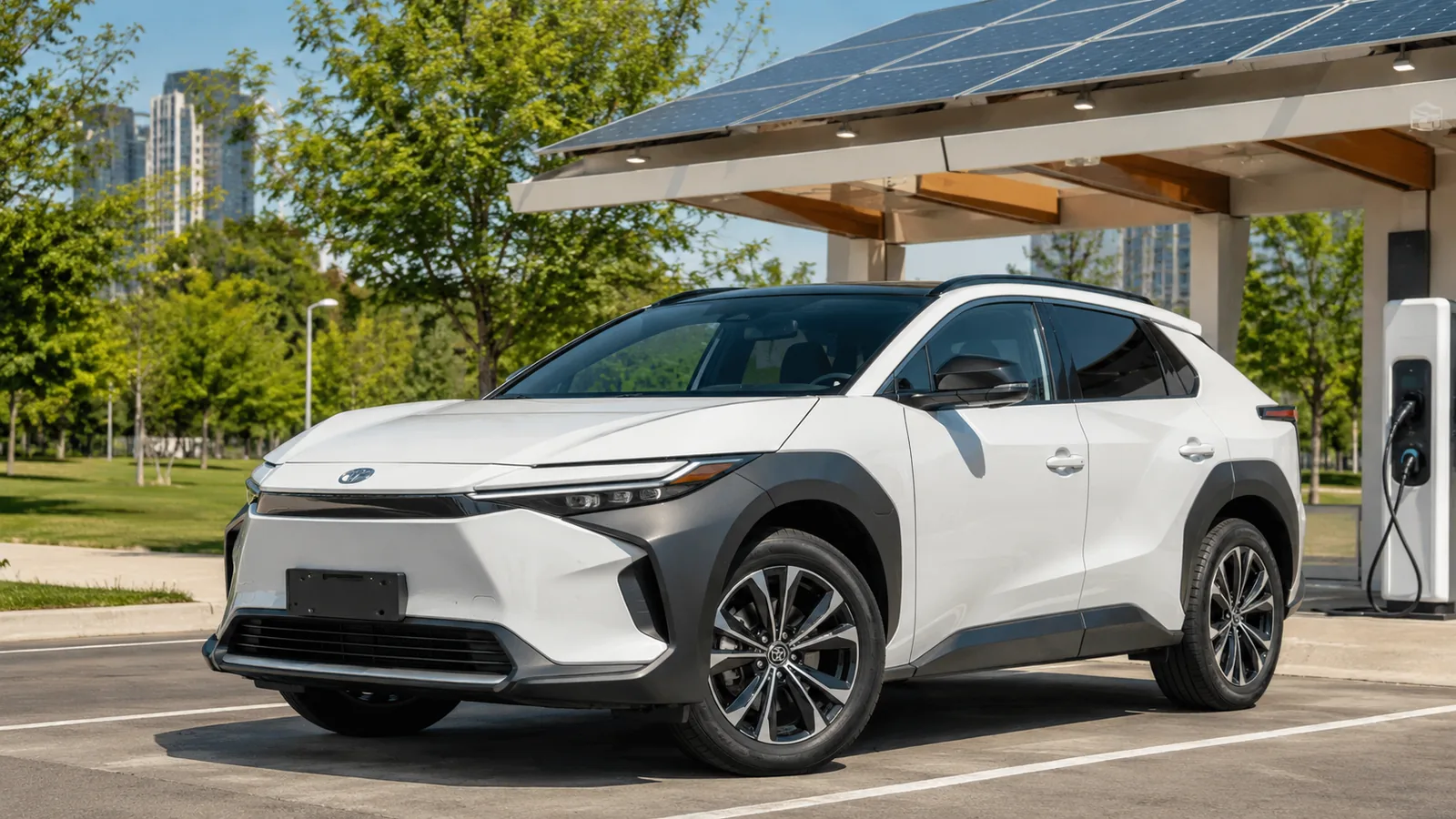
The 2026 bZ retains its compact crossover shape, but with refreshed styling details. The front fascia is sleeker and more elegant compared to the clunky original. Up front you’ll find new LED headlights and a partially closed grille (as with most EVs). Some trim-specific touches include black roof-painted panels and an available “Tech Bronze” color pack on higher grades.
Step-by-step exterior walkaround: The hood is slightly more sculpted, and the closed front grille bears a small Toyota badge. Available wheels now include 18- and 20-inch designs in silver or black finishes. A new panoramic sunroof (on Limited AWD) brightens the cabin. At the rear, a full-width LED light bar connects the tail lights. The charging port is relocated to the left front fender behind a flush door (now on the driver side). On Touring/RS trims, features like LED fog lamps and a power-operated hatch make loading easy (a hands-free liftgate is standard on AWD models)carsguide.com.
Interior and Technology
Powertrain and Performance
Drivetrain: The 2026 bZ4X is built on Toyota’s e-TNGA platform, shared with the Subaru Solterra. Two drivetrain layouts are offered:
Overall, the driving experience is solidly competent. The AWD model in particular is entertaining – its acceleration rivals many sportier EVs (e.g. it beats Ioniq 5 AWD and matches most trims of the VW ID.4). Off-road, the X-MODE and Grip Control functions help on loose terrain, making it more capable than before. At the limit, some testers found the AWD bZ can feel “anodyne”, but most drivers will enjoy the confident ride and one-pedal driving on city streets.
Battery, Range, and Efficiency
In metric terms, CarsGuide notes the AWD model now reaches up to 517 km WLTP range (vs 411 km before). InsideEVs expects the top WLTP range to be ~573 km (~356 miles). (EPA ratings are typically lower than WLTP, so a ~314-mi EPA is consistent.) In daily driving, the bZ4X should comfortably cover most commutes. Real-world consumption is around 16 kWh/100 km per WLTP (roughly 290 Wh/mi) for AWD. Owners can eke out more range by using Eco mode, gentle regen, and preconditioning the cabin/battery before driving. Toyota’s range estimates can vary with weather, speed, and driving style; 314 miles is the high end on highway tests.
Efficiency features include an improved heat pump (optional), front/rear heated seats and steering wheel, and available lower-body seat heaters to cut HVAC loads. The 2026 bZ also gains a battery thermal management system that speeds up pre-heating in cold weather. Toyota adds a battery preconditioning function: setting a DC fast-charging destination in the nav will automatically warm the battery to optimal temperature, allowing faster charging especially in winter. These EV-specific tweaks (plus tire low-rolling-resistance and aero tweaks) help the bZ close the efficiency gap on rivals.
Charging and Connectivity
Driving Impressions
On the road, the 2026 bZ4X is a pleasant everyday EV. Its smooth power delivery and instant torque make city driving effortless. On the highway, it feels stable and refined, aided by good high-speed aerodynamics. As noted, the AWD version is notably brisk – overtaking is quick, and the car can pin you back in your seat during wide-open throttle launches. Even in Normal mode, acceleration is lively. Sport mode sharpens throttle response but at a mild trade-off in range.
On-road stability: The bZ tracks straight and feels sure-footed. On twisty roads, roll is controlled and grip is good. In AWD models, Toyota’s ABS and stability systems (including X-MODE grip) inspire confidence in low-traction situations. Braking is progressive with strong pedal feel. Thanks to regen, one-pedal driving is easy once accustomed to it.
Cargo and practicality: For such a compact exterior, the interior is quite roomy. Front seats have ample head- and legroom, and even tall adults sit comfortably in back. The flat floor (thanks to the underseat battery) leaves generous foot space. Cargo capacity is competitive: mid-20s cu ft behind rear seats, expanding to ~60 cu ft folded. The hatch opening is low, making loading groceries or gear straightforward. The rear seat backs can recline slightly or flip forward for larger items.
Pricing, Trims, and Availability
Toyota will offer the bZ in two main trim levels (XLE and Limited), each available in FWD or AWD. The XLE is the entry grade; in 2026 it comes in XLE, XLE Plus (larger battery FWD), or XLE AWD. The Limited is top-tier (74.7 kWh only). AWD adds about $6,000 to the price in our market research.
Toyota also offers incentives or financing deals on the bZ in many regions to move inventory faster. With price cuts of “up to $10,000” reported in Australia, the value proposition is strong. Given its improved specs and now high level of standard equipment (12-way driver seat, heated features, JBL sound on AWD, etc. as reported by CarsGuide), many reviewers say you’re getting a lot of kit for the money.
Competition
In the small electric SUV segment, the 2026 Toyota bZ4X competes with a number of rivals:
- Subaru Solterra: Nearly identical underpinnings (shared assembly), the Solterra AWD Touring had similar specs. The new bZ now clearly outclasses the old Solterra in power and range. Both will still share the 150 kW charging cap, but the Toyota gains the NACS port. (Subaru version may lag on charging infrastructure.)
- Volkswagen ID.4: The ID.4 AWD gives up to ~275 mi range. It lacks the bZ’s power (201 hp) and climate features, but VW’s EV software is user-friendly. The Toyota’s higher utility (V2L, X-MODE, ambient lights) is a plus.
- Ford Mustang Mach-E: A sporty crossover with 270–314 mi range (LR RWD). Mach-E has more charging speed (150–250 kW) and a variety of trims. The bZ competes on comfort, price, and the latest tech rather than outright performance.
Conclusion
The 2026 Toyota bZ4X (bZ) represents a genuine turnaround for Toyota’s first EV crossover. By adding a bigger battery, more power, faster charging, and a host of modern features, Toyota has addressed the key criticisms of the original model. In practice, the new bZ offers much-improved acceleration, a much longer driving range, and a more user-friendly cabin. The experience is not flawless – charging speed is still modest (150 kW cap) and the interior layout remains unconventional – but it is now competitive in the compact EV SUV class.
Overall, if you want a solid, well-equipped electric SUV and value Toyota’s reliability and dealer network, the 2026 Toyota bZ4X is worth considering. It may not match a Tesla or high-end EV in every spec, but it has closed the gap significantly while undercutting many on price. With its upgraded battery and tech, the bZ4X is arguably now the EV Toyota should have offered all along.
Author: Wiredu Fred – Automotive Analyst at FrediTech. Expert in electric vehicle technology and automotive reviews, Wiredu has contributed in-depth articles on EV trends and launches for FrediTech and other tech publications.
Frequently Asked Questions
What is the driving range of the 2026 Toyota bZ4X?
How much horsepower does the 2026 Toyota bZ4X have?
Does the 2026 Toyota bZ4X charge faster than before?
What’s new on the 2026 Toyota bZ4X vs the old bZ4X?
When will the 2026 Toyota bZ4X be available and how much will it cost?
Is the 2026 Toyota bZ4X a good SUV?
Bottom Line
Choose an EV by the routes, charging access, passenger needs and ownership costs you actually have. The best specification on paper matters less than the configuration that fits daily use and remains well supported.