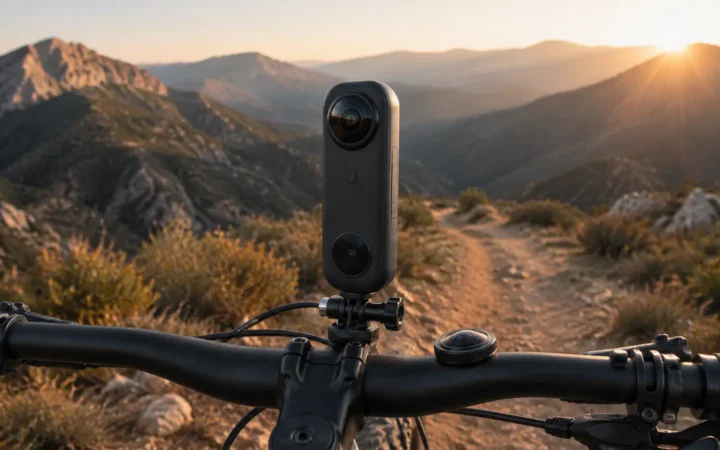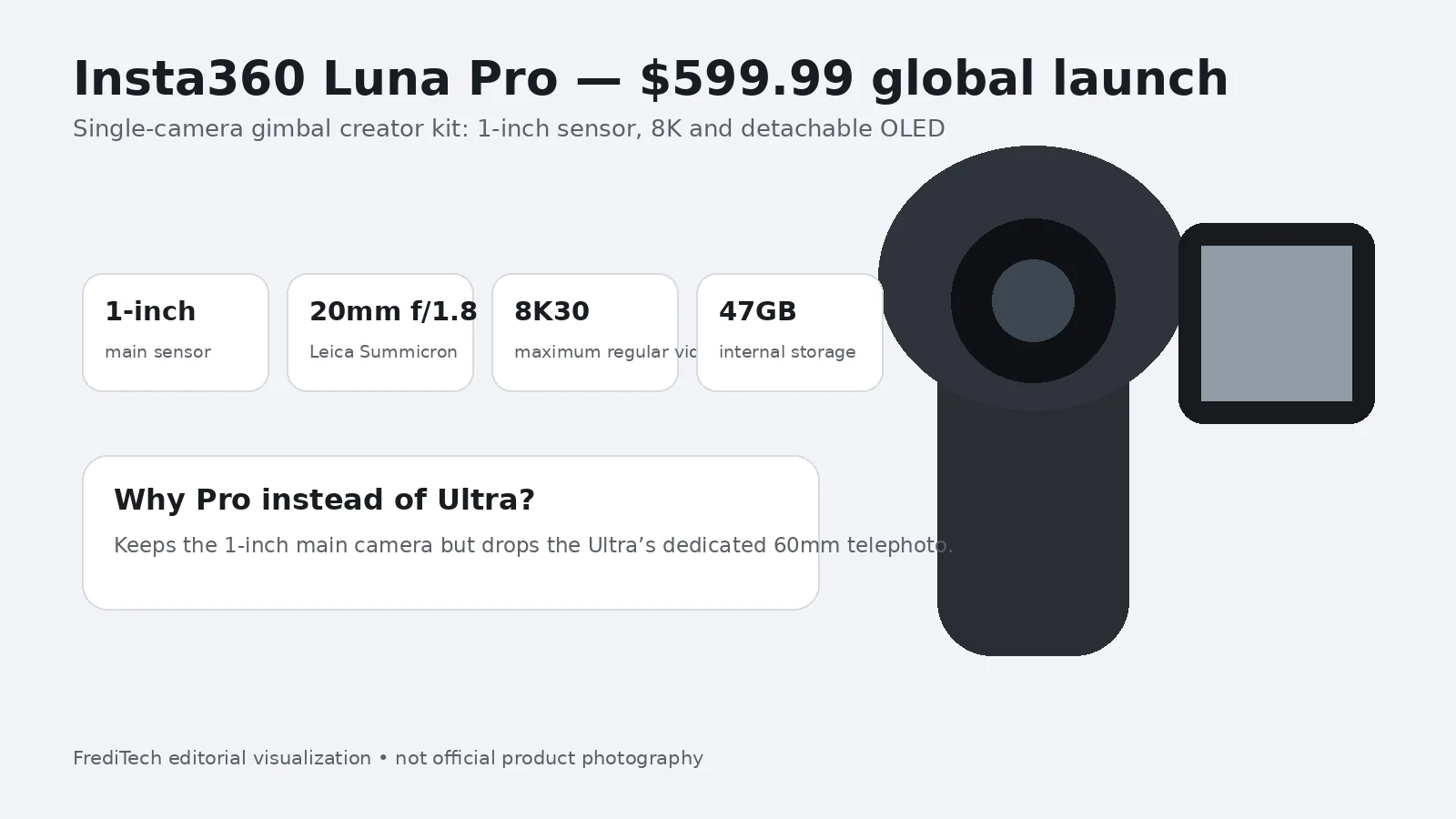

The Insta360 Luna Pro is now available globally, starting at $599.99 in the United States, £469 in the UK and €529 in Europe. It sits $170 below the $769.99 Luna Ultra while retaining the core 1-inch 8K imaging platform, 20mm-equivalent f/1.8 Leica Summicron lens, detachable 2-inch OLED, 47GB internal storage, 10-bit I-Log, timecode and three-axis stabilization. The key omission is simple: Luna Pro has one camera, while Luna Ultra adds a dedicated 60mm-equivalent telephoto camera. For social-first creators, Luna Pro also brings native 4K30 vertical recording. U.S. buyers have another practical advantage: Luna Pro is officially sold domestically, while DJI Osmo Pocket 4 has not had the same normal U.S. retail availability in the publication baseline.
Insta360 Luna Pro is now available worldwide
Insta360 released Luna Pro on September 10 through its store, Amazon and selected retailers. The official lineup includes Cosmic Black and Stellar White. The black model is listed around 215g and the white around 218g, making both lighter than the corresponding Luna Ultra variants.
Bundle names can vary by region, with Standard, Vlog, Endurance and other accessory packages appearing in some stores. Buyers should compare what is actually included rather than assuming a higher bundle price represents a different camera body.
Insta360 Luna Pro price: $599.99 in the US
| Market | Launch price | Context |
|---|---|---|
| United States | $599.99 | Official Luna Pro starting price. |
| United Kingdom | £469 | Regional price; do not direct-convert from dollars. |
| Europe | €529 | Regional price; VAT/retail structure differs. |
| Luna Ultra (U.S. comparison) | $769.99 | Sibling model with dedicated telephoto camera. |
The $170 gap equals about 22.1% of the Ultra’s $769.99 U.S. price. It is a model-to-model difference, not a “$170 discount.” The decision is therefore whether the telephoto camera and any related Ultra advantages are worth the premium for the way you shoot.
What Luna Pro removes to hit the lower price
Luna Pro uses one main camera with a 1-inch sensor and 20mm-equivalent f/1.8 lens. Luna Ultra adds a second 1/1.3-inch telephoto camera around 60mm equivalent. That additional focal length matters for portraits, events, travel details, stage performances and distant subjects because it changes perspective and working distance rather than simply cropping a wide image.
Pro can use sensor cropping for closer views, including a documented 2× lossless-style crop from the high-resolution sensor area before moving into stronger digital zoom. That can be useful, but it is not the same as a dedicated optical telephoto. If most of your footage is selfie vlogging, room tours or wide environmental video, the removed camera may spend little time being missed.
The 1-inch 8K Leica camera is still the main attraction
The main imaging system combines a roughly 50MP-effective 1-inch sensor with a 20mm-equivalent f/1.8 Leica Summicron lens and close focusing around 9cm. A 1-inch sensor provides more imaging area than the very small sensors used by many action or pocket cameras, which gives the system stronger light-gathering potential and more room for dynamic-range processing.
That does not guarantee superior images. Autofocus, stabilization, sharpening, noise reduction, color processing, bitrate and thermal behavior all contribute to the result. Early hands-on reports can provide useful direction, but broader side-by-side testing is still needed before declaring Luna Pro better than DJI or smartphone alternatives in low light.
8K adds flexibility, but not everyone needs to shoot 8K
Luna Pro records up to 8K30, 4K120 and 1080p240 in the supplied official specification. Insta360 also promotes 8K Dolby Vision, 10-bit I-Log, ACES compatibility and built-in timecode. Those tools matter most to creators who reframe, crop, grade or synchronize multi-camera projects.
The cost is workflow. 8K files fill storage quickly, require more powerful editing hardware and use more battery. A creator publishing primarily to 1080p social feeds may gain more from good framing, audio and lighting than from recording everything at maximum resolution.
4K vertical video gives social creators a genuine advantage
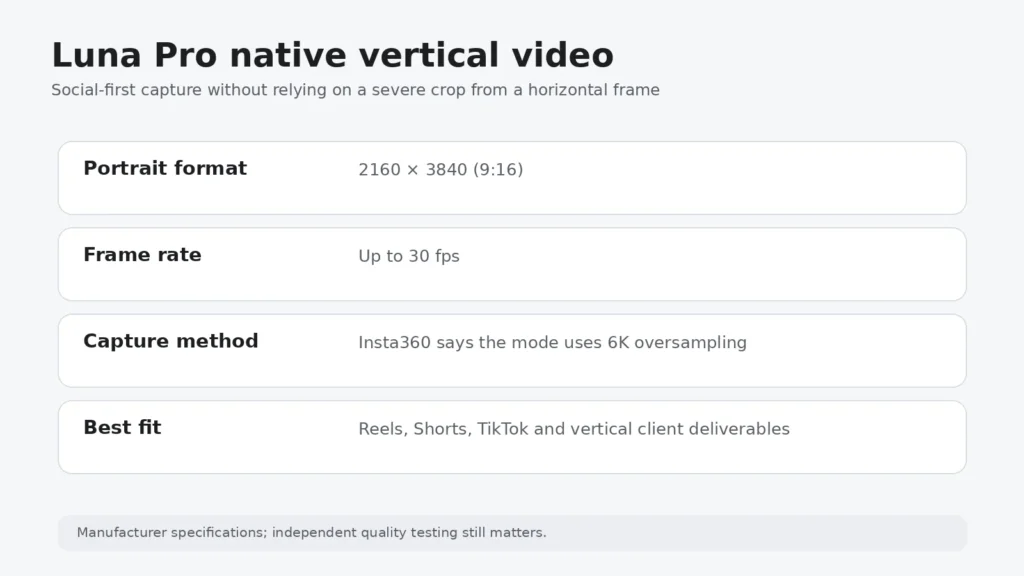
Luna Pro supports native 2160×3840 9:16 video up to 30fps, with Insta360 describing a 6K-oversampled pipeline. That matters for Reels, Shorts and TikTok because the camera can dedicate a proper high-resolution portrait frame instead of forcing a severe crop from horizontal footage.
This advantage is time-sensitive in the Luna family. Insta360 planned a firmware path for Ultra to gain comparable vertical capability. Once that update is confirmed, the feature should no longer be described as permanently exclusive to Pro.
The detachable OLED can change solo shooting
The 2-inch, 1000-nit OLED can detach from the camera and work as a remote monitor/controller. Insta360 rates wireless preview/control up to around 20 metres in clean, unobstructed conditions. That creates genuinely useful setups for solo creators: mount the camera across the room, remove the screen, confirm framing and start recording without walking back to the gimbal.
The range claim is an ideal-condition figure; walls, interference and crowded RF environments can reduce it. Detached operation also consumes power, which matters when planning longer sessions.
47GB storage helps—but 8K fills space quickly
Luna Pro includes 47GB of internal storage plus microSD expansion, with Insta360 documenting compatible high-capacity cards. Internal memory is excellent emergency capacity when a card is forgotten or for short sessions, but it is not a large archive for sustained 8K capture.
Creators should budget for a fast, reliable microSD card and a backup workflow. High-resolution video makes storage an ownership cost rather than a one-time accessory purchase. FrediTech’s iPhone 17 Pro creator/video guide provides related context on high-bitrate mobile workflows.
Can the Luna Pro really last four hours?
Yes under Insta360’s stated low-demand test, but not at 8K. The maximum figure uses 1080p24 with the screen and Wi-Fi off at 25°C. Insta360’s more useful detailed table is around 2.5 hours at 4K30, about two hours at 4K60 and roughly 1 hour 50 minutes at 8K30. Active detached-screen use can reduce endurance further.
That is why “up to four hours” should always be attached to the recording condition. The optional Battery Handle can extend runtime and improve grip, but it adds size. Creators planning event coverage should test the exact resolution, tracking and screen configuration they intend to use.
Luna Pro vs Luna Ultra: which should you buy?
Choose Luna Pro when your work is dominated by wide-angle vlogging, walk-and-talk pieces, interiors, travel diaries and social video. It preserves the large main sensor, Leica lens, detachable OLED and professional workflow tools while saving $170 and some weight.
Choose Luna Ultra when a real 60mm-equivalent perspective is part of your shooting style. Portraits, concerts, events and travel details benefit from optical focal-length flexibility that digital crops cannot fully replace. Paying more is rational when the telephoto solves a recurring problem, not merely because Ultra is the flagship.
Luna Pro vs DJI Osmo Pocket 4
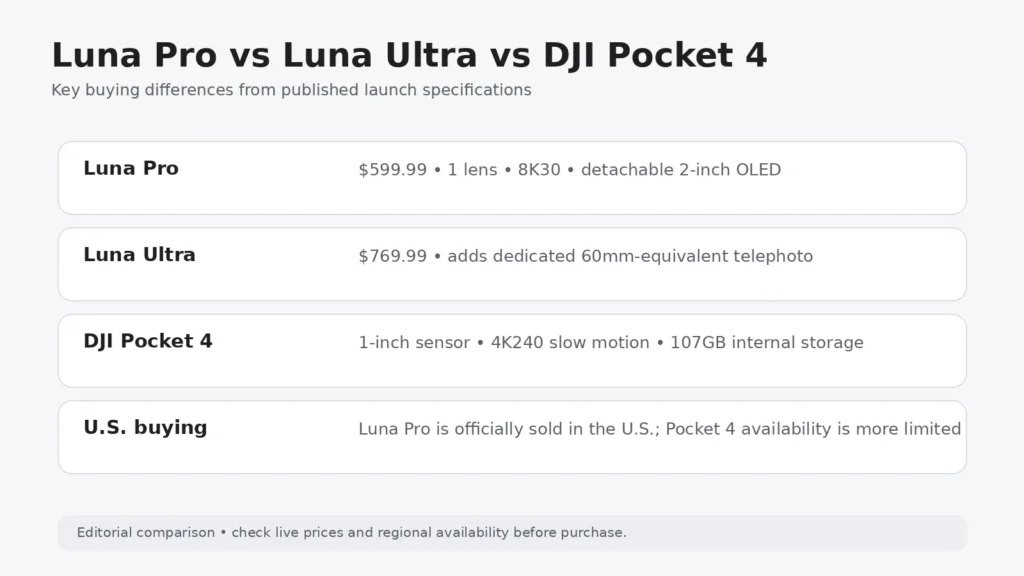
| Feature | Luna Pro | Luna Ultra | DJI Pocket 4 context |
|---|---|---|---|
| Main camera | 1-inch, 20mm f/1.8 | Same main + telephoto | 1-inch-class compact gimbal camera |
| Headline video | 8K30 | 8K30 | 4K-focused with higher slow-motion emphasis |
| Slow motion | 4K120 | 4K120 | Up to 4K240 in current DJI specs |
| Vertical | 4K30 native | Firmware-dependent/currently evolving | Up to 3K60 in current baseline |
| Display | Detachable 2-inch OLED | Detachable 2-inch OLED | Integrated/rotating screen approach |
| Internal storage | 47GB | 47GB | 107GB in current DJI baseline |
| Core reason to buy | 8K + detachable screen + value | Telephoto flexibility | Tracking/audio ecosystem + slow motion |
Neither camera should be declared universally better. DJI’s strengths include its mature tracking/audio ecosystem, higher slow-motion ceiling and more internal storage. Luna Pro counters with 8K, a detachable monitor, Leica-branded optics and native 4K vertical capture. The best choice depends on the actual output format and accessories used.
For U.S. buyers, availability changes the comparison
Luna Pro is officially sold in the United States at $599.99. In the publication baseline, DJI Pocket 4 does not have the same normal official U.S. retail presence. That makes Luna Pro easier to buy with domestic warranty/returns instead of relying on grey-market imports.
Availability can outweigh a small specification advantage. A camera that is slightly cheaper abroad may be a worse U.S. purchase if warranty service, returns or accessories are complicated.
For UK and European buyers, price matters more
Where DJI Pocket 4 is officially sold, the comparison becomes closer because DJI’s Standard bundle can undercut Luna Pro slightly. That means UK/EU shoppers should compare real bundle contents rather than focusing on U.S. availability. DJI can be stronger for 4K slow motion and built-in storage; Luna Pro is stronger when 8K, detachable monitoring and high-resolution vertical video matter.
Who should buy Insta360 Luna Pro?
- Solo vloggers who will use the detachable screen.
- Travel creators who want a compact gimbal with a large main sensor.
- Reels/Shorts/TikTok creators who value native 4K vertical capture.
- U.S. buyers who want an officially supported pocket-gimbal alternative.
- Creators using I-Log, timecode or multi-camera workflows.
- Buyers who do not routinely need a 60mm telephoto perspective.
Who should spend more on Luna Ultra?
Spend the extra when telephoto framing is essential to your work—portraits, events, street details, stage performances or subjects you cannot physically approach. If you often crop wide footage because everything is too distant, Ultra’s second camera can save time and preserve quality. If you mostly film yourself, the extra lens may be wasted money.
Before buying Insta360 Luna Pro
- Confirm the current regional price and bundle contents.
- Choose Cosmic Black or Stellar White.
- Decide whether you genuinely need Ultra’s telephoto.
- Budget for a fast microSD card if 47GB is not enough.
- Plan around shorter battery life at 8K and with the detached screen.
- Check Mic Air/Mic Pro or other audio compatibility.
- Compare DJI Pocket 4 pricing where it is officially sold.
- U.S. buyers should verify official DJI availability rather than importer listings.
- Review warranty and return policy.
- Remember Luna Pro is not positioned as a waterproof action camera.
Frequently asked questions
How much does Insta360 Luna Pro cost?
$599.99 in the U.S., £469 in the UK and €529 in Europe at launch.
When was Luna Pro released?
September 10, 2026.
Can you buy it in the U.S.?
Yes, Luna Pro is officially available in the United States.
Is it cheaper than Luna Ultra?
Yes. The U.S. starting gap is $170.
What is the biggest difference from Ultra?
Ultra adds a dedicated 60mm-equivalent telephoto camera.
Does Luna Pro shoot 8K?
Yes, up to 8K30 in the official specification.
Can it record vertical 4K?
Yes, native 4K30 9:16 recording is supported.
How much internal storage is included?
47GB, with microSD expansion supported.
Does the battery last four hours at 8K?
No. The four-hour maximum uses 1080p24 with screen and Wi-Fi off; 8K30 is rated much shorter.
Is it better than DJI Pocket 4?
Not universally. Luna favors 8K, detachable display and 4K vertical; DJI has strengths in slow motion, tracking, storage and its accessory ecosystem.
Sources and verification
- Insta360 Luna Pro launch announcement and Luna Series documentation — prices, specifications, battery conditions and workflow features.
- DJI Osmo Pocket 4 official product/support pages — comparison context.
- Independent camera publications such as PetaPixel, DPReview and TechRadar — early handling and test context.