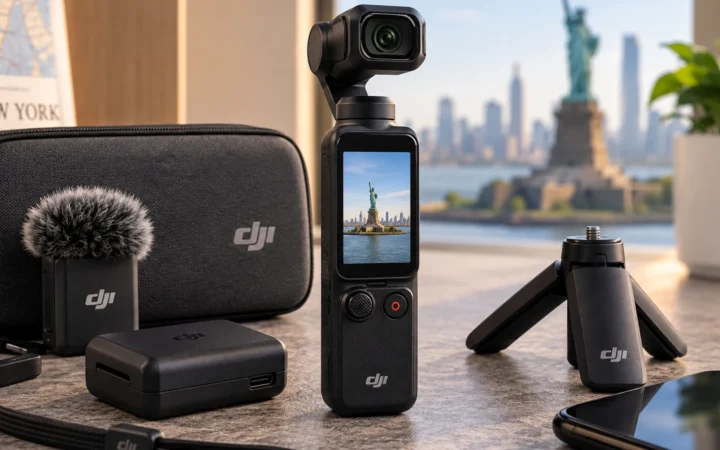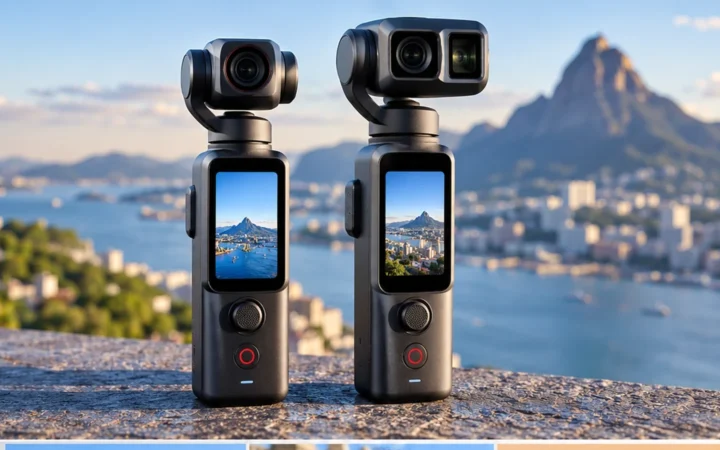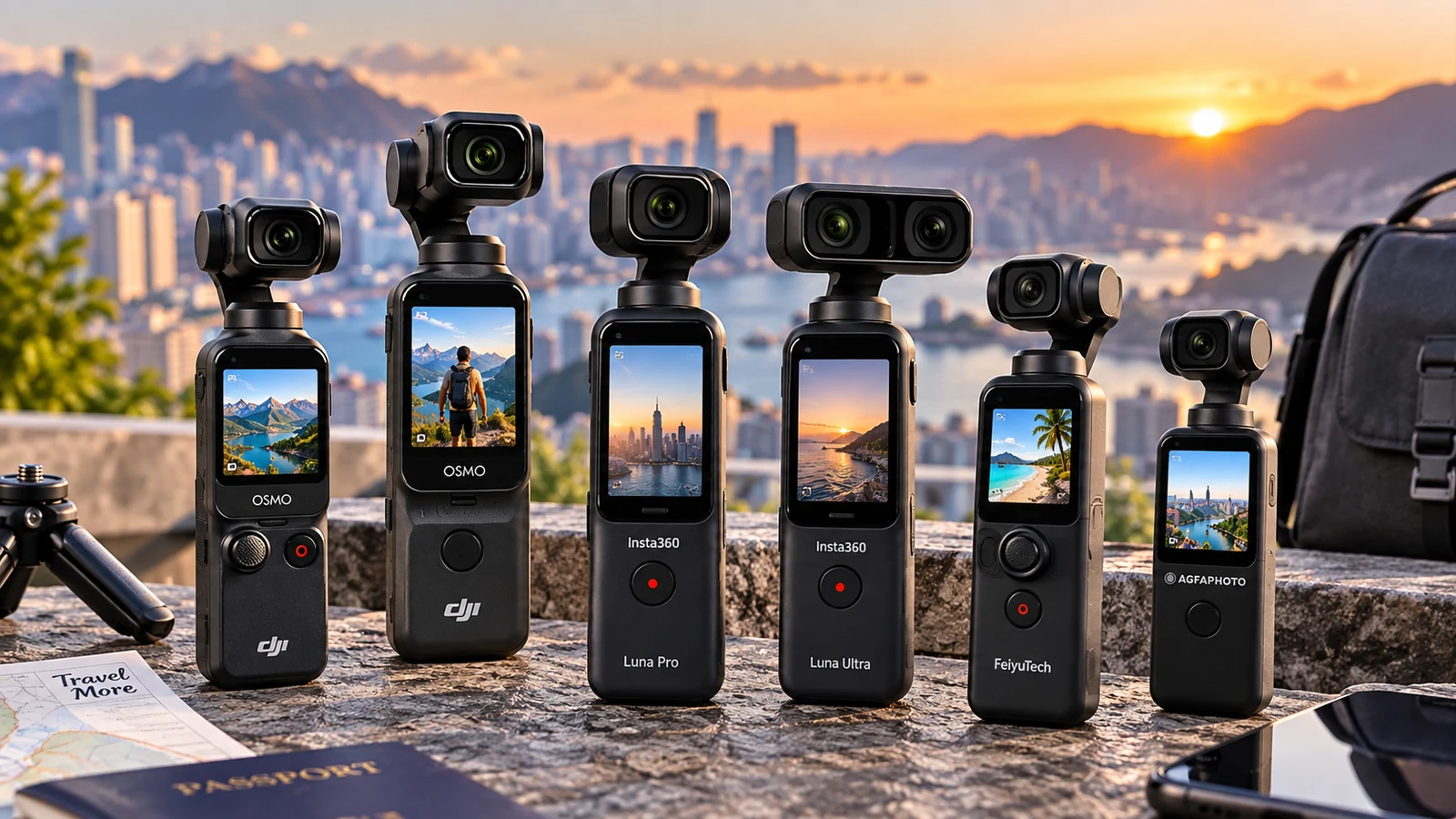

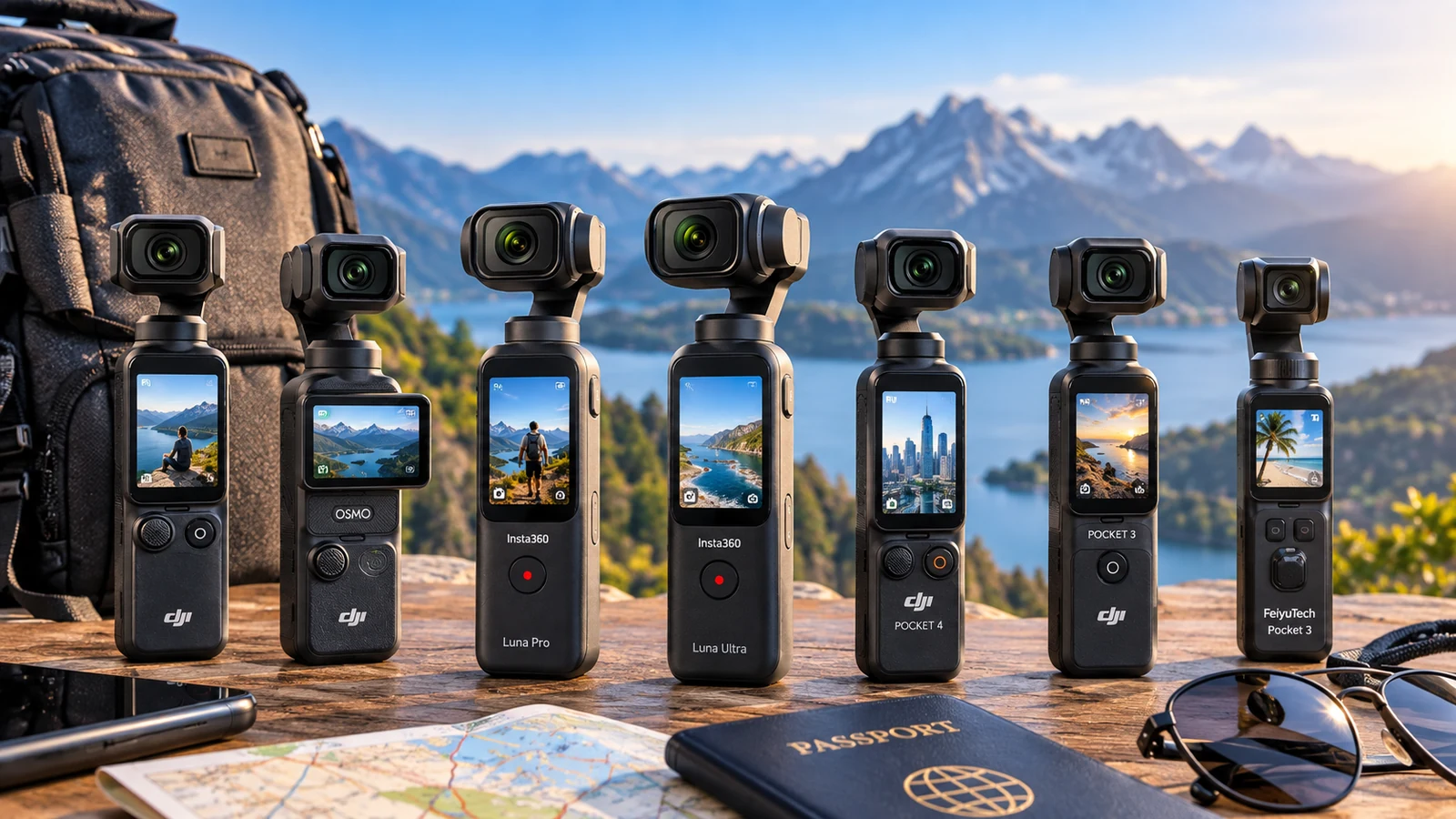
2026 has turned pocket gimbal cameras from a mostly DJI-dominated niche into a real buying contest. DJI now has the single-lens Osmo Pocket 4 and dual-lens Osmo Pocket 4P; Insta360 counters with the 8K Luna Pro and dual-camera Luna Ultra; the older Pocket 3 remains relevant; and Feiyu’s Pocket 3 still offers a uniquely detachable budget design.
The complication is regional. Pocket 4 and Pocket 4P are easy to buy in the UK, Europe, Canada and other supported DJI markets, but DJI’s current U.S. store still does not list either model. In the United States, Insta360 therefore has a major practical advantage. This guide ranks the cameras by the needs of actual vloggers—not by whichever model has the biggest specification number.
Best pocket gimbal cameras in 2026: Quick picks
| Award | Camera | Why it wins |
|---|---|---|
| Best overall outside the U.S. | DJI Osmo Pocket 4P | Outstanding 4K image quality, dual lenses, strong tracking and polished creator workflow. |
| Best for U.S. buyers | Insta360 Luna Pro | Official U.S. availability, 8K30, native 4K vertical video and detachable OLED remote. |
| Best premium U.S. telephoto option | Insta360 Luna Ultra | 20mm plus real 60mm telephoto, 8K, detachable remote and official U.S. sales. |
| Best mainstream value outside the U.S. | DJI Osmo Pocket 4 | 1-inch sensor, 4K240 slow motion, excellent tracking, 107GB storage and competitive pricing. |
| Best established value | DJI Osmo Pocket 3 | Mature firmware, proven image quality, strong accessories and lower 2026 pricing. |
| Best budget / modular pick | Feiyu Pocket 3 | Detachable wireless camera head, magnetic mounting and 4K60 at a much lower price. |
How we chose the best pocket gimbal cameras
This guide combines official specifications and live store pricing with independent hands-on testing from TechRadar, PetaPixel and Digital Camera World. FrediTech did not physically test the cameras listed here, so performance statements are attributed rather than presented as first-hand findings.
We weighted image quality, gimbal stabilization, autofocus and tracking, audio options, screen usability, vertical video, battery, storage, portability and regional support. Price matters, but value means useful performance for the intended buyer—not simply the cheapest camera.
Best overall outside the U.S.: DJI Osmo Pocket 4P
Current price: £529 in the UK; USD $619 on DJI’s Canada store.
Regional availability: Official in the UK, Canada and many other markets; not listed for normal official U.S. retail on DJI’s current U.S. store.
Best for: Premium vlogging, portraits, travel, event coverage and professional creator work.
Pocket 4P is the strongest overall pocket gimbal camera where you can officially buy it. Its 20mm f/2.0 main camera uses a new 1-inch sensor, while the second camera adds a 60mm-equivalent f/1.8 lens over a 1/1.28-inch sensor. That gives vloggers a genuinely different perspective rather than relying entirely on digital cropping.
TechRadar called it the compact vlogging camera to beat after extended testing, praising the dual-lens flexibility, 4K image quality, tracking and stabilization. Digital Camera World similarly described it as near-perfect for the category. PetaPixel found the main camera’s real-world dynamic range extremely impressive, while also cautioning that DJI’s advertised 17-stop figure should not be treated as an independently verified laboratory result.
Key strengths: native 20mm and 60mm views, 4K240 slow motion from the wide camera, 4K200 slow motion from the telephoto, 103GB built-in storage, ActiveTrack 8.0, 10-bit D-Log 2 and strong DJI microphone integration.
Weaknesses: the dual-camera head makes it top-heavy, it is limited to 4K rather than 8K, the telephoto does not match the main camera in every high-contrast situation, and U.S. availability remains the biggest practical problem.
Who should buy it: creators who want the best mix of image quality, telephoto versatility and polished operation. Who should skip it: U.S. shoppers who want a straightforward domestic warranty path, or creators who genuinely need 8K masters.
Best for U.S. buyers: Insta360 Luna Pro
Current price: $599.99 U.S.; £469 UK.
Regional availability: Official Insta360 retail channels in the U.S., UK, Canada and other markets.
Best for: U.S. vloggers, social creators, 8K reframing and remote self-framing.
Luna Pro is the easiest recommendation for most U.S. creators because it combines serious video hardware with normal official availability. Its single 20mm-equivalent Leica Summicron f/1.8 lens sits in front of a 1-inch sensor and records up to 8K30 or 4K120. It also records true 2160×3840 4K vertical video at up to 30fps.
TechRadar found its tracking and stabilization excellent and liked the detachable two-inch OLED screen, which doubles as a remote monitor and includes its own microphone. That removable screen is a major advantage for tripod shots, group videos and solo creators working away from the camera.
The compromise is the single-lens design. Insta360’s 2× “Clarity Zoom” is a sensor crop that holds up reasonably well, but quality falls more clearly beyond 2×. Battery is also workload-dependent: Insta360’s up-to-four-hour figure comes from light 1080p24 conditions, while TechRadar measured roughly 90 minutes during demanding 8K use.
Who should buy it: U.S. vloggers and vertical-video creators who mostly use 1×–2× framing. Who should skip it: creators who regularly need a real telephoto camera.
Best premium telephoto option in the U.S.: Insta360 Luna Ultra
Current price: $769.99 U.S.; £649 UK; CA$949.99 Canada.
Regional availability: Officially sold in the U.S. and other major markets.
Best for: portraits, travel details, events and creators who want 8K plus a true second focal length.
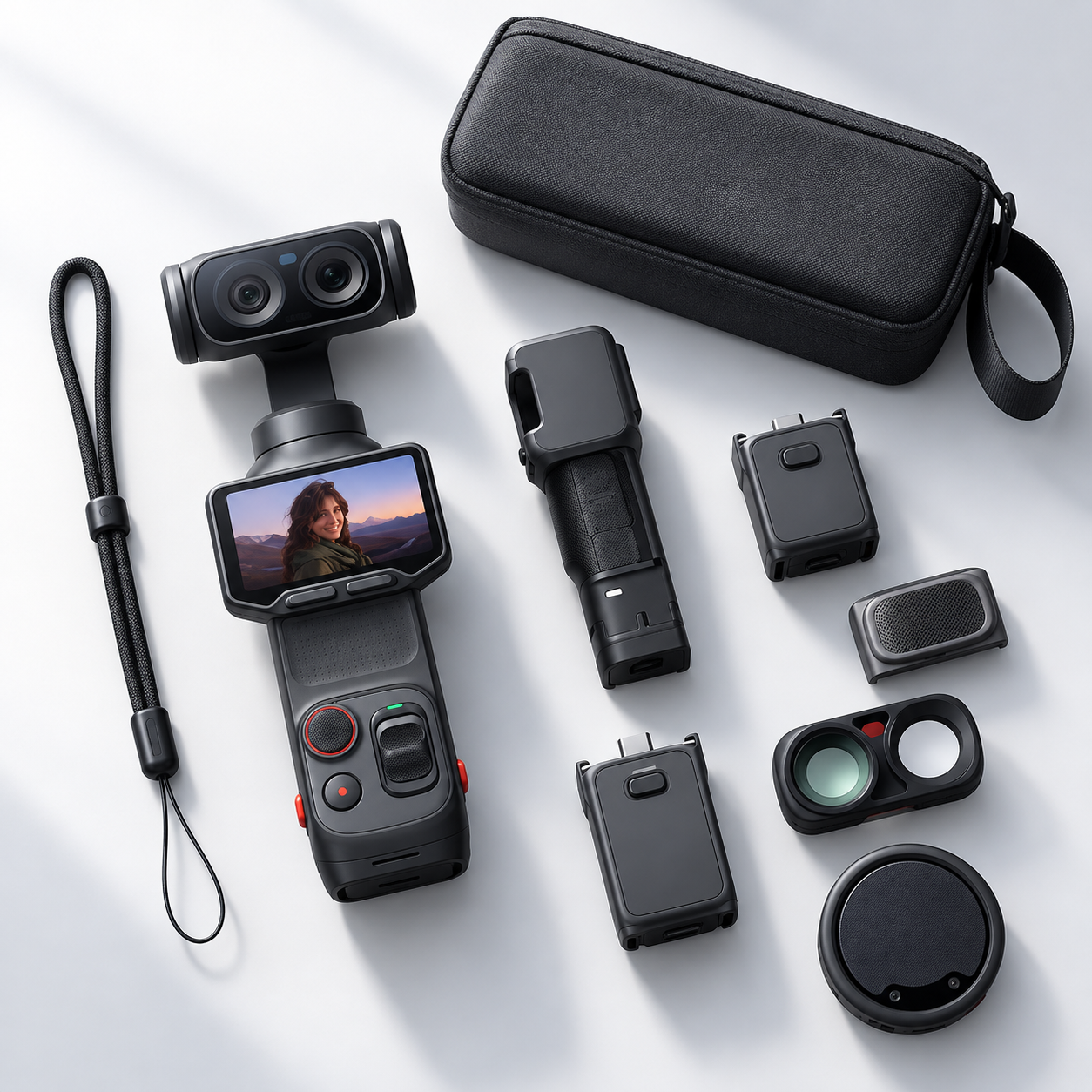
Luna Ultra takes the Pro’s 20mm f/1.8 1-inch main camera and adds a 60mm-equivalent f/2.0 telephoto over a 1/1.3-inch sensor. PetaPixel called the camera convenient, powerful and capable, and praised the dual-lens flexibility, tracking, stabilization and low-light performance. TechRadar also found the detachable OLED remote particularly useful.
The telephoto matters because it changes working distance and composition. A 60mm-equivalent view is much more useful for flattering portraits, stage details, architecture and cinematic B-roll than simply cropping a 20mm image. The Ultra also supports 8K30 and 4K120, 47GB internal storage and microSD expansion.
The downsides are price, extra weight and the fact that wide-angle vloggers may rarely use the second camera. At 233g in Cosmic Black it is heavier than Luna Pro and Pocket 4. Its current official video specification also still lists 3K60 portrait recording rather than the Pro’s native 4K vertical mode.
Who should buy it: U.S. creators who will genuinely use telephoto every week. Who should skip it: selfie-first vloggers who stay wide and would rather save $170.
Best mainstream value outside the U.S.: DJI Osmo Pocket 4
Current price: £445 Standard Combo in the UK; USD $477 on DJI Canada.
Regional availability: Official in many non-U.S. markets; not listed on DJI’s current U.S. store.
Best for: travel, walk-and-talk vlogging, slow motion and creators already using DJI Mic gear.
Osmo Pocket 4 is the single-lens sweet spot in DJI’s 2026 range. Its 1-inch sensor and 20mm f/2.0 lens are paired with full-pixel PDAF, Intelligent AF and ActiveTrack 7.0. Normal video tops out at 4K60, but Slow Motion mode reaches 4K240.
TechRadar described it as a polished evolution of Pocket 3 rather than a revolution, which is exactly why it works so well: the fundamental Pocket formula was already strong. The upgrade adds 107GB of built-in storage, faster transfer, broader feature compatibility and new physical controls.
It weighs 190.5g, significantly less than the dual-lens flagships. For travelers and handheld vloggers, that lower weight matters more often than a second lens. Its main limitation is obvious: there is no telephoto camera and no 8K.
Who should buy it: creators in supported markets who want mature tracking, excellent slow motion and a compact body. Who should skip it: U.S. buyers who want a normal official sales channel.
Best established value: DJI Osmo Pocket 3
Current price: $439 U.S. list price, currently out of stock on DJI’s U.S. store at the time checked; £309 UK; USD $356 DJI Canada.
Regional availability: Broad official support and a mature retailer ecosystem, although stock can fluctuate.
Best for: beginners, creators who want proven reliability and buyers who do not need 4K240 or built-in storage.
Pocket 3 remains excellent in 2026. It has a 1-inch sensor, 20mm f/2.0 lens, full-pixel focusing, ActiveTrack 6.0, 4K120, a rotating two-inch OLED and direct DJI Mic compatibility. Its 179g weight is still among the best for all-day carrying.
Its weaknesses are simply age-related: no internal storage, slower maximum 4K frame rate than Pocket 4, older tracking and older processing. But mature firmware and an enormous accessory ecosystem are real advantages for a beginner who values predictable operation over novelty.
Who should buy it: first-time pocket-gimbal buyers who find good authorized stock or a meaningful discount. Who should skip it: buyers paying close to Pocket 4 pricing in countries where Pocket 4 is officially available.
Best budget option: Feiyu Pocket 3
Current price: about $279 on FeiyuTech’s current store listing, with promotions sometimes lower.
Regional availability: FeiyuTech ships to the U.S., EU, UK and Canada.
Best for: budget buyers, creative mounting and users who specifically want a detachable wireless camera head.
Feiyu Pocket 3 cannot match the one-inch models for image quality, but its design remains unusually clever. The 86g camera module detaches from the 73g remote handle and can operate wirelessly, while magnets make unusual mounting positions possible.
Official specifications list a 1/2.3-inch 12MP sensor, 16mm-equivalent f/2.0 lens, 4K60 recording and three-axis stabilization. The camera module is rated for about 60 minutes at 1080p30, or about 116 minutes when connected to the handle, which can power it during use.
Digital Camera World praised the detachable concept and value but found the smaller sensor weaker in low light and the overall ecosystem less polished than DJI. It is also not waterproof.
Who should buy it: creators who value unusual camera placement more than flagship image quality. Who should skip it: professionals who need reliable low-light performance, stronger tracking or advanced log workflows.
Pocket gimbal camera comparison table
| Camera | Award | Price reference | Sensor / lenses | Max video | Tracking | Storage | Weight | U.S. status |
|---|---|---|---|---|---|---|---|---|
| DJI Pocket 4P | Best overall outside U.S. | £529 UK | 1-inch 20mm f/2 + 1/1.28-inch 60mm f/1.8 | 4K60 normal; 4K240 slow-mo wide | ActiveTrack 8.0 | 103GB + microSD | 230g | No normal DJI U.S. store listing |
| Insta360 Luna Pro | Best U.S. | $599.99 | 1-inch, 20mm f/1.8 | 8K30 / 4K120 | Auto Tracking / Smart Framing | 47GB + microSD up to 2TB | 215g | Official |
| Insta360 Luna Ultra | Premium U.S. telephoto | $769.99 | 1-inch 20mm f/1.8 + 1/1.3-inch 60mm f/2 | 8K30 / 4K120 | Auto Tracking / Smart Framing | 47GB + microSD up to 2TB | 233g | Official |
| DJI Pocket 4 | Mainstream value | £445 UK | 1-inch, 20mm f/2 | 4K60 normal; 4K240 slow-mo | ActiveTrack 7.0 | 107GB + microSD | 190.5g | No normal DJI U.S. store listing |
| DJI Pocket 3 | Established value | $439 U.S. list | 1-inch, 20mm f/2 | 4K60 normal; 4K120 slow-mo | ActiveTrack 6.0 | microSD only | 179g | Official listing; stock currently out |
| Feiyu Pocket 3 | Budget / modular | ~$279 current store price | 1/2.3-inch, 16mm f/2 | 4K60 | Face/object tracking | microSD up to 512GB | 86g camera + 73g handle | Feiyu ships to U.S. |
The best choice depends heavily on where you live
| Region | Best overall choice | Why |
|---|---|---|
| United States | Luna Pro for most; Luna Ultra for telephoto | Official Insta360 sales and support; newer DJI Pocket models are not on DJI’s U.S. store. |
| United Kingdom | Pocket 4P | £529 is aggressive for a polished dual-lens flagship; Pocket 4 at £445 is the value alternative. |
| Europe | Pocket 4P or Pocket 4 | Official DJI availability and competitive local pricing make the DJI options compelling. |
| Canada | Pocket 4P | Official DJI Canada price is USD $619; Pocket 4 is USD $477. Insta360 remains a strong 8K alternative. |
| Other supported markets | Pocket 4P where officially sold | Best all-round evidence for image quality, tracking and dual-lens versatility. |
Do you need 8K or 4K240?
8K and 4K240 solve different problems. Luna Pro and Luna Ultra use 8K to give editors more crop and reframing room, high-resolution masters and better frame-extraction potential. The trade-offs are larger files, heavier editing, more battery drain and more heat. TechRadar’s Luna Pro battery test illustrates the cost: roughly 90 minutes of 8K use with the screen active versus Insta360’s four-hour 1080p24 laboratory claim.
DJI’s Pocket 4 and 4P instead prioritize extreme 4K slow motion. 4K240 is valuable for sport, water, movement and cinematic B-roll, but many vloggers will use 4K30 or 4K60 almost all the time. A strong 4K camera can absolutely be the better choice.
Do you need a telephoto camera?
For selfie vlogging, walk-and-talk videos, desk content and Shorts, a single 20mm lens is usually enough. A telephoto matters when you shoot portraits, events, architecture, stage performances, distant travel details or layered cinematic B-roll.
That is why Pocket 4P and Luna Ultra cost more. Their 60mm lenses are not merely “more zoom”; they give a second native perspective and let the camera work farther from the subject for the same framing.
Which camera is best for vertical video?
Luna Pro is the strongest dedicated social-video option because it records true 4K30 9:16 and 3K60 portrait video. Pocket 4 records 3K60 vertical, which trades some resolution for smoother motion. Pocket 3 also offers 3K60 vertical. Luna Ultra’s current official shooting table still lacks the Pro’s 4K portrait mode, so buyers should recheck firmware before purchasing specifically for vertical 4K.
Which has the best autofocus and subject tracking?
DJI currently has the strongest documented tracking stack. Pocket 4P uses ActiveTrack 8.0, while Pocket 4 uses ActiveTrack 7.0 and Pocket 3 uses ActiveTrack 6.0. TechRadar and Digital Camera World both praised Pocket 4P tracking, and PetaPixel described its autofocus as responsive.
Luna Pro and Ultra are also strong. TechRadar found Luna Pro tracking excellent, while PetaPixel praised Luna Ultra’s tracking and stabilization. Feiyu’s face/object tracking is useful for the price but sits a tier below the flagship systems in polish and consistency.
Which has the best audio setup?
DJI has the ecosystem advantage if you already own DJI Mic transmitters. Pocket 4 and 4P support direct DJI microphone connections and sophisticated multi-channel workflows. Pocket 3 also works well with DJI Mic hardware.
Insta360 counters with four microphones across the Luna body and detachable screen and support for Mic Air and Mic Pro. For serious vlogging, microphone compatibility can improve every video more than 8K resolution ever will.
Which is best for travel?
Outside the U.S., Pocket 4 is arguably the easiest travel recommendation because it is lighter than the dual-lens flagships, has 107GB built in, charges quickly and still offers excellent tracking. Pocket 4P is better if you expect to use the telephoto often. In the U.S., Luna Pro wins by combining official support with 8K and remote framing.
None of these should be treated as waterproof action cameras. Luna Pro and Ultra are explicitly not waterproof or dustproof, DJI says Pocket 4 is not waterproof, and Feiyu Pocket 3 is also officially not waterproof.
Which is best for beginners?
Pocket 3 remains the easiest recommendation when it is meaningfully cheaper than newer models. Its controls, autofocus, tracking and accessory ecosystem are mature, and the 1-inch sensor gives beginners good image quality without requiring complex setup.
Feiyu Pocket 3 is cheaper but asks the buyer to accept weaker low-light performance and a less polished ecosystem. Pocket 4 is the better beginner choice in supported markets when the price gap is small.
Which is best for professional vloggers?
Pocket 4P and Luna Ultra are the two serious premium choices. Pocket 4P has the more polished DJI workflow, excellent 4K output, 103GB built in, strong tracking and D-Log 2. Luna Ultra counters with 8K, I-Log, timecode-oriented workflow support and its detachable OLED remote.
For professionals, regional service may decide the winner. A camera you can buy, insure, repair and replace locally is often more valuable than a slightly better specification sheet.
How to choose a pocket gimbal camera
- Check official availability in your country before comparing prices.
- Decide whether you genuinely need a 60mm telephoto lens.
- Choose 8K only if crop/reframing is part of your workflow.
- Choose 4K240 only if extreme slow motion is useful to your content.
- Compare vertical-video resolution and frame rate.
- Prioritize autofocus, tracking and stabilization for solo vlogging.
- Check direct wireless-microphone compatibility.
- Confirm internal storage and microSD requirements.
- Read battery claims together with their test conditions.
- Verify water/dust limitations before travel or outdoor use.
- Compare accessory prices, warranty and return support.
- Avoid unauthorized imports unless you understand the service risk.
For editing after capture, FrediTech’s mobile editing apps review and smartphone editing workflow guide are useful companion resources. For broader camera context, see the iPhone 17 Pro camera review, Xiaomi 17 Ultra review, Pixel 8 Pro camera review, smartphone photography guide, emerging mobile-photography technologies and mobile photo editing techniques.
FrediTech final recommendations
Best overall outside the U.S.: DJI Osmo Pocket 4P. Its dual-lens system, 4K image quality, tracking and mature workflow make it the strongest complete package.
Best for most U.S. creators: Insta360 Luna Pro. It is officially sold, less expensive than Ultra, records 8K and true 4K vertical video, and the detachable screen is genuinely useful.
Best premium U.S. option: Insta360 Luna Ultra. Pay the extra money only if the 60mm telephoto will materially improve your work.
Best mainstream value outside the U.S.: DJI Osmo Pocket 4. It keeps most of the everyday strengths of the 4P in a lighter, cheaper single-lens body.
Best mature bargain: DJI Pocket 3. Still an excellent buy when discounted or when newer DJI models are unavailable.
Best budget modular option: Feiyu Pocket 3. Its detachable wireless head is still unique enough to justify the compromises.
Frequently Asked Questions
What is the best pocket gimbal camera in 2026?
DJI Osmo Pocket 4P is the best overall where officially sold. In the United States, Luna Pro is the more practical mainstream recommendation.
What is the best pocket gimbal camera for U.S. buyers?
Insta360 Luna Pro for most buyers; Luna Ultra if a real telephoto camera is important.
Is DJI Osmo Pocket 4P better than Insta360 Luna Ultra?
Pocket 4P is more polished and less expensive in many markets; Luna Ultra offers 8K, a detachable remote screen and official U.S. availability.
Is Insta360 Luna Pro better than DJI Pocket 4?
Luna Pro is better for 8K, 4K vertical and U.S. availability. Pocket 4 is lighter, has more internal storage and offers 4K240 slow motion.
Is DJI Pocket 3 still worth buying in 2026?
Yes, especially when discounted. Its 1-inch sensor, tracking, stabilization and accessories remain very competitive.
Which pocket gimbal cameras record 8K?
In this shortlist, Insta360 Luna Pro and Luna Ultra record up to 8K30.
Which has the best slow motion?
DJI Pocket 4 and Pocket 4P lead with up to 4K240 slow motion on their wide cameras.
Which is best for TikTok and Reels?
Luna Pro is the strongest choice for maximum portrait resolution because it records 4K30 9:16.
Which has the best tracking?
Pocket 4P has the strongest current DJI system with ActiveTrack 8.0, although Luna tracking is also excellent in independent testing.
Do I need a telephoto lens for vlogging?
No for most walk-and-talk and selfie vlogging. It becomes valuable for portraits, events, travel details and cinematic B-roll.
Are pocket gimbal cameras waterproof?
Generally no. These are mechanically stabilized creator cameras, not replacements for waterproof action cameras.
Can you officially buy DJI Pocket 4 or 4P in the U.S.?
DJI provides U.S.-region support documentation, but its current U.S. store does not list Pocket 4 or Pocket 4P for normal official retail purchase.
What is the best budget pocket gimbal camera?
Feiyu Pocket 3 is the strongest budget/modular pick if you accept its smaller sensor and weaker low-light performance.
Sources and Further Reading
- DJI UK Pocket Series store and comparison
- DJI United States Store
- DJI Canada Store
- DJI Osmo Pocket 3 specifications
- Insta360 Luna Series official store
- Insta360 Luna hardware specifications
- Insta360 Luna photo and video specifications
- FeiyuTech Pocket 3 official store/specifications
- TechRadar DJI Osmo Pocket 4P review
- PetaPixel DJI Osmo Pocket 4P review
- PetaPixel Insta360 Luna Ultra review
- Digital Camera World Feiyu Pocket 3 review
Fact-check date: September 14, 2026. Prices, stock, firmware and regional distribution can change.