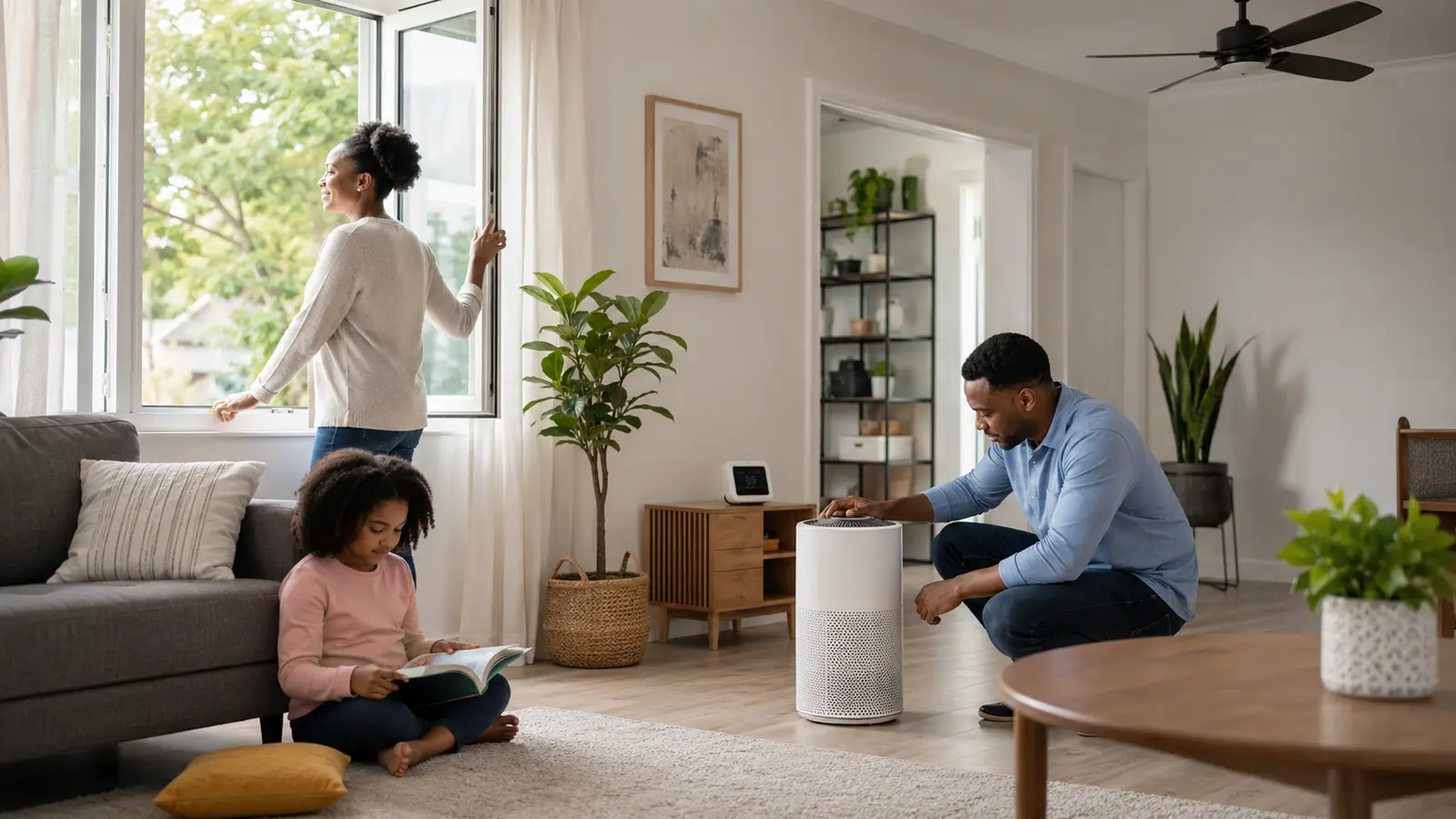

Indoor air can look clean while carrying moisture, smoke, combustion gases, particles, fragrances or chemicals released by ordinary activities. Buying an air purifier may help with some airborne particles, but it cannot repair a leak, vent a stove, remove a source of carbon monoxide or replace clean outdoor air.
The most reliable plan for improving indoor air quality at home follows three steps: control the source, ventilate when outdoor conditions are suitable, and use correctly chosen filtration as a supplement.
Research checked: August 27, 2026. This guide summarizes current public-health and efficiency guidance; it does not diagnose illness or replace medical, environmental, building or emergency advice. Seek urgent local help for suspected carbon monoxide, fire, serious breathing difficulty or other immediate danger.
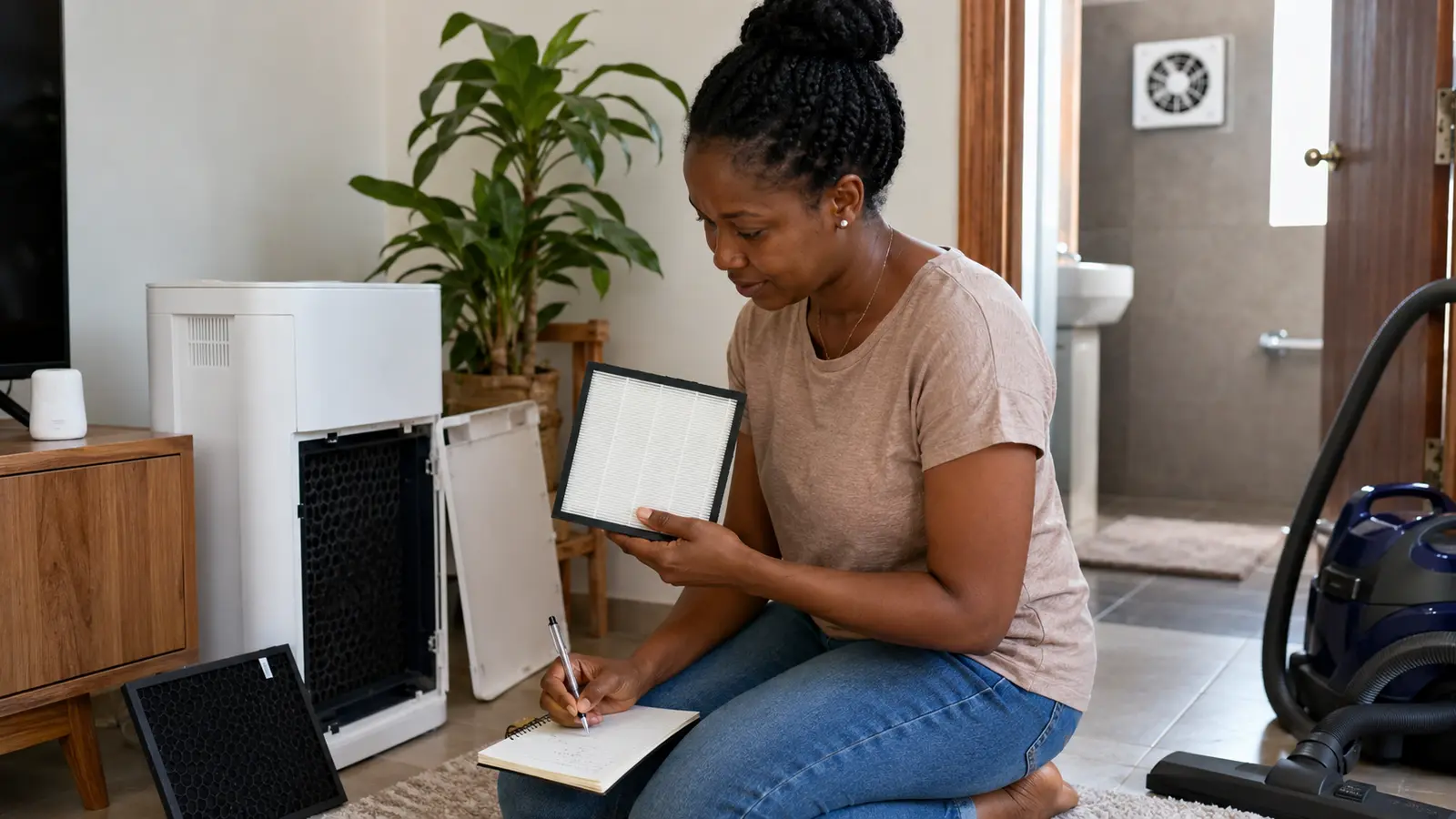
Table of contents
The fastest practical indoor-air assessment
Look for water or mold, smoke, fuel-burning equipment, cooking emissions, strong chemical products, blocked vents, dirty filters, pest activity and outdoor pollution entering the home. Remove or reduce the source safely, repair moisture promptly, use kitchen and bathroom exhaust, and select an air cleaner only for pollutants it can actually capture.
Start with the pollutant, not the product
The U.S. Environmental Protection Agency identifies indoor pollutants such as carbon monoxide, smoke, radon, mold, particulate matter and volatile organic compounds. The correct response differs by source. A particle filter may reduce airborne dust or smoke particles; it does not remove water inside a wall, and many filters do not meaningfully remove gases.
| Concern | Possible sources | First action | Device limitation |
|---|---|---|---|
| Moisture and mold | Leaks, wet materials, bathroom humidity, condensation | Stop water, dry safely and correct ventilation | An air cleaner does not repair moisture |
| Fine particles | Outdoor smoke/dust, cooking, candles, tobacco, some cleaning | Reduce source and ventilate appropriately | Filter performance depends on particle size, airflow and runtime |
| Carbon monoxide | Faulty or unvented fuel-burning equipment, generators, charcoal | Leave danger, seek emergency help and correct the source | Ordinary air purifiers do not make CO safe |
| VOCs and odors | Paints, solvents, fragrances, furnishings, fuels and products | Remove/reduce source and use clean-air ventilation | A particle-only filter may not remove gases |
| Radon | Soil gas entering a building in applicable regions | Test with an approved method and mitigate high results | Consumer particle monitors do not measure radon |
| Allergens and settled dust | Pets, pests, bedding, carpets, tracked-in soil and outdoor sources | Source management and careful cleaning | Filtration affects airborne material, not every surface reservoir |
When symptoms appear or worsen in a particular building, document time, room, activity, visible damp, odors and ventilation conditions, then seek appropriate medical and building advice. Consumer monitor readings alone cannot determine the cause of symptoms.
The EPA’s three-part indoor-air strategy
1. Source control
The EPA describes source control as usually the most effective approach. Keep smoking outdoors and away from openings, store fuels and strong chemicals safely outside living areas where appropriate, choose lower-emitting products, operate combustion equipment correctly and remove damp materials according to professional guidance. Never mix cleaning chemicals unless the labels explicitly permit it.
2. Ventilation with suitable outdoor air
Outdoor air can dilute indoor pollutants, but opening every window is not always correct. Check heat, humidity, smoke, dust, pollen, nearby traffic, refuse, security and noise. Use kitchen and bathroom exhaust at the source when installed and maintained correctly. Cross-ventilation can be useful when the outdoor air is cleaner and conditions are comfortable.
3. Air cleaning and filtration
Portable air cleaners and central HVAC filters can reduce some airborne pollution, but the EPA emphasizes that they cannot remove every pollutant. Select the technology for the pollutant, room and ventilation context. Run it long enough at a tolerable speed, maintain filters and keep air paths clear.
Control humidity, condensation and mold at the source
Find the water pathway
Inspect roofs, plumbing, walls, windows, floors, air-conditioner drains and bathroom surfaces. A recurring patch after rain points to a different cause than condensation on a cold surface. Stop the leak before repainting. Wet porous materials may require removal, and widespread or hazardous contamination requires qualified assessment.
Use humidity as a clue—not a complete diagnosis
The EPA’s consumer guide recommends keeping indoor relative humidity around 30% to 50% where practical. Climate and building conditions affect what is achievable. A basic hygrometer can reveal patterns, but inexpensive readings have uncertainty and a room can contain localized damp areas even when the central reading looks acceptable.
Vent bathrooms and kitchens
Run an appropriately vented bathroom fan during and after showers according to guidance, dry wet surfaces and repair dripping fixtures. Use kitchen capture ventilation during cooking and keep filters clean. A fan that only recirculates air through a grease filter is not the same as an exhaust system that carries air outdoors.
Use dehumidification only after fixing sources
A dehumidifier can help in persistently humid spaces when correctly sized and drained, but it uses electricity and releases heat into the room. Keep the collection container clean, prevent spills and maintain clearance. Do not allow the device to conceal an unresolved roof, wall or plumbing leak.
Clean small areas carefully and know when to stop
Follow official local guidance for small, limited mold areas and the material involved. Do not disturb large, hidden or contaminated areas without professional advice, especially after flooding, sewage, suspected asbestos or major structural damage. People with health conditions may need additional precautions recommended by a clinician.
Manage cooking emissions, smoke, carbon monoxide and radon
Capture cooking pollution close to the source
Use a suitable range hood or exhaust fan, especially when frying, grilling or using fuel-burning appliances. Turn it on before heavy cooking when recommended and allow it to run long enough to clear the area. Use rear burners under the capture zone when safe and practical. Maintain grease filters to reduce fire risk and preserve airflow.
Keep smoke outside
There is no safe method for “filtering away” active tobacco smoke while continuing to smoke indoors. Avoid indoor tobacco, charcoal, incense and unnecessary candles. During outdoor wildfire or severe pollution events, follow local public-health advice, close openings when directed and create a cleaner-air room using appropriate filtration.
Treat carbon monoxide as an emergency hazard
Carbon monoxide is colorless and odorless. Install and maintain approved CO alarms where appropriate for the home and local rules. The U.S. Centers for Disease Control and Prevention warns never to burn charcoal or use a portable gas camp stove indoors and not to operate generators near windows, doors or vents. If an alarm sounds or CO is suspected, leave for fresh air and follow local emergency guidance; do not search the home for the source first.
Test for radon where it is a recognized concern
Radon cannot be seen or smelled and requires a specific test. Use the approved testing and action guidance for the country or region. A general indoor-air monitor or air purifier is not a substitute. If testing identifies a high level, use a qualified mitigation approach.
Maintain fuel-burning equipment
Have furnaces, heaters, chimneys, flues and other combustion equipment installed and serviced by qualified people. Never heat a home with a cooking oven, and never run an engine in an attached garage. Proper ventilation does not make an improperly installed appliance acceptable.
How to choose a portable air cleaner
Match the filter to the pollutant
Mechanical filters target airborne particles. Activated-carbon or other sorbent media may reduce some gases and odors, but performance depends on the substance, amount of media and replacement schedule. A thin carbon sheet should not be assumed to control a serious gas source. No portable air cleaner replaces a CO alarm, radon mitigation, ventilation or source removal.
Use CADR and room size—not marketing words
Clean Air Delivery Rate combines airflow with particle-removal performance. Compare smoke, dust or pollen CADR as relevant and select a model sized for the occupied room, ceiling height and desired cleaning rate. ENERGY STAR notes that its product finder’s recommended room sizes use an eight-foot ceiling; higher ceilings may require more capacity.
Choose a noise level you will actually run
A purifier delivers little value when switched off because the highest setting is too loud. Compare performance at realistic operating speeds, not only maximum CADR. Place the unit where air can enter and leave freely, away from curtains and walls according to instructions.
Calculate filter and electricity cost
Check genuine filter availability, replacement frequency, washable prefilter care, power use and warranty. A cheap unit with scarce filters can become expensive or useless. Record the installation date; replace by condition and manufacturer guidance rather than relying only on an app reminder.
Avoid intentional ozone generation in occupied spaces
The EPA states that ozone is a lung irritant and that generators sold as air cleaners are generally ineffective at concentrations that meet public-health standards. Avoid products whose primary cleaning method intentionally produces ozone. Evaluate ionizing or electrostatic features carefully and disable optional generation where the manufacturer permits.
| Question | Good evidence | Red flag |
|---|---|---|
| Will it fit the room? | Published CADR and room-size basis | Only “covers huge spaces” with no test basis |
| What does it remove? | Specific particle/gas technology and limits | Claims to eliminate every pollutant or illness |
| Can it be maintained? | Available filters, clear interval and accessible design | Proprietary consumable with no price or supply information |
| Can it run continuously? | Acceptable noise, energy use and safe clearances | Performance quoted only at an intolerably loud setting |
What consumer air-quality monitors can—and cannot—tell you
A monitor can reveal trends in particles, carbon dioxide, humidity, temperature or selected gases, depending on its sensors. It can help connect a spike with cooking, cleaning, a closed bedroom or outdoor smoke. It cannot identify every chemical, confirm mold behind a wall or diagnose why someone feels unwell.
- Choose sensors for a defined question rather than the longest specification list.
- Check measurement range, stated accuracy, calibration or replacement needs and data export.
- Place the monitor away from direct breath, a window, purifier outlet, steam or a source unless measuring that source deliberately.
- Compare patterns over time and with outdoor conditions instead of reacting to one unexplained number.
- Use a certified alarm for smoke or carbon monoxide; a general monitor is not a life-safety substitute.
- Review cloud accounts, microphone access, location data and retention before connecting a monitor.
A room-by-room cleaner-air plan
Kitchen
Use capture ventilation, supervise cooking, maintain filters, store fuels safely and avoid unnecessary smoke. Add a leak sensor beneath suitable plumbing.
Bathroom
Vent moisture, dry wet surfaces, repair leaks, clean the fan and keep doors or windows arranged for airflow where safe.
Bedroom
Wash bedding appropriately, manage damp, keep smoke out, vacuum carefully and place filtration so noise and airflow remain acceptable.
Living room
Reduce fragrance and smoke sources, control tracked-in soil, clean fabrics and select a room-sized filter if particle control is needed.
Home office
Maintain ventilation, avoid blocking air paths, reduce printer/chemical sources and keep humidity and temperature comfortable.
Storage and utility areas
Keep fuels, pesticides and solvents out of occupied space where required, prevent pests and inspect for water or appliance leaks.
A practical 14-day reset
- Days 1–2: Inspect. Photograph leaks, condensation, blocked vents, damaged filters and strong-product storage.
- Days 3–4: Remove avoidable sources. Stop indoor smoke and fragrance, close chemical containers and discard safely according to local rules.
- Days 5–6: Repair moisture. Address plumbing, roof, drainage and air-conditioner water problems with appropriate help.
- Days 7–8: Restore ventilation. Clean accessible exhaust covers and test fans; arrange clean-air ventilation around outdoor conditions.
- Days 9–10: Clean carefully. Use methods that capture dust rather than redistributing it, and dry all cleaned materials.
- Days 11–12: Evaluate filtration. Inspect existing filters and size any portable unit to the room and pollutant.
- Days 13–14: Test safety and document. Follow official alarm-testing guidance, record filter dates and note remaining problems requiring professionals.
Energy efficiency and indoor air should be planned together. Sealing uncontrolled leaks can reduce cooling loss, but deliberate ventilation and source control must remain. Read the FrediTech home energy-saving guide before making building changes that affect airflow.
Frequently asked questions
What is the best way to improve indoor air quality?
Public-health guidance prioritizes source control, followed by suitable ventilation, with air cleaning used as a supplement. The exact action depends on whether the concern is moisture, smoke, particles, carbon monoxide, radon, gases or another source.
Do air purifiers remove every indoor pollutant?
No. Particle filters do not remove all gases, and portable units do not repair leaks, replace ventilation, remove radon or make carbon monoxide safe. Match verified performance to the pollutant and room.
What indoor humidity level should I aim for?
The EPA commonly recommends roughly 30% to 50% relative humidity where practical, but climate and building conditions matter. Investigate persistent condensation, damp odors or visible water even when one monitor reading appears normal.
Do houseplants clean indoor air?
Plants can improve the feel of a room, but ordinary household quantities should not replace source control, ventilation or tested filtration. Damp soil can also support mold or pests if poorly managed.
When should I seek professional help?
Get urgent help for suspected carbon monoxide, fire, major breathing difficulty or dangerous chemical exposure. Building or environmental professionals may be needed for large or recurring mold, flood/sewage damage, asbestos concerns, combustion problems, radon mitigation or hidden structural moisture.
Research sources and methodology
This guide prioritizes public-health agencies and official efficiency programs. It distinguishes source removal, ventilation, particle filtration, gas control and life-safety detection because these are not interchangeable. Health and building risks require case-specific professional advice.