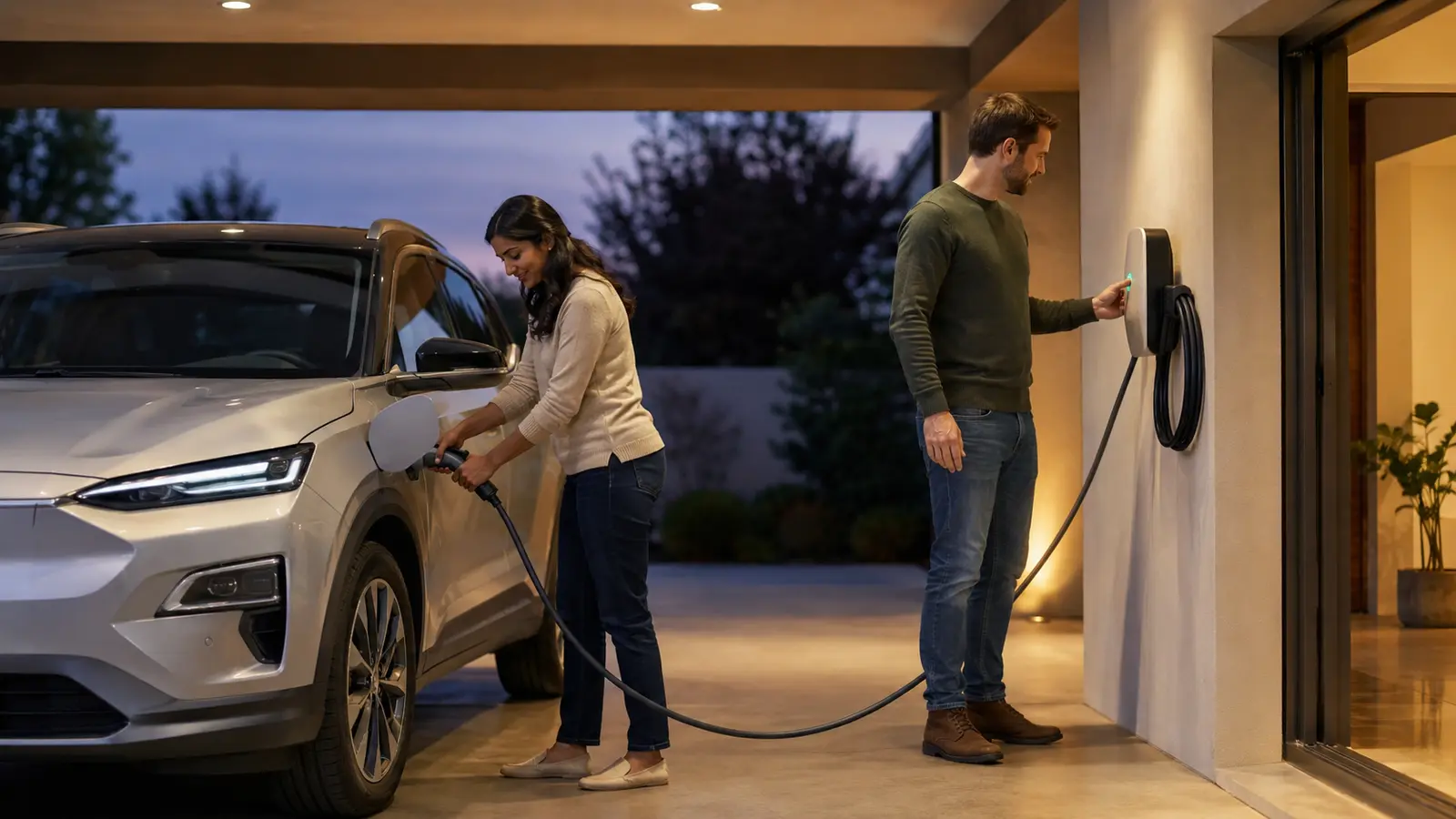

A home EV charger is not chosen by buying the highest kilowatt number on a retailer’s page. The right system begins with how far the car travels, how long it normally remains parked, what its onboard charger can accept, what the building can safely supply and whether a lower electricity tariff rewards flexible timing.
This home EV charging guide for 2026 explains charging speeds, connectors, installation, costs, smart scheduling, solar and bidirectional power for international buyers. It treats North America, the United Kingdom, Europe, Australia, New Zealand and other markets as distinct electrical environments instead of forcing one country’s terminology onto everyone.
Research checked: August 28, 2026. Electrical codes, permits, utility approvals, grants, connector transitions and tariffs change by country, state, province and network operator. Use the vehicle manual, charger instructions, local authority, utility and appropriately licensed electrical professional for the final design.
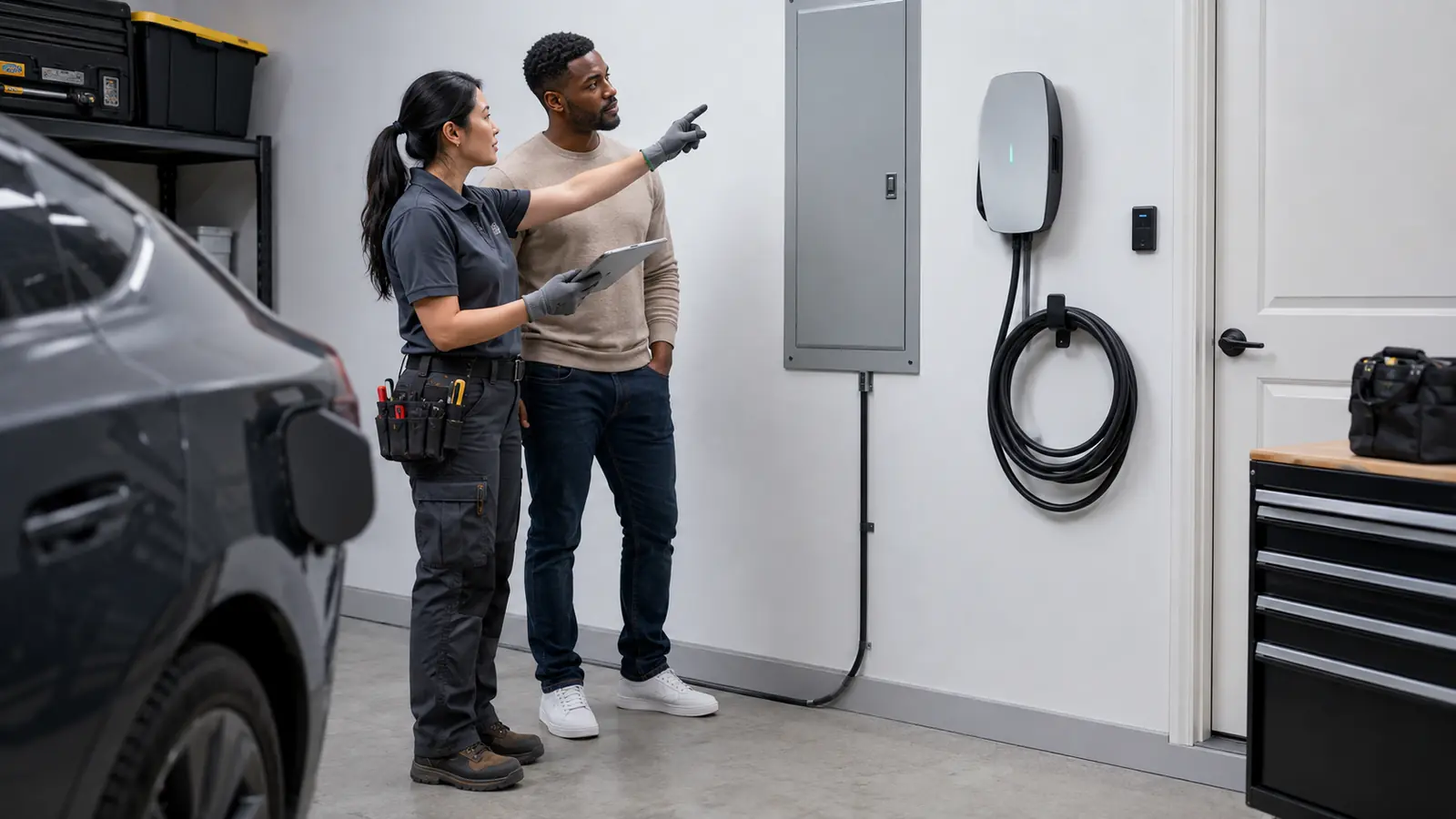
Table of contents
The practical recommendation
For many homes, the best charger is a professionally installed 7–11 kW class smart unit or the nearest safe regional equivalent, limited by the car and electrical service. Drivers with short daily mileage and long overnight parking may need much less. Choose the correct regional connector, tethered or untethered cable, outdoor rating, scheduled charging, reliable local support and load management where capacity is tight. Do not upgrade the service panel until an electrician has measured demand and assessed managed charging.
In this guide
Calculate how much home charging you actually need
Start with daily driving, not battery size. A vehicle that travels 45 km per day and uses 18 kWh per 100 km needs about 8.1 kWh returned to the battery: 45 × 18 ÷ 100. Charging losses mean the wall supplies more than the battery receives, and losses vary with temperature, power, battery conditioning and equipment. Use recent vehicle or charger data where available and leave a sensible margin rather than applying one universal percentage.
Daily battery energy (kWh) = distance driven × vehicle consumption ÷ 100
Then ask how many hours the car is parked. Returning 10 kWh over ten hours requires roughly 1 kW reaching the battery, before losses and charging limits. That explains why a standard outlet can work for a low-mileage driver even though it cannot refill a large battery quickly. A higher-power wall unit becomes valuable for long commutes, multiple EVs, short overnight windows, time-of-use tariffs or frequent near-empty arrivals.
Do not size from an occasional road trip. Public rapid charging can cover rare high-energy days, while home charging handles normal use. If the household expects a second EV, heat pump, electric water heater or induction cooking, include those future loads in the electrical plan even if the first charger is commissioned at a lower current.
Charging levels, power and real charging time
| Home charging approach | Typical role | Advantages | Limits |
|---|---|---|---|
| Portable cord on a standard household outlet | Low daily mileage, emergency or temporary use | Lowest setup cost where the outlet is approved and sound | Slow; outlet/circuit quality and continuous load must be assessed |
| Dedicated lower-power circuit or wall unit | Overnight charging without maximum service demand | Can match modest mileage and constrained supply | Longer recovery after a high-mileage day |
| 7–11 kW class wall charger | Common full overnight home solution in many 230/240V markets | Useful speed, smart scheduling and broad vehicle fit | Vehicle, phase, service and cable may cap power |
| 19.2–22 kW class AC charging | Special cases with compatible vehicle and substantial supply | Faster AC turnaround when every component supports it | Often unnecessary; may require three-phase or major capacity |
| Home DC or bidirectional equipment | Selected V2H/V2G systems or specialist fleets | Can bypass onboard AC limits and enable export | Expensive, vehicle-specific, regulated and not broadly interchangeable |
The charger’s advertised power is only one ceiling. Actual AC charging is limited by the lowest of the supply, circuit, EV charging equipment, cable and vehicle onboard charger. A car limited to 7.4 kW will not accept 11 kW because the wall unit can offer it. Battery temperature, state of charge, scheduled departure and vehicle settings also affect the session.
Estimate time by dividing energy needed by effective charging power. Returning 42 kWh at an effective 7 kW takes about six hours; at 3.5 kW it takes about twelve. This is more useful than dividing the total battery capacity every evening because most owners replace only the energy used that day.
Home EV connectors by region in 2026
| Market | Common AC connection | Important 2026 note |
|---|---|---|
| United States and Canada | SAE J1772 and SAE J3400/NACS, depending on vehicle and model year | The market is transitioning; confirm the exact vehicle inlet and whether an adapter is approved for AC use |
| United Kingdom and much of Europe | Type 2; tethered or socketed home units | CCS2 is associated with compatible public DC charging; domestic smart-charger rules and grants vary |
| Australia and New Zealand | Type 2 is common on newer vehicles | Confirm single/three-phase supply, local standards and distributor requirements |
| Japan and some imported-vehicle markets | Vehicle generation may use Type 1/J1772 for AC | CHAdeMO concerns DC charging and some bidirectional systems; check the specific vehicle |
| Other and mixed-import markets | Varies by official vehicle origin and national standard | Do not infer compatibility from a plug photo; verify inlet, mode, voltage, frequency and certification |
In North America, the U.S. Department of Energy’s Alternative Fuels Data Center now describes J3400 alongside J1772 and CCS. An adapter changes the physical interface, not every electrical or communication capability. Use only vehicle- and equipment-approved adapters, store them clean and dry, and inspect contacts for heat damage or contamination.
In a Type 2 market, an untethered socket can let the driver use the cable suited to the car and replace a damaged cable separately. A tethered unit is quicker to use and avoids daily handling from the boot, but the fixed connector must match current and future vehicles. Cable length should reach the inlet without tension while remaining safely stored off the ground.
The electrical and site assessment
A qualified installer should assess the service rating, main protection, existing peak loads, earthing/grounding arrangement, spare circuit capacity, route length, voltage drop, protective devices, surge exposure, meter position, utility rules and proposed mounting environment. The correct residual-current or ground-fault protection differs by jurisdiction and equipment design. A charger’s built-in protection does not automatically remove every external requirement.
Ask for measured or calculated load evidence. Dynamic load management can monitor the building’s demand and reduce EV current when cooking, heating or cooling loads rise. That may avoid an expensive supply upgrade while still replacing normal daily driving overnight. The trade-off is dependence on a compatible sensor, communication link and configuration that should fail safely.
Plan the physical route. The connector should reach the charge port in normal parking orientations without being stretched, driven over or placed across an unauthorized public walkway. Outdoor units need appropriate environmental ratings, impact protection and drainage. In a garage, keep the cable away from door tracks, hot equipment and storage that can fall. Accessibility matters: mounting height, connector weight and cable stiffness should suit the people who use it.
Avoid improvised charging: do not use an ordinary extension cord, travel adapter, damaged outlet or non-approved splitter to create a permanent EV solution. Continuous charging can expose weaknesses that a brief household load does not. Stop using any connector or outlet that becomes unusually hot, loose, discolored, cracked or wet.
Which home EV charger features are worth paying for?
- Reliable scheduling: set off-peak or solar windows without creating conflicting car and charger schedules.
- Dynamic load management: useful where the service is constrained or several major electric loads share capacity.
- Adjustable current: lets the installer commission a safe limit and adapt to future changes.
- Energy records: helpful for cost tracking, reimbursement and diagnosing unexpected consumption.
- Local controls: charging should remain possible if the cloud service or home internet is unavailable.
- Access management: RFID, app permissions or keys can help shared parking, but a private garage may not need them.
- Solar integration: worthwhile only when the charger, inverter/meter and household export rules can exchange useful data.
- Open integrations: a documented API or OCPP support can improve flexibility, but verify the exact model and whether use affects support.
- Long warranty and local service: more valuable than a decorative screen exposed to weather.
Wi-Fi is convenient but not always reliable at the parking location. Ethernet, cellular or another supported link may be appropriate where billing or shared access is critical. Confirm the charger’s behavior after a router change, phone replacement and power outage. A manual start method and visible status indication make troubleshooting easier.
What determines home EV charger installation cost?
The equipment is only one line. Budget for site survey, circuit protection, cable and conduit, trenching or wall penetration, labor, permit/inspection, network hardware, load management, utility application, parking protection and finish repair. A detached garage, long cable run, older panel or apartment car park can cost much more than a charger beside a modern distribution board.
Also ask who pays when connectivity fails or the unit must be replaced. A longer hardware warranty is less valuable when local labor, removal, shipping and recommissioning are excluded.
For context, the U.S. AFDC states that Level 2 equipment can range from roughly $500 to $4,000 before installation and incentives; this is not a global quote and covers a wide equipment class. Request itemized local proposals using the same power, route and features. Ask whether taxes, permits, commissioning, load management and warranty labor are included. The cheapest bid is not comparable if it excludes a required panel change discovered later.
Review incentives only on the official government, utility or tax-agency site and verify eligibility before ordering. Programs can restrict approved equipment, installers, parking arrangements, application timing or smart functions. The UK, for example, publishes current grant guidance for eligible renters, flat owners, landlords and some on-street solutions; other countries and subnational regions operate different programs.
Smart tariffs, solar charging and bidirectional power
Time-of-use charging can shift demand to lower-price periods. Put the schedule in either the car or charger first, not both, then verify several sessions. Include the tariff’s higher daytime price, standing charge and export rate when comparing plans. A very cheap overnight rate may not be the cheapest household tariff if daytime heating and cooking become expensive.
Solar surplus charging varies EV current to follow available generation. It works best when the car can accept the minimum current, the charger measures import/export accurately and the vehicle remains parked during production. A home battery, hot-water diverter and EV may compete for the same surplus; decide the household priority rather than allowing several independent apps to react against each other.
Vehicle-to-home (V2H), vehicle-to-building (V2B) and vehicle-to-grid (V2G) can let a compatible vehicle and bidirectional charger supply loads or support the grid. The U.S. Department of Energy describes this potential, but compatibility is not implied by a large traction battery. The vehicle, connector protocol, bidirectional equipment, transfer/islanding protection, utility, tariff and local approval must all support the same use. Confirm warranty effects and reserve enough driving range.
Apartments, renters and homes without private driveways
Obtain written permission before modifying a rental or shared car park. The proposal should define ownership, metering, billing, cable route, fire strategy, network capacity, access, maintenance, insurance and what happens when the resident moves. In a multi-unit building, scalable load management is often more valuable than installing one unrestricted charger that consumes the spare capacity.
Never trail a cable across a pavement or common route without an approved local solution. Some authorities permit certified gullies or cross-pavement systems; others prohibit them. Where home charging is not feasible, compare workplace, destination and nearby public charging by availability, parking rules, connector, power, reliability and total price—not only the advertised energy rate.
A safe home EV charger installation plan
- Collect vehicle data. Record inlet, approved adapters, onboard AC limit, battery size, normal efficiency and charging settings.
- Measure the routine. Use daily distance, parking hours and tariff windows to calculate the required energy and practical power.
- Survey the electrical service. Have a qualified installer assess demand, protection, earthing, route, phase and network rules.
- Choose the mounting and cable. Test parking positions, inlet location, reach, accessibility, storage, weather and impact exposure.
- Compare itemized proposals. Match power, load management, permits, warranty, connectivity and finish work.
- Commission and document. Record circuit rating, charger limit, protective tests, serial details, installer, account owner and emergency isolation method.
- Test smart behavior. Verify scheduled, manual, internet-off and power-restoration charging; teach every driver how to stop safely.
FrediTech recommendation: size for normal daily energy, not the fastest possible refill. Pay for a safe dedicated installation, correct regional connector, load management when useful, dependable scheduling and local support. A correctly limited 7 kW charger that works every night is a better modern-living upgrade than a 22 kW unit the building or car cannot use.
Frequently asked questions
What size home EV charger do I need?
Calculate the energy used on a normal day and divide it by the available parking hours. Many drivers are well served by a 7–11 kW class unit or a lower safe setting. The vehicle onboard charger and electrical service can limit the result.
Can I charge an EV from a normal household outlet?
Some vehicles include an approved portable cord for a suitable outlet, and it may cover low daily mileage. The outlet, circuit, continuous load, protection and local rules must be appropriate. Do not use an ordinary extension lead or damaged/loose outlet.
Is a 22 kW home charger better than a 7 kW charger?
Only when the building supply, phase arrangement, charger, cable and vehicle all support the higher power and the household needs faster turnaround. Otherwise it costs more without reducing charging time.
Should I choose a tethered or untethered charger?
Tethered is convenient because the cable stays attached. Untethered can look tidier and lets the cable be replaced or matched to another car. Choose by regional connector, storage, accessibility, weather and likely future vehicles.
Can my EV power my home during an outage?
Only if the exact vehicle, bidirectional charger, transfer/islanding equipment, utility rules and local approvals support V2H or V2B. Ordinary AC charging capability does not prove the vehicle can export power.
Research method and primary sources
This guide separates everyday energy need from maximum equipment power, then reviews connector fit, building capacity, protection, cable route, smart operation, regional support and future flexibility. It does not replace a site survey, vehicle manual, electrical design or local regulatory approval.
- U.S. Department of Energy AFDC — Consumer EV charging and typical equipment costs
- U.S. Department of Energy AFDC — Charging types and connectors
- UK government — Electric vehicle smart-charge-point regulations
- UK government — Current chargepoint grant guidance
- U.S. Department of Energy — Bidirectional charging and mobile storage
- Australian Government — Green Vehicle Guide and home-charging calculator
- European Commission — Connected-product cybersecurity context