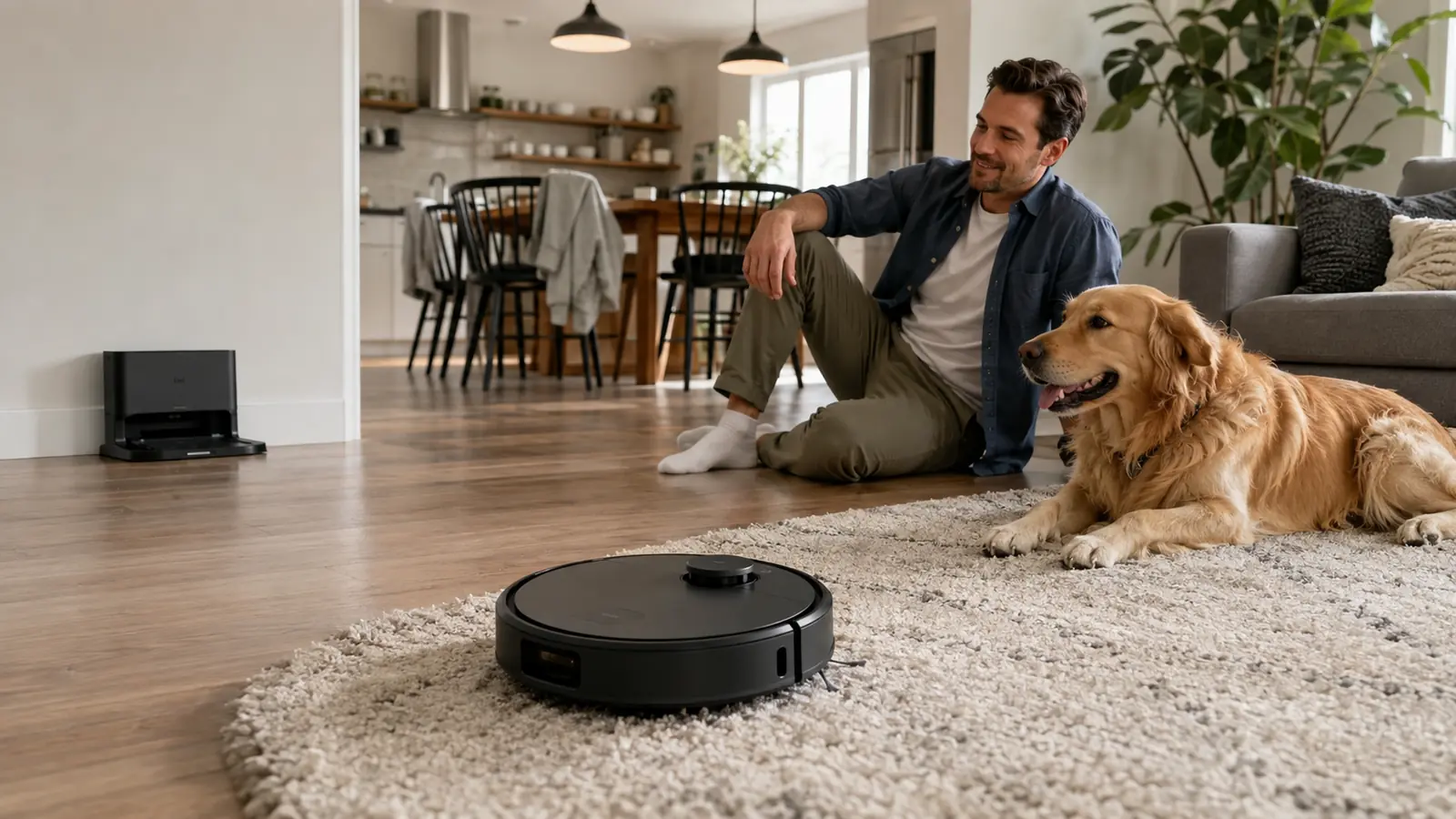

The best robot vacuum is not the machine with the largest suction number or the tallest dock. It is the one that can leave its station, cross your actual thresholds, avoid the objects your household drops, clean the dominant floor type and return without asking for rescue every afternoon.
This guide compares five of the most capable robot vacuum cleaners available in 2026, then shows how to choose for carpet, hard floors, pet hair, mopping, privacy and maintenance. It is written for a global audience: prices, model names, voltage, warranty and accessory supply must be confirmed in the buyer’s market.
Research checked: August 28, 2026. This is a specification-led buying guide, not a claim that FrediTech conducted identical laboratory floor tests on every model. Manufacturer claims use different methods and baselines, so numbers should not be treated as directly comparable without independent standardized testing.
Table of contents
Our 2026 shortlist
- Best specification-led flagship for difficult thresholds: Roborock Saros 20
- Best for low furniture and high claimed suction: Dreame X60 Max Ultra Complete
- Best premium choice for carpet-focused automation: eufy Robot Vacuum Omni S2
- Best bagless dock and targeted stain-treatment concept: ECOVACS DEEBOT X12 OmniCyclone
- Best familiar all-round platform with an advanced roller mop: iRobot Roomba Max 775 Combo
These labels identify the strongest on-paper fit for a use case. Buy only after checking local price, consumable cost, warranty service, floor compatibility and return terms.
In this guide
Five of the best robot vacuum cleaners for 2026
1. Roborock Saros 20 — best on-paper choice for complex floors
The Saros 20 is Roborock’s 2026 flagship. Its global product information lists an AdaptiLift Chassis 3.0, up to 8.8 cm of combined double-layer threshold capability under specified conditions, a body around 7.95 cm high, 36,000 Pa claimed suction, edge-reaching hardware and a new RockDock. Those features make it the most interesting shortlist option for homes with room transitions, low furniture and mixed vacuum/mop demands.
Threshold figures require caution: shape, spacing, grip, approach angle and firmware settings can change the result. Measure every transition and compare it with the manufacturer’s footnotes, not just the headline. The advanced dock also needs floor space, water handling and regular cleaning. Choose the Saros 20 when difficult navigation is the real problem and regional service is available—not simply because its feature list is longest.
2. Dreame X60 Max Ultra Complete — best for low clearance and feature density
Dreame lists the X60 Max Ultra Complete at approximately 3.13 inches tall with 35,000 Pa claimed Vormax suction and a dock that washes the mop with water advertised up to 212°F/100°C. The slim profile is compelling for beds and sofas that defeat taller turret-based robots. Its extensive accessory pack and dock automation target buyers who want long intervals between routine interventions.
A low body does not guarantee access: measure the lowest point across the furniture, allow margin for uneven floors and check whether hanging fabric or cables will interfere. Hot-water dock claims describe a stage of the station process, not sterile floors. Buyers should examine detergent rules, replacement-bag and brush pricing, clean/dirty tank effort, obstacle handling and local warranty support.
3. eufy Robot Vacuum Omni S2 — best premium fit for carpet-led homes
The 2026 Omni S2 product page lists 30,000 Pa suction, HydroJet 2.0 self-cleaning roller mopping, anti-tangle brushes, carpet detection and height adjustment, an all-in-one station and Matter support in supported regions. Eufy positions it for deeper carpet management while retaining hard-floor mopping. It is a strong candidate for pet households that need both brush detangling and frequent autonomous passes.
Carpet performance depends on pile, fiber, edge shape and embedded debris—not only suction. Confirm whether the mop lifts high enough for each rug and whether tassel avoidance works with your layout. Matter support may expose useful start/stop and status functions, but the maker’s app can still be required for maps, camera features, maintenance and firmware. Review its account and video-processing settings before enabling optional AI functions.
4. ECOVACS DEEBOT X12 OmniCyclone — best bagless-dock concept
ECOVACS lists the X12 OmniCyclone with 22,000 Pa claimed suction, a bagless OmniCyclone station, an OZMO Roller 3.0 mop, dToF navigation, RGBD obstacle avoidance and FocusJet targeted stain pre-treatment. Avoiding disposable dock bags could reduce recurring purchases for households willing to empty and clean a reusable cyclone chamber. Targeted spraying may also help with dried hard-floor marks when the approved solution and floor finish are compatible.
Bagless is not maintenance-free. Fine dust can be messy to empty, seals and filters still require care, and allergy-sensitive households may prefer a sealed disposable bag. The stain system adds tanks, fluid paths and cleaning steps. Treat the X12 as a good fit when recurring bag purchases are the bigger concern and local consumables are easy to obtain.
5. iRobot Roomba Max 775 Combo — best familiar all-round platform
Introduced in July 2026, the Roomba Max 775 Combo combines ClearView Pro LiDAR, PrecisionVision AI object avoidance, a covered PowerSpin roller mop intended to keep carpets dry, heated spot mopping and an AutoWash dock. iRobot quoted a U.S. MSRP of $999.99 at launch; price, numbering and availability differ elsewhere. The product suits buyers who value a familiar app ecosystem and want a roller-style mop without moving to the most expensive flagships.
Its “4X” suction statement uses an iRobot comparison baseline, so it cannot be placed beside another brand’s Pascal figure as a laboratory ranking. Evaluate obstacle recognition, edge pickup, dock consumables, map controls and replacement-part availability. Owners of older Roombas should not assume brushes, bags or docks transfer to the new series.
Robot vacuum comparison: what separates the five
| Model | Standout specification | Best-fit home | Check before buying |
|---|---|---|---|
| Roborock Saros 20 | Adaptive chassis, very slim body, advanced dock | Complex thresholds, mixed floors, low furniture | Threshold shape, dock size, local model/version |
| Dreame X60 Max Ultra Complete | 3.13-inch class height, 35,000 Pa claim, hot-water dock wash | Low furniture, pets, buyers wanting many automated features | Consumables, obstacle handling, under-furniture clearance |
| eufy Omni S2 | Carpet-focused lift/detection, 30,000 Pa claim, Matter support | Carpet-led pet homes with hard-floor zones | Rug pile/tassels, feature availability by platform |
| ECOVACS X12 OmniCyclone | Bagless dock, roller mop, targeted stain spray | Hard-floor homes wanting fewer disposable dock bags | Filter cleaning, dust-emptying exposure, solution rules |
| Roomba Max 775 Combo | Covered roller mop, AI obstacle detection, AutoWash dock | Mixed floors and buyers preferring iRobot’s platform | Series-specific parts, relative-claim baseline, regional price |
No single row establishes cleaning quality. A cheaper robot that completes ninety percent of the floor every day can outperform a flagship that repeatedly gets trapped. Map the home first, then rank the obstacles that create human work.
Match a robot vacuum to your floor, pets and layout
Carpet and rugs
Measure pile height, rug thickness, fringe and the transition from hard floor. Look for automatic carpet boost, reliable wheel traction, brush design, mop lift or physical mop separation, and the ability to define no-mop zones. Deep carpet still benefits from a full-size vacuum with appropriate agitation and filtration; a robot is best treated as frequent maintenance, not the only cleaning tool.
Hard floors and mopping
A roller, spinning pads or vibrating plate can improve contact, but water control and floor compatibility matter more than marketing temperature. Check the flooring maker’s care instructions before using detergent or frequent wet cleaning. Robots do not recognize every spill: remove oils, chemicals, pet accidents, glass and excess liquid manually rather than allowing the machine to spread them.
Pet hair and pet waste
Anti-tangle rollers, easy brush removal and large dust handling reduce daily work. Obstacle-recognition claims can lower risk but cannot guarantee avoidance of pet waste, toys or bowls. Inspect the floor before scheduled runs and keep feeding areas as no-mop zones when water or food is likely. Check filters and wheels more often in shedding seasons.
Thresholds, stairs and clutter
Measure thresholds vertically and photograph their profile. A rounded single step differs from two closely spaced rails. Keep stair-edge sensors clean and provide a physical barrier during early mapping when failure would be dangerous. Lift cables, narrow curtains, shoelaces and lightweight mats. “AI avoidance” reduces preparation; it does not make every floor object safe.
The robot-vacuum features that actually matter
- Completion rate: can it clean the intended area without rescue?
- Navigation and maps: are rooms, floors, zones and edits understandable?
- Obstacle handling: which object types are recognized, and is a camera involved?
- Brush serviceability: can hair, thread and bearings be reached without specialist tools?
- Carpet protection: does the mop lift, cover, detach or return to the dock?
- Dock hygiene: how are debris, wastewater, detergent, mop washing and drying handled?
- Parts supply: are genuine filters, bags, brushes, pads and cleaning solution sold locally?
- Offline behavior: can it start, dock and use saved maps during an internet outage?
- Update support: is a support period stated and is reset/account transfer documented?
Do not rank by suction pressure alone. Air path, brush contact, seals, floor gap, speed and test method affect pickup. Likewise, battery runtime is measured in a selected mode; real coverage changes with carpet boost, mopping, obstacle processing, room temperature and dock visits. Floor area completed is a more useful household metric than the longest advertised minutes.
Dock automation does not remove maintenance
A full-service dock can empty dust, refill clean water, collect wastewater, wash pads and dry them. It also occupies more space, draws standby power and contains more parts that can smell, scale or clog. Place it on a hard level floor with the clearances specified by the maker and access to a suitable socket. Never crowd ventilation or run a cord where someone can trip.
Noise deserves a separate check. A robot may sound modest while cleaning but become much louder during automatic dust emptying or high-speed mop drying. In apartments, shared homes and households with infants, remote workers or noise-sensitive pets, schedule the dock cycle as carefully as the floor run. Confirm whether emptying and drying can be delayed, disabled or assigned a quiet period. A slightly less automated station may be the better neighbor—and the better household fit—when its loudest process would run beside a bedroom or home office.
Budget for dust bags where used, filters, side brushes, main rollers, mop pads, approved solution and occasional battery replacement. Compare twelve-month consumable cost, not just purchase price. Third-party parts may be economical, but dimensions, filtration and material quality vary. A washable component must dry fully before reinstallation; a reusable filter is not automatically washable.
Realistic expectation: a robot vacuum trades one large manual session for small recurring tasks—floor pickup, water changes, hair removal, sensor cleaning and consumable replacement. The best model is the one whose maintenance pattern fits the household.
Camera privacy, app support and global buying
Advanced obstacle avoidance may use structured light, lasers, cameras or combinations. A camera can improve object classification but introduces image and access questions. Review whether images are processed on-device or in the cloud, whether remote viewing exists, who can access maps, how long data is retained and how deletion works. Disable optional camera or voice features that do not solve a household need.
Use a unique account password and multifactor authentication if offered, update the app and firmware, remove old household members, and factory-reset the robot before sale. A map reveals room layout even without a conventional photograph. See the smart-home privacy and cybersecurity guide for network separation and end-of-support planning.
For an imported unit, confirm voltage and plug, radio approval, app-region availability, language, cloud region, warranty, return shipping, consumables and repair service. A model with the same name may have different station plumbing, accessories or features across regions. Avoid adapters for a high-power dock unless explicitly approved; buy the correct regional model.
How to set up and evaluate a robot vacuum fairly
- Prepare the dock. Follow clearances, level-floor and socket instructions; fill only approved tanks and solutions.
- Remove hazards, not normal furniture. Lift cables, liquid, sharp objects and delicate fringe while leaving chairs and ordinary obstacles in place.
- Create the first map in good light. Open intended doors, block unsafe drops and supervise the initial route.
- Edit rooms and surface zones. Mark carpet, no-mop areas, pet bowls and fragile zones before scheduling.
- Run separate pickup tests. Observe hard-floor crumbs, edge debris, pet hair and the dominant carpet rather than mixing an artificial mess.
- Inspect, do not just admire the app. Check the bin, brush, filter, missed edges, dampness and objects moved after each run.
- Use the return window. Repeat at different times and with normal household clutter. Return a machine that cannot complete the home reliably.
FrediTech recommendation: choose by completion rate, dominant floor, obstacle risk, dock workload and local parts—not by suction alone. The Roborock Saros 20 has the strongest complex-floor specification; the Dreame X60 and eufy S2 lead on different premium priorities; the ECOVACS X12 offers a distinctive bagless approach; and the Roomba Max 775 is the most approachable current all-rounder on this shortlist.
Frequently asked questions
What is the best robot vacuum cleaner in 2026?
There is no universal winner. The Roborock Saros 20 is the strongest specification-led fit for complex thresholds; Dreame X60 emphasizes low clearance and automation; eufy S2 targets carpet-heavy premium homes; ECOVACS X12 offers a bagless dock; and Roomba Max 775 balances current features in iRobot’s platform.
Are robot-vacuum suction numbers comparable?
Not reliably. Brands may use different locations, modes, conditions and baselines. Pickup also depends on brush agitation, air path, seals, floor contact and navigation. Use suction as one specification, then prioritize credible floor tests and return rights.
Can a robot vacuum replace a normal vacuum?
It can maintain open floors frequently, but most homes still need a manual tool for stairs, upholstery, corners, deep carpet, spills and areas the robot cannot reach. Allergy-sensitive cleaning may require a sealed full-size vacuum and careful emptying.
Which robot vacuum is best for pet hair?
Look for anti-tangle rollers, accessible bearings, strong carpet contact, reliable obstacle avoidance and locally available filters and brushes. The Dreame X60, eufy S2 and Roborock Saros 20 all advertise hair-management features, but the home’s carpet and pet behavior should determine the choice.
Is a self-emptying and mop-washing dock worth it?
It is useful for frequent cleaning and larger homes when there is space and the owner will maintain tanks, trays, filters and bags. It is poor value for a small uncluttered home if dock cleaning becomes more work than emptying a simple robot.
Research method and official product sources
Products were shortlisted from current official 2026 ranges, then compared by intended use, navigation, threshold claims, floor handling, dock workload, serviceability, privacy and regional support. Manufacturer claims are attributed and not converted into unsupported cross-brand laboratory rankings. Prices and availability can change after the research date.