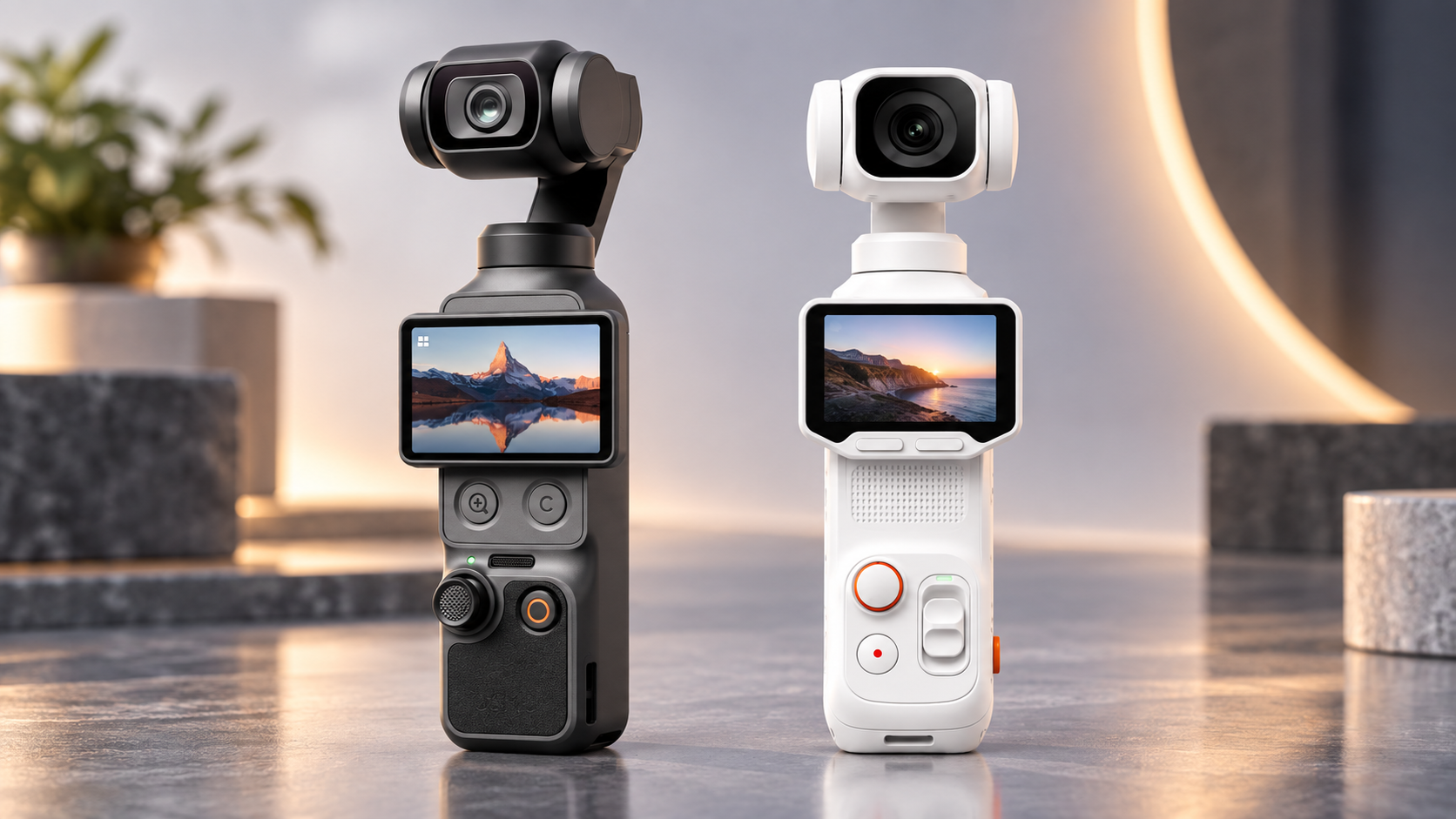

The Insta360 Luna Pro and DJI Osmo Pocket 4 share 1-inch CMOS sensors and 20mm-equivalent lenses, but their priorities differ. Luna Pro reaches 8K30 and native 4K portrait video; Pocket 4 tops out at 4K60 in normal video but adds 4K240 slow motion. Luna Pro is officially sold in the U.S. for $599.99, while Pocket 4 still lacks normal official U.S. retail availability.
In the UK and Europe, DJI is harder to ignore: Pocket 4 is currently £445 in the UK and €499 in France/Germany, versus £469 and €529 for Luna Pro. DJI is also lighter, stores more internally and charges faster; Luna counters with an f/1.8 lens, 8K, 4K vertical output and a detachable OLED remote.
Insta360 Luna Pro vs DJI Osmo Pocket 4: Quick Verdict
United States: choose the Luna Pro unless you deliberately accept grey-market import risks. It is officially sold with normal manufacturer and retailer support, while Pocket 4 still has no standard DJI U.S. retail launch.
UK and much of Europe: the DJI Osmo Pocket 4 is the better all-round value for many vloggers and travelers because it costs less locally, weighs less, has 107GB built in, charges faster and offers excellent ActiveTrack plus 4K240 slow motion. Choose Luna Pro instead when 8K, maximum-resolution vertical video or remote self-framing matters more.
Image quality: call it a conditional tie until a strong same-scene comparison proves otherwise. Both start with 1-inch-class sensors and 20mm lenses; Luna is about one-third stop faster at f/1.8 versus DJI’s f/2.0, but processing, autofocus, exposure and noise reduction matter more than that small aperture difference alone.
Price and availability: US buyers face a very different choice
Insta360’s official store currently lists Luna Pro at $599.99 in the U.S., £469 in the UK and €529 in supported European markets. DJI’s UK store lists the Pocket 4 Standard Combo at £445. DJI’s French and German stores currently list the Standard Combo at €499, while some other European markets are around €509. That means Pocket 4 can undercut Luna Pro by about £24 in the UK and roughly €30 in France or Germany.
The U.S. situation is different. Pocket 4 launched without official U.S. pricing or normal retail availability, and that remains the practical constraint at publication time. You can find import listings, but those are not a DJI U.S. MSRP. An importer may also change warranty handling, DJI Care eligibility, return costs, customs exposure, repair logistics and seller support.
| Feature | Insta360 Luna Pro | DJI Osmo Pocket 4 |
|---|---|---|
| Release date | September 10, 2026 | April 16, 2026 |
| U.S. availability | Officially available | No normal official U.S. retail availability at publication time |
| U.S. price | $599.99 | No official U.S. MSRP confirmed |
| UK baseline | £469 | £445 Standard Combo |
| EU baseline | €529 | €499 in France/Germany; varies by market |
| Sensor | 1-inch CMOS, about 50MP effective | 1-inch CMOS |
| Lens | 20mm equivalent, f/1.8 | 20mm equivalent, f/2.0 |
| Minimum focus | 9cm | 20cm |
| Maximum normal video | 8K30 | 4K60 |
| High-frame-rate 4K | 4K120 | 4K240 in Slow Motion mode |
| Vertical video | 4K 2160×3840 up to 30fps; 3K up to 60fps | 3K 1728×3072 up to 60fps |
| Photos | Up to 37MP UltraPhoto | Approx. 37MP Single Shot / SuperPhoto-class output |
| Zoom | 1× native, 2× lossless/clarity crop, up to 4× digital | 2× lossless position; digital zoom up to 4× in supported video modes |
| Tracking | Auto Tracking / Smart Framing for people, pets and objects | ActiveTrack 7.0; tracking supported at up to 4× zoom in supported modes |
| Gimbal | 3-axis mechanical | 3-axis mechanical |
| Screen | 2-inch detachable OLED, 318×564, 1000 nits | 2-inch integrated OLED, 556×314, 1000 nits |
| Internal storage | 47GB | 107GB usable |
| microSD | Supported cards up to 2TB | Up to 1TB |
| Built-in microphones | 4 | 3 |
| Battery | 1550mAh | 1545mAh |
| Claimed runtime | Up to 240 min under 1080p24 lab conditions | Up to 240 min under 1080p24 lab conditions |
| 80% charge | About 23 min | About 18 min with specified DJI charger |
| Weight | Approx. 215g black / 218g white | 190.5g |
| Dimensions | 52.78 × 155.7 × 38.47mm | 144.2 × 44.4 × 33.5mm |
| Log | 10-bit I-Log | 10-bit D-Log |
| Low light | PureVideo | Dedicated Low-Light Video; ISO ceiling up to 25,600 in that mode |
| Waterproof | No | No |
| Best for | U.S. buyers, 8K, 4K vertical, remote self-framing | UK/EU value, slow motion, portability, storage, DJI workflow |
Camera hardware: both start with a 1-inch sensor
These cameras are closer at the core than their marketing makes them look. Both pair a 1-inch CMOS sensor with a 20mm-equivalent lens. Luna Pro’s lens is f/1.8; Pocket 4 is f/2.0. The f/1.8 opening is roughly one-third stop faster, so in a perfectly controlled equal exposure it can admit slightly more light. That is useful, but not enough to declare a low-light winner by itself.
Autofocus architecture and focusing distance also differ. DJI specifies full-pixel PDAF and a 20cm minimum focusing distance. Luna Pro focuses to about 9cm, which is more convenient for close product shots, food, details and hand-to-camera demonstrations. DJI counters with Product Showcase and additional focus modes designed around creator workflows.
Image quality: which camera actually looks better?
No strong same-scene laboratory comparison yet proves one is universally sharper. TechRadar found Luna Pro’s video, tracking and stabilization strong, while its Pocket 4 review praised crisp 4K, excellent stabilization and very reliable tracking.
Luna’s 8K gives more crop and reframing headroom; Pocket 4’s 4K is sufficient for most YouTube, Reels and client delivery, with 10-bit D-Log for grading. Judge these cameras by the formats you use rather than megapixels or manufacturer dynamic-range headlines.
For related creator-video context, FrediTech’s iPhone 17 Pro camera and video review explains why codec, transfer speed and workflow can matter as much as headline resolution. FrediTech’s Xiaomi 17 Ultra review also shows why “optical-quality” and native optics should be distinguished carefully when evaluating camera marketing.
8K vs 4K240: two very different strengths
Luna Pro’s headline advantage is 8K30. It is useful when you want a high-resolution master, need to crop a horizontal shot into multiple compositions, stabilize in post, pull high-resolution frames or preserve extra resolution for a 4K timeline. The cost is heavier storage demand, more demanding editing and reduced battery endurance under sustained high-resolution recording.
Pocket 4 answers with 4K240 slow motion, available specifically in Slow Motion mode. That is a major creative advantage for sports, water, hair and fabric movement, dance, action details and dramatic B-roll. Normal Pocket 4 video tops out at 4K60, so do not confuse its 240fps slow-motion mode with ordinary real-time 4K recording.
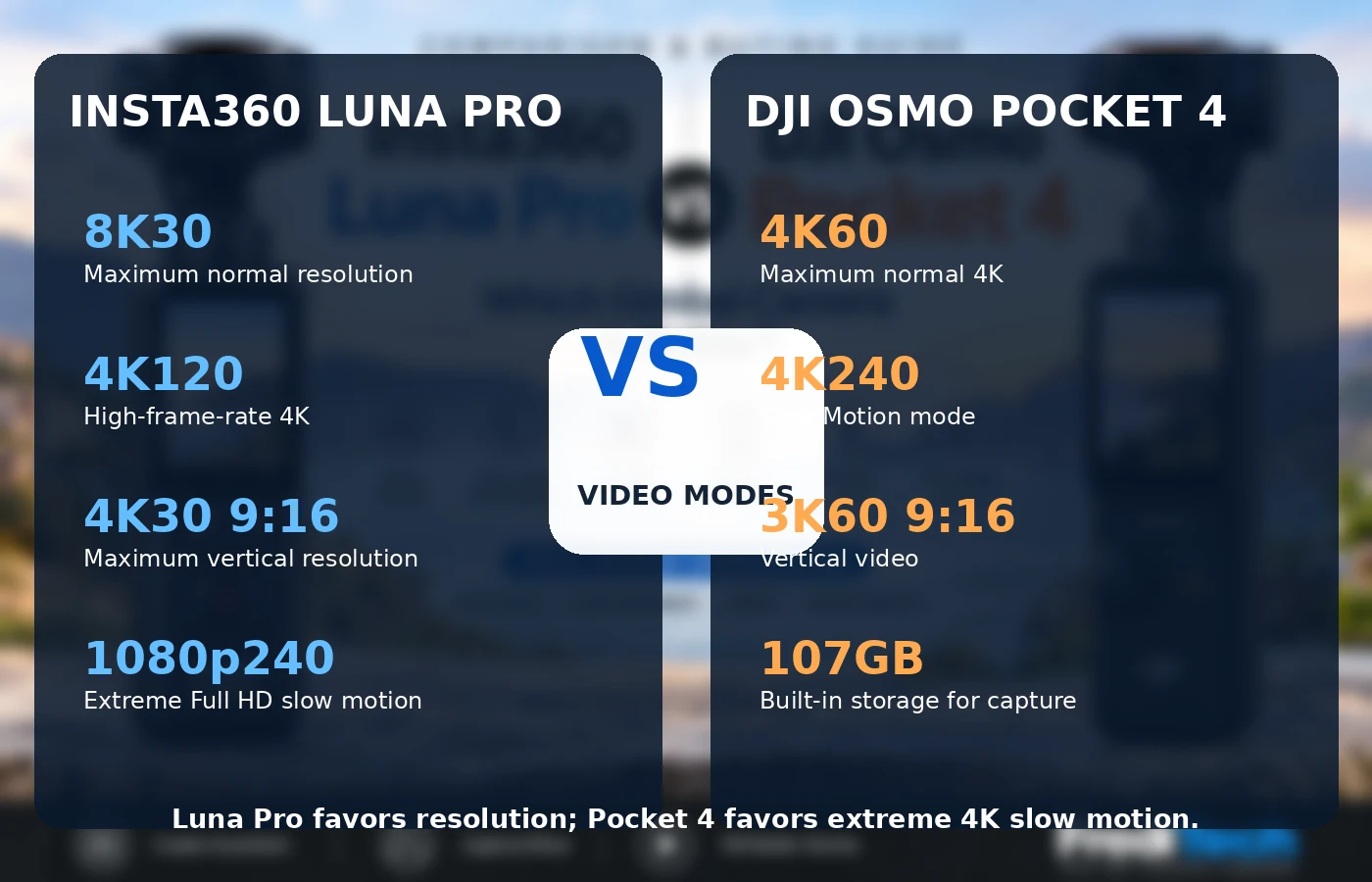
Choose 8K if cropping and reframing are weekly requirements. Choose 4K240 if high-speed motion is central to your style. For an ordinary walk-and-talk vlogger delivering 4K30 or 4K60, neither headline mode is automatically decisive.
Vertical video: Luna Pro wins resolution, DJI wins frame rate
Luna Pro records true 9:16 2160×3840 4K vertical video up to 30fps and also offers 3K vertical up to 60fps. Pocket 4’s vertical mode reaches 1728×3072 3K up to 60fps. That creates a rare comparison where both products have a legitimate advantage.
Luna Pro is better when you want the highest-resolution portrait master for cropping, reframing or archival use. Pocket 4 is better when you value 60fps motion smoothness but do not need 4K portrait resolution. A social creator shooting fashion walks, dance or fast handheld movement may reasonably prefer Pocket 4’s 3K60. A creator who crops aggressively for multiple platforms may prefer Luna’s 4K30.
Autofocus and tracking: Luna tracking vs ActiveTrack 7.0
Insta360’s Auto Tracking and Smart Framing can lock onto people, pets and objects, and TechRadar found Luna Pro tracking excellent. DJI’s ActiveTrack 7.0 tracks people, vehicles, pets and objects, adds Registered Subject Priority and Subject Lock Tracking, and supports tracking at up to 4× zoom in compatible modes.
DJI gets a slight evidence-based edge for tracking maturity, but Luna is also strong. Lighting and mode restrictions still matter on both.
Stabilization and gimbal control
Both cameras use three-axis mechanical gimbals. Insta360 specifies very low angular jitter and offers several gimbal modes; DJI likewise provides follow and FPV-style control plus a refined 5D joystick. Independent reviews describe both as highly effective for walking footage.
Mechanical gimbal stabilization is excellent for smooth panning and walking, but neither product is a rugged action camera. A pocket gimbal has moving arms and exposed mechanics. If your use includes rain, crashes, surf, sand or mounting directly to a bike, a weather-sealed action camera is the more appropriate tool.
Screen and controls: Luna’s detachable OLED changes the workflow
Luna Pro’s 2-inch OLED is detachable and can function as a remote monitor/controller. That is a meaningful advantage when the camera is across the room, on a tripod, above eye level, low to the ground or aimed at a group. It also contains one of Luna Pro’s four microphones, so the remote is more than a second display.
Pocket 4’s 2-inch OLED stays integrated with the body, but DJI adds physical controls below it: a Zoom button, Custom button and 5D joystick. That approach is faster for run-and-gun handheld work because you can reach common functions without living in touch menus.
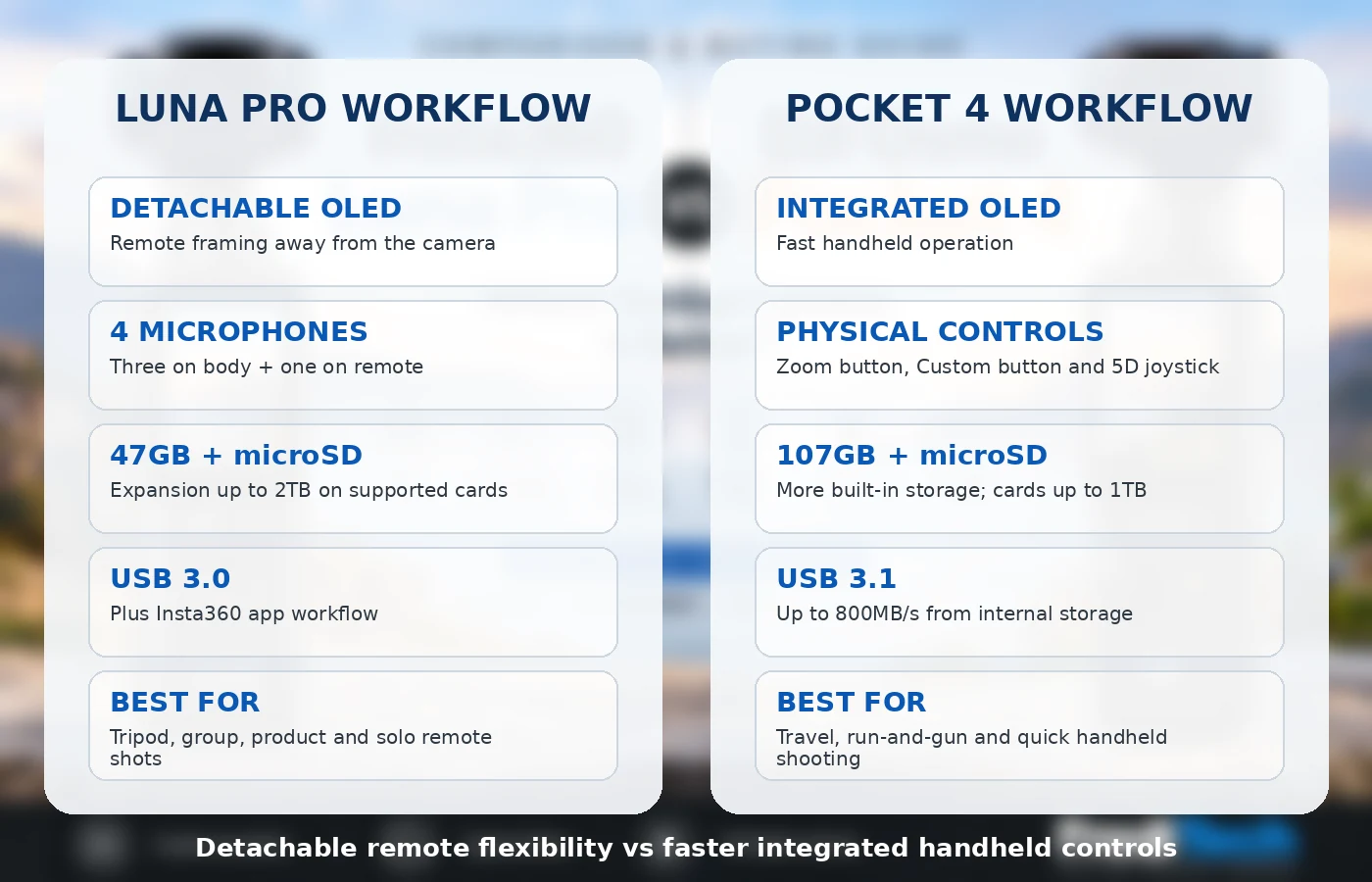
The choice is workflow-driven: Luna for remote placement and self-framing; DJI for quick handheld control.
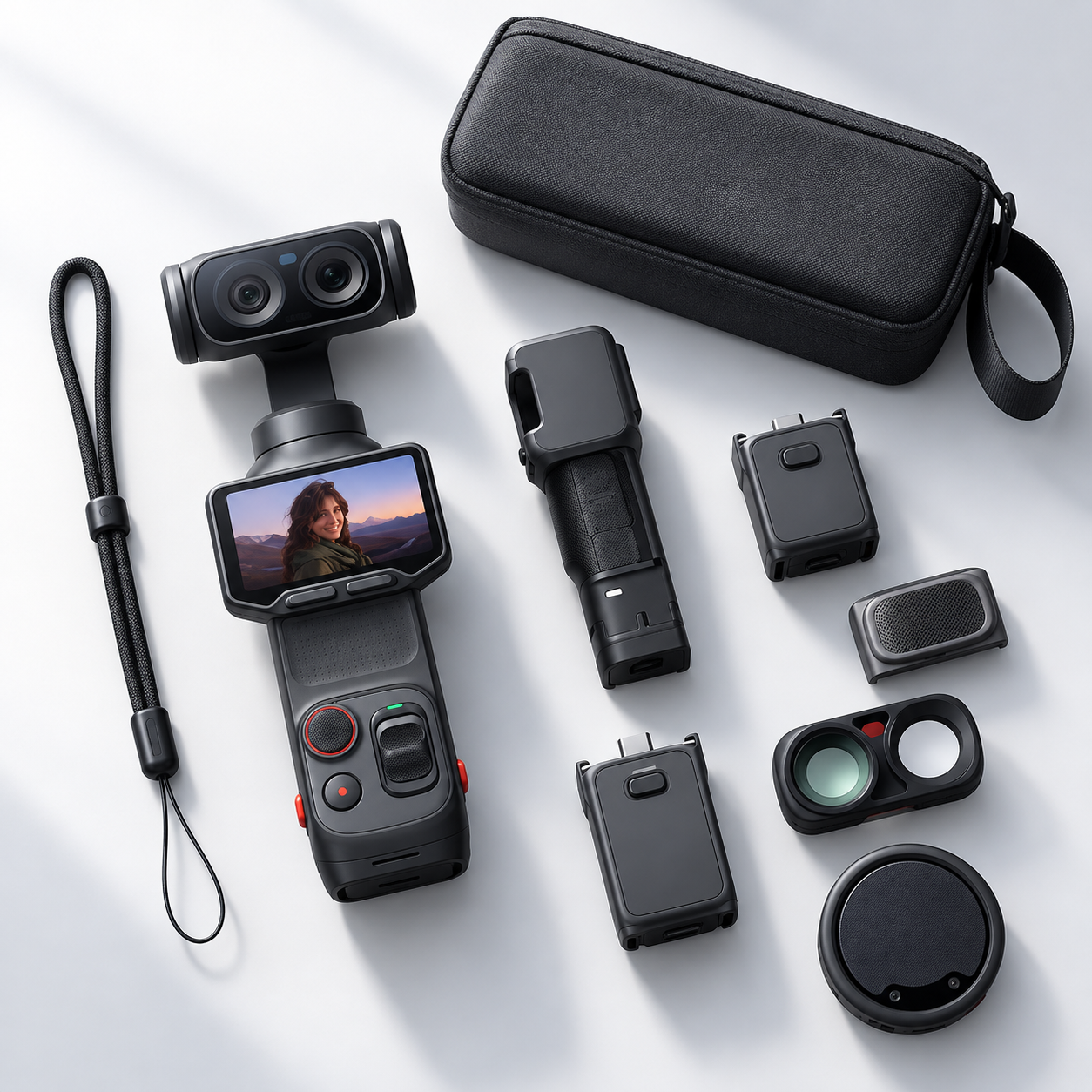
Storage: Pocket 4 gives you more out of the box
Pocket 4 has 107GB usable built-in storage versus Luna Pro’s 47GB. Luna supports specified microSD cards up to 2TB, while DJI supports up to 1TB. DJI also specifies Wi-Fi 6 and USB 3.1 transfer from internal storage at up to 800MB/s under the required conditions; Insta360 lists USB 3.0 but does not publish an equivalent transfer claim.
Battery life: both claim four hours, but read the fine print
Luna Pro has a 1550mAh battery and Pocket 4 a 1545mAh unit; both claim up to 240 minutes under 1080p24, screen-off, Wi-Fi-off lab conditions. TechRadar saw roughly 90 minutes in demanding Luna Pro 8K use, showing why the four-hour headline should not be treated as normal creator endurance or compared across unequal workloads.
Charging: DJI gets back to 80% faster
Insta360 specifies about 23 minutes to 80% and 38 minutes to full using the stated 45W PD/PPS conditions. DJI specifies 18 minutes to 80% and 32 minutes to full with its stated 65W charger conditions. That is a modest Pocket 4 advantage for travelers who recharge between locations.
Audio: Insta360 Mic vs DJI Mic ecosystem
Luna Pro has four microphones and supports Insta360 Mic Air and Mic Pro. Pocket 4 has three microphones and direct DJI Mic support, including workflows that preserve transmitter audio alongside built-in stereo. Existing mic gear matters more than microphone count alone.
Low light and color: Leica/I-Log vs DJI/D-Log
Luna Pro pairs f/1.8 with PureVideo, Leica looks, 10-bit I-Log and Dolby Vision. Pocket 4 combines f/2.0 with Low-Light Video, 10-bit D-Log and film tones. DJI’s ISO 25,600 ceiling is not proof of cleaner footage; both are capable 1-inch low-light tools, and a direct same-scene test is still needed for a definitive winner.
For broader context on high-resolution capture and HDR workflows, see FrediTech’s guide to emerging mobile-photography technologies and its Pixel 8 Pro camera review.
Portability: Pocket 4 is lighter
Pocket 4 weighs 190.5g, versus about 215g for the black Luna Pro—a difference of approximately 24.5g. DJI is also shorter and narrower in important dimensions. That is noticeable in a pocket, sling bag and long handheld session. Luna’s extra bulk buys the detachable-screen concept, so the trade-off is not wasted weight; it is a different workflow.
Which is better for vlogging?
Walk-and-talk vlogging: Pocket 4 gets the edge outside the U.S. because it is lighter, offers excellent tracking, has strong physical controls and integrates neatly with DJI Mic gear. Tripod or room-scale solo vlogging: Luna Pro can be more convenient because you can detach the screen and monitor yourself remotely.
In the U.S., however, availability overrides a narrow ergonomic advantage. Luna Pro is the straightforward official purchase.
Which is better for TikTok, Reels and Shorts?
Luna Pro wins maximum portrait resolution with 4K30 9:16. Pocket 4 wins portrait frame rate with 3K60. If your work involves beauty, product, talking-head or crop-heavy portrait content, Luna’s 4K master is attractive. If movement is the priority, DJI’s 60fps vertical option is compelling.
Which is better for travel?
For UK/EU travel, Pocket 4 is the stronger all-round pick thanks to lower weight, 107GB storage, faster charging and current pricing. Luna counters with its detachable screen, 8K crop latitude and 2TB microSD support. In the U.S., official availability swings the recommendation back to Luna Pro.
Which is better for slow motion and action?
Pocket 4 wins decisively with 4K240 slow motion. Luna Pro’s 4K120 is already useful, but DJI doubles the maximum 4K slow-motion frame rate. Neither is waterproof, though, so “action” should mean controlled sports and motion B-roll rather than surf, rain or impact-heavy mounting.
Should US buyers choose Luna Pro because DJI Pocket 4 is unavailable?
For most buyers, yes. A warranty-supported local purchase is part of the product value. Importing Pocket 4 can make sense for an experienced DJI user who accepts the seller, return and service implications, but it should not be presented as equivalent to an official U.S. launch.
Choose Luna Pro or Pocket 4 in 30 seconds
- Buying in the U.S.? Luna Pro.
- Need 8K or 4K portrait masters? Luna Pro.
- Need 4K240 slow motion? Pocket 4.
- Need remote self-framing? Luna Pro.
- Already use DJI Mic gear? Pocket 4.
- Want the lightest body and most internal storage? Pocket 4.
- Regularly forget microSD cards? Pocket 4.
- Prefer maximum expansion capacity? Luna Pro.
Which camera wins each category?
| Category | Winner | Why |
|---|---|---|
| Best U.S. buy | Luna Pro | Official retail availability and support. |
| Best UK/EU value | Pocket 4 | Currently cheaper in major markets and strong all-round features. |
| Maximum resolution | Luna Pro | 8K30. |
| Slow motion | Pocket 4 | 4K240 in Slow Motion mode. |
| Vertical resolution | Luna Pro | 4K30 9:16. |
| Vertical frame rate | Pocket 4 | 3K60 9:16. |
| Remote framing | Luna Pro | Detachable OLED remote. |
| Built-in storage | Pocket 4 | 107GB vs 47GB. |
| Portability | Pocket 4 | 190.5g vs about 215g. |
| Charging | Pocket 4 | 18 min to 80% vs about 23 min under each maker’s test. |
| Tracking | Pocket 4, slight edge | ActiveTrack 7.0 is well documented and independently praised; Luna is also strong. |
| Audio ecosystem | Depends | Choose the microphone ecosystem you already own. |
| Social media | Depends | Luna for 4K portrait resolution; DJI for 60fps portrait motion. |
| Action B-roll | Pocket 4 | 4K240 slow motion. |
| Best overall | Region-dependent | Luna Pro in the U.S.; Pocket 4 is the better all-round value for many UK/EU buyers. |
FrediTech Verdict
Best for U.S. buyers: Insta360 Luna Pro. Official availability, 8K, 4K vertical and the detachable remote make it the practical choice.
Best for UK/EU buyers: DJI Osmo Pocket 4 for most people. It is currently cheaper in major markets, lighter, faster to charge and roomier internally, with 4K240 and polished ActiveTrack. Choose Luna instead for 8K, 4K vertical or remote placement.
Vlogging: DJI for handheld walk-and-talk outside the U.S.; Luna for remote/self-framed setups. Social: Luna for 4K portrait resolution, DJI for 60fps portrait motion. Slow motion: DJI. Travel: DJI where officially sold; Luna in the U.S.
Frequently Asked Questions
Is Insta360 Luna Pro better than DJI Osmo Pocket 4?
Not universally. Luna Pro is better for official U.S. buying, 8K, 4K vertical video and detachable remote framing. Pocket 4 is stronger for 4K240 slow motion, portability, internal storage, faster charging and, in major UK/EU markets, current value.
Which has the better camera sensor?
Both use 1-inch CMOS sensors. The exact sensor models are not established as identical, so it is safer to compare their published imaging systems and real footage rather than claim they use the same sensor.
Does Luna Pro shoot 8K?
Yes. It supports 8K video up to 30fps.
Does DJI Pocket 4 shoot 8K?
No. Normal video tops out at 4K60.
Does DJI Pocket 4 shoot 4K240?
Yes, in Slow Motion mode. That is not the same as ordinary 4K240 real-time video.
Which is better for vertical video?
Luna Pro wins maximum portrait resolution at 4K30. Pocket 4 wins maximum portrait frame rate at 3K60.
Which has better subject tracking?
Pocket 4 gets a slight evidence-based edge because ActiveTrack 7.0 is well documented and independently praised, but Luna Pro’s tracking has also tested strongly.
Which has more internal storage?
Pocket 4, with 107GB usable versus Luna Pro’s 47GB.
Can you buy DJI Osmo Pocket 4 in the US?
It can appear through importers and third-party sellers, but there is still no normal official DJI U.S. retail launch or confirmed U.S. MSRP at publication time.
Which is better for travel?
Pocket 4 is the stronger UK/EU travel value because it is lighter, has 107GB built in and charges faster. Luna Pro is the safer travel purchase for U.S. buyers because of official availability and support.
Sources
- Insta360 Luna Series hardware specifications
- Insta360 Luna Series photo and video specifications
- Insta360 Luna Series compatibility
- Insta360 UK Luna Series store
- DJI UK Osmo Pocket 4 store listing
- DJI Osmo Pocket 4 specifications and support
- TechRadar Insta360 Luna Pro review
- TechRadar DJI Osmo Pocket 4 review
Methodology: This is a specification-led buying comparison, not a claim that FrediTech physically tested both cameras. Official specifications, store pricing and support documentation were checked on September 14, 2026. Independent review observations are attributed to the publications that performed the testing.