
The cheapest appliance on the shop floor can become the expensive one at home. A refrigerator runs every hour, an oversized air conditioner cycles inefficiently, and an old dryer can turn every laundry day into years of avoidable electricity cost.
The best energy-efficient appliances in 2026 are not chosen by a “smart” badge or a green sticker alone. They are correctly sized, verified by an official label, affordable to maintain and efficient in the way your household will actually use them.
Research checked: August 27, 2026. Efficiency labels, test methods, rebates, tariffs and product standards are market-specific. Always use the official label and electricity rate for your country.
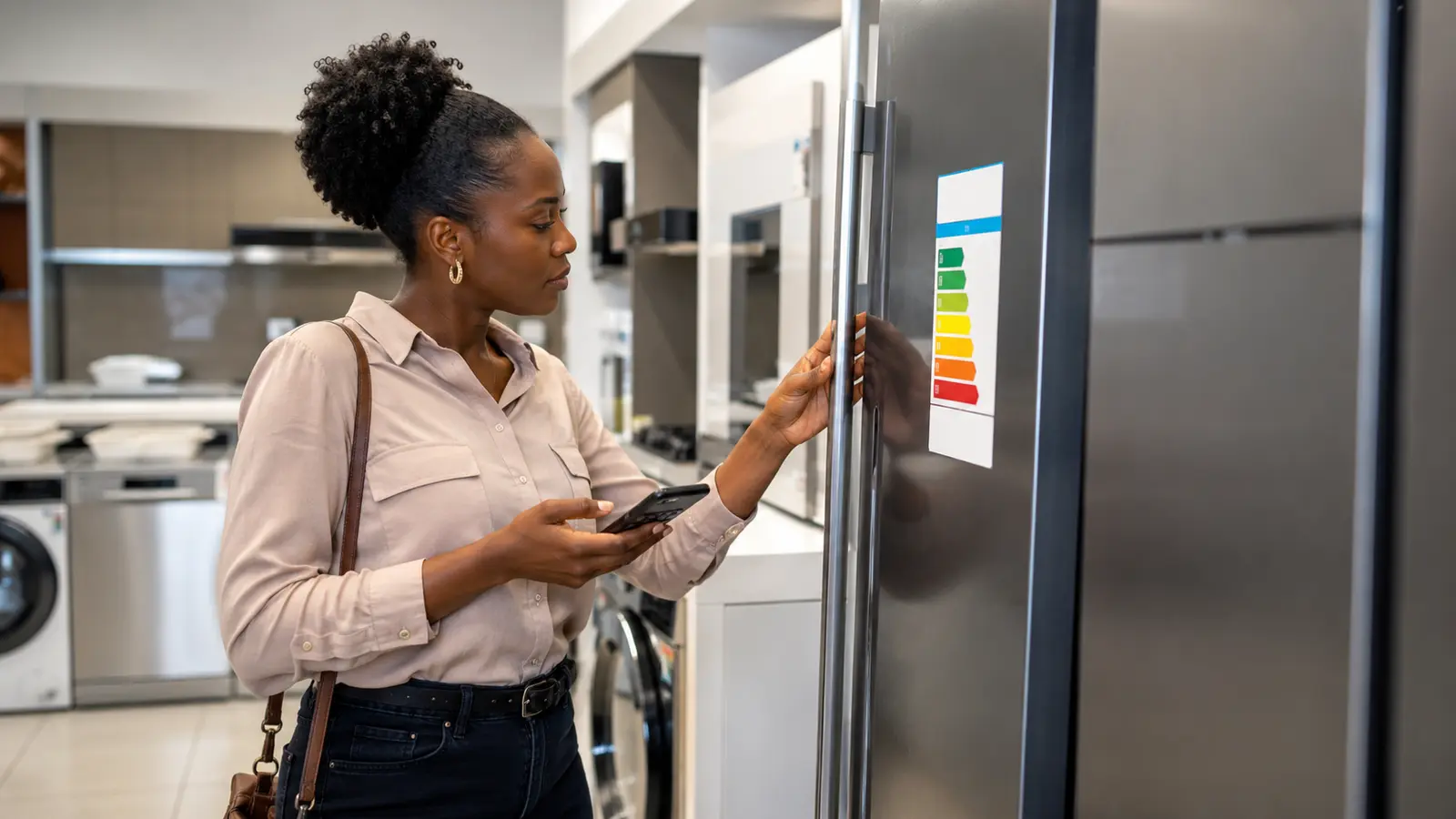
Table of contents
The quick answer
Compare appliances of the same type and usable capacity. Read annual kilowatt-hours or energy per cycle, estimate lifetime running cost, then add water, filters, detergent, repairs and installation. In the United States, use both EnergyGuide and ENERGY STAR information; in Ghana, look for the Energy Commission’s approved efficiency label; in the European Union, use the A–G energy label and EPREL database.
EnergyGuide, ENERGY STAR and other labels are not the same
United States: EnergyGuide shows comparison data
The yellow EnergyGuide label shows estimated energy consumption or efficiency, estimated annual operating cost and a comparison range for similar models. The Federal Trade Commission explains how to read it. The dollar estimate uses standardized assumptions; your tariff and usage may differ, so the energy figure is often the better starting point.
United States: ENERGY STAR identifies certified efficiency
Products that earn ENERGY STAR meet category-specific efficiency requirements set by the US Environmental Protection Agency and are subject to third-party certification processes. ENERGY STAR is not the same as the EnergyGuide comparison label. A model can have an EnergyGuide label without earning ENERGY STAR.
European Union: use the A–G label and EPREL
The EU label presents an A–G efficiency class and category-specific consumption and performance data. The QR code can lead to the product’s record in EPREL, the European Product Registry for Energy Labelling. Compare the underlying kWh, capacity, water and noise data—not the letter alone—because category rules and label scales can change.
Ghana: look for the Energy Commission label
Ghana’s Energy Commission publishes efficiency standards and labelling requirements for regulated appliances, including refrigerators, air conditioners, televisions, fans, microwaves, electric kettles and other products. Verify the label and model information instead of relying on an unverified “low energy” claim from a seller.
How to calculate lifetime appliance cost
Use the label’s annual kWh where available. Multiply it by the electricity tariff on your recent bill. If your tariff has bands, time-of-use rates or taxes, use a realistic blended rate or calculate a range.
For example, if two same-size refrigerators differ by 120 kWh per year and electricity costs the equivalent of $0.25 per kWh, the more efficient model saves about $30 per year, or $300 over ten years before tariff changes. A purchase-price premium below that amount may be reasonable if reliability and usable capacity are similar.
| Cost | Examples | How to verify |
|---|---|---|
| Purchase | Appliance, delivery, taxes | Written retailer quote |
| Installation | Electrical circuit, plumbing, venting, mounting | Qualified installer quote |
| Electricity | kWh per year or cycle | Official label × local tariff |
| Water | Washer or dishwasher consumption | Label/test data × local rate |
| Consumables | Filters, salt, detergent, bags | Model-specific replacement price |
| Maintenance | Cleaning, service, likely wear parts | Warranty and service network |
Best energy-efficient appliance choices by category
These are feature and certification recommendations rather than a universal model ranking. Exact models differ across voltage systems, climates and markets.
1. Refrigerator: right-size, simple layout and low annual kWh
A refrigerator runs continuously, making annual consumption especially important. ENERGY STAR states that certified US refrigerators are about 9% more efficient than models meeting the federal minimum standard. Compare same-size units, allow ventilation clearance and avoid paying to cool unused space. Ice makers, through-door dispensers and extra compartments can add convenience but also complexity and energy use.
Best choice: the smallest capacity that comfortably handles the household’s normal groceries, with a current official label, suitable climate rating, good door seals and local service support.
2. Clothes washer: efficient front load or high-efficiency impeller
ENERGY STAR reports that certified clothes washers use about 20% less energy and 30% less water than regular US models under its comparison. Front-load designs can use less water than traditional top-load agitator machines, but buyers should consider bending access, cycle time, floor stability and gasket care.
Best choice: a properly sized washer with low per-cycle energy and water use, adjustable temperatures, useful spin speeds and a serviceable filter. High spin efficiency can also reduce dryer energy.
3. Clothes dryer: heat-pump technology where practical
A heat-pump dryer recirculates heat instead of exhausting most of it. ENERGY STAR’s current consumer guidance says certified heat-pump dryers can use around 70% less energy than conventional dryers, though model, test basis, load and electricity price affect results. They are often ventless, which can suit apartments, but may cost more upfront and require condenser/filter maintenance.
Best choice: a correctly sized heat-pump model with moisture sensing, accessible filters, local parts and a cycle time that suits the household. Line drying remains the lowest-energy option when weather, space and fabric allow it.
4. Dishwasher: soil sensor and low energy/water per cycle
Efficient dishwashers reduce both electricity and hot-water use. ENERGY STAR says a standard-size certified dishwasher costs about $50 per year to operate under its US assumptions and can save around 5,800 gallons of water over its lifetime compared with the referenced alternative. Actual savings depend on local rates and habits.
Best choice: a model that fits the household’s normal load, has an effective eco cycle and soil sensor, and lets dishes air-dry or opens the door automatically after the cycle. Run full loads and avoid pre-rinsing unless the manual requires it.
5. Room air conditioner: variable speed and correct capacity
Cooling equipment can dominate electricity bills in warm climates. An oversized unit may cool quickly but cycle inefficiently and remove less humidity. ENERGY STAR notes that many certified room air conditioners use variable-speed compressors and that larger is not automatically better.
Best choice: a variable-speed or inverter model sized using room area, ceiling height, sun exposure, insulation, occupancy and climate—not floor area alone. Check the official regional metric, such as EER, CEER, SEER or Ghana’s applicable annual efficiency measure, and ensure professional installation seals openings correctly.
6. Dehumidifier: efficient litres removed per kWh
A dehumidifier can run for long periods, so correct capacity and humidistat control matter. ENERGY STAR says a certified dehumidifier can use about 20% less energy than a similarly sized conventional unit under its current program comparison. The relevant metric links moisture removed to electricity consumed.
Best choice: a unit sized for the moisture load, with automatic humidistat, easy drainage and low-temperature performance if needed. Fix leaks and ventilation problems first; a dehumidifier should not mask an active water source.
7. Portable air cleaner: high CADR per watt, not a huge room claim
Clean Air Delivery Rate measures how quickly a unit delivers filtered air. Compare smoke CADR, room size at the desired air-change rate, noise, operating watts and filter price. A very quiet low setting may move too little air for the advertised room.
Best choice: an efficient certified unit with enough CADR for the real room, affordable replacement filters and no unnecessary ionizing feature. Source control and ventilation remain important.
8. Smart thermostat or room control: certified and compatible
A thermostat does not make inefficient HVAC equipment efficient, but it can reduce operation when heating or cooling is not needed. ENERGY STAR reports average savings of approximately 8% of heating and cooling bills for certified smart thermostats in its US field-data framework.
Best choice: a certified controller compatible with the exact HVAC system, with a schedule the household will maintain. Renters and homes using mini-split air conditioners may need manufacturer-approved controls instead of a North American central-HVAC thermostat.
9. LED lighting: compare lumens, color and control quality
ENERGY STAR’s consumer guidance says certified LED bulbs can use up to 90% less energy and last much longer than standard incandescent bulbs. Choose brightness in lumens, not by copying the old wattage. Color temperature, color rendering, dimmer compatibility and flicker performance affect satisfaction.
Best choice: efficient LED lamps in the five most-used fittings before replacing rarely used lights. Smart bulbs add convenience, but a non-smart efficient LED can be the better choice where automation is unnecessary.
Energy-efficient appliance buying guidance for Ghana
Ghana’s hot climate and electricity costs make cooling and refrigeration especially important. The Energy Commission lists current standards and labelling regulations covering refrigerators, air conditioners, fans, televisions and monitors, microwaves, kettles, water heaters, inverters and other regulated products.
Check the approved label
Match the model number on the appliance, carton, receipt and efficiency label. A generic star sticker is not enough.
Avoid incompatible imports
Confirm 230 V/50 Hz compatibility, plug arrangement, warranty coverage, refrigerant service and spare parts before importing.
Size cooling correctly
Ask a qualified installer to account for room volume, sun, roof, windows, occupancy and insulation. Bigger can waste energy.
Calculate in Ghana cedis
Use current tariff information from your bill and calculate a range if the household falls across consumption bands.
The Energy Commission’s 2024 port report estimated very high annual consumption for inefficient used refrigerators and air conditioners in its analysis. That does not mean every older appliance uses the same amount; it reinforces the need to verify condition, label and measured consumption rather than assuming a low purchase price equals value.
Should you replace an old appliance or keep using it?
Do not replace a reliable appliance solely because a newer one has a better label. Manufacturing and purchase costs matter. Replacement is most convincing when several conditions are true:
- The old appliance has unusually high measured or label-based consumption.
- It is failing, unsafe, poorly sealed or expensive to repair.
- The new model is correctly sized and offers a meaningful annual reduction.
- The purchase premium has a reasonable payback within expected ownership.
- Local repair, parts, warranty and responsible recycling are available.
A three-year payback can be attractive; a fifteen-year payback may exceed the product’s useful life. Use low, expected and high electricity-price scenarios rather than pretending one forecast is certain.
Seven mistakes that erase appliance savings
- Buying too large. Extra refrigerator volume or air-conditioning capacity can consume more energy without improving daily life.
- Comparing different label systems. A US EnergyGuide estimate, Ghana label and EU A–G class use different rules.
- Ignoring installation. A poorly sealed room AC, kinked dryer duct or unlevel refrigerator can waste energy and shorten life.
- Leaving eco settings unused. The efficient test cycle may not be the quick or intensive cycle selected every day.
- Forgetting filters and coils. Dirty filters, condenser coils and blocked airflow reduce performance.
- Assuming “smart” means efficient. Connectivity can improve control, but a connected appliance can still be inefficient or oversized.
- Ignoring standby and subscriptions. Always-on screens, hubs and paid services add ownership cost even when energy impact is modest.
Energy-efficient appliance buying checklist
- Measure the installation space, ventilation clearance, doors and delivery route.
- Choose the required usable capacity before comparing efficiency.
- Verify the official label and exact model number.
- Record annual kWh, per-cycle use, water, noise and relevant efficiency metric.
- Calculate annual and five- or ten-year cost with your local tariff.
- Add installation, filters, consumables, warranty and service costs.
- Check voltage, frequency, plug, circuit and local safety certification.
- Confirm repair technicians and genuine parts are available locally.
- Save the label, receipt, warranty and model information.
- Recycle the replaced appliance through a responsible local route.
Frequently asked questions
Does ENERGY STAR always mean the cheapest appliance to run?
No. Certification identifies qualifying efficiency within a category, but annual cost also depends on size, features, local tariffs and use. Compare the exact model’s energy data with similar-capacity alternatives.
What is the difference between EnergyGuide and ENERGY STAR?
In the United States, EnergyGuide provides standardized consumption and cost comparison information for covered products. ENERGY STAR is a voluntary certification for models meeting program efficiency criteria. They answer different questions and can appear together.
Are inverter air conditioners more efficient?
Variable-speed inverter systems can adjust compressor output instead of repeatedly operating only at full power or off. Efficiency still depends on the exact rating, correct sizing, installation, climate and operating pattern. Check the official model label.
Is it worth replacing a working refrigerator?
Measure or estimate its annual use, compare it with a correctly sized replacement, and calculate payback. Replacement is more compelling when the old unit is very inefficient, failing or poorly sealed. Do not assume every new model justifies its purchase cost.
Which appliance normally uses the most electricity?
It depends on the home and climate. Heating, air conditioning and water heating are often major loads, while refrigerators run continuously. Use bills, submeter data and official labels instead of applying one ranking to every household.
Research sources and methodology
Efficiency claims were checked against official government label programs and product-category guidance. US percentage and cost figures use US test methods and assumptions and should not be transferred directly to Ghana, Europe or another market.
- Federal Trade Commission — How to use the EnergyGuide label
- ENERGY STAR — Energy-efficient products
- ENERGY STAR — Refrigerators
- ENERGY STAR — Clothes washers
- ENERGY STAR — Clothes dryers and heat-pump dryers
- ENERGY STAR — Dishwashers
- ENERGY STAR — Room air conditioners
- ENERGY STAR — Dehumidifiers
- Ghana Energy Commission — Efficiency standards and labelling
- European Commission — Understanding the EU energy label